


‘Deadly Six’ deinstall
Bethany Milne from the Museum’s Visitor Experience team has spent some time working alongside the Exhibitions team to deinstall a temporary art exhibition. She has reflected on the day – what she enjoyed and what she learnt along the way.

Oxford team’s fieldwork revealing how complex life first evolved on Earth
By Ross Anderson In Summer 2024, a team of palaeontologists and geologists from the University of Oxford, along with colleagues from Dartmouth College, the University of Washington, and Williams College in the USA, undertook an expedition to the Little Dal Group in the Mackenzie Mountains, Northwest Territories, Canada. Our purpose was to uncover some of…

Amber Time Capsules and the Synchrotron’s X-Ray Vision
Imagine a drop of ancient resin. Inside is an insect, trapped for 53 million years, so well preserved it looks like it might twitch back into life. These amber fossils offer us a breathtaking glimpse into long vanished ecosystems. But there’s a catch: the most revealing details, like delicate mouthparts or microscopic genitalia, are sealed…

Back to the Jurassic Highway
Excavations at Oxfordshire’s ‘dinosaur highway’ continued this summer to uncover Europe’s longest sauropod dinosaur trackway. Following the success of the excavation last summer, which featured on BBC Two’s Digging For Britain, a new area of Dewars Farm quarry near Bicester has been uncovered. Teams from the Universities of Oxford, Birmingham and Liverpool John Moores joined…

John Phillips: A Life in Stone
In 1819, 18-year-old John Phillips—an orphan and future pioneer of geological science—began experimenting with the revolutionary new art of lithographic printing in London. Long before digital design, he was testing inks, stones, and presses to reproduce scientific drawings faster and more affordably than traditional copperplate engraving. His inventive work not only advanced early 19th-century printing…

Behind the scenes at Oxfordshire’s dinosaur highway
Oxford may today be known for its ‘dreaming spires’ but it was once a land of tropical mires upon which colossal reptiles walked, leaving their marks to be found millions of years later…. Come behind the scenes to uncover one of the most exciting dinosaur trackways in the world.Oxford may today be known for its…

A Seed of Doubt
MYSTERIOUS FINDINGS IN THE BUCKLAND ARCHIVE
Paper can be used to store information for decades, if not centuries, but it is still vulnerable to frequent handling and poor environmental storage conditions. When the Museum acquired the Buckland archive it was around two hundred years old and, unsurprisingly, many of its items needed care and…

Ubiquitous and Inconspicuous
THE INVISIBLE HISTORY OF THE MUSEUM’S GLASS DISPLAY CASES
Glass cases play an integral role in museums and galleries, but they are designed to be overlooked and ignored. In this blog post, Librarian and Archivist Danielle Czerkaszyn uses research collected by Helen Goulston (AHRC Collaborative Doctoral Partnership PhD Candidate) to uncover the invisible history of…

“The True Nature of Nature Itself”
MAKING ART WITH SWIFTS FROM THE MUSEUM’S COLLECTIONS
Between 14th May and 21st July, the mixed media artwork Fly Over My City was on display at the Museum of Natural History, delighting visitors with a visual and auditory exploration of swifts and the threats they face in urban environments. In this blog post, artist Becca…
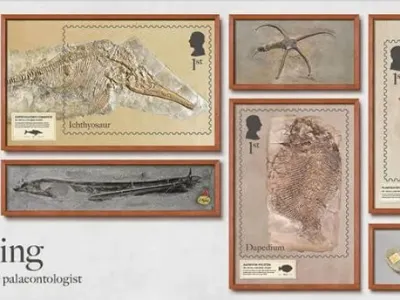
Museum’s Mary Anning Fossil Gets Stamp of Approval
200 years since OUMNH’s very own Megalosaurus fossils were used in the first scientific description of a dinosaur, the Royal Mail has launched The Age of Dinosaurs, a two-part series of commemorative stamps. The stamps include one series of palaeo-art reconstructions of Mesozoic dinosaurs and reptiles and another series celebrating Mary Anning (1799-1847), a self-taught…
Something went wrong. Please refresh the page and/or try again.
 More Than A Dodo