The Big Brain Competition

What happens in your brain when you receive compliments? And what’s going on in your mind when you watch your football team win a match? Does the brain respond differently when recalling music, compared to listening to it? All these questions, and more, have been posed in our Big Brain Competition…

Coinciding with the Museum’s Brain Diaries exhibition, the Wellcome Centre for Integrative Neuroimaging is inviting you to ask your own question about the brain to be in with a chance to have it tested by neuroscientists using Oxford’s state-of-the art Magnetic Resonance Imaging (MRI) scanner.

The advanced MRI scanner at the John Radcliffe Hospital in Oxford is one of the strongest in the world. It allows scientists to carry out functional MRI (fMRI) scans to see the brain in action. This mind-blowing procedure can reveal how the brain changes when learning a new skill or how it compensates when someone recovers from brain damage. It can also reveal which areas are used when people speak, move or laugh, to give just a few examples.

This fMRI scan shows how blood flows to the visual cortex region at the back of the brain when viewing a visually-stimulating checkerboard pattern
layouttile
Dr Stuart Clare of the Nuffield Department of Clinical Neurosciences is asking you for questions about the brain

Functional MRI shows when a brain area is more active by detecting the changes in blood oxygen levels and blood flow that happen in response to neural activity. The technique can be used to produce activation maps showing which parts of the brain are involved in a particular mental process.

The scientist behind the Big Brain Competition is Dr Stuart Clare, whose research involves pushing the technological boundaries of the fMRI technique to reveal new insights about how the brain functions normally and how it is affected by disease. There is still so much that the fMRI scans can bring to light, so Stuart is asking you for ideas!

Over several years of inviting people in to see the beautiful pictures that our MRI scanner can produce, I’ve been fascinated by the questions they have about the brain and whether you can see this thing or that thing in our fMRI scans.  With this competition we want to give people the unique access to our scanner and the chance to try an idea out for themselves.

When coming up with an idea for investigation there are a few practical things to bear in mind. Any activity has to be something people can do when lying down in the scanner and it has to be clear when they start and stop doing the activity. But Stuart is very open to ideas for experiments that they haven’t come across before – something that scientists really don’t already know the answer to.

The animation below explains how fMRI works and what it can do. So take a look, think up an experiment of your own and enter your idea via this form. The best one will be put into action by the research team and you will be able to watch the scans take place at the John Radcliffe Hospital yourself!

On a dung beetle’s trail

dung-beetles-blog-post

Thanks to the work of our Head of Life Collections Darren Mann, and the Dung Beetle UK Mapping Project team, the conservation status of the UK’s dung beetles, chafers, and stag beetles (Scarabaeoidea) is currently undergoing a comprehensive review.

Contributing to this effort, Jack Davies, one of our summer interns, has been on the trail of a species that has proven to be particularly rare in the UK…

Aphodius lividus
Aphodius lividus

I am on the hunt for Aphodius lividus, a dung beetle with a truly cosmopolitan distribution, being found across most of the globe, but which is rather rare in Britain. Since 1990 it has been recorded at only six sites, though historical accounts suggest it was more common in the past.

Most of these historic records are from the south east of England, particularly Kent and the London area, but there are several geographically isolated records from across England and Wales too. So might A. lividus, whilst being extremely local, actually be widespread across the UK?

During my time at the Museum I have been contributing to a comprehensive review of this species’ distribution by helping to verify these records. This has involved a thorough search of collections, journals and the Museum archives, a process which revealed that many of the recordings of A. lividus were almost certainly erroneous.

We were able to discount the only two Welsh records, as well as single records from Cheshire, Leicestershire and Lincolnshire. Our reasons for doing so included a lack of supporting evidence, the unreliability of certain collectors, and the confirmed misidentifications of some specimens.

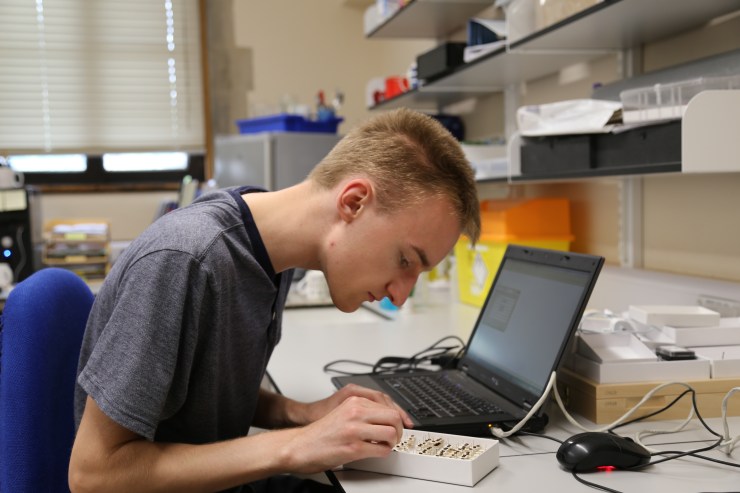
IMG_9966
Jack Davies working on a collection of Aphodius lividus

The number of known localities for A. lividus decreased further when we realised that three of the reported sites in Kent most probably all refer to the same location. This is a common problem in this type of research, due to the very broad locality names found on Victorian specimen labels.

So it has become clear that this incredibly scarce beetle is even rarer than we first thought. But it’s not all bad news for A. lividus; our research has uncovered reports from localities in Devon and Northumberland in the old literature, which we found to be trustworthy records.

Aphodius lividus
Map showing the distribution of the dung beetle Aphodius lividus in the UK

All the verified data from the project has been collated to produce this map of the distribution of A. lividus in the UK. Its very local distribution, and the very low number of recent records, confirm that this species should be classified as Vulnerable to Extinction in the UK.

Although it would be a shame to lose this species in Britain, we don’t believe it should be a priority for conservation efforts. Since Aphodius lividus has a strong preference for high temperatures, it’s likely that the UK is simply at the very edge of its range.  It is also a very abundant species in many areas around the world, and it contributes little in terms of ecosystem services in Britain compared to many of our other dung beetles.

So conservation should instead aim to preserve the dung beetle ecosystem as whole, which supports a huge number of species and also brings many benefits to agriculture.