Two pints of lager and a puffin, please

FFTMC Puffin Bar

Seen anything unusual in town recently? If you’re a resident or visitor in Oxford you may have noticed that some strange things have popped up around the city centre. A naked ape-man on the corner of Broad Street and Cornmarket, for example; or a Utahraptor dinosaur in Blackwell’s children’s section. You see, the Museum has had some escapees while we’ve been closed, in a project we’ve called Goes to Town.

Every night, as everyone knows, the specimens in the Museum come alive. And they got talking. And they soon realised they were jealous of their colleagues who had escaped to gallivant around town. In fact, they got so restless being pent up inside the closed Museum, that in the end we thought it best to take them out for a pint.

Have you seen our beer mats advertising Goes for a Pint?

So, over the past four weeks, members of the Education team and some super volunteers have been heading out to local Oxford pubs, armed with some great specimens to show off to unsuspecting pub-goers. But that’s not all – for Museum Goes for a Pint we’ve also been hosting our very own natural history-themed pub quiz!

Each week, we have either joined a pub’s regular quiz, or compiled our own special event. We arrive around 7pm and chat to people in the bar about the Museum and its collections, before diving into the quiz around 8pm. Quiz rounds have been roughly based on the pubs themselves (‘rusty’ coloured animals at the Rusty Bicycle; oak tree teasers at the Royal Oak…you get the idea). We’ve had just as much fun writing the quizzes as we hope the quiz-goers have taking part.
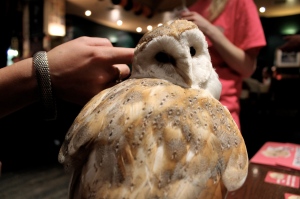
Barny gets a stroke from a quiz-goer.

The idea for Museum Goes for a Pint came from Kathy Clough, a project volunteer, shortly before the Museum closed for the roof repairs. It fit perfectly into our plans to get out and about in the city during the year.

We would like to thank the wonderful pubs who have hosted us so far: The Rusty BicycleFar From the Madding CrowdJames St TavernThe Royal Oak and The Royal Blenheim.

But we’re still only half way through. We’ve got three pubs left to visit. So if you find yourself in the Eagle & Child next Wednesday, the Cape of Good Hope on Tuesday 26 November, or the Big Society on Monday 2 December, look out for some pink t-shirted individuals juggling barn owls and entomology trays.

If you’ve no other plans then do come along and join us. The quizzes are free, and different each week. And where else are you going to get a pint and a puffin?

Simone Dogherty, Education officer

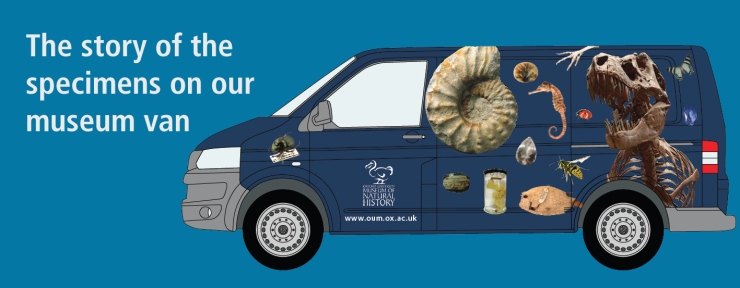
What’s on the van? – Trilobite

Trilobite

This week’s What’s on the van? comes from Dr David Legg, Post-doctoral Research Fellow in the Museum’s Earth Collections.

This particular trilobite specimen (Acaste inflata) was collected and named by John William Salter during the Ledbury Railway Tunnel cutting in 1864. Salter worked with many famous scientists during his career; he was an apprentice of the famous mineralogist James De Carle Sowerby, before becoming a curator for Adam Sedgwick at the Woodwardian Museum in Cambridge (now the Sedgwick museum), and in his later years he assisted Roderick Murchison on his work on Siluria. During this time, Salter developed an interest in the trilobites of Wales and was considered a world expert on this group.

Trilobites are a group of arthropods (the group that includes spiders, scorpions, crustaceans, insects, etc.) characterised by the possession of a hard exoskeleton composed of calcium carbonate. They are some of the first animals with hard parts found in the fossil record. The first trilobites appeared roughly synchronously on various continents around 520 million years ago, and went extinct during the largest mass extinction of all time at the end of the Permian (c. 251 million years ago), nearly 20 million years before the first dinosaurs appeared.

Acaste inflata belongs to a group of trilobites called the phacopids. The eyes of phacopid trilobites are unlike any others in the animal kingdom. The eye may consist of over 50 lenses, each separated from the next by a thick interlenticular cuticle. Because there are no modern animals with similar eyes it is unclear how they functioned to produce a clear visual image, however, the shape of each individual lens meant it was capable of focussing on objects of varied distance without the need for any additional focal mechanism (like the human lens which needs to change shape in order to see objects of different distances).

This picture is a bit strange because the trilobite is enrolled (curled up like a woodlouse) and the view is of the top of the head. We assume that this was a form of defence used by most trilobites.

What's on the van?

In Wallace’s footsteps

Malaysia map2

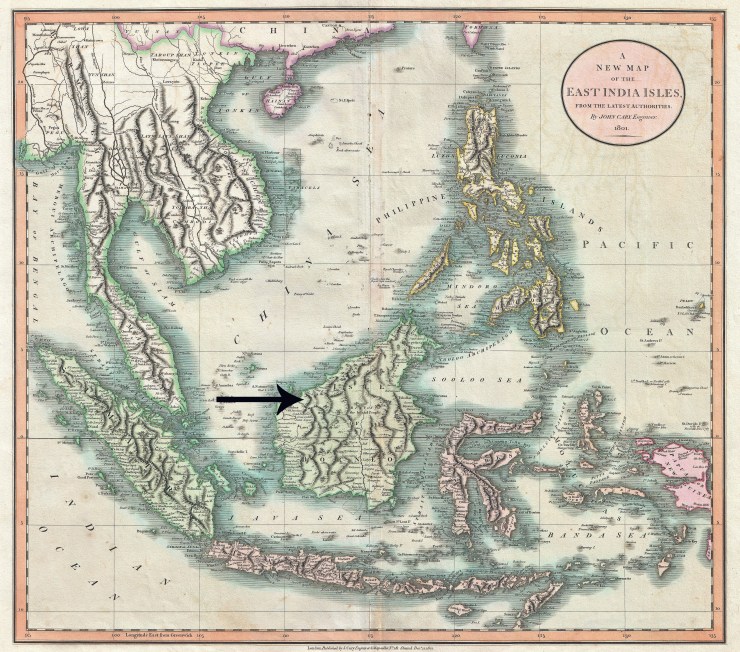
This week, Darren Mann, the Museum’s Head of Life Collections, is at the International Conference on Alfred Russel Wallace in Sarawak, Malaysia. He’s speaking about the Oxford’s Wallace collections, alongside other Wallace experts and enthusiasts from across the globe.

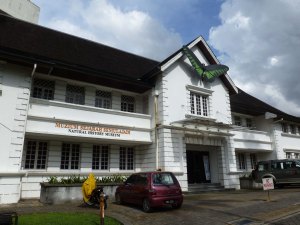
Sarawak Natural History Museum

The conference takes place at the impressive-sounding Riverside Majestic Hotel in Kuching City, Sarawak. Wallace’s ‘Sarawak Law’ is the name of one of his first publications on evolution, so the location is important. Wallace did some of his most important work in what was then known as the Malay Archipelago, so for a naturalist like Darren, it provides an opportunity to walk in the footsteps of one of his heroes.

dung drawer
Dung beetles

Darren has sent a couple of brief reports from Malaysia, along with some photos from his trip so far. He spent a satisfying afternoon in the Sarawak Natural History Museum, courtesy of Dr. Charles Leh Moi Ung and assistant curator Mdm Wong. Darren loves dung beetles, so he helped to re-identify some of their dung beetle collection. He said “They had more Paraphytes (cool genus of dung beetle) than I’ve ever have seen before. They’re the same species Wallace collected in Sarawak all those years ago.”

Rainy season in Sarawak

Wallace will certainly have encountered some difficult weather conditions on his adventures in the Malaysian jungles, so it seems appropriate that Darren has arrived in the middle of the rainy season. In his words “It’s raining a lot!”.

We’re all sending Darren a lot of good luck across the world as he represents the Museum in his talk tomorrow.

And so ends Wallace Week. We’ve looked back in time to remember and celebrate one of the greatest naturalists of the 19th Century and we’ll end on how his legacy will continue to inspire the scientists of the 21st… 22nd… 23rd…?

Rachel Parle, Education Officer

Am feeling quite jolly!

"Many thanks for kind congratulations – am feeling quite jolly!"
“Many thanks for kind congratulations – am feeling quite jolly!”

This lovely example of Alfred Russel Wallace’s beautiful handwriting and cheerful nature was written to chemist and Wallace’s good friend Raphael Meldola. He wrote it on his 90th (and sadly last) birthday. It is particular favourite of Annette Lord, who has scanned and transcribed the Museum’s collection of 300+ Wallace documents.

Fungus weevils (Anthribidae) collected by Wallace

Today marks 100 years since Wallace’s death and provides a good opportunity to reflect on his achievements. We’ve set up a display in the Museum to mark the occasion and show some of the most impressive Wallace specimens in our collection. Wallace travelled to remote, dangerous parts of the world in search of new and fascinating species. He was a meticulous and careful collector; you can’t help but marvel at how the incredibly long antennae of these beetles survived the journey back to Britain!

Wallace is now credited by many as co-author of the theory of evolution through natural selection, so it is very exciting to hear that today Sir David Attenborough is due to unveil a statue to the great man at the Natural History Museum in London.

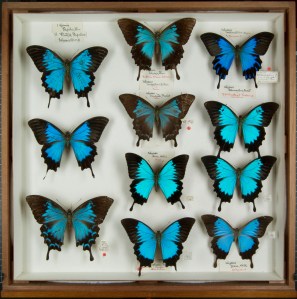
Ulysses Butterflies (Papilio Ulysses)
Ulysses Butterflies (Papilio Ulysses) collected by Alfred Russel Wallace

Wallace is not a household name like his collaborator Charles Darwin, but naturalists and Wallace fans all over the world will appreciate this gesture and the new interest in his work that this will promote.

If you would like to know more about Alfred Russel Wallace, you may like to see this new slideshow that the BBC have released today. It tells the story of his life and works and is narrated by Sir David Attenborough, one of Wallace’s greatest supporters.

Rachel Parle, Education Officer


Wallace in his own words

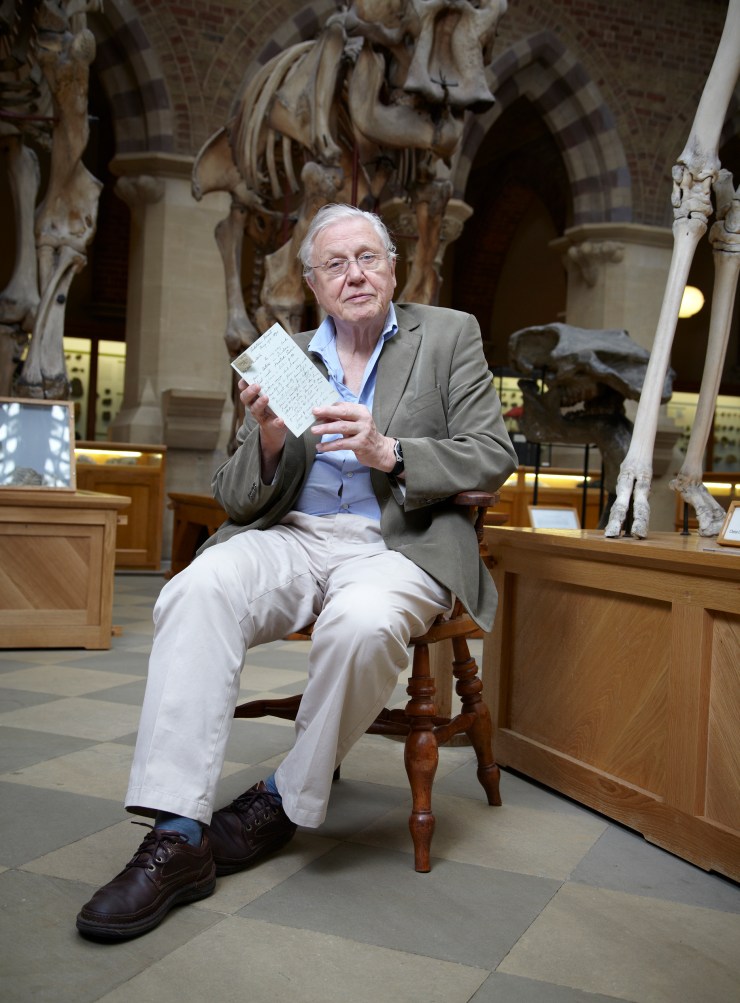
Sir David Attenborough in the Museum with a Wallace letter

Here in the Museum of Natural History’s archives, we proudly house over 300 of Alfred Russel Wallace’s documents. Letters, notes and postcards written by the great naturalist himself. Here you can see Sir David Attenborough holding one of his favourites.

Over the past two years, all of the Wallace paper items in our collection have been scanned, transcribed and uploaded to Wallace Letters Online, a worldwide documentation project that’s part of the Wallace 100 celebrations. But the most remarkable thing is that all this work was done by one woman!

Annette Lord
Annette Lord

Annette Lord has been a volunteer at the Museum for 3 years and has helped with many family friendly activities, but one day she popped up to the Entomology Department to ask about Wallace’s letters. Her curiosity was piqued and she soon set to work on the enormous task of making them accessible to Wallace fans across the world.

The bulk of the letters are from Wallace to Edward Bagnall Poulton, the Hope Professor of Zoology, based at the Museum. Wallace sent Poulton specimens that he collected on his travels and they were good friends, sharing advice and anecdotes. Annette told me about one of the most memorable letters, which revealed Wallace gave Paulton some tips on setting up a display on mimicry in the Museum. In return, Wallace asked for tips on the best microscope to buy for his young daughter Violet… sadly, before he could decide on the final choice, Violet decided she didn’t want a microscope after all!

Wallace signatureAnnette said that she has found the project incredibly satisfying; “It’s given me a real insight into what he was like – I’ve seen his human side and his excellent sense of humour”. She also praised his lovely handwriting, which she’s found relatively easy to read for the transcripts. As part of the project, Annette has given talks in Bournemouth and here in Oxford, where I’m sure her enthusiasm and knowledge help to spread the love of Wallace.

I also spoke to Kate Santry, Head of Archival Collections, who was singing her praises; “Annette’s enthusiasm for the project is un-shakable. Every time you think she must have had enough of reading Wallace’s letters, she’s still right in there in the thick of it. She really has become one of the Museum’s greatest Wallace experts! The material that Annette has recorded gives us an invaluable glimpse into the close relationships between the early natural scientists.”

Tomorrow, to mark the centenary of Wallace’s death, I’ll reveal Annette’s favourite letter of all!

Rachel Parle, Education Officer

Why Wallace?

David Attenborough in the Museum with Wallace's Giant Bee
Sir David Attenborough in the Museum with Wallace’s Giant Bee

Sir David Attenborough is arguably the world’s most famous living naturalist and broadcaster. Here he sits in the Museum of Natural History, holding our priceless Wallace’s Giant Bee specimen. So why did a man as important (and busy!) as Attenborough take the time to pose for our photo? It’s because Attenborough, like thousands of other natural history enthusiasts, knows that Alfred Russel Wallace is one of the greatest naturalists, geographers and explorers of all time. So what’s so great about him? Why are we dedicating Wallace Week to celebrating his work?

Chris Jarvis, Education Officer, explain why he thinks Wallace is so special…

Chris at Sedgwick
Chris Jarvis at the Sedgwick Museum

Last week I gave a talk on Alfred Russel Wallace at the Sedgwick Museum in Cambridge. I was asked ‘Why does Wallace deserve the statue next to Darwin’s, which he’s likely to get in London’s Natural History Museum?’ My answer was that ‘He deserves a statue as an inspiration on the importance of following your own interests, despite the barriers that may stand in your way’.

Unlike Darwin, Wallace was a largely self-made man. Born into a large family (he was the 8th of 9 children) that was always on the edge of financial disaster, Wallace was inspired by his love of the natural world around him and encouraged to explore it. Later he wrote that he could recall virtually every detail of the environment of the river Usk that was his playground but could hardly remember anything of his family, even faces, from that time! His love of the great outdoors led him to teach himself botany and entomology and how to collect, identify and preserve insects. Today, at a time when many children are being diagnosed as suffering from ‘Nature Deficit Disorder’ Wallace is a particularly pertinent example of the benefits of exploring the natural world.

At school, Wallace described himself as a ‘dull, ignorant and uneducated person’. Lessons were basic and dry and he left school finally in 1837 aged 14. Ironically for the father of Biogeography it was Geography that he found the driest of subjects, after Latin grammar!

Young Wallace
Young Wallace

Despite this, Wallace was a voracious reader and seems to have sought out his own curriculum. His family, although poor in other ways, always had interesting books around the house and Alfred was introduced to libraries, museums and working men’s institutes from an early age. His favourite books as a child included ‘Gulliver’s Travels’, ‘Robinson Crusoe’ and Mungo Park’s ‘Travels in West Africa’ and clearly fuelled the lust for adventure that led to his collecting trips in the tropics.

Wallace’s understanding of the importance of self-education and modest beginnings led him to be a firm supporter of the aphorism that ‘knowledge is power’ and he was involved in advising on setting up public libraries, museums and other free institutions that encouraged education throughout his life. His legacy, as important as all his discoveries and theories are, is surely as an inspiration to all of us to get out into nature, to read about what you find there and then share that knowledge with others, it may lead you to some amazing places and discoveries as it did Wallace!