Delightful dung beetles

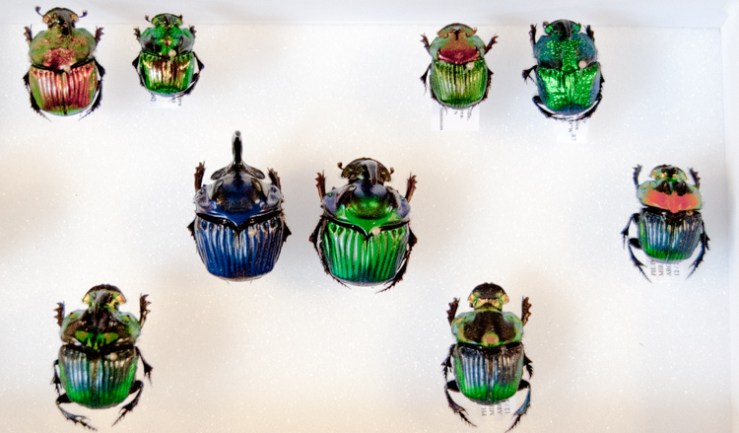
The latest display in our changing Presenting… case showcases a wonderful array of dung beetles. Darren Mann, head of our Life Collections, tells us why they are so important.

Worshipped during ancient Egyptian times, dung beetles have a long history of human appreciation. Jean-Henri Fabre (1823-1915), one of the first to popularise insects in his writings, began his Souvenirs entomologiques series with the Sacred Scarab, and even Charles Darwin appreciated the weaponry adorning many dung beetles.

Dung beetles can be divided into three main groups based on their nesting behaviour. The rollers, often seen on television wildlife documentaries, make a ball out of dung and roll it some distance before burying it. The tunnellers dig directly below the dung pile and bury as much as needed for nest construction. Finally, the dwellers nest within the dung pile.
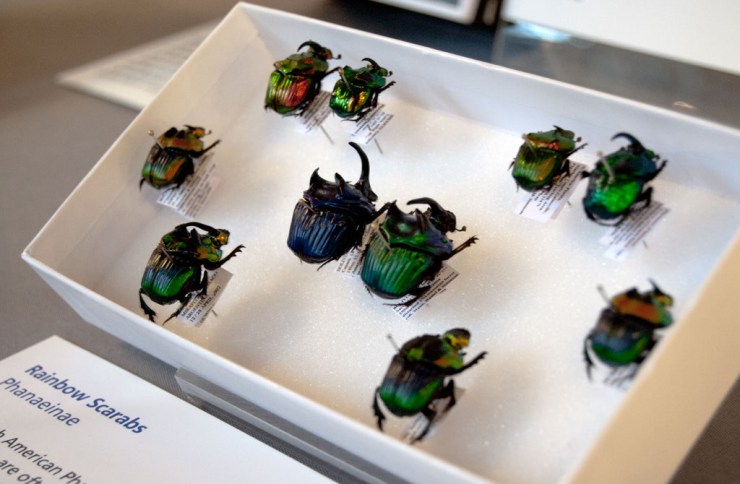
The South American Phanaeinae is one of most colourful groups of beetles. They are often referred to as Rainbow Scarabs due to their bright metallic bodies. We don’t fully understand why these beetles are quite so colourful.

Dung beetles are one of the more popular groups of insects used in ecological and evolutionary research today. They can help us to understand questions about how biodiversity loss impacts on ecosystems, or act as model organisms in the field of evolutionary development.

Unlike the much-publicised importance of bees and their pollination services, dung beetles are relatively unknown, despite their huge ecological and economic value. Their feeding and nesting behaviours provide many useful ecosystem services such as dung removal, pest fly control, parasite suppression, nutrient cycling, plant growth enhancement, improvement of soil structure, secondary seed dispersal, and a possible reduction of greenhouse gas emissions.

Through these activities, one study calculated that dung beetles are worth around £367 million a year to the UK cattle industry alone.

The largest dung beetles belong to the genus Heliocopris, which can reach up to 69 mm (pictured is Heliocopris dominus). These large beetles specialise on elephant and rhino dung. From around 2 mm in length is the oriental genus Panelus. These small beetles probably feed on the ‘dung’ of other insects and fungi.

Ancient Egyptians believed that the dung beetle kept the Sun moving across the sky like a giant ball of dung, linking the insect to the god of the rising sun Khepri. Some historians believe that it was through observing dung beetle behaviour and biology that Egyptians developed ideas about life after death.

The two most widely depicted species in Egyptian art are Kheper aegyptiorum and Scarabaeus sacer. Nowadays, only Scarabaeus occurs in this region of Africa; Kheper is now a more southern species, possibly indicating climatic changes since Ancient Egyptian civilization.

Kheper aegyptiorum on display in the museum’s Presenting… case

The UK has about 60 species of dung beetle and most of these belong to the ‘lesser dung beetle’ subfamily Aphodiinae. The largest of our dung beetles are the Dor Beetles which can reach 28 mm. Our smallest, Plagionus arenarius, is a meagre 2.5 mm. Sadly, over 50 per cent of our dung beetles are in decline due to agricultural intensification, pesticides and habitat loss.


Imitation game

Last month we had the pleasure of hosting artist and scientist Dr Immy Smith as part of her week-long takeover of @IAmSciArt on Twitter. Drawing inspiration from the Museum’s collections, Immy has created some beautiful paintings. Here she tells us a little more about her interests and work…

My current artwork is focused on crypsis and mimicry – the ways that animals and plants disguise themselves or pretend to be something they’re not. Cryptic camouflage helps animals to avoid being seen, often to help them catch prey – or to avoid becoming prey themselves! Mimicry is also often about trying not to get eaten: the harmless hornet moth, for example, mimics a stinging insect to deter predators. I use these themes to develop print art projects, and also public workshops to help people learn more about the ecology of cryptic animals.

Cryptic Cards by Immy Smith

In my arts practice I try to imagine how animals and plants might evolve to camouflage themselves on human-made materials, and what they might look like. Will we one day find moths adapted to hide on advertising hoardings, or beetles mimicking litter? I made an entire deck of Cryptic Cards as a response to this kind of question.

Another project I’m working on at the moment is called Emergent Crypsis. This is a collaboration with Norweigan generative artist Anders Hoff who makes art using algorithms executed by a computer. I’m imagining how creatures might adapt to an extreme example of human-made patterns – computer generated abstract images.

Violin Beetle (Mormolyce phyllodes) by Immy Smith

My work requires me to closely study many animals and plants, but how do I learn about all these species in order to draw their imaginary relatives? How do I make my art a convincing representation of how life might find ways to hide on human-made art?

One answer is of course, the internet. I’ve been lucky enough to find many wildlife photographers online who are kind enough to let me use their images as reference. But photographs alone are not always enough to get to know the fine details and defining characteristics of a species: the joints and articulations of small insects, for example, are best studied from specimens. And some species are rare, or even extinct, and it can be hard to find photographic a reference.

Leaf-footed Bug (Diactor bilineatus) by Immy Smith

This is where scientific collections come into the picture. The collections held in museums and other institutions are not only essential for scientists and scientific illustrators, they are also an invaluable resource for artists of many disciplines, science communicators, and educators of many kinds. In the collections at the Oxford University Museum of Natural History I can photograph and sketch leaf-mimicking insects, for example, that are native to the forests of South America which I may never visit. I can study in minute detail the articulation of beetles that are rarely seen, and which might be difficult to find – and irresponsible to collect – myself.

A display of terrestrial bugs (Heteroptera) in the Museum, including the Leaf-footed Bug painted by Immy Smith

Not only do I find specific species that I want to study in natural history collections, I often see new ones – animals I didn’t know about or hadn’t thought of drawing before. In the same week that I visited Oxford, I also made a trip to Herbarium RNG in Reading to study plant mimicry, and found similar inspiration there. I can channel all this into both aesthetic art destined for print and sciart workshops that communicate the wonders of insects or plants with the wider community.

Working on sciart projects and educational workshops helps me appreciate the multitude of ways in which collections benefit research and education. We must try to communicate the plethora of roles they play, and the host of ways they cross into our lives – whether through scientific research on insects pollinators of the crops we eat, or via a deck of cards made by someone like me for mainly recreational purposes. We must fight to protect scientific collections because they are a resource that benefits all of us as a society.

Oxford Swift City takes flight

The Museum is really pleased to be a partner in Oxford Swift City, a major new initiative to protect and nurture the city’s populations of swifts. Here Keo Baxendine at RSPB Midlands tells us more about the project…

Swift expert George Candelin shares his experience of researching the swifts at the Museum. Image: Colin Wilkinson.

The swifts have just returned to the UK after their long migration from Africa. At the Museum they have begun circling the tower where they nest each year.

These charismatic birds, Apus apus, are commonly recognised throughout the UK as a sign of summer. They also have a long cultural association with Oxford as a symbol of knowledge and dexterity. Yet sadly, the national swift population has fallen by 42 per cent since 1994, due to a lack of nesting sites and food.

The Oxford Swift City project hopes to turn the birds’ fortunes around by protecting existing swift nesting sites as well as encouraging the creation of new ones. Last night, project partners and guests gathered at the Museum to kick off the project.

The swift is an iconic species whose appearance announces the start of summer. Sadly the swift is in trouble. Numbers have dropped dramatically, putting the birds at risk of disappearing completely from the UK. The Oxford Swift City community project provides local people with a great opportunity to learn about this important bird and discover how to take action to help give swifts a home in Oxford.
– Lucy Hyde, Oxford Swift City Project Officer

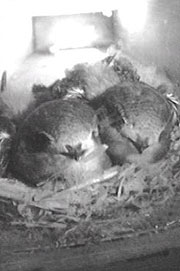
Swift chicks in a nestbox in the Museum tower, shown on the webcam feed

There are lots of ways to get involved: take part as a swift survey volunteer; help out at a community event; or just put up a nestbox or plant wildflowers in the garden. You can also join a local swift expert on a number of ‘swift walks’ through Oxford over the summer.

The colony of swifts which nests in the Museum has been the subject of a research study since 1948, and is one of the longest continuous studies of a single bird species in the world. This work has contributed much to our knowledge of the swift.

Fittingly, Oxford Swift City is running a ‘Swift Tower’ design competition. Subject to approval, the winning design will be constructed in Oxford next year, providing ideal nesting spaces for swifts – so get scribbling!

Funded by the Heritage Lottery Fund, the RSPB-led Oxford Swift City project is supported by many local partners, including Oxford University, Oxford University Museum of Natural History, Oxford City Council, Thames Valley Environmental Records Centre, Environment Resources Management and the local Wildlife Trust.

For more information please email oxfordswiftcity@rspb.org.uk.

Fossil-finding

By Jack J Matthews, research fellow

On the southern shores of Newfoundland in Canada lie rocks containing the oldest known evidence of large, architecturally-complex life. Deposited within the Ediacaran Period, some 565 million years ago, these deep marine deposits have been the focus of palaeontological research since the first discovery of fossils there in 1967, and the locality – Mistaken Point Ecological Reserve – now sits in the UNESCO World Heritage list.

As part of my research on these rocks, alongside colleagues from Memorial University of Newfoundland, and the University of Cambridge, I created a new geological map of the area, covering 35 km of coastline in and around the Reserve. As well as providing new insights into the rocks themselves, and what environments they were deposited in, this mapping had an unexpected outcome – the discovery of some totally new fossil sites.

Overview of the Mistaken Point outcrop of the famous ‘E’ Surface

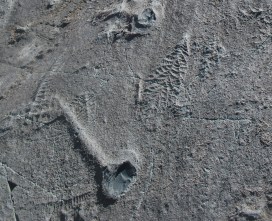
One site in particular, dubbed the ‘E’ surface, is the focus for Ediacaran fossils in Newfoundland. It is an area about the size of three Olympic boxing rings, containing more than 3,000 fossil organisms. Through the mapping we found a number of other outcrops of this same surface, but each shows slightly different types of fossils.

This is a mystery: if all the outcrops are from the same geological surface, why do they show different fossil assemblages?

The clue to the answer came while photographing the fossils and overlying volcanic ash at Mistaken Point, when I heard a loud, deep boom: a freak wave had struck the bottom of the cliff below the outcrop, sending a large splash of salty spray over much of the surface.

This got me thinking – how are processes such as weathering and erosion affecting the fossil surfaces now? Closer observation revealed those outcrops of ‘E’ with pristine beautiful fossils tended to be further from the sea, have a shallower dip, and the overlying ash tended to fall away in little flakes revealing beautiful, crisp, fossils. Other outcrops with scruffy fossils were usually close to the sea, battered by waves and rocks, steeply dipping, and the overlying ash, and often the fossils below it, would gradually abrade away as they are attacked by the sea.

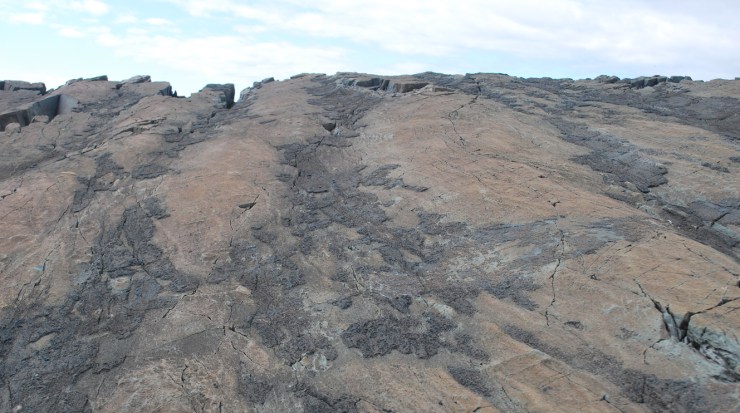
Looking along the ‘E’ surface showing areas still covered in ash (black) and revealed fossil surface (red and grey)

Palaeontologists often discuss how changes during the fossil preservation of an organism can affect what we discover today, but they rarely discuss how processes occurring after preservation – metamorphism, exhumation, weathering, erosion, and even the time, manner, and conditions in which the fossil is recorded – might all affect how we analyse and interpret the original community of life which became fossilised.

Our new paper, published by the Geological Society of London, talks about these Post-Fossilization Processes, and recommends that when researchers are collecting fossil data they consider how their measurements might have been biased by such factors.

For 50 years now, the coastline of Newfoundland has yielded some of the most important finds in understanding the rise of the early life of the Ediacara, and through that the first evidence of animal life. Discoveries over the past few years show there is still much more to be found, and we’ll just have to hope that the post-fossilization processes fall in our favour to allow for many more significant discoveries.