High time for a check up

by Bethany Palumbo, life collections conservator

This month marks three years since the completion of our ‘Once in a Whale’ project. The initial conservation undertaken in 2013 focused on the cleaning and stabilisation of five whale skeletons, which had hung from the roof of the Museum for over 100 years.

The skeletons were lowered into a special conservation space, where the team were able to work up close with the specimens. As well as the cleaning, they improved incorrect skeletal anatomy, replacing old corroded wiring with new stainless steel. For final display, the specimens were put into size order and rigged using new steel wiring, with the larger specimens being lifted higher into the roof space to make them a more prominent display than previously. You can read all about the project on our blog, Once in a Whale.

Three years on, our conservation team felt it was a good time to check on the specimens to see how they’re coping, post-treatment, in the fluctuating museum environment.

Conservation intern Stefani Cavazos works on high to clean the Beaked Whale

It’s been wonderful to see the whales on display and their new position looks very impressive. However, when the time came for making this recent conservation assessment, the new height was greater than any of our ladders could reach. Specialist scaffolding was brought in to allow the conservators to access the specimens. Starting at the highest level, with our Beaked Whale, cleaning was completed using a vacuum and soft brush for delicate areas. This removed a thick layer of dust and particulate debris: especially satisfying work!

Dust gathered on the Beaked Whale fin

With cleaning complete, visual assessments could then be undertaken. These showed that while the specimens were still very stable, a few areas of bone have continued to deteriorate, visible in cracking and flaking of the surface. In other areas, the fatty secretions which we previously removed using ammonia had once again started to emerge. We had expected to see this though, because, in life these whales’ bodies contained a lot of fat, deep within the bones and this is notoriously impossible to completely remove.
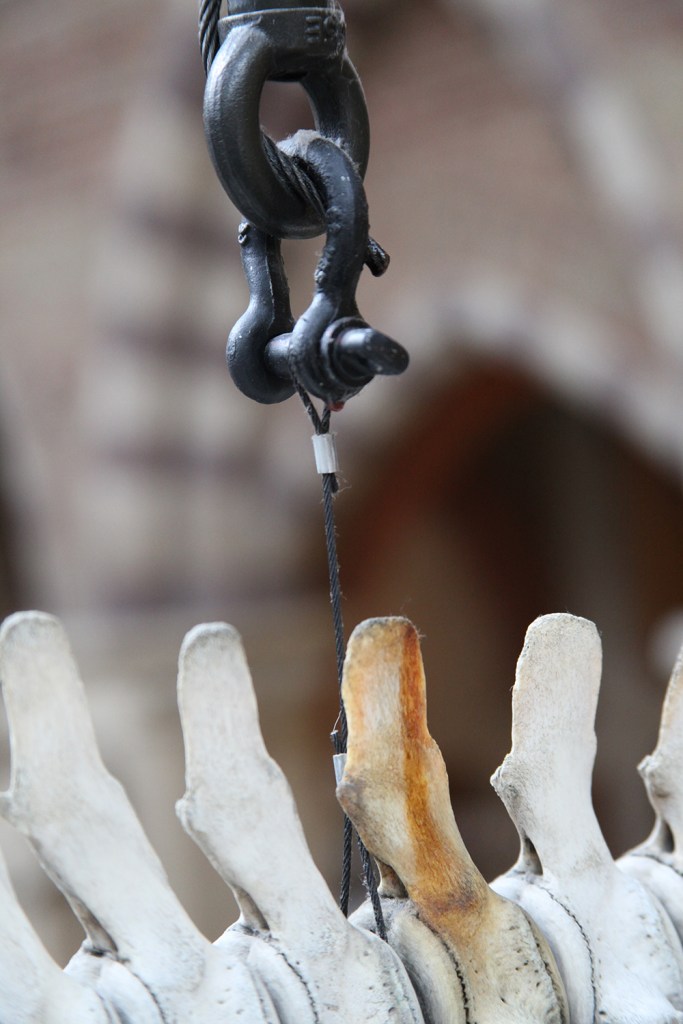
Lubricant stain seen on a vertebra

It was also observed that the lubrication used on the new rigging bolts had melted and dripped down the wires. You can see in the photo above how this has become drawn into the vertebrae of the Orca and Common Dolphin, staining them yellow. While no conservation treatment was undertaken due to time restrictions, thorough photography was performed to document these changes and once time permits this can be carried out.

This shows how conservation work, especially with natural history specimens, is a gradual, ongoing process. With frequent check-ups and specialist attention, these whales will be able to continue their life as our beautiful display specimens.
The crucial cortex

Lance Millar_Developmental Anatomy_14Oct2017.jpg-large

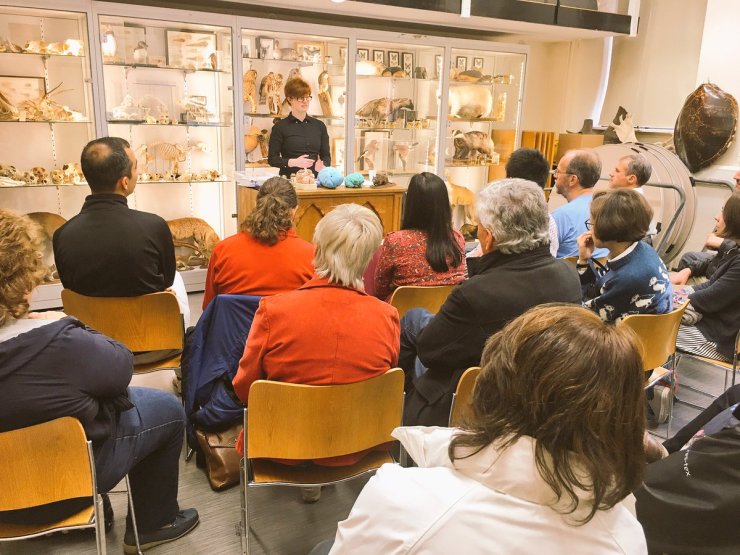
University of Oxford PhD student Lance Millar recently ran one of our Brain Spotlight events as part of the Brain Diaries exhibition programme. Here, Lance explains his research into neurodevelopmental disorders and possible treatments.

The brain has always been a fascinating organ for me. It is the site of our intelligence, our problem-solving and social skills, and it allows us to connect our senses to the world around us.

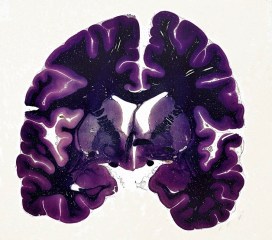
The large, folded outer part of the human brain is called the cortex, and is responsible for decision-making, language, face recognition, and a lot of the other things that I like to think are what make us human. The word cortex comes from the Greek for husk or outer shell, which underestimates the importance of what the cortex does.

Humans can survive with damage to the cortex, but depending on the part of the cortex that is damaged, a range of disabilities can result. People who have had a stroke can lose part of their cortex, leading to limb paralysis, loss of speech, or loss of memory, depending on the site of the damage.

B0009564 Human brain, coronal section, LM
Cerebral cortex – Professor Michael R Peres – Wellcome Images

Some people are also born with a developmental problem in the cortex, and are said to have a neurodevelopmental disorder. Such conditions are thought to include autism, schizophrenia, ADHD, and even dyslexia – all fairly common conditions. The damage to the cortex is subtle and complex in these conditions, and scientists are still working out exactly what happens to the brain during its prenatal development.

I am studying one particular neurodevelopmental disorder caused by lack of oxygen at birth. It is known to medical specialists as neonatal hypoxia ischaemia. The image on the right shows a cross-section MRI scan of a normal newborn human brain, alongside some babies who have been damaged by oxygen deprivation. You can see that the brains are smaller, the cortex is less folded and it takes up less space inside the skull.

Woodward
MRI scans of normal newborn brains alongside those of babies who have been damaged by oxygen deprivation. Image: Woodward et al., New England Journal of Medicine, 2006

Scientists still don’t know how to protect the newborn brain from these injuries. Some are caused by inflammation which is a normal response to illness, but can wreak havoc in the confined space of the skull. Some is caused by the presence of free radicals, which are thought to contribute to ageing and organ failure, as the newborn brain doesn’t have many antioxidants to fight these chemicals. It’s also possible that the electrical signals that neurons within the brain send to each other contribute to the damage when there isn’t enough oxygen to feed them.

So what can we do to treat oxygen deprivation at birth? One breakthrough treatment currently available is known known as hypothermia. In this technique, the baby is cooled to 33℃ which slows down the brain-damaging chemical reactions which in turn protects the brain. This is currently the only treatment available, but I am involved in the study of possible alternatives.

We don’t want to introduce any drugs to the baby’s system as they might be harmful to normal development. So scientists are currently working on treatments which help the baby’s natural body proteins to protect the brain. I do this by looking at neurons under the microscope, and identifying proteins expressed by these neurons using fluorescent probes known as antibodies.

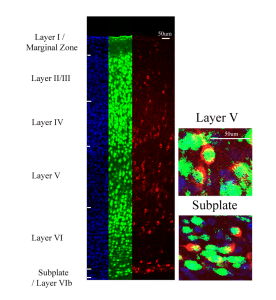
Neurons under the microscope
An example of neurons under the microscope. Image: Lancelot Millar

These neurons are expressing neuroserpin, a natural brain protein which decreases inflammation and cell death. I’m looking at exactly where neuroserpin is expressed in the brain, how it can be upregulated in response to oxygen deprivation, and how its chemical reactions could be used to protect the brain.

Another way to help people with neurodevelopmental disorders is to better understand how the cortex connects to other parts of the brain and how it can carry out complicated decisions. There is still so much to understand about the complexity of the human brain, and what seems like fundamental research could generate the springboard for new ideas for neurodevelopmental disorder treatments.

To explore the structure of the human brain and compare it to that of other animals see the Brain Diaries Brain Explorer below.


Is it real? – models, casts and replicas

One of the most common questions asked about our specimens, from visitors of all ages, is ‘Is it real?’. This seemingly simple question is actually many questions in one and hides a complexity of answers. 

In this FAQ mini-series we’ll unpack the ‘Is it real?’ conundrum by looking at different types of natural history specimens in turn. We’ll ask ‘Is it a real animal?’, ‘Is it real biological remains?’, ‘Is it a model?’ and many more reality-check questions. Here’s your final installment…

There’s nothing like standing under a huge T.rex skeleton, staring up at its ferocious jaws, to get the blood pumping. Visitors often ask “Is it real?” and look rather deflated when they find out it’s a cast. So why do we include casts, models or replicas in our displays, if they don’t have the same impact as the real deal? The truth is that they’re valuable additions to museum displays, allowing the public to engage with specimens that would otherwise be hidden behind the scenes.

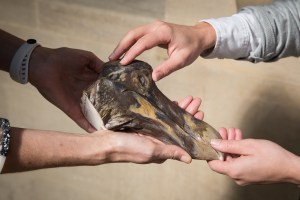
Please touch! A cast of the famous Oxford Dodo helps visitors explore this fragile specimen.

On any visit to the Museum, you’ll come across labels that tell you the object you’re looking at is a cast. It could be a dinosaur skeleton, a brightly coloured fish, an amphibian specimen or even the head of the Oxford Dodo. But what is a cast? Casts are made by taking a mould of bones, or sometimes whole animals, then filling that mould with resin, plaster or fibre glass to make a copy. They can be incredibly accurate or lifelike.

It’s extremely rare to find whole dinosaur skeletons, and very difficult to mount heavy fossils (weighing tonnes) onto large armatures. Our Tyrannosaurus rex is a cast of the famous Stan, found in South Dakota, USA, and one of the best preserved skeletons of its kind in the world. But the “real” Stan is kept at the Black Hills Institute of Geological Research, so the only way we can offer the breath-taking experience of standing beneath a T. rex here in Oxford is by using a cast.

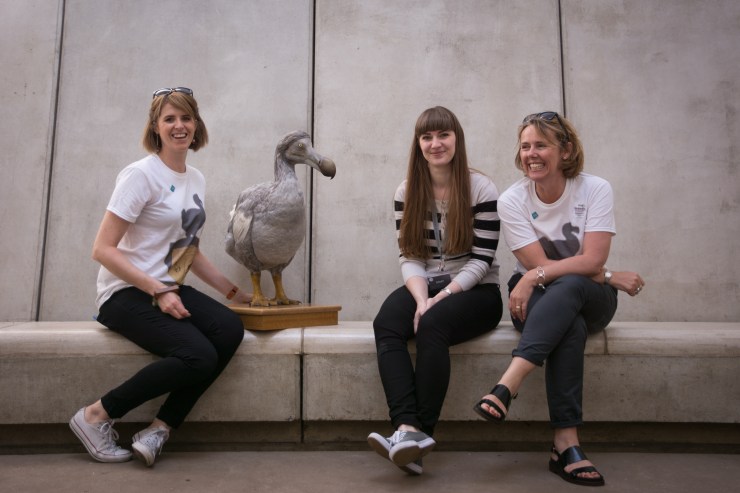
The Dodo Roadshow in 2015 would have been a lot less fun without our life-size dodo model

Even Stan has some bones missing, so sometimes casts are made up of several individual skeletons. Copies can also be made to give the impression of a more complete skeleton. For example, if a left bone is missing, a mirror of the right hand bone can be created. We call these specimens “composites”.

Animals such as fish and frogs aren’t easy to taxidermy; their skins shrivel, dry out, lose their colour and crack. Painted casts are a good way to show what these animals look like.

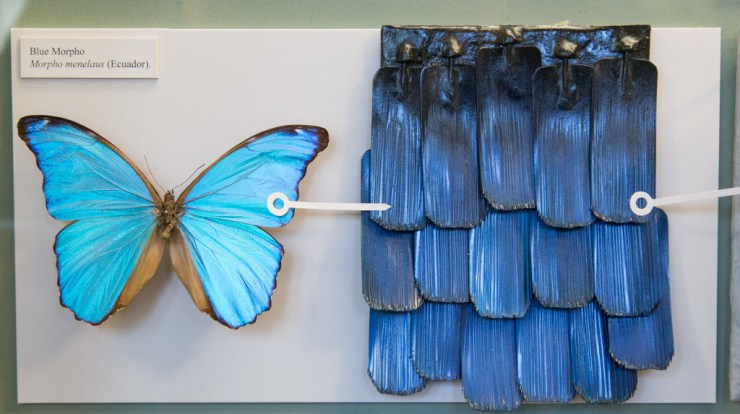
A model allows us to show the intricate scales of this Blue Morpho butterfly up close.

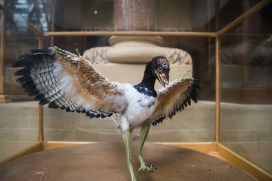
Models, such as the giant insects on the upper gallery and the Archaeopteryx in the Evolution of Flight display (at the top of this post), are very clearly not real. These are made by model makers to show something that can’t be seen or shown with real specimens. The giant insects are a way of showing the detail of very small creatures. The palaeontological models show what we think extinct animals might have looked like in life. They’re hypothetical models based on the latest scientific research, which can change very quickly, and always have an element of artistic assumption or speculation in the details.

In this series we’ve talked about taxidermy, skeletons, fossils and more, but these are just a few of the kinds of specimens we have on display. There are also nests, plastinated models, microscope slides and dioramas, which all have a mix of real and non-real elements. When you are looking around the Museum try to think about which specimens are real and which aren’t… and how does that make you think about the specimen?

Read the other posts in the Is it real? series here.