Why do we need pinned insect specimens?

Since we posted about ten-year-old Sarah’s amazing beetle discovery, we’ve had lots of queries as to why the insect needed to be caught and pinned. It’s a question we’re often asked, so here’s Darren Mann, Head of Life Collections at the Museum, to explain the value of ‘voucher specimens’.

The Museum’s collection houses over five million insect specimens, amassed over the past 300 years. This collection is, in effect, a biodiversity database, but unlike virtual databases, each data point has an associated ‘voucher specimen’ that was caught, pinned and labelled.

Although technical advances in digital macro-photography do reduce the need for some collecting, it is impossible to dissect an image to confirm an identification. So for many groups, even the best photograph in the world is inadequate for identification purposes.

Shingle CrawlerD18 (Psammoporus insularis Pittino, 2006) one of our few endemic insects.

Unlike plants and birds, many insects can only be identified with the aid of a microscope, to study tiny features that distinguish closely-related species. Some groups even require the dissection of minuscule genitalia to really tell them apart.

Entomologists take voucher specimens to enable this correct identification and these are later deposited in museum collections, making them available for further study in years to come. From an entomologist’s point of view, we believe we need to know what a species is, where it occurs and as much about it as possible, so we can inform biodiversity conservation.

The conservation assessment of UK insects by Natural England in their Species Status Reviews has only been possible with the data provided by entomologists, generated from collecting and identifying voucher specimens.

Entomologists follow a Code of Conduct for responsible collecting, which ensures they don’t remove too many species or damage the environment during their work .

There are numerous examples of the value and use of insect collections in contemporary science, including the discovery of previously unknown species in the UK and population genetics for butterfly conservation. Recently a species believed extinct in the UK was rediscovered. This was only made possible by checking the identification of several thousand museum specimens.

Museum collections also contain numerous examples of species now considered extinct in the UK. Without voucher specimens much of this research would be impossible and our understanding of insect distribution patterns, ecology and conservation would be significantly diminished.

Large Tortoiseshell butterflies, now considered to be extinct in the UK. The voucher specimens act as record in time of its occurrence in the UK.

What is rare?
Sarah’s False Darkling Beetle (Anisoxya fuscula) has been described as ‘rare’, but what does that mean in reality? For most invertebrates when we talk about a rare species we are not talking about a tiny number of individuals. This conservation status is based on their known distribution and the level of threat they face. A species can be rare if it is only found at one or two locations, but at those locations there may be many thousands of individuals.

The greatest threats to biodiversity are well known and include habitat loss, fragmentation and degradation and pollution, such as pesticides and light. Taking a small number of voucher specimens to confirm the identification of species has negligible impact on its population. But if we don’t know it’s there because we couldn’t identify it, then a housing development destroys its entire habitat… well you get the picture!

Further Reading
Ask an Entomologist
Entomological Collections
Natural England Species Status Reviews
To Kill or Not to Kill That is the Question Part 1
To Kill or Not to Kill That is the Question Part 2
To Kill or Not to Kill That is the Question Part 3
– Austin, J. J., & Melville, J. (2006). Incorporating historical museum specimens into molecular systematic and conservation genetics research. Molecular Ecology Notes, 6(4), 1089-1092.
– Colla, S.R., Gadallah, F., Richardson, L., Wagner, D., & Gall, L. (2012). Assessing declines of North American bumble bees (Bombus spp.) using museum specimens. Biodiversity and Conservation, 21(14), 3585-3595.
– Short, A. E. Z., Dikow, T., & Moreau, C. S. (2018). Entomological collections in the age of big data. Annual review of entomology, 63, 513-530.
– Suarez, A.V., & Tsutsui, N.D. (2004). The value of museum collections for research and society. AIBS Bulletin, 54(1), 66-74. Abstract available here
– Wandeler, P., Paquita, Hoeck, E.A. & Keller, L.F. (2007). Back to the future: museum specimens in population genetics. Trends in Ecology & Evolution 22.12, 634-642.
One in a million find

By Rachel Parle, Public Engagement Manager

The Museum’s collection of British insects already houses over a million specimens, and now it boasts one more special insect.

Ten-year-old Sarah Thomas of Abbey Woods Academy in Berinsfield, Oxfordshire discovered a rare beetle in her school grounds while taking part in a Museum outreach session. To Sarah’s excitement, the beetle is so important that it has now become part of the collections here at the Museum – and it is the first beetle of its kind to be added to the historically important British Insect Collection since the 1950s.

Sarah Thomas examines her beetle under the microscope with Darren Mann, entomologist and Head of Life Collections at the Museum

Sarah’s class took part in a HOPE Discovery Day, where they were visited by a professional entomologist, learnt about insect anatomy and how to identify and classify specimens, and went on the hunt for insects in the school grounds. HOPE – Heritage, Outreach and Preservation of Entomology – is reaching out to students in state primary schools across Oxfordshire, using the Museum’s British Insect Collection to spark curiosity and foster a love of natural history. It’s all part of a bigger project at the Museum, supported by the Heritage Lottery Fund, to safeguard this important Collection for the future and engage people with natural heritage.

Sarah brought her family to the Museum to see her beetle in the British Insect Collection.

After some searching, Sarah spotted a 5mm insect lurking under a leaf. To the untrained eye it looked rather like any other tiny shiny beetle, but luckily Darren Mann, Head of the Museum’s Life Collections, was visiting as part of the HOPE team. Darren spotted it as something unusually and took it back to the Museum to get a closer look under the microscope. He was then able to identify it as a False Darkling Beetle.

It’s Anisoxya fuscula, which is rated as Nationally Scarce in Great Britain. We seldom see these outside old forest habitats and this is the first beetle of its kind to be added to the collections for around 70 years.

– Darren Mann, Head of Life Collections

The False Darkling Beetle under the microscope and labelled in the Museum’s British Insect Collection as found by Sarah Thomas

The tiny beetle has been labelled with Sarah’s name and the location of her find, and added to the British Insect Collection. Though she’s very excited to have her specimen in the collections, Sarah admits that she hasn’t always been a big fan of insects:

Before Project Insect I didn’t really like insects, but now I really do.

– Sarah Thomas

Everyone at the Museum is really pleased with Sarah’s fantastic find and we hope it spreads the word to inspire others to become budding young entomologists too.

The beetle Sarah discovered will be stored in this drawer in the British Insect Collection.

Digging in the archives

by Danielle Czerkaszyn, Senior Archive and Library Assistant

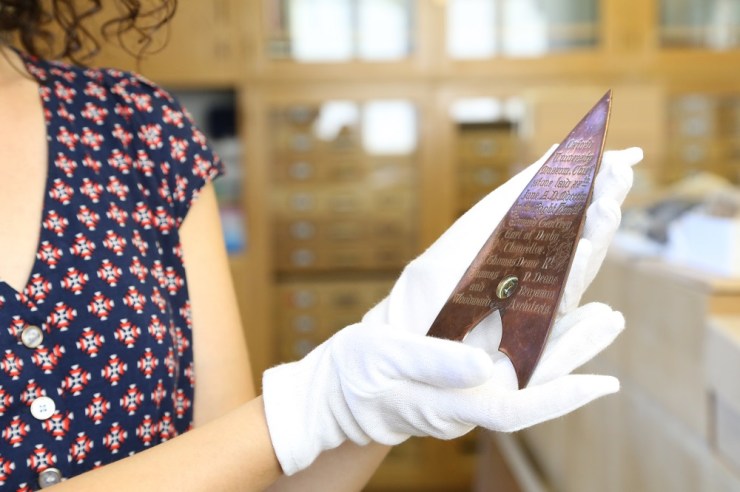
Working day in, day out in the Museum of Natural History’s archive, we like to think we know a lot about our collections. The truth is, with the sheer number of items in our archive and the many nooks and crannies which exist in a historical building, we sometimes need some help rediscovering items in our collections. One such item is the engraved trowel used to set the Museum’s foundation stone.

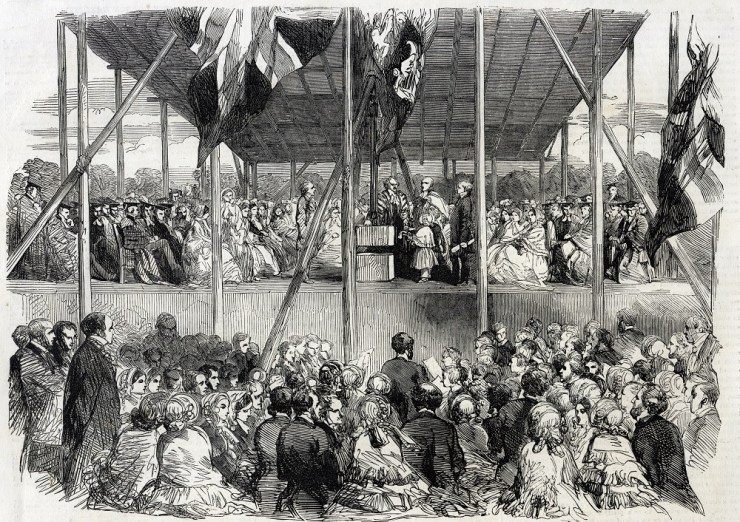
The Earl of Derby lays the foundation stone at the 1855 ceremony. Engraving from Illustrated London News.

The story began when we received an enquiry from a museum enthusiast in America. He had read an article from an 1855 edition of the Illustrated London News, about the foundation stone ceremony. This was the moment that construction began on the Oxford University Museum, as it was then known. It seems that a small trowel was used as part of this ceremony. The article describes the trowel as follows:

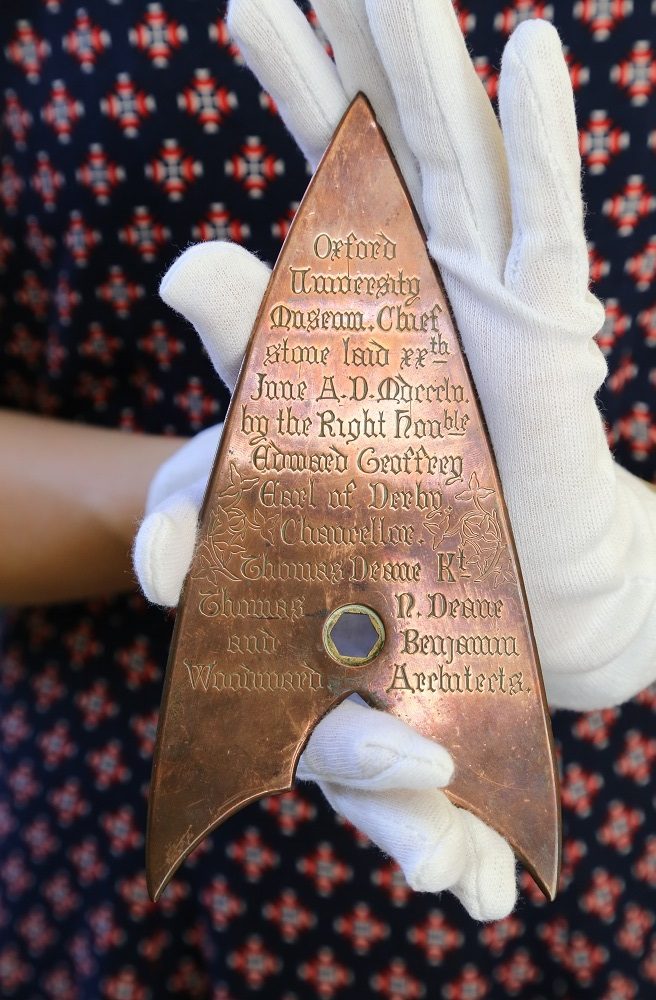
The trowel, which is of silver and bronze, is highly finished, and novel in form. It is enriched by an engraved Gothic pattern on the upper, or silver, side. It was made by Skidmore, of Coventry, who has contracted for the foliated wrought-iron work which will decorate the quadrangle of the building. The trowel bears the following inscription-

Oxford University Museum. Chief Stone laid 20th June, 1855, by the Right Hon. Edward Geoffrey Earl of Derby, Chancellor; Thomas Deane, Knt; Thomas N. Deane, and Benjamin Woodward, Architects.

Look carefully at the engraving from Ilustrated London News and you’ll see that children were also involved in the ceremony. They were likely to be Sarah and William Acland, the two eldest children of Dr. Henry Acland, who was instrumental in the founding of the Museum:

The trowel, borne on a cushion by two interesting children (the son and daughter of Dr. Acland), was then handed to the Earl.

The article does not say what happened to the trowel so our enquirer wanted to know; did the trowel end up in our archival collection or does it sit in the void under the stone?

Details from the Museum’s wrought iron roof decoration. Both the metalwork and the trowel were designed by Francis Skidmore.

As far as any of the Museum staff were aware, there was no trowel in our collections. With little to go on, we momentarily put the enquiry to one side and hoped for some good luck. The rediscovery came by accident just one week later, as we were rearranging boxes in the archive to make additional room for art storage. The trowel was spotted at the top of a box of items that had yet to be sorted and catalogued. With the recent enquiry on our minds, we recognised the trowel from its description and instantly knew what a special find this was.

Danielle Czerkaszyn holds the newly-discovered trowel. Her next challenge is to track down the missing silver handle.

Our enquirer was pleased to hear of the trowel’s rediscovery and thrilled to know the part that his enquiry played. Without his curious question, we might not have recognised the trowel for what it was. The trowel is now undergoing conservation treatment and cataloguing, and as an important part in the history of the Museum, it will hopefully be on display in the near future.

The Museum archive and library is open by appointment to anyone who would like to visit, and we welcome enquiries at library@oum.ox.ac.uk.