Over the last few months, I have been working on cataloguing and rehousing the archival collection of William John Burchell (1781-1863). Burchell was an important early naturalist, explorer, ethnographer, and linguist who worked in South Africa and Brazil, contributing greatly to our understanding of the flora and fauna of these areas. He was also a highly talented artist!
Burchell amassed huge natural history collections and described many new species, but his work was not widely recognised in his lifetime. Although he received an honorary degree from Oxford in 1834, he felt neglected by the government and scientific community in Britain. Later on in his life, Burchell became something of a disillusioned and reclusive figure, strictly guarding access to his collections and publishing few of his own findings.
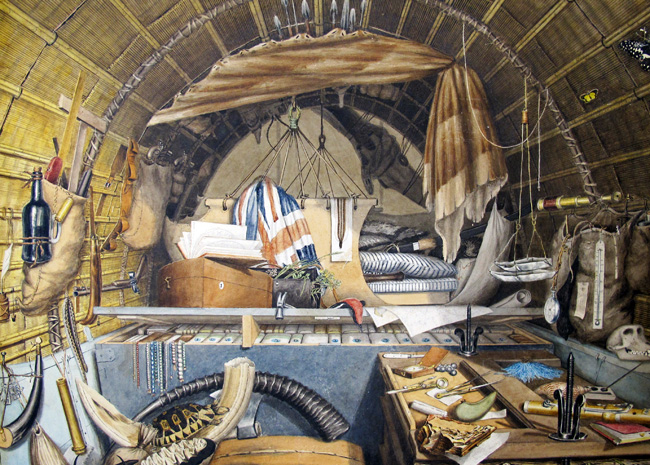
A painting by William Burchell of his collecting wagon, full of natural history specimens (1820)
The first section of the Burchell collection that I tackled was his correspondence. I am happy to report that our wonderful volunteers – Lucian Ohanian, Mariateresa DeGiovanni, Naide Gedikli-Gorali and Robert Gue – have now finished digitising this material and we have made the scans available to all on Collections Online. Now that the digitisation of the Burchell correspondence is complete, we are able to more easily search his letters, and learn more about his motivations to conduct expeditions so far afield.
Burchell first left the British Isles in 1805 when he travelled to the island of Saint Helena. He moved to Cape Town in 1810 before beginning his expedition into the interior of South Africa in 1811. This epic journey covered 7000 kilometres, mainly through terrain unexplored by Europeans at the time. It lasted four years, with Burchell only returning to Britain in 1815.
What prompted him to undertake such an extraordinary expedition? In a letter home to his mother written on 29th May 1811, Burchell relates several potential motivations. Firstly, he describes his frustration with the East India Company (his employers in St Helena), and his desire for a new beginning: “I have been patient with the Company’s promises till it is become evident to everyone that I was only wasting my life living any longer in St Helena.” He goes on to stress his enthusiasm for scientific research, which may also have been a motivating factor behind his journey: “I have thought it best to give free indulgence to my inclination for research which I feel so natural to me, that I flatter myself it will be my best employment.” Finally, Burchell shows a more pecuniary motive when he notes, “I do not consider myself out of the way of making money, when I think of the value of what I shall be able to obtain in my journey.”
Burchell’s correspondence has been digitised and is available from Collections Online.
Burchell closes the letter very affectionately, suggesting he had a close relationship with his family. More than half of the letters in our collection written by Burchell are addressed to his parents or sisters. He ultimately left his specimens to his sister, Anna, who in 1865 donated his botanical specimens to Kew Gardens and his other specimens to Oxford University Museum of Natural History, with the archival collection following later.
No longer an underappreciated figure, Burchell is recognised as a pioneering and significant naturalist. Through preserving and reading our Burchell archive, we can continue to shed more light on his life and personality.
By Ella McKelvey, Web Content and Communications Officer
A few days ago, I was working from home when a delivery driver arrived with a strange parcel – a cardboard box stamped with the letters FRAGILE that seemed to be producing a peculiar, scratching sound. Tentatively, I opened the cardboard box and pulled out a plastic punnet filled with newspaper, old egg cartons, and… wait! Was that an antenna?
The parcel turned out to be a box of locusts, ordered by my housemate who uses them to feed her pet reptiles. I set the punnet down beside me and tried to continue with my morning’s work. But over the next few hours, the locusts grew increasingly restless, bouncing against the walls of their punnet like hot, microwaved popcorn. The sight and sound of the insects began to return memories of the infamous locust swarms of 2020 — one in a series of near-apocalyptic events that befell us that fateful year. Worryingly, climate change is set to make locust swarms increasingly common, with Sardinia currently facing its worst locust swarm in thirty years.1
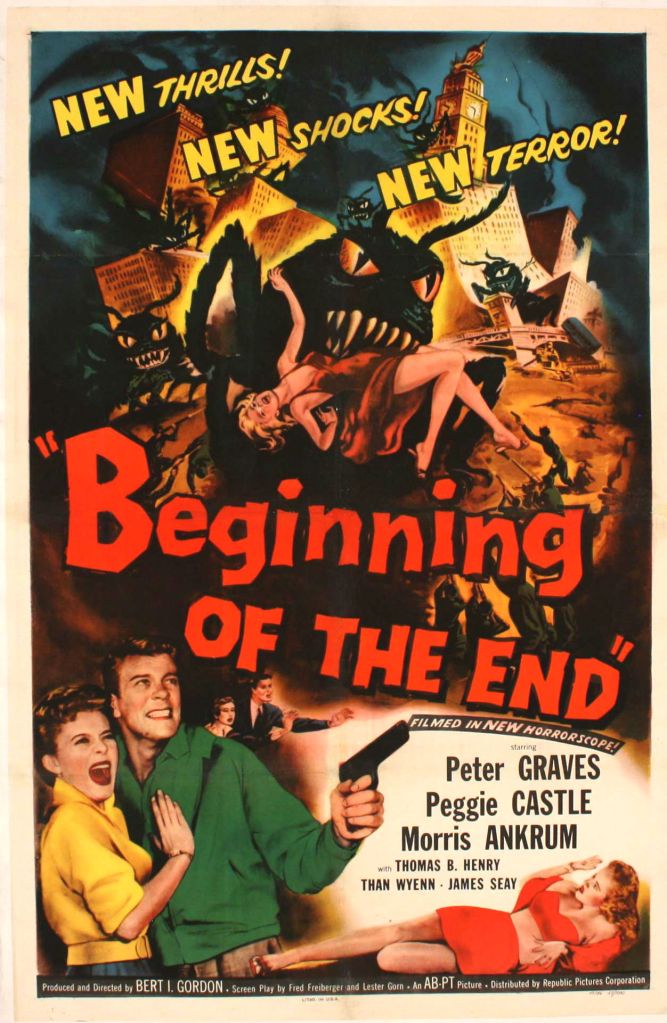
Left: A poster for The Beginning of the End (1957) about a fictional invasion of giant, mutant locusts in Illinois. Right: A real-life locust swarm near Satrokala, Madagascar (2014).
Throughout history, locusts have been widely understood as symbols of maleficence and misfortune. One of the oldest written references to locusts is, of course, the Biblical story of the ten plagues of Egypt, in which locusts were sent as a punishment from God. Since then, these infamous insects have been featured in art, books, music, and films as harbingers of destruction. Americans of the mid-twentieth century were somewhat obsessed with giant locusts and grasshoppers which were featured everywhere from cartoons to postcards. 1957 saw the release of the movie The Beginning of the End – a schlocky Hollywood sci-fi tale about a swarm of giant, mutant locusts invading Illinois. The film’s principal Entomologist describes locusts as “deadly killer[s]”, both “intelligent and strong”. Real-life locusts are, indeed, very strong for their size, with back legs that can catapult them up to a metre from standing. This means that it would be feasible for the human-sized locusts in The Beginning of the End to jump as far as forty metres — a terrifying thought!2
While The Beginning of the End is ridiculous both in premise and execution, I can’t deny that I find the concept of giant locusts pretty nightmarish. Earlier in the week, I sent an email to the Life Collections team to enquire about the possibility of looking through our pinned locusts and snapping a few photos of the biggest and grisliest specimens. As I walked upstairs to entomology, I braced myself for an encounter with some fearsome insects. But what I found were a few drawers of modest-sized locusts that looked about as benign as garden grasshoppers. Many of them were even stuffed with wool; more like teddy bears than agents of Armageddon.
Left: Anacridium aegyptium or Egyptian Locust from the Collections at OUMNH. Right: Underside of a locust specimen showing cotton wool stuffing.
According to Collections Assistant Rob Douglas, stuffing large insect specimens with cotton wool used to be a common entomological practice. Insects with fatty insides, like locusts, must be gutted to ensure good preservation. Following the removal of the insects’ insides, cotton was often used to return their abdomens to their usual size and shape. Locusts’ ample fat stores contribute as much to their physical prowess as their powerful hind legs; sustaining them through migrations of up to 310 miles a day.3 Such migrations occur when locusts are exposed to a dry spell followed by wet weather, allowing for the sudden regrowth of vegetation. These conditions will cause locusts to switch their solitary lifestyles for gregariousness, coming together to chomp their way through crops and vegetation at a density of 80-160 million insects per square mile. A large migrating swarm of locusts has been estimated to need as many calories in a day as 1.5 million human males, explaining why even ordinary-sized locusts are capable of causing agricultural annihilation.4
If it weren’t for government and international interventions, the 2020 locust swarms in East Africa could have caused up to $8.5 billion in economic damages by the year-end.5 But locusts can do much worse. One of the most notorious locust swarms on record was that of the Rocky Mountain locust in the USA between 1874 and 1877. According to some accounts, the swarm caused damages to agriculture equivalent to $116 billion in today’s money, leaving behind piles of locust carcases up to six feet high.6
When it comes to protecting crops from locusts, prevention is better than cure. Likely locust outbreaks can be pre-empted by studying weather patterns and using satellite imagery to keep an eye on vegetation growth.7 Once a (potential) locust swarm has been identified, traditional methods of locust management involve the use of pesticides to wipe out the insects as soon as possible. Back in the 1950s, this meant dowsing locusts with DDT. But as the drawbacks of synthetic pesticides become increasingly apparent, chemical interventions are being replaced with the application of naturally occurring ‘pesticides’ like the fungus Metarhizium acridum.
Our understanding of locusts has come a long way since the release of The Beginning of the End. One of my favourite news stories of the past month was the announcement by a laboratory at Michigan State University that locusts have been successfully used to ‘sniff out’ mouth cancer.8 It turns out that locusts no longer just spell danger for humanity — they can smell danger for humanity too! These cancer-detecting locusts are, in my opinion, far more ‘sci-fi’ than the giant bugs imagined by scriptwriters of the 1950s, reminding us that, when it comes to science, the truth is often stranger than fiction. Reports like these demonstrate that scientific research has the power to transform our relationship with the pests that have tormented us for thousands of years.
[5] Dominy, Nathaniel J., and Luke D. Fannin. “The sluggard has no locusts: From persistent pest to irresistible icon.” People and Nature 3, no. 3 (2021): 542-549.
[6] Lockwood, Jeffrey A. Locust: The Devastating Rise and Mysterious Disappearance of the Insect that Shaped the American Frontier. London: Hachette (2004).
[7] Zhang, Long, Michel Lecoq, Alexandre Latchininsky, and David Hunter. “Locust and grasshopper management.” Annu. Rev. Entomol 64, no. 1 (2019): 15-34.







 More Than A Dodo