Making Microsculpture

Microsculpture

Today we are excited to be opening our new special exhibition, Microsculpture: The Insect Photography of Levon Biss. You may well have already heard about Microsculpture, and have perhaps watched the video showing how Levon Biss made these incredible portraits of insects from the Museum’s collection.

As we open the show in the Museum’s main court we wanted to give a little more insight into the process that Dr James Hogan, an entomologist in our Life Collections, went through to select and describe the specimens for the project. So I put a few questions to James to explain the making of Microsculpture from his point of view.
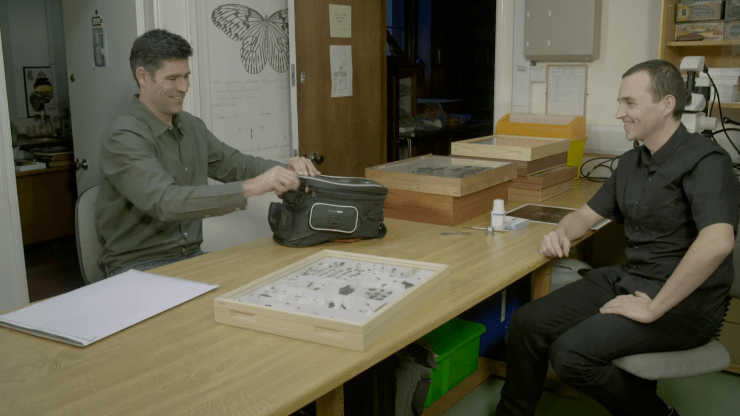
James Hogan (right) selecting specimens with Levon Biss

There are 23 specimens on show in the exhibition: how did you choose these particular ones?
We wanted a wide variety of specimens that would all show some interesting surface detail. Some were also chosen for their spectacular colours, interesting shapes or strange appearance.
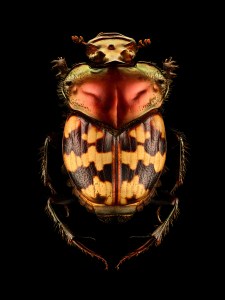
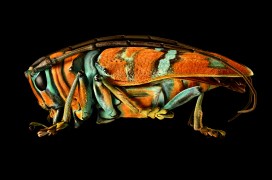
Splendid-necked Dung Beetle (Helictopleurus splendidicollis). From Madagascar. Length: 10 mm
Splendid-necked Dung Beetle (Helictopleurus splendidicollis) from
Madagascar. Length: 10 mm

But perhaps 95 per cent of the specimens we initially considered were rejected because we had some pretty strict criteria; very hairy specimens, which includes most bees, were out as the image processing was too difficult; the specimens had to be intact, so no broken antennae or legs.

Probably the biggest problem was finding specimens which were clean enough. Because Levon’s technique reveals so much detail, any dirt on the specimen is glaringly obvious. And the whole idea was to look at the surface structures, which are obviously very small and easily obscured by any dirt.

How did you prepare them for their close-ups?
All the specimens needed a bit of preparation work before being ready for Levon’s photography. First they needed to be remounted on the end of long pins to allow more clearance space for the lighting setup. Some of the specimens are very small and fragile and this is the stage where damage is most likely to occur.

After remounting, all the insects needed at least some degree of cleaning under the microscope. For this I used a range of fine paintbrushes; we also make our own tools from micro-pins bent into different points and hooks. Again, I had to be careful to not damage the specimens – easily done by over-enthusiastic cleaning!

Where do the specimens come from?
The specimens in the exhibition are from the Museum’s very large insect collection, stored behind the scenes in many different rooms. The insects in the show are from all over the world, from a back garden in England to a remote island near Antarctica. Some were collected over 150 years ago while others were collected very recently by Museum staff.

Of particular historical significance is the Tricolored Jewel Beetle (Belionota sumptuosa) which was collected by the Victorian naturalist and explorer Alfred Russel Wallace, co-publisher of the theory of evolution with Charles Darwin in 1858.

Tricolored Jewel Beetle (Belionota sumptuosa), collected by Alfred Russel Wallace in Seram Island, Indonesia. Length: 25 mm
Tricolored Jewel Beetle (Belionota sumptuosa), collected by Alfred Russel Wallace in Seram Island, Indonesia. Length: 25 mm

How big are the actual specimens in comparison with the photos?
The actual specimens are mostly pretty small, ranging from 6 mm to about 30 mm. Some of the larger printed photographs will be about a thousand times larger than the specimen!

Orchid Cuckoo Bee (Exaerete frontalis) from Brazil. Length: 26 mm
Orchid Cuckoo Bee (Exaerete frontalis) from Brazil. Length: 26 mm

What do you hope people will get out of the pictures in the exhibition?
To me insects are beautiful creatures and Levon has done an outstanding job of revealing this. I hope the photographs will spark people’s interest in insects and inspire more people to study them.

The photographs certainly pose some interesting questions, and reveal that there is so much we don’t know, particularly about the functions of all their strange and varied adaptations.

Is it valuable to showcase specimens from the collections in this way?
One of the most exciting parts of this exhibition for me was the opportunity to show part of the Museum’s collection which visitors don’t normally see.

The collection is used all the time by scientists, artists and educators, but unfortunately most of it is unsuitable for display because the specimens are so small. Levon’s ultra-high resolution photography has in a way solved this problem, allowing us to showcase some of these spectacular, but tiny and fragile creatures in all their beauty.
Getting the picture

Photographing museum specimens is an important part of the documentation process. It creates a record of the condition of the object at a particular point in time, and may reduce the need for long descriptions of the specimen and associated material  such as labels. Making pictures available online also provides an exciting new window into the behind-the-scenes collections. There’s recently  been a big drive in the museums sector towards mass digitisation, and our museum is moving towards that model. The important thing for us is to balance speed with  the need to produce photographs that are both useful and appealing to our audiences.

PhotoBlogBridge.JPG
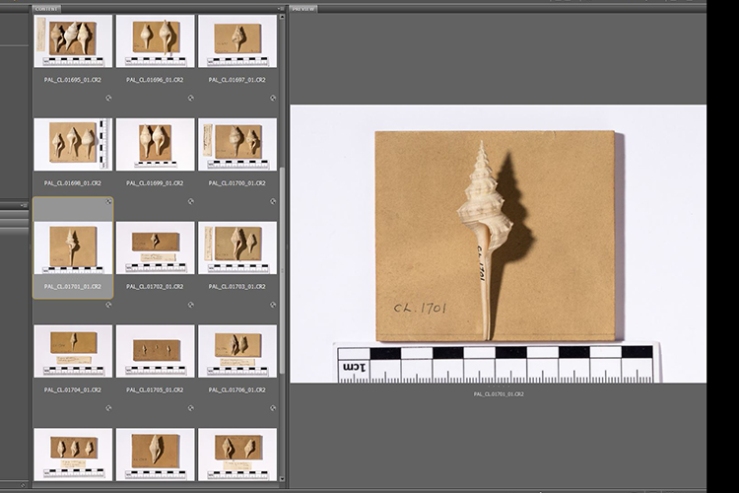
Digitised images in AdobeBridge

I’ve taken many different types of photos over the course of the Lyell Project, trying out different ways of creating the best image to illustrate a blog post, record an entire drawer or capture different types of handwriting. It’s been a useful but time-consuming process. We are now moving on to the mass digitisation part of the project, and I’ve spent  much of the past few weeks experimenting with various ways of doing this.  My aim is to get the entire process of photography, from getting out the specimens to uploading the images, to work more smoothly, making everything faster and more efficient.

The equipment I’m using was already in the museum, purchased during various projects and using different funding sources:

  • Camera: Canon EOS 6D (the specification is probably overkill for these photos)
  • Lens: EF 100mm f/2.8L Macro IS USM
  • Copy stand: Kaiser RS1 copy stand
  • Lights: Kaiser RB30 lights
  • Scale bar
  • Basic laptop
  • Software: DSLR Remote Pro (remote capture application for camera)
  • Cable with USB type A plug to mini-B plug to connect the camera to the laptop
  • Paint brush to dust specimen and clean background
  • White paper for background
  • Stiff white card reflector to reduce shadows
PhotoBlog_20160401_160715
The photography set up

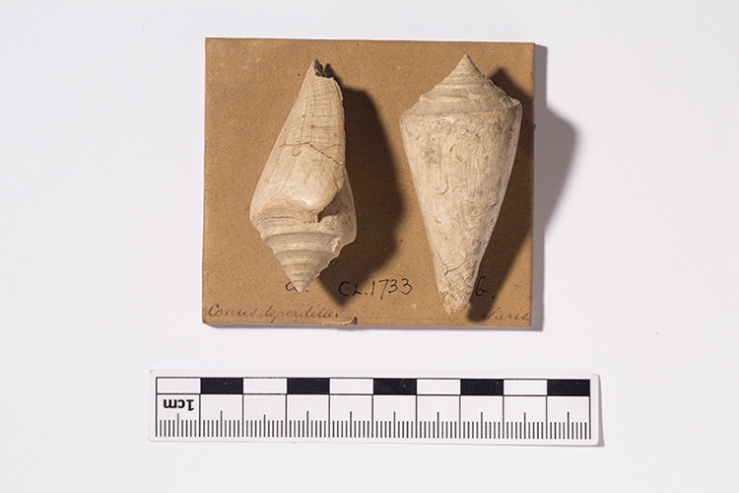
For rapid photography, the big advantage of the Lyell Collection is that around 95% of the specimens are attached to wooden or cardboard tablets, many of which are the same width. We want to capture images of the entire tablet as that provides useful information about the specimen, including the object number, locality, genus and species. As the specimens are already fixed to the tablets, there was no need to go through the time-consuming and fiddly process of orientating every specimen in the same way and keeping it in position using props. The only decision was which way up to photograph the tablet. As you can see from the photos below, there is very little consistency to the orientation of the fossils on the tablets, so we decided to go with standard paleontological orientations e.g. apex up for gastropods or, where there was a mixture of ways up, to go with the orientation of  handwriting.

PhotoBlogIMG_0023
The right way up
PhotoBlog_IMG_0027
Which way should this go?

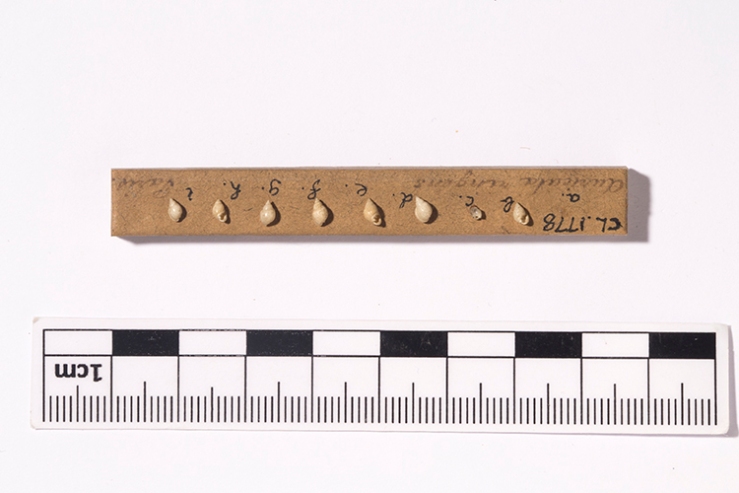
I was surprised how quickly I could take photos of the specimens when I left the camera at a fixed height above the specimens and used autofocus, instead of adjusting the working distance and manually focusing for every specimen. Only the very smallest shells (less than 1cm) looked a bit flat, and there was still enough of the shape recorded to be useful.

PhotoBlog_IMG_0033
Very small shells

I’ve done three drawers about 250 specimens so far and I’ve got down to approximately 2 minutes per specimen. This includes the whole process from getting drawers out of the cabinets, photographing all the specimens, manually renaming the images with the specimen number, doing basic image adjustments to the RAW files, saving as archival tiffs (5472 x 3648 pixels), and jpegs (1000 x 667 pixels) for online use, editing metadata, and uploading to our collections management system and digital archives.  Other demands of the project mean that I won’t be doing this full time, but I’ll probably be be doing a day or two of photography per week for the rest of the project.

This process will slow down considerably as we get to less uniform drawers of specimens and specimens that aren’t on tablets, but it is really useful to know how much we can do with limited equipment. In the future we may look at automating some of these processes. We’ve just been joined by a Museum Studies student who’ll be on placement with us for the next eight weeks. She’ll be working on all aspects of the Lyell project including photography, and simplifying the photography procedure in this way should make the training much easier and allow her to achieve much more in a short period of time.


Introducing the Dodo Crew

IMG_7579

by Carly Smith-Huggins, Education Officer

Over the past six months we’ve been trying something new at the Museum, working with an enthusiastic group of young people who have come to call themselves The Dodo Crew. Otherwise known as the Museum Youth Forum, the group meets up with us once a month to discuss ideas, plan events, see the collections, and generally have a dialogue about the Museum and its activity.

Dodo crew stickerThe Crew is made up of eleven 14-19 year olds who are already passionate about natural history and we’re really pleased to have them on board. Many museums across the UK run youth forums to engage the young people within their community, who are often underrepresented in museum audiences.
In fact, I was on a Museum Youth Forum at Norwich Castle Museum and found the experience very valuable as I had the opportunity to express my opinion, contribute and be part of a community, and make new friends. The group also enabled me to find my passion for working in museums, which I did not get from formal education or at home.

By joining the forum our Dodo Crew gets a chance to be involved in what we do as a museum, which I think is very important. And it will hopefully help us to be more successful in attracting people aged 14-19 years.

Going behind the scenes is great- seeing objects and talking to people.

It really felt like a unique opportunity and made me feel special.

IMG_7458
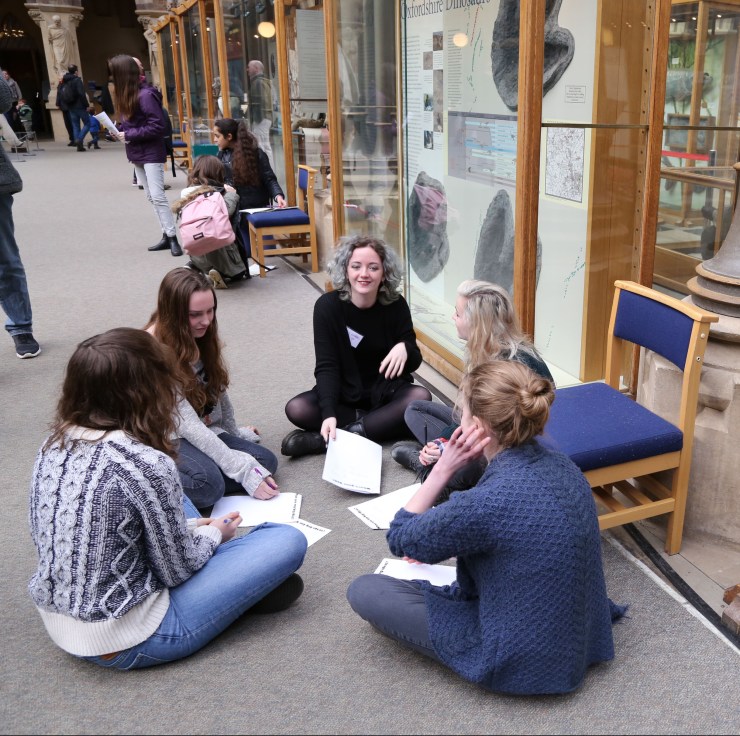
Members of the Dodo Crew get down to some planning in the Museum court

So what exactly have we been doing? The Crew has been enjoying taking part in various activities, from live animal handling and taxidermy demos, to planning events and meeting scientists. They will also be helping with programmed events, designing their own events, contributing to temporary exhibitions, and much more.

And their very first event is this Saturday 16 April, all about skin and bones. Everyone is welcome between 2-4pm, so come and meet the Dodo Crew and see their great ideas in action (and if that doesn’t entice you, there will also be a live chameleon!).

IMG_7576
Getting up close and personal with a friendly skunk

The ancient ‘Kite Runner’

72dpi Press%205

An ancient creature which carried its young like tiny, swirling kites is the latest discovery by researchers at the Museum, working with Yale Peabody Museum of Natural History, Leicester University, and Imperial College London.

Found in a deposit of rocks known as the Herefordshire Lagerstätte, which preserves ancient remains with superb detail, the 430 million year old fossil shows that the marine animal carried its young in kite-like capsules tethered to the parent’s body, earning it the moniker “Kite Runner” after the 2003 novel by Khalid Hosseini.

The small creature has been officially named Aquilonifer spinosus, from “aquila”, meaning eagle or kite, and “fer” which means carry. It grew to just over a centimeter long, not including the tail spines, and there is only one known fossil of the animal.

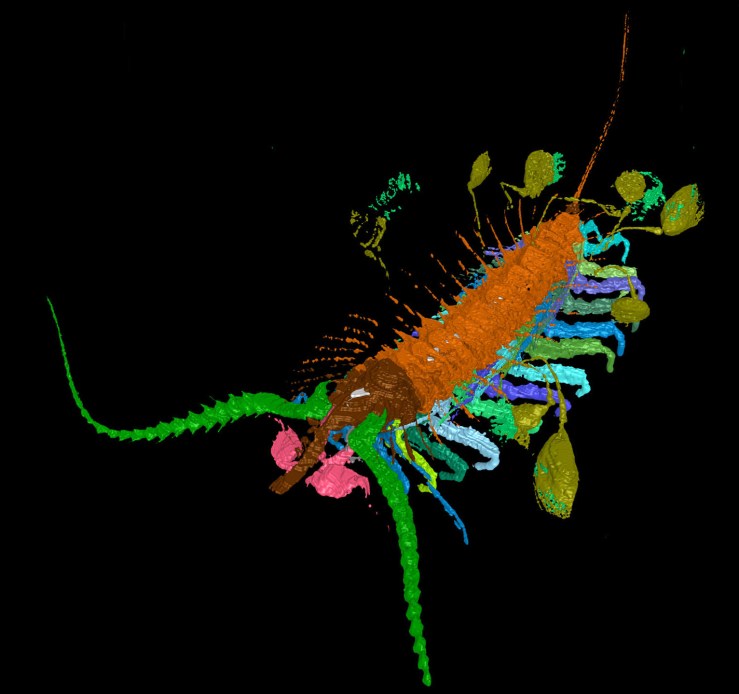
Kite runner. Anterior oblique.The arthropod Aquilonifer spinosus
Reconstruction of Aquilonifer spinosus

Modern crustaceans employ a variety of strategies to protect their eggs and embryos from predators — attaching them to limbs, holding them under a carapace, or enclosing them within a special pouch until they are old enough to be released — but this example is unique. We know of nothing alive today which attaches the young by threads to its upper surface; perhaps this strategy was less successful and became extinct.

Kite runner. Two young in capsules of the arthropod Aquilonifer spinosus
Two capsules of juveniles tethered to the parent’s body

Aquilonifer spinosus lived on the seafloor during the Silurian period, with a variety of other animals including sponges, brachiopods, worms, snails and other mollusks, a sea spider, a horse-shoe crab, various shrimp-like creatures, and a sea-star.

The researchers were able to describe Aquilonifer spinosus in detail thanks to a virtual reconstruction. They reconstructed the animal and the attached juveniles by stacking digital images of fossil surfaces that were revealed by grinding away the fossil in exceptionally thin increments. You can see this animation here:

The Yale Peabody Museum of Natural History, the Natural Environmental Research Council, the John Fell Oxford University Press Fund, and the Leverhulme Trust supported the research.


A picture is worth…

IMG_0262
‘Paddling with Yin-Bou Fisherman’ © Asher Svidensky
by Scott Billings, digital engagement officer

We recently hosted freelance photographer Asher Svidensky for a free public lecture at the Museum, on 16 March 2016, in a talk about photography, people, storytelling, fish, fire, and some rather impressive birds.

Asher’s work has been featured by National Geographic, the BBC, the Guardian and many other media outlets, and includes projects on Mongolian eagle hunters, Yin-Bou fisherman, and the Miao ‘goddess’ in China. The talk offered a good opportunity to hear Asher discussing some of these projects, talking about his methods, and explaining why he thinks photography can be the “eye candy” which lures you into the fuller story.

EP5B6767
Asher Svidensky chats with a visitor after his talk at the Museum
As a photographer and sometime journalist I found this a refreshingly honest appraisal of the types of images he is making: sumptuous, atmospheric, pooled with light and colour, and beautiful, but ultimately designed to make you swoon a little.

Rather than big up his photographic prowess, Asher instead presented his photography mostly as a means to an end. It is the people and their stories, he explained, which interest him more than photography, but striking imagery attests to a strong story.

Some photographers take a lot of time and effort into getting to know the people they are photographing; into creating those relationships and creating the understandings and learning about the culture so they can get more from it and make a better image.

So the image stems from the photographer’s submersion in people and culture, or in the ‘story’, and then itself becomes the route into that story for the reader – the irresistible “eye candy” that whets your appetite. On a slightly less adventurous level we aim to do the same with the natural history collections images on this blog.

IMG_2107
‘Searching for the Miao goddess’ © Asher Svidensky
In the hour-long talk, Asher also spoke about many other aspects of his philosophy of photography, and revealed details about his acclaimed Eagle Huntress of Mongolia project, in which he documented the rise of the first female eagle hunter of the Mongolian Steppe.

You can watch a short excerpt from the talk in this video:

‘Father of English geology’

William_Smith

by Kate Diston, Head of Archives and Library

Today marks the 247th birthday of William Smith. “Who’s he?”, you may well ask. William Smith is perhaps one of the least well-known, yet very significant, figures in the history of the science. Among other things, he created the very first geological map of England and Wales, 200 years ago.

Smith’s work as a land surveyor and mining engineer in the early days of the Industrial Revolution allowed him to understand first-hand how the layers, or strata, of rock beneath the earth are related to those above and below them. From this, he realised you could predict those three-dimensional layers in other locations and also represent the whole thing on a two-dimensional map.

Smith_1815Map
A section of the famous 1815 geological map of England and Wales
IMG_4696
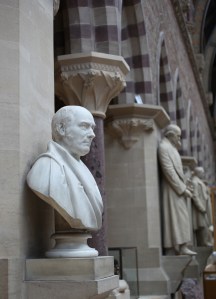
William Smith’s bust in the Museum court

If you visited us in the past few months you may have seen lots of Smith’s maps and other material in Handwritten in Stone, our special exhibition which celebrated his life and work. Now, a new exhibition featuring copies of items from our collections is opening in Smith’s birthplace of Churchill, Oxfordshire.

The displays at the Heritage Centre in Churchill take a very different look at the ‘father of English geology’, offering a rare glimpse of Smith’s personal correspondence with his family.

In honour of Smith’s birthday, we showed off his most famous work, the beautifully coloured 1815 map, in front of his bust in the Museum court today. As one of the Museum’s treasures not normally on display, it is a real treat to see it being admired by visitors.

20160323_151319
Visitors get a close look at the original 1815 map with Chris Jarvis