Temporarily misplaced

When I started work on the Lyell project in July of this year, I was very keen to know more about the history of the collection, both before and after it arrived at the museum. Collections often arrive at the Museum with associated material such as catalogues, letters or notebooks and after they arrive any activity related to the collection should be documented.

The first step in investigating the history of the collection was to find out what was in the Museum’s records. I began by looking at the donors database; this recorded the date that the Lyell collection arrived (1903) and the donor, Sir Leonard Lyell, Charles Lyell’s nephew. There was a little more information in the donors card index, which mentioned the fact that the collection came in two parts, the bulk of the collection in 1903 and then additional Italian specimens in 1907. The Collections Manager, Eliza Howlett, also directed me to the annual reports of the Museum for 1903 and 1907, which noted the two donations, and to the Earth Collections Lyell file, but this started in the 1960s and was entirely related to the use of the collection.

I wondered if there was a book of acquisitions that recorded the information that went into the annual reports. A colleague had vague memories of some early donation books, so I decided to go on a hunt to see if that would yield more information. I checked many shelves, climbing up ladders and peering into boxes all over the Museum. My search eventually narrowed down to a cupboard full of folders taken from a former curator’s office. The donor book was there (and interestingly included library books as well as fossils) but it started in 1929 so it didn’t cover the years that I was interested in. I delved further into the pile and noticed that a tattered box file was labelled “Lyell Collection” among other things. Bingo!

Or so I thought. After carefully searching through the box, there was nothing Lyell related at all. There was quite a bit of space, so clearly something had been removed. I kept on searching, roping in various colleagues to help me think of new possibilities, which involved more ladders and delving into cupboards that hadn’t been disturbed for years. I found some interesting things but nothing on Lyell and I started to think that whatever had been in the file was already in our Lyell folder.

Then one day, a month or so later, I came in to work to find a mysterious cardboard box on my chair. Inside was some old notepaper, photocopies of most of the 1980-1990s catalogues, and a marble bound notebook with “Lyell Collection” on the front. It was the missing piece! It took me a while to work out where it came from but it turned out that one of our Honorary Associates had found it on the top of a filing cabinet while looking for something else.

Photograph of original Lyell Collection catalogue
Original Lyell Collection catalogue

It was fascinating to read. Inside was a complete, drawer by drawer listing of the species and localities of specimens from the collection. There were references to the places in which they were published, and references for further information as the cataloguer worked out where the localities were and how the stratigraphy fitted together.

The book contained two sets of handwriting. it became clear that this was a document created after the collection was presented to the Museum, as we identified the first set as that of Maud Healey, who worked as Assistant to Professor W.J. Sollas, Keeper of the University Museum, between 1902 and 1906. We know that she did a lot of cataloguing and arranged displays, and the 1903 annual report gratefully notes how the “work of reorganization of the fossils of the Museum Collection … has … progressed … at a much more rapid rate during this year, a result entirely due to the devoted efforts of Miss Healey.”

It seems Miss Healey may have pushed herself too hard; the 1906 annual report notes that the ” Professor regrets to have to record the loss of the invaluable services of Miss Healey, who as a result of overwork has been recommended to rest for an indefinite period. This will prove a serious check to the rate of progress which has for some time been maintained in the work of rearrangement, and it is to be hoped that her retirement may be only temporary. ”

We haven’t yet identified the second set of handwriting, but the owner recorded the specimens that arrived after 1907, when Miss Healey had left. We suspect that it belongs to a C.H. Dunham or Durham, whose name is written on the book along with the date December 1907, but research so far hasn’t come up with any more information. If anyone reading this recognises the name or can suggest anywhere to look, we would love to hear from you!

So long, 2015…

IMG_6901-Edit

As you can tell from the adornment of our Red Deer, Christmas is upon us, so it’s nearly time to bid farewell to another year. It’s been another remarkable twelve months here at the Museum so here’s a little round up a few highlights from 2015…

As winter gave forth to spring
News emerged of a heartwarming thing
The Art Fund whispered in our ear
We were nominees for Museum of the Year!

Although eventual winners we were not
It mattered really not one jot
For in celebration we embarked
On the Dodo Roadshow – a tremendous lark

Back in April we’re pleased to say
Another award came our way
Goes to Town gave creatures free reign
And grabbed a gong for Marketing Campaign

But we weren’t always on the road
In our exhibitions many stories were told
Of evolution, geology and sensory powers
Science and research passed the visitors’ hours

Our doors were open without interruption
While out on the lawn was a volcanic eruption
University scientists had plenty to say
On a really Super Science Saturday

So to our schools, and families, and adults and more
Thank you, cheers, and thank you some more

Here’s our programme for January to April. See you in 2016…

Coming out of the shell

We have a brand new blog to share with you – http://www.charleslyell.com.

Just over a hundred years ago the Museum acquired a collection of fossils from renowned 19th-century geologist Charles Lyell. Lyell is famous for his book Principles of Geology which provided a foundation for the modern study of the science of geology. On the new blog we will be documenting the digitisation of this collection.

Read on to find out more…

Sarah Joomun's avatarPast to Present

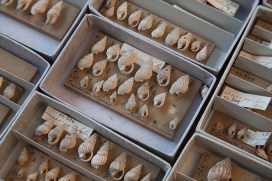
Drawer of Lyell’s fossil gastropods

Just over a hundred years ago there was great excitement amongst the staff at Oxford University Museum when they acquired the Charles Lyell Collection of Tertiary molluscs. In his 1903 Annual Report the Professor of Geology, W.J. Sollas, described it as one of the most noteworthy events in the Geological Department that year.

The collection contains over 16,000 fossil specimens, mostly molluscs (bivalves, gastropods and scaphopods) but also shark teeth and other vertebrate remains.  Although some of the specimens are on display in the museum, few people were aware that we had the collection. It wasn’t until the 1990s that the collection was fully catalogued, and it has never been included in the Museum’s main collections databases.

Over the next 18 months we are planning to digitize the collection and create links to our archival material and Lyell’s publications. We want to make the collection…

View original post 290 more words

Out of order

Amphionides small

Our head of research, Sammy De Grave, is the lead author of a paper published in Scientific Reports last week. In this paper he and his co-authors propose to remove an entire ‘order’ of crustaceans. But just what is an order, and why would we want to get rid of one?

Biologists organise all life into ranked groups. The most familiar, and at the bottom level, are genus and species. These are recognisable in the format Homo sapiens, where Homo is the genus and sapiens is the species.

One of the higher groupings is called an order. For crustaceans, there are around 70,000 known species grouped into approximately 50 different orders. One of these orders is the subject of the paper mentioned above – it’s called Amphionidacea – and the odd thing about it is that it was created in 1973 for just one species, an enigmatic open-sea creature called Amphionides reynaudii.

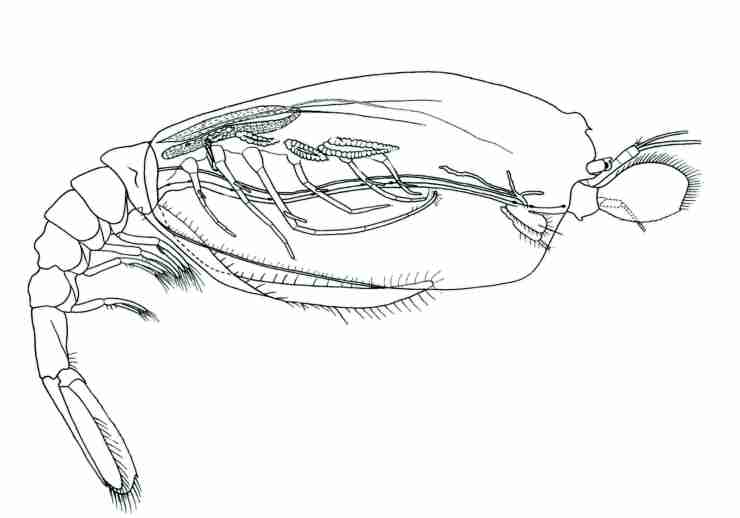
Presumed adult female of Amphionides reynaudii (after Williamson, 1973)

Although the species has been known since 1833, relatively few specimens have been collected and almost none since 1973. Some larval stages have but recognised, but only three adult males have ever been found and no intact adult females have been collected. The reference illustration above is a composite of 43 damaged specimens.

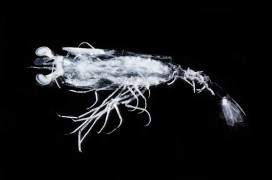
Lacking good research specimens, the status of this creature has long been debated. Luckily, in 2011 Jose Landeira, a biologist on Gran Canaria, collected six specimens. As usual they were extensively damaged (you can see this in the photograph at the top), but a specialist genetic lab at National Taiwan Ocean University was able to extract some small fragments of DNA.

Building on earlier work by a US group, the sequences were analysed and the results show that Amphionides is not a separate order after all, but merely a shrimp. You can see where it fits in the taxonomic scheme of things by clicking the chart below.

Out of Order Fig3
Phylogram of the Decapoda order of crustaceans, which includes crayfish, crabs, lobsters, prawns and shrimp. The position of Amphionides indicated in red (click to enlarge)

In keeping with its oddball status, however, many questions remain unanswered. Amphionides larvae have been recorded across all oceans from the tropics to subtropics, but almost no known shrimp species have such a distribution as adults. And although the genetic analysis reveals a strong affinity to a single family of shrimp (Pandalidae), it remains unclear which genus or even species it could be the larvae for.

So Amphionides may be removed from its order, but the mystery of the little shrimp lingers yet…

Super Science Saturday

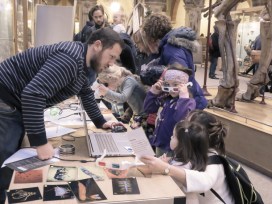
On Saturday 28 November we held the first of our new Super Science Saturdays events – a mini science fair for all the family.

The first event was Earth-themed, and featured many stalls about geology, geography and the natural environment – everything from fossils to earthworms!

Visitors got the chance to chat to University of Oxford scientists, meet people from wildlife organisations, and get their hands on specimens from the Museum collection.

Super Science Saturdays is a souped-up version of our regular Science Saturdays events, where scientists from the University help visitors investigate natural history specimens.

Many thanks to the University’s Department of Earth Sciences, the School of Geography and the Environment, and also to the Berks, Bucks & Oxon Wildlife Trust, and the Oxford University Museums and Collections Volunteers for making the event a success.

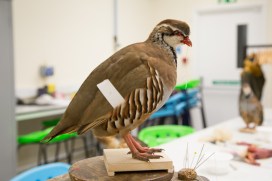
Partridge in a laboratory

IMG_6669

We recently ran a second series of taxidermy workshops here at the Museum, run under the expert guidance of professional taxidermist Derek Frampton. Once again they proved very popular with participants, so we asked one of those budding taxidermists, Kit Collins, to give us a short write-up of the day…

As a child I was always fascinated by nature, finding adders, baby hares, grass snakes, slow worms, and watching dolphins, buzzards, and Red Kites, when they were much rarer. I even once skinned a mouse that had been caught in our mouse trap.

I have always wanted to try taxidermy and I now work at an auctioneers where I regularly see all sorts of taxidermy – skins, horns, and skulls, including a hippopotamus skull. So I was keen to know more about the process. This was the first taxidermy course I’ve seen so I jumped at the chance to try something new and learn from an expert taxidermist.

IMG_6677
Derek Frampton puts some finishing touches to his partridge

During the workshop we were taken through each step of the process, first watching Derek demonstrating on his bird then copying these steps on our own Red-Legged Partridges.

Kit and partridge
Kit and his finished specimen regard one another

We could see the finished article that had been made in the previous day’s workshop, sitting watching us on a nearby windowsill. Unfortunately, our specimens looked nothing at all like this at the start and as the morning went by it looked less and less likely that our piece of wet skin and feathers with a few bones attached would end up looking anything like a real bird again…

However, with the help of a blow dryer the feathers regained their soft, striking plumage. We then spent the afternoon piecing the bird back together using a kind of packing straw to recreate the shape of the body, and wire, clay, false eyes, and car body filler to do the rest.

We each ended up with a beautiful bird to take home, as well as the memories of a fun and unusual day out (and anatomy lesson) at the Museum. I would love to do it again.

Kit Collins