I'm Public Engagement Manager at Oxford University Museum of Natural History and I look after permanent displays and other interpretation. I do a bit of social media on the side, too.
Not many people know that the Oxford University Museum of Natural History doesn’t just consist of the specimens on display – it also houses the Hope Entomological Collection: the second largest entomological collection in the UK. The space contains thousands of incredible pinned specimens as well as some live ones too (Geraldine the stick insect on the right). Entomology is the study of insects, and so the department is responsible for the curation of thousands of invertebrate specimens collected over hundreds of years by biologists such as Darwin and Wallace. We have all sorts in the collection – from beetles and flies (Coleoptera and Diptera) to bees and ants (Hymenoptera).
The collection consists of over five million specimens, which keeps the staff, volunteers and interns well occupied. Each person working in the department has their own role and
often their own speciality. Not only are the permanent staff experts, but the…
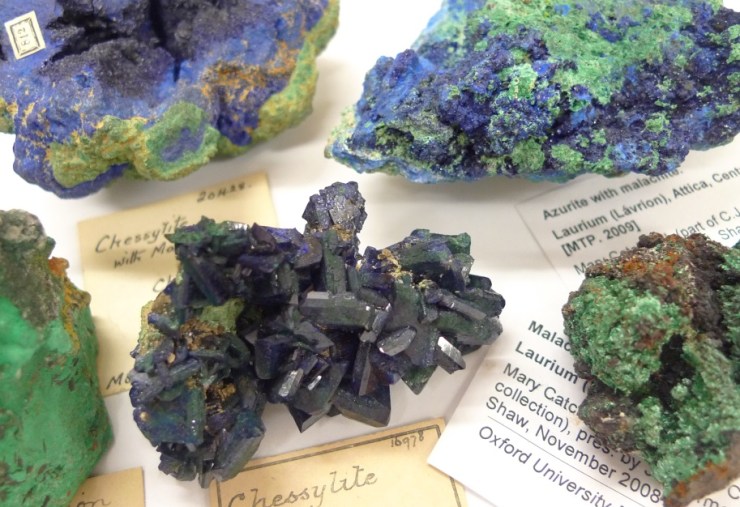
Azurite (formerly called chessylite) and malachite are two copper minerals that were used as pigments 9,000 years ago.
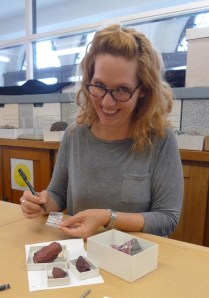
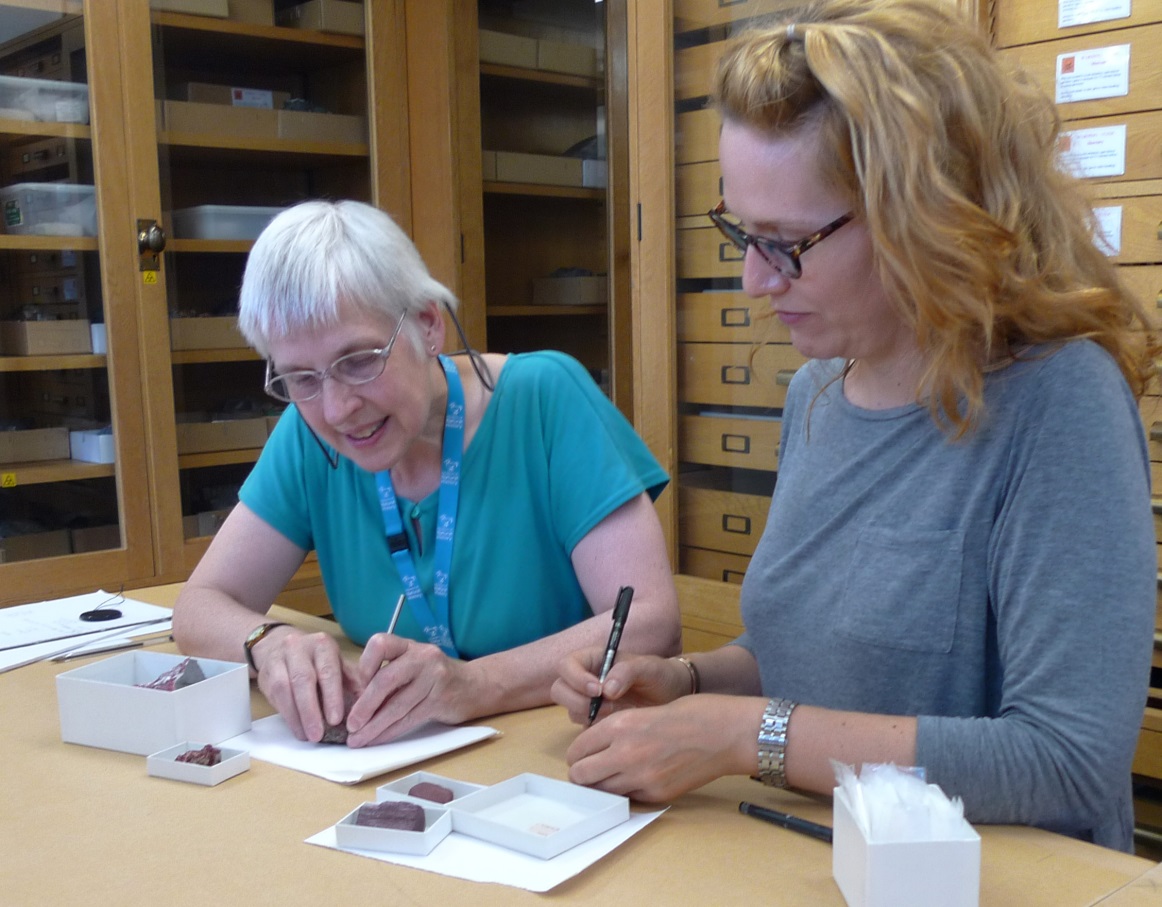
Last week, Ina St George visited to photograph and sample some of our most colourful minerals. As part of research for her DPhil at the Archaeology Department in the University of Oxford, she is studying the pigments used at an archaeological site in Turkey.
Ina St George
Our Museum’s collections include samples of the kinds of minerals used for colouring in paintings, artefacts, and body decoration, obtained from countries all around the world. Ina tells us:
“My project is looking at paintings and pigments from a Neolithic, 9,000 year old site in Turkey called Çatalhöyük. Part of the project is to characterise these pigments using techniques for mineralogical and chemical analysis. The palette of colours at my case study site has both pigments often used in prehistoric times such as iron oxides and carbonaceous blacks, and much rarer ones such as the minerals cinnabar, azurite, and malachite.
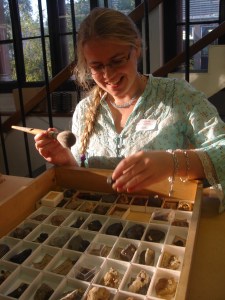
Monica Price (l) and Ina St George (r) are removing tiny samples from the mineral specimens, ready to analyse
“Historically, pigment analysis, referred to as ‘technical art history’, focuses on the actual material that gives the colour, such as hematite or cinnabar. This is more appropriate for historical or modern pigments where preparation techniques and tools were more refined, allowing the artist to use grains of pure colourant.
“In prehistoric times, tools for the preparation of pigments were cruder, and so archaeological samples of pigment tend to have more of other minerals contaminating them. For instance, we see a higher proportion of quartz in a cinnabar sample, or iron minerals in an azurite or malachite sample. In my project, I will be able to see this using a microscope, looking at particles at high magnifications, and analyse the minerals using techniques such as X-ray diffraction or scanning electron microscopy.
“Seeing the minerals in the Museum of Natural History’s collection is an opportunity to better train my eye to see the source minerals for pigments, and to photograph mineralogical samples with a confirmed provenance for my D.Phil thesis.”
This week marks a landmark in the history of the Museum. Kristin Andrews-Speed will retire after 23 years of loyal work.
Over the years, Kristin has arranged corporate events and venue hire, been an essential part of hiring new staff, and managed all sorts of complicated logistics. She’s a dab hand at coaxing the photocopier back to life, too!
When a landmark is reached, it’s a chance to look back. In Kristin’s 23 years, she has seen enormous changes in the Museum, so I caught up with her to share some memories and reflections.
On 22nd July 1991, Kristin walked through the doors of the Museum and into her new job as assistant to the administrator.
With a zoologist father and a previous job at the Scott Polar Research Institute in Cambridge, Kristin always had a love of natural history. She soon fell in love with the beautiful building and its fascinating collections.
In 1991, just 83,000 people visited the museum, – the fact that it was open only Monday to Saturday from 12-4.30pm probably didn’t help. But with extended hours and Sunday opening introduced in January 1999, visitor numbers soared, reaching 575,000 in 2012.
“It’s wonderful to see how many more people are now enjoying the museum and still gasping as they walk through the main door.”
The museum’s first director, Keith Thomson, arrived in 1998 and Kristin’s job changed to include Director’s Assistant duties. They shared a love of ornithology and Kristin remembers when they watched a Black redstart clinging to the museum building. The Director brought many changes, like a full refurbishment of the main museum displays, which Jim Kennedy later continued.
Museum staff in summer 1998. Kristin stands on the far right, second row from the front. Delphrene is on her left.
Kristin described a major change in how the Museum runs reception events. She talked affectionately about a hot evening in August 1991 where she served drinks to guests on the gallery, with help from the museum’s cleaners, Delphrene and Sue, and quickly learnt how to open a bottle of wine. All a long way from the professionally catered events of today.
Kristin’s meticulously maintained diaries have become such a valuable piece of the museum’s history that they will be added to our Archival Collections, for future fact-finding missions.
Kristin has enjoyed meeting all kind of people, from new young scientists to older staff and visitors with their stories about the Museum over the years.
One way that Kristin will remain connected with the Museum is by watching out for our summer visitors; not the tourists, but the swifts!
I’ve always kept my office window open in late April to listen for the first screech of the birds round the tower, and will continue to listen out for them around Oxford.
Rachel Parle, Education and Interpretation Officer
I’ll be spending a year working with the education teams, learning the skills it takes to become a great museum education officer.
My placement starts with 4 months here at the Museum of Natural History, before moving to the Ashmolean, and finishing in the Pitt Rivers Museum.
Last Sunday I was lucky enough to work at Cowley Road Carnival with the rest of the trainee team. When we met in the morning the sun was shining, music was playing, the whole street already smelt delicious from the many street food stalls… we just knew it was going to be a good day!
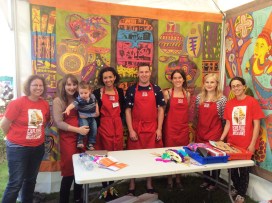
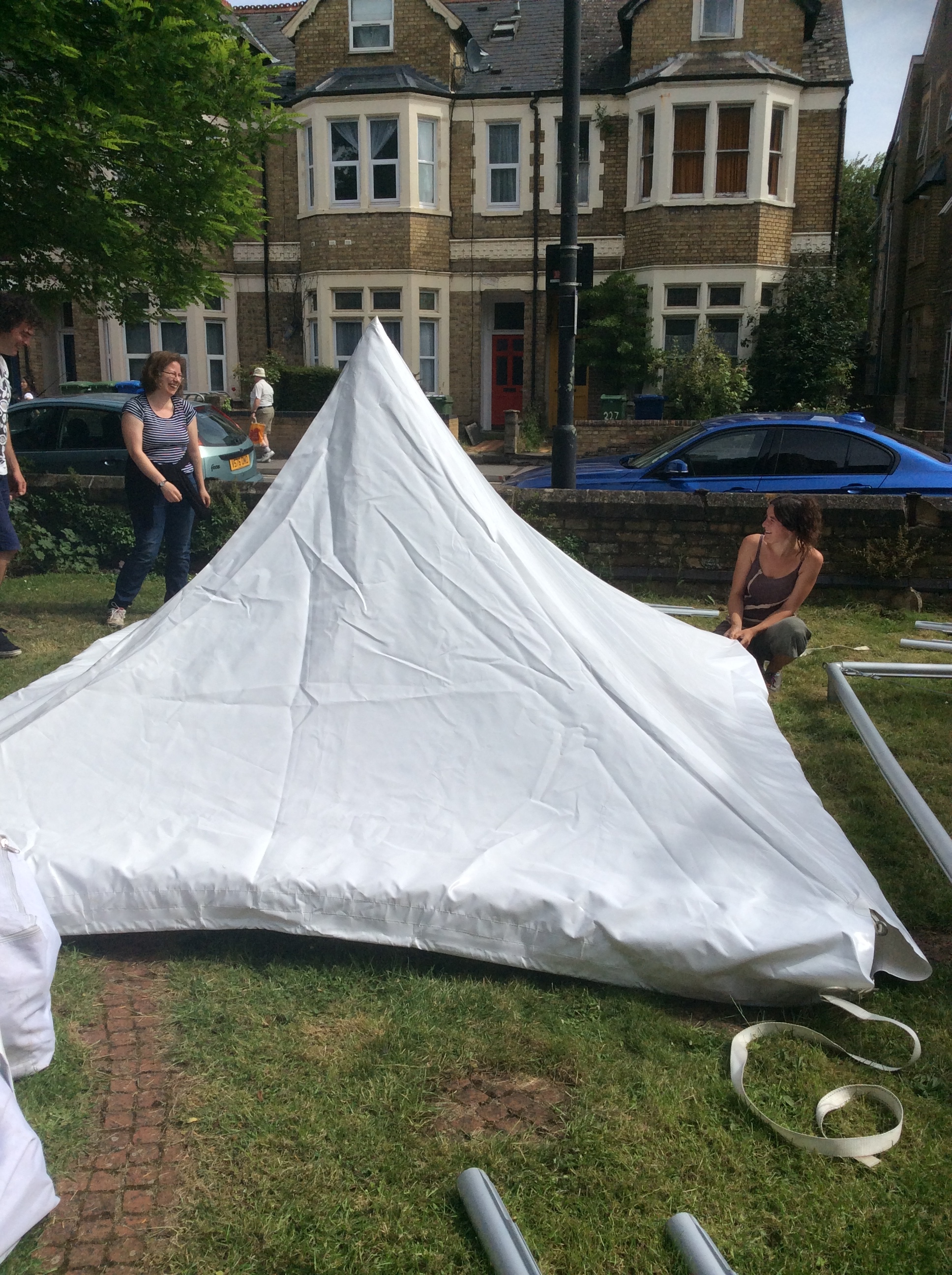
Before all the fun could start we had to set up base at our spot in the grounds of St Mary and St John Church. How many trainees does it take to set up two tents and a few tables?
The answer is five trainees, a project coordinator, a head of education and three additional helpers. It took teamwork, perseverance and the truly superhuman strength of Andy, head of education at the Pitt Rivers, but we got there in the end, and didn’t it just look beautiful!?
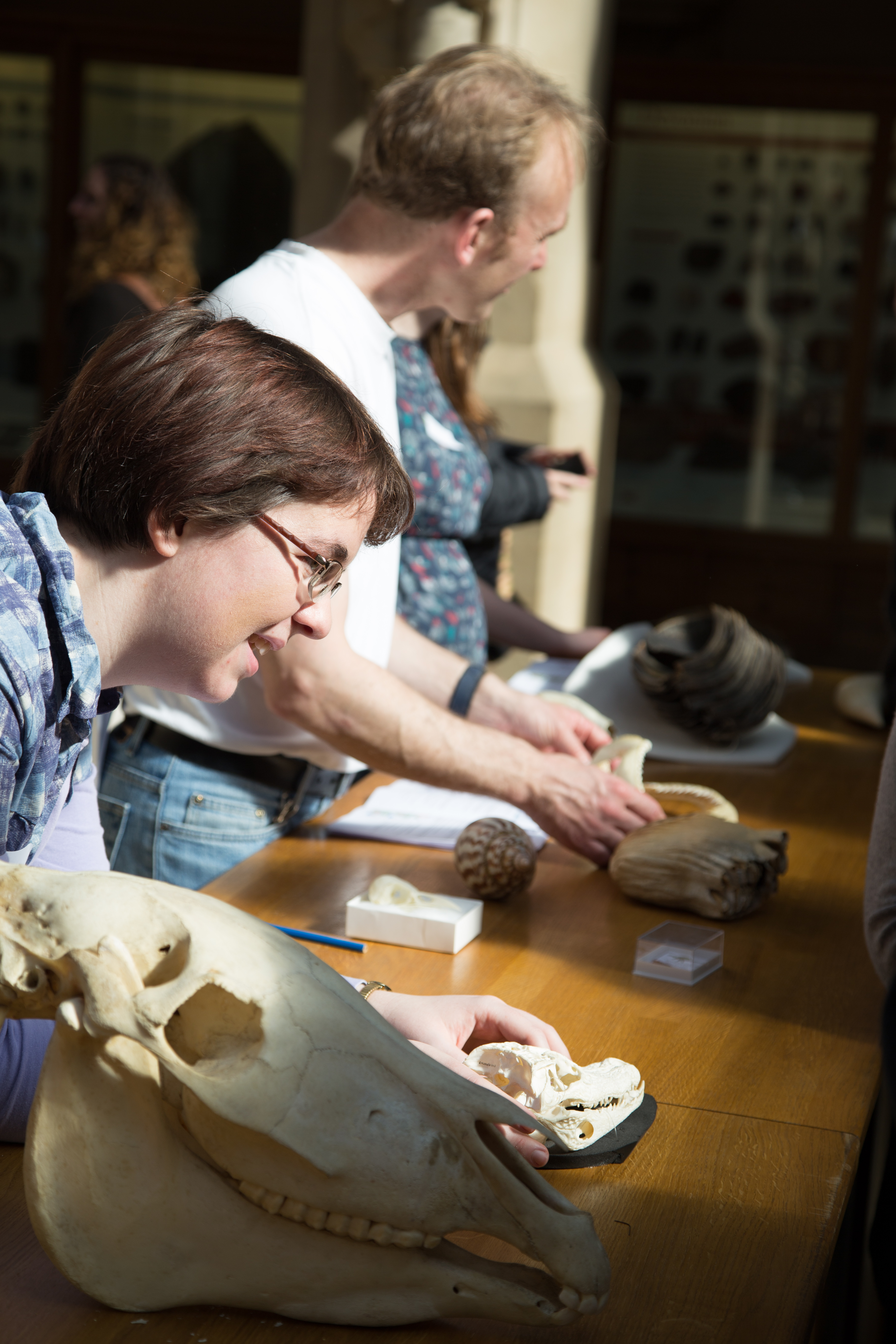
After we had rewarded our hard work with a much-needed tea break we began setting up our handling objects. We took lots of beautiful masks, quite fitting for the theme ‘the many faces of Oxford.’ We also took a horse skull, a cast of a velociraptor skull, and some fossilised dinosaur poo. The last of which created some very funny reactions when the person holding it found out what it was.
The make and take activity we chose to run was mask-making, which is always a hit with the children (and some grown-ups too!) There was shiny paper, glitter and sequins everywhere, and we mean everywhere, and a fun time was had by all.
Our activity proved very popular and we counted 220 children who left for home as Egyptian pharaohs, samurai warriors or fierce dinosaurs. What’s more, the sun stayed shining for the whole day, despite the forecasts predicting otherwise, and we even got time to catch some of the procession. Definitely a good day!
They sort, they scan, they stick, they smile: who are they? Our team of brilliant Collections and Public Engagement Volunteers of course! This week has been the 30th anniversary of Volunteers’ Week, so we wanted to put the spotlight on them…
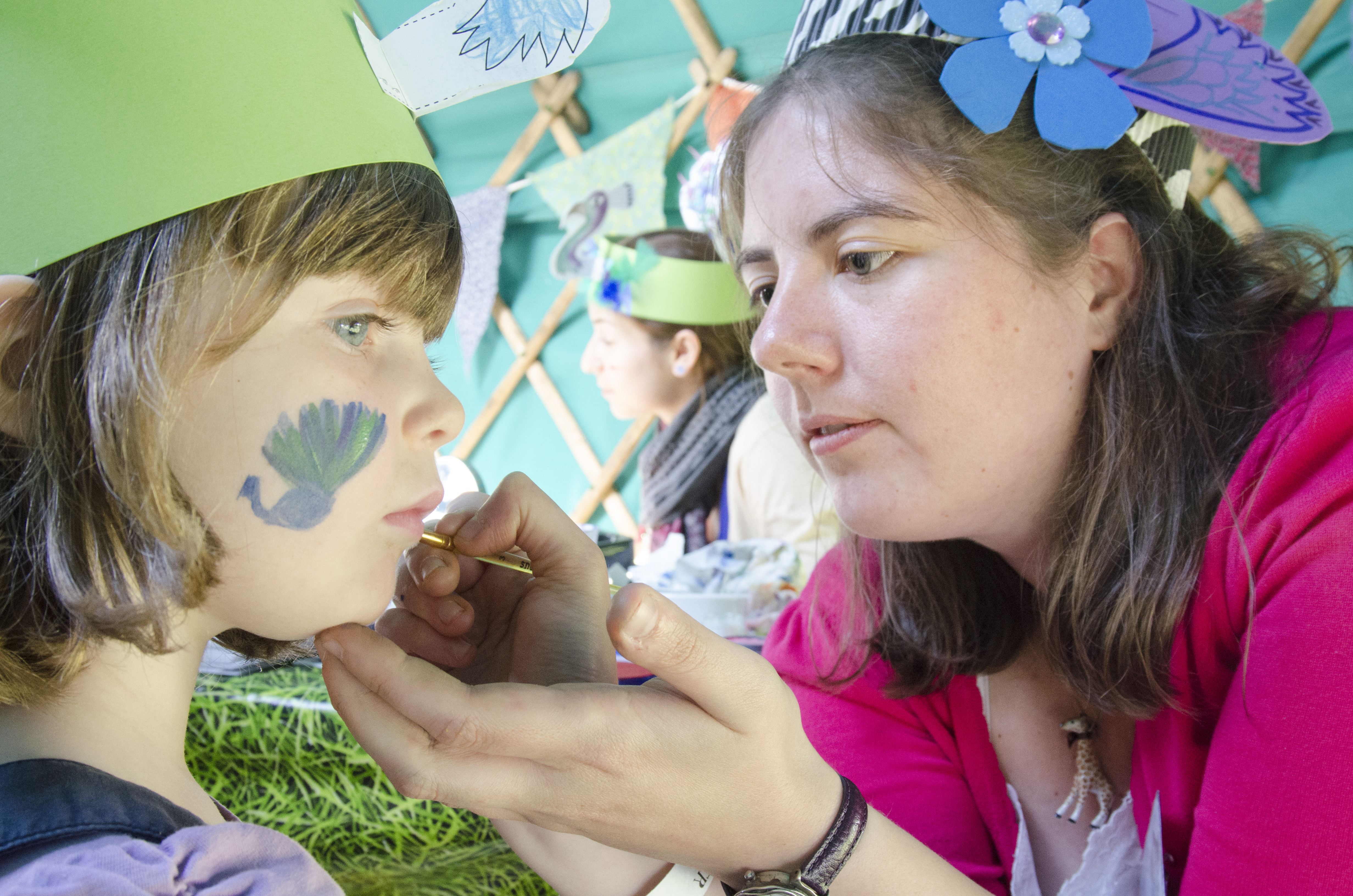
The majority of our volunteers help with public events, particularly those for our family audience. In 2014 alone, our awesome team of volunteers have given the Museum over 1500 hours of their time to help with public engagement events. This includes painting children’s faces, like the wonderful Alice Wilby (above), leading tours of the Museum’s architecture and running a pub quiz at one of our late night events.
On top of that, we have a team working away behind the scenes supporting our collections staff. Here’s just a sample of the projects they’ve been working on this week…
Laura Cotton in the Earth Collections.
– 5 volunteers identifying butterflies from painted images in our Archival Collections.
– 1 volunteer working in the Life Collections sorting and cataloguing bones.
– 4 volunteers tucked away in the Earth Collections cleaning ancient horse fossils or sorting Jurassic fish teeth.
Simone Dogherty is the Museum’s Education Assistant and co-ordinator of Science Saturdays – a weekly family event aimed at older children and led entirely by volunteer scientists. So why does she think volunteers are so valuable?
We’re very lucky here to have such a large quantity and high quality of volunteers. They help us with a huge range of activities and with the increase in visitor numbers that the Museum has been experiencing since re-opening in February, I just don’t know how we’d cope without them.
For Science Saturdays we use volunteers with a specific expertise. This gives children access to enthusiastic and inspiring individuals that they can look up to. And, in return, the volunteers gain valuable science communication skills.
Fancy joining our merry band of volunteers? Whether you’re into making masks or dusting off molluscs, we need you! You can simply sign up to help out on our Volunteers website.
But what’s in it for you? Aside from the glow of knowing you’ve simply helped us do more, you can develop your confidence when working with the public, learn a new skill or get up close with the treasures stashed away behind the scenes. But that’s forgetting the most important part – you’d be joining a fantastic team of people who, like you, think this museum is a pretty exciting place to be!
Our lunar visitor with presenter, Maggie (l), and guest, Sarah (r)
We’ve had a visitor all the way from the Moon! Dr Sarah Russell from the Natural History Museum brought a slice of lunar meteorite with her when she came to be a guest on the BBC’s The Sky at Night television programme. A whole episode was filmed here in the Museum last week.
Meteorites are rocks from space that have fallen to Earth and, in fact, it was a meteorite hitting the Earth that created the Moon!
Chris holds a piece of the Chandakapur; Maggie holds a slice of the Gibeon meteorite
In the programme, presenters Dr Maggie Aderin-Pocock and Dr Chris Lintott will be showing some of the meteorites in our collection.
One of these arrived at Amalia Farm in Gibeon, Namibia, in 1836, and the other landed at Chandakapur, India, in 1838. Both had travelled from the asteroid belt, a band of planetary debris orbiting between Mars and Jupiter.
We now believe that the dinosaurs became extinct after a massive meteorite collided with the Earth. It brought with it a lot more of the element iridium than would naturally occur on Earth. You’ll be able to see our sample of the iridium-rich clay rock that formed at the bottom of the sea, hundreds of miles away from the giant impact crater.
Chris holds a piece of the special iridium-rich clay that gave scientists an important clue to the extinction of the dinosaursFilming behind the scenes in the Museum
This episode of The Sky at Night has a lot about impacts – not just meteorite landings. It will be screened on BBC4 at 10pm on Sunday 8 June, and repeated on Thursday 12 June at 7.30pm. Don’t miss it!


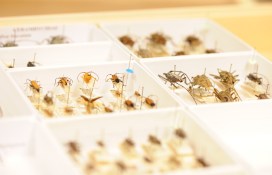

 Not many people know that the Oxford University Museum of Natural History doesn’t just consist of the specimens on display – it also houses the Hope Entomological Collection: the second largest entomological collection in the UK. The space contains thousands of incredible pinned specimens as well as some live ones too (Geraldine the stick insect on the right). Entomology is the study of insects, and so the department is responsible for the curation of thousands of invertebrate specimens collected over hundreds of years by biologists such as Darwin and Wallace. We have all sorts in the collection – from beetles and flies (Coleoptera and Diptera) to bees and ants (Hymenoptera).
 often their own speciality. Not only are the permanent staff experts, but the…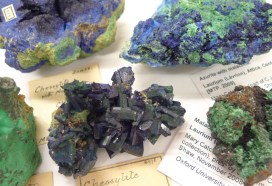
 “In prehistoric times, tools for the preparation of pigments were cruder, and so archaeological samples of pigment tend to have more of other minerals contaminating them. For instance, we see a higher proportion of quartz in a cinnabar sample, or iron minerals in an azurite or malachite sample. In my project, I will be able to see this using a microscope, looking at particles at high magnifications, and analyse the minerals using techniques such as X-ray diffraction or scanning electron microscopy.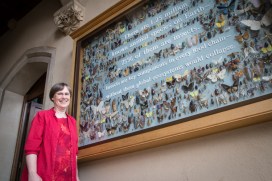

 On 22nd July 1991, Kristin walked through the doors of the Museum and into her new job as assistant to the administrator.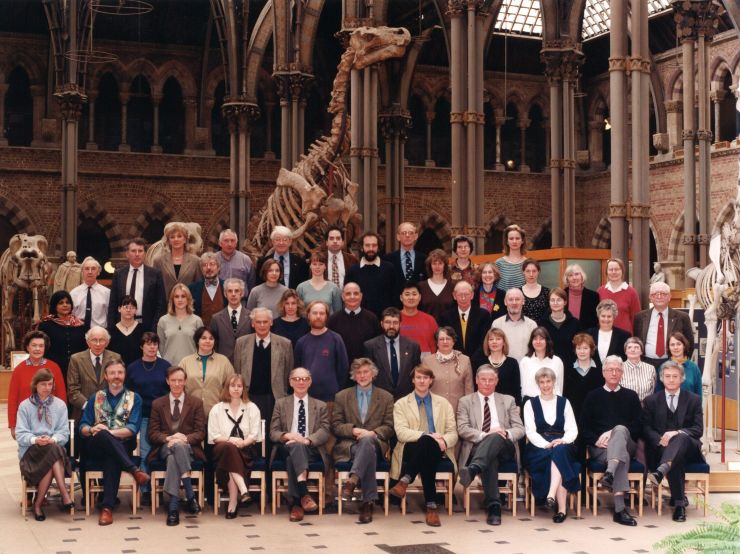




 The make and take activity we chose to run was mask-making, which is always a hit with the children (and some grown-ups too!) There was shiny paper, glitter and sequins everywhere, and we mean everywhere, and a fun time was had by all.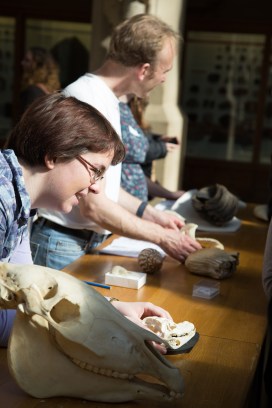


 More Than A Dodo