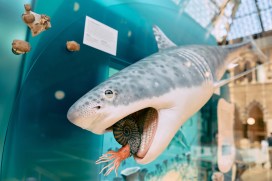
A shark’s tale

Following the completion of our Life, As We Know It redisplay project earlier this year, we are taking a look at some of the exceptionally skilled people who helped to bring it all together. In this article, model maker Jeremy Hunt and our Vertebrate Palaeontology Collections Manager Emma Nicholls take a deep dive into what we believe is the world’s first 3D reconstruction of the extinct shark Ptychodus as an open water predator…

In six of our newest displays, fossil material found in and around Oxfordshire is used to reconstruct ecosystems from slices of geological time. One of these recreates a marine environment of the Cretaceous Period, between 94 and 84 million years ago, when most of northern Europe was submerged under a warm shallow sea. In these seas swam a formidable 8-metre long shark called Ptychodus.

Until recently, Ptychodus remained something of a mystery: teeth and vertebrae were the only remains scientists could use to work out what it looked like. Its robust, low-domed teeth are covered in deep ridges of enamel that created a mosaic in each jaw. They were capable of crushing shelled prey like a giant nutcracker. Similar teeth in modern sharks are found only in slow-moving species that prowl the seabed, so it was presumed that Ptychodus behaved in the same way.
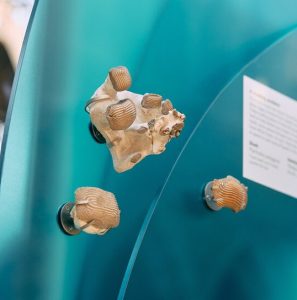
Fossils of Ptychodus teeth in the new display

But then in 2024 an incredible fossil with much of the animal’s soft tissue preserved was published by Dr Romain Vullo and co-authors. This new fossil revealed clues to the shapes of the fins and their position on the body. The study concluded that Ptychodus was in fact not a bottom-dwelling animal at all, but much more likely to be a fast, agile predator living higher in the water column, and perhaps related to the Great White Shark.

Armed with this recent discovery, we decided to create a three-dimensional model of the reimagined Ptychodus for our Cretaceous display. It had to be a quarter of life-size to fit it in the showcase, but would still be a huge two metres long.
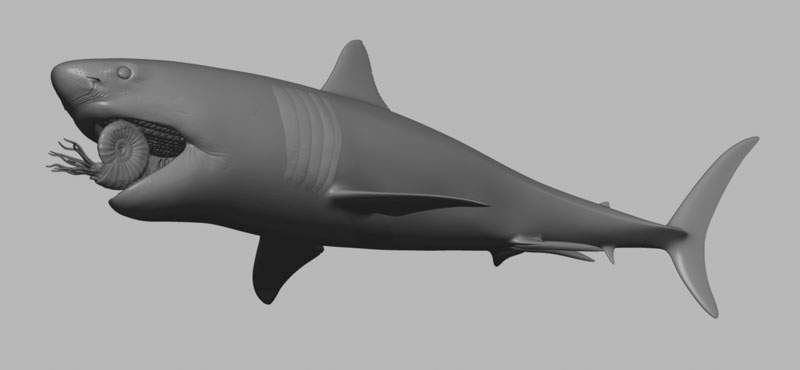
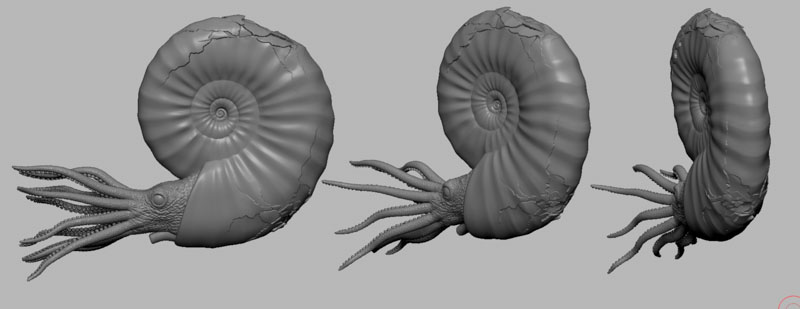
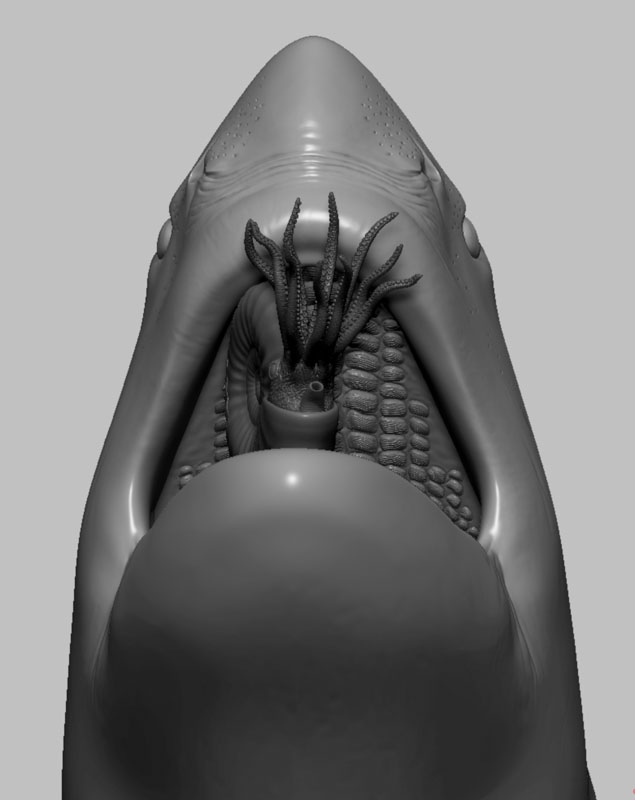
Digital 3D model of a shark, shown in grey, without any skin colouring or texture. The mouth is open and inside is an ammonite being crushed by the shark's plate-like teeth.
An early computer model of the shark and ammonite

“In discussion with Dr Vullo and others we began to decipher the shark’s possible appearance,” says Emma.  “Aspects to sink our teeth into included the skull shape, how it would have fed on hard-shelled free-swimming prey such as ammonites, how the mosaic of teeth sat in the mouth, as well as where and what shape the fins would have been.”

The next stage was to turn these ideas into a realistic model, and for this we turned to specialist model maker Jeremy Hunt. “When I was asked to make the reconstruction of Ptychodus I thought it was a great opportunity to incorporate modern digital techniques and processes that would give great accuracy, but also and flexibility so that adjustments could be made at later stages. This would be really difficult using a traditional clay sculpting approach,” he explains.

Together, Emma and Jeremy began to translate the shark fossil research into draft models on the computer, digitally sculpting versions on-screen. As well as being scaled down to quarter size, the position and pose of the model also needed to work inside the showcase structure and the designs of the rest of the display. Combining computer models helped us to make sure that Ptychodus would fit perfectly and that its method of support could be worked out well ahead of installation.
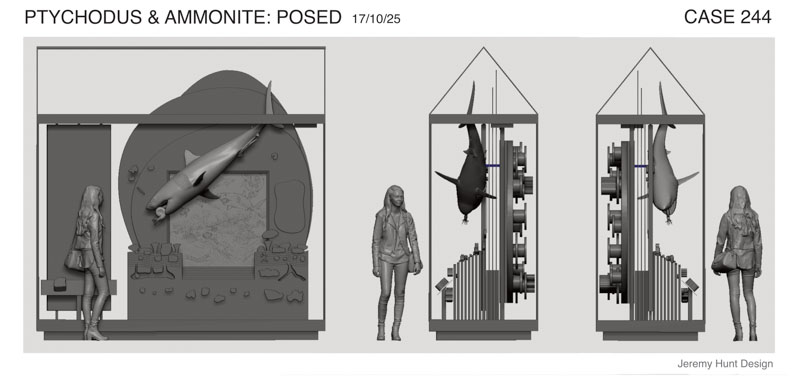
To give us a sense of how the final model would actually look, Jeremy 3D-printed little maquettes just a few centimetres long. On these we could check that the anatomy and pose were just what we needed. The maquettes also showed how the shark would be suspended in a diving angle, chomping down on an ammonite which Jeremy was modelling separately, in collaboration with Ricardo Pérez-de la Fuente, a researcher here at the Museum.
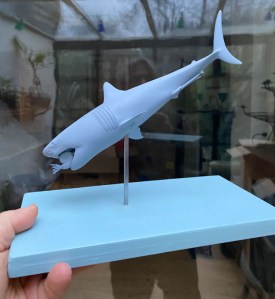
A hand holds out a wooden plinth, painted blue, onto which a 3D printed shark model is mounted on a vertical metal rod. The 3D print is also blue and is approximately 15cm  long.
3D-printed maquettes of the model helped us to check its form and pose

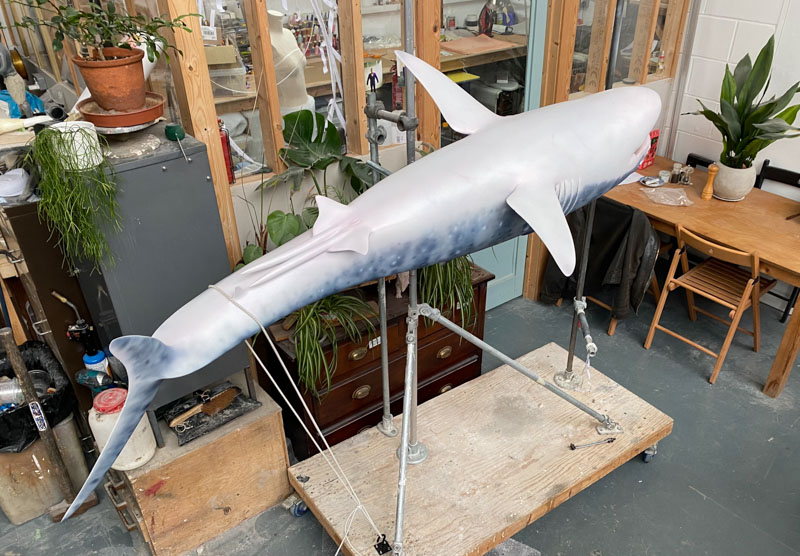
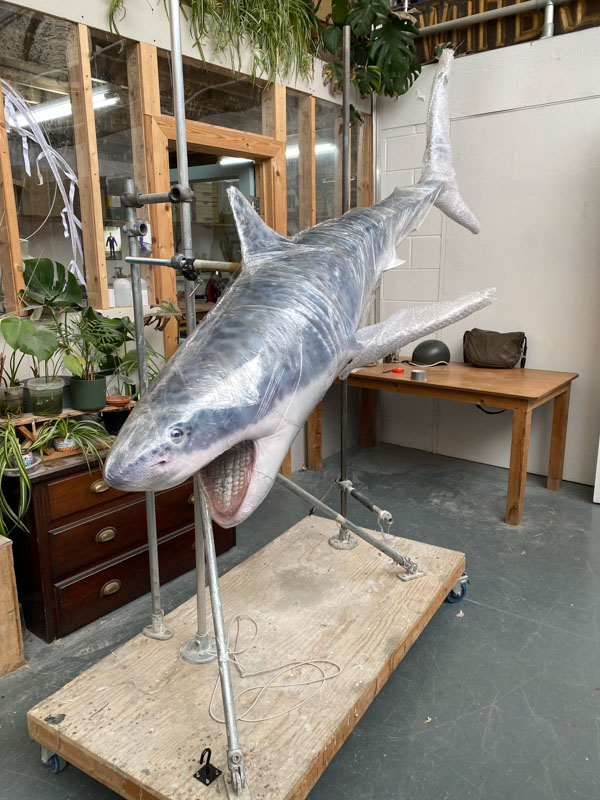
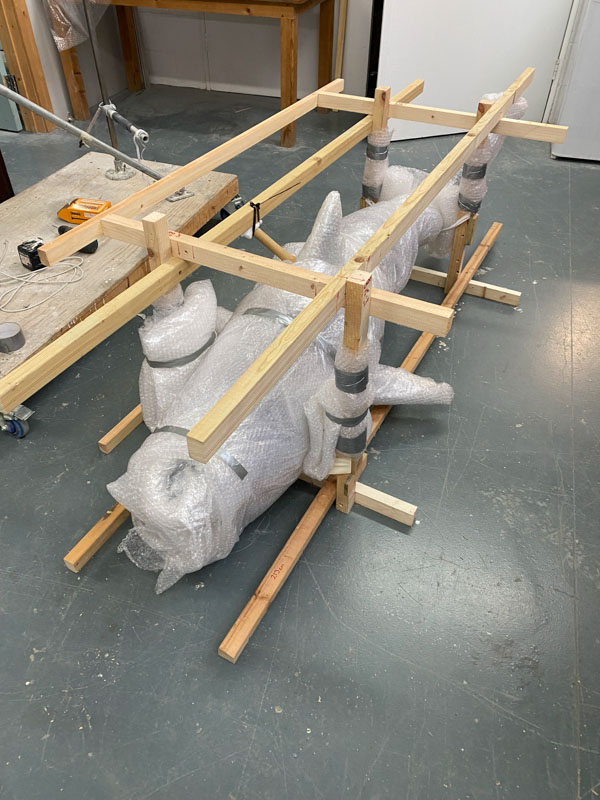
Once ready, the model was 3D-printed at its display size of two metres long, allowing Jeremy to create a silicone rubber mould to produce a fibreglass cast of the final structure. Fibreglass is both strong and light, perfect for the display. But the model really came to life when Jeremy hand-painted and airbrushed its colourings and markings based on a research by Emma and a concept drawing by palaeo-artist Julius Csotonyi.
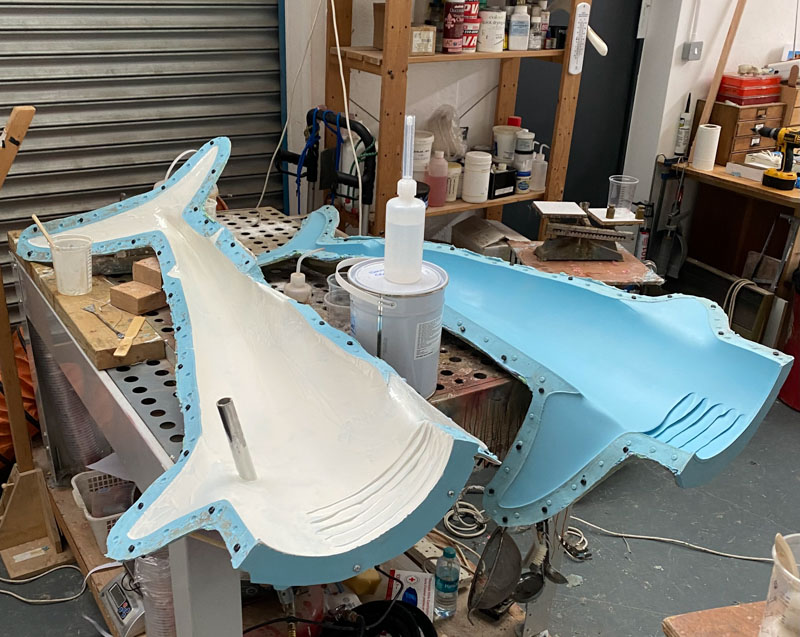
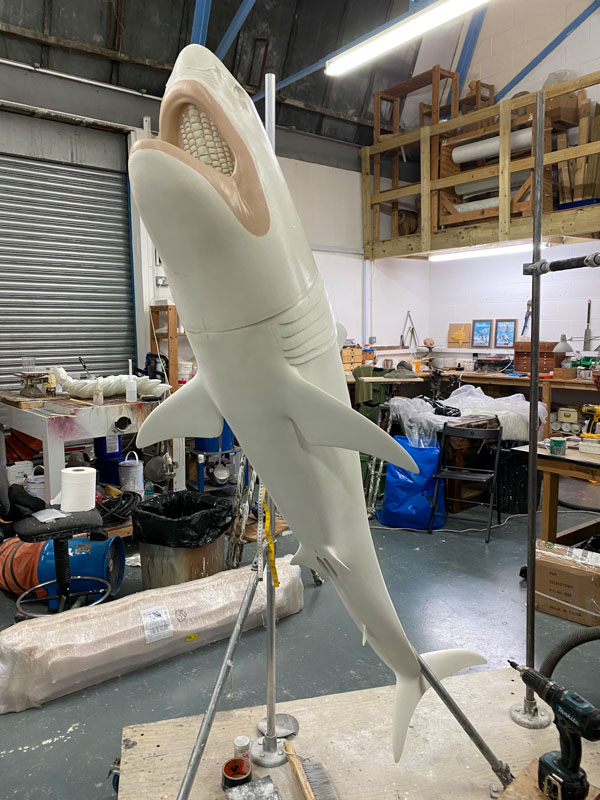
Once Ptychodus and the rest of the display were installed, the ammonite was placed in the mouth. It is held safely there by hidden strong magnets, caught permanently between those crushing plates, about to become shark food.
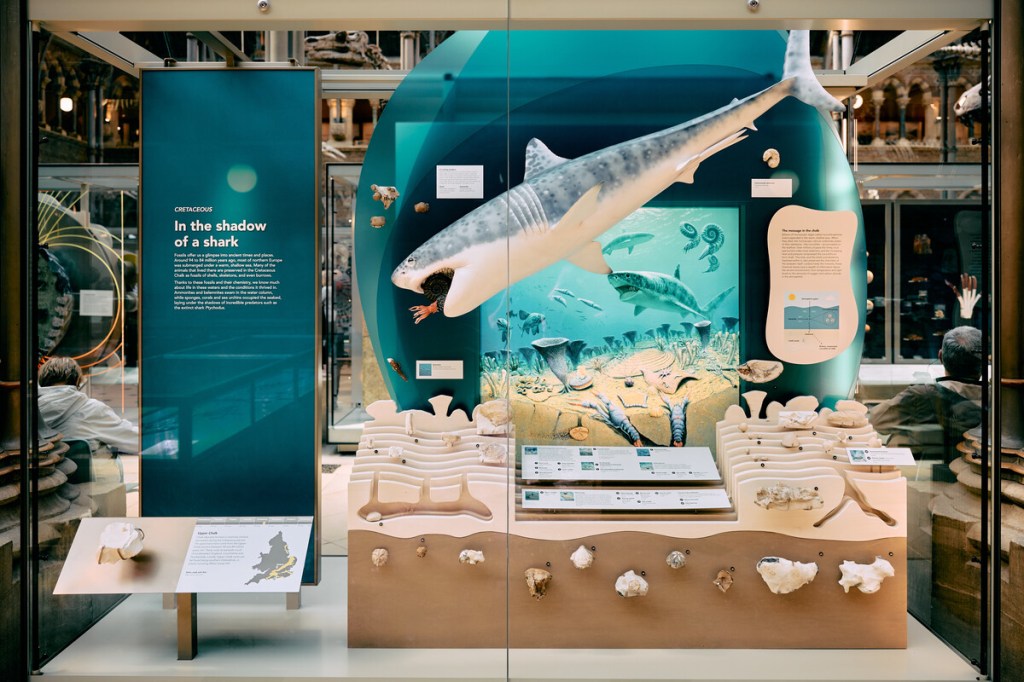
Museum exhibit showing a 2 metre long shark model against a backdrop artwork of an ocean containing drawings of other sharks, fish, ammonites and belemnites in the sea, along with corals, shellfish and lobsters on and burrowing into the seabed. Below this scene are a selection of chalk fossils. On the left the title panel is printed on blue acrylic and shows the display's name as 'In the shadow of a shark'.
The Ptychodus model in the final display at the Museum

“This was a great project to be involved with, and I hope the new displays will be enjoyed by all who visit the Museum,” says Jeremy.

Jeremy Hunt, model-maker

*

See more of Jeremy’s work at: www.instagram.com/memsculpt
From Fossil To Flesh: Reconstructing a Phascolotherium

Following the completion of our Life, As We Know It redisplay project earlier this year, we are taking a look at some of the exceptionally skilled people who helped to bring it all together. In this article, taxidermist Alexandra Rose Cherrett tells us about the ‘unusual proposal’ that she received one day…

I was sitting at my studio desk ready to start the day with some admin. I often receive emails enquiring about commissions ranging from peoples’ pets to wild animals that have been found by the public, asking for them to be preserved after death through taxidermy. At the top of my inbox was an email with an “unusual proposal” from the Museum of Natural History in Oxford.

As a taxidermist I have been lucky enough to work on a wide range of animals over my short career, from kingfishers to vultures, hedgehogs to lemurs and many more in-between. Safe to say I was not expecting the request to taxidermy an animal that hasn’t walked the earth for 165 million years.

I was then introduced to Phascolotherium; a small, furry mammal that lived in the Mid Jurassic alongside Megalosaurus, the first dinosaur ever named and discovered, right here in Oxford, UK. A proverbial stone’s throw from the museum itself.

Now, I have always been rather obsessed with dinosaurs. My obsession and adoration for dinosaurs and wildlife has been evenly matched for as long as I can remember. Suddenly I found my Jurassic Park dreams were coming to life. An impossible task? I thought, “Life, uh…finds a way”.

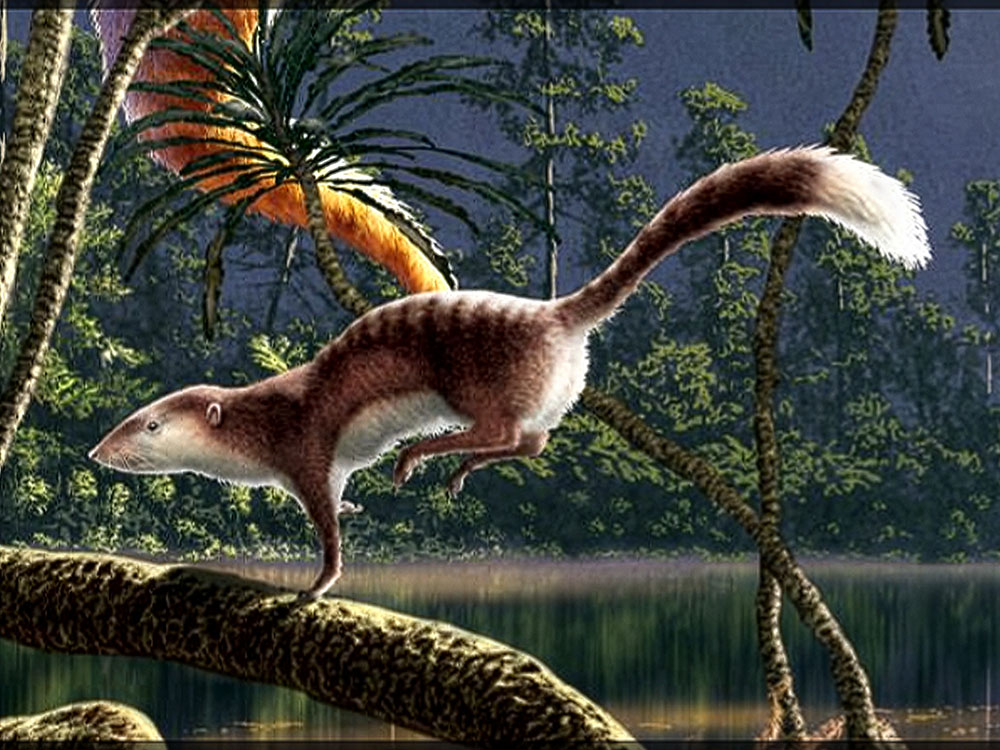
The first challenge was that only the jawbone and teeth of Phascolotherium had ever been discovered. I was given a reference image by Paleo artist, Julius Csotonyi, from which I primarily  worked.

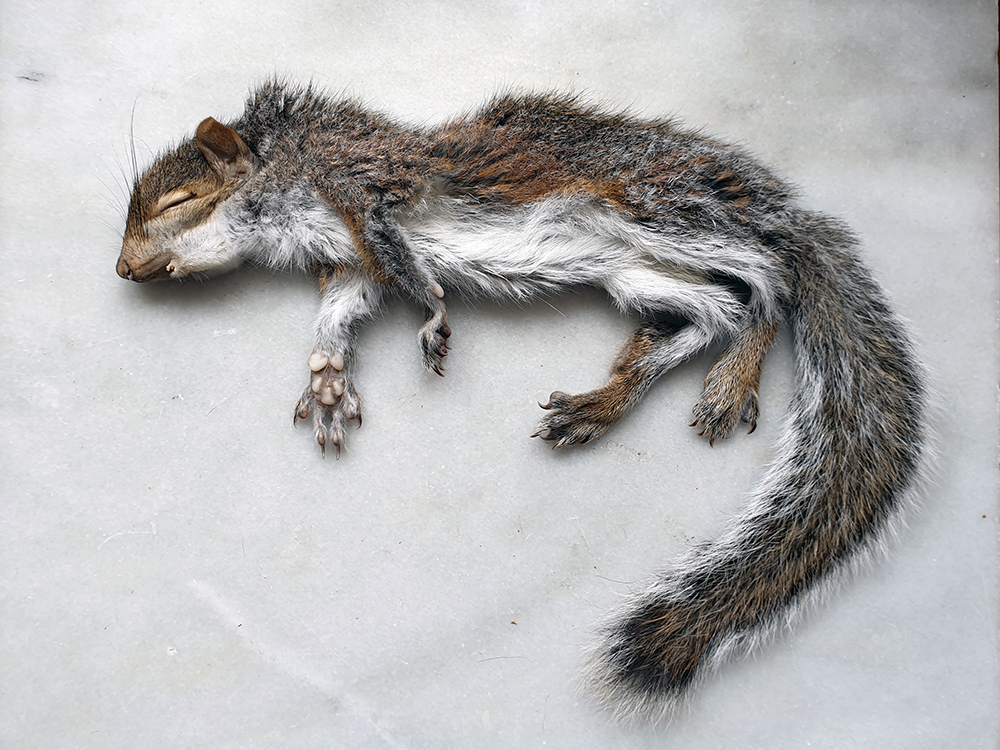
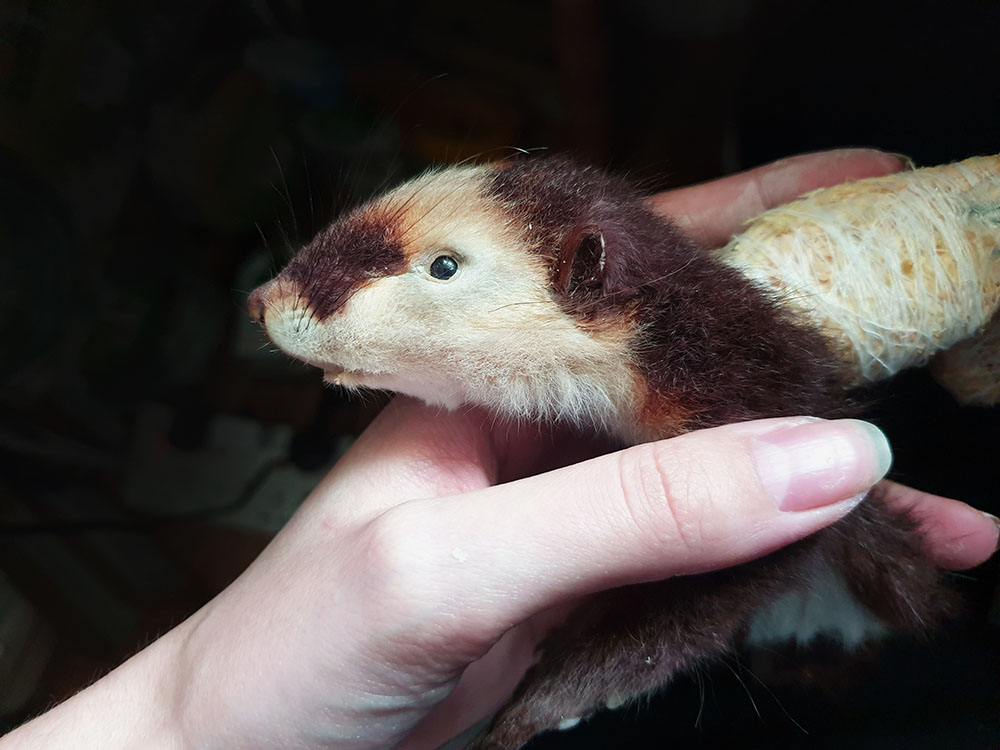
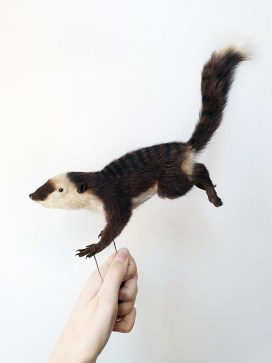
It was rodent-like in nature, with an elongated head, a lithe body and a long, plumed tail. My first thought was to use a squirrel as the base as the limb structure and body shape were so similar. I knew I had a pair of juvenile grey squirrels in my freezer that could be the perfect size, one was donated as a cat kill and the other perished at a wildlife rescue.

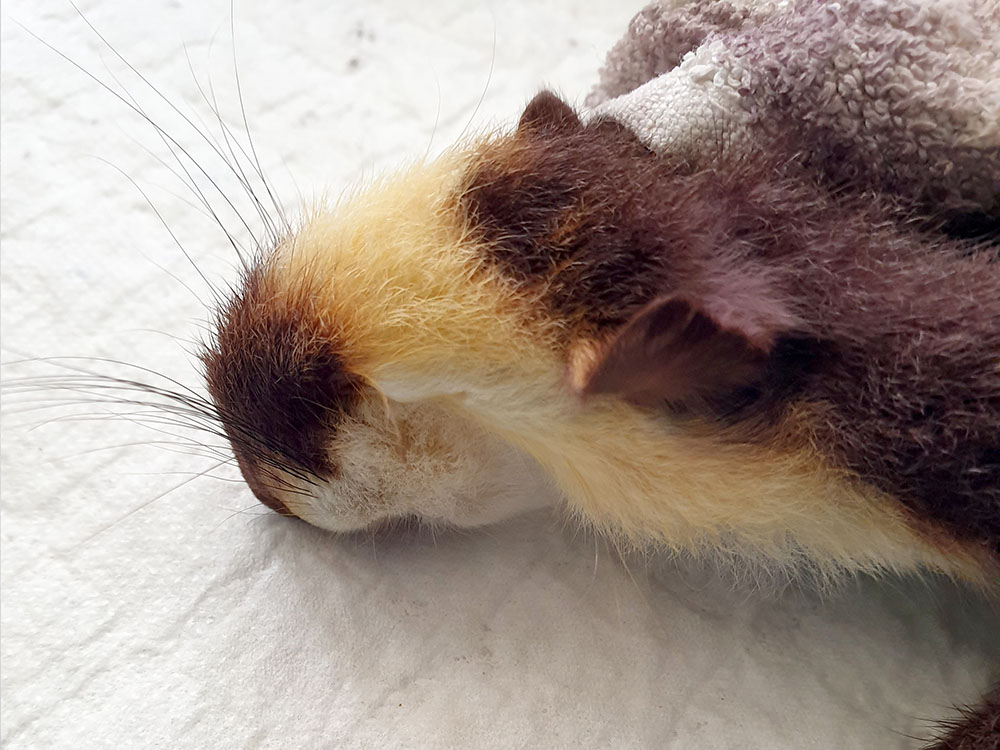
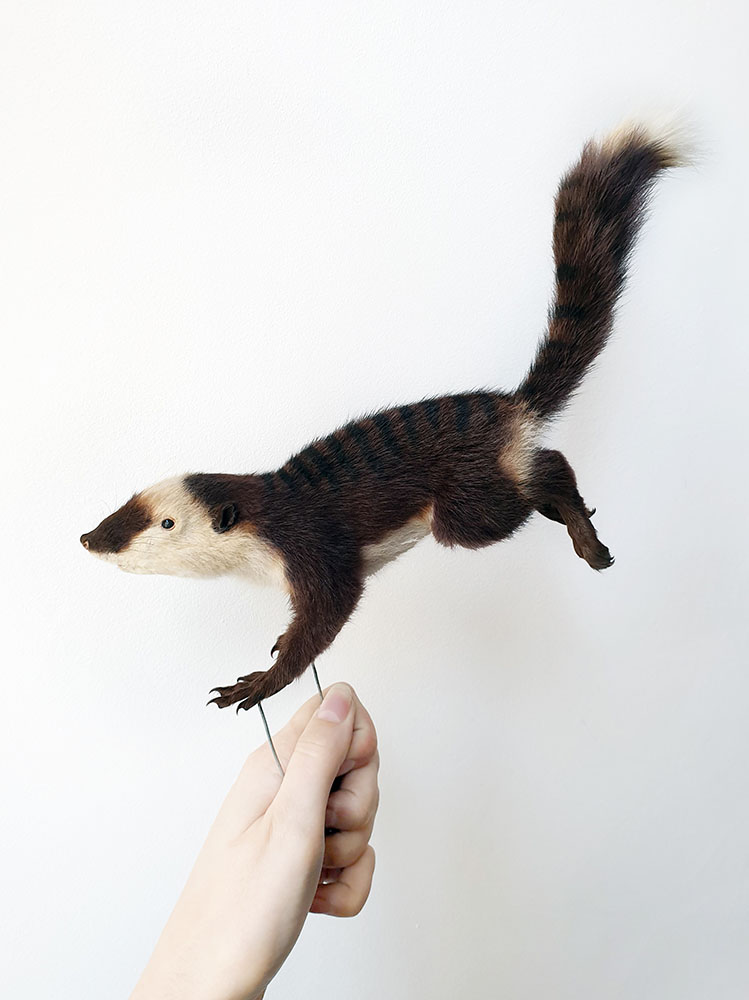
The most obvious visual changes were the colouration. The artworks showed a body of a dark reddish hue, with patches of white on the face, stomach and tip of the tail and stripes stemming down the spine. My next step of course, was Boots. A few boxes of Garnier hair dyes and peroxide bleach later and I had a completely different animal skin laid out on my desk.

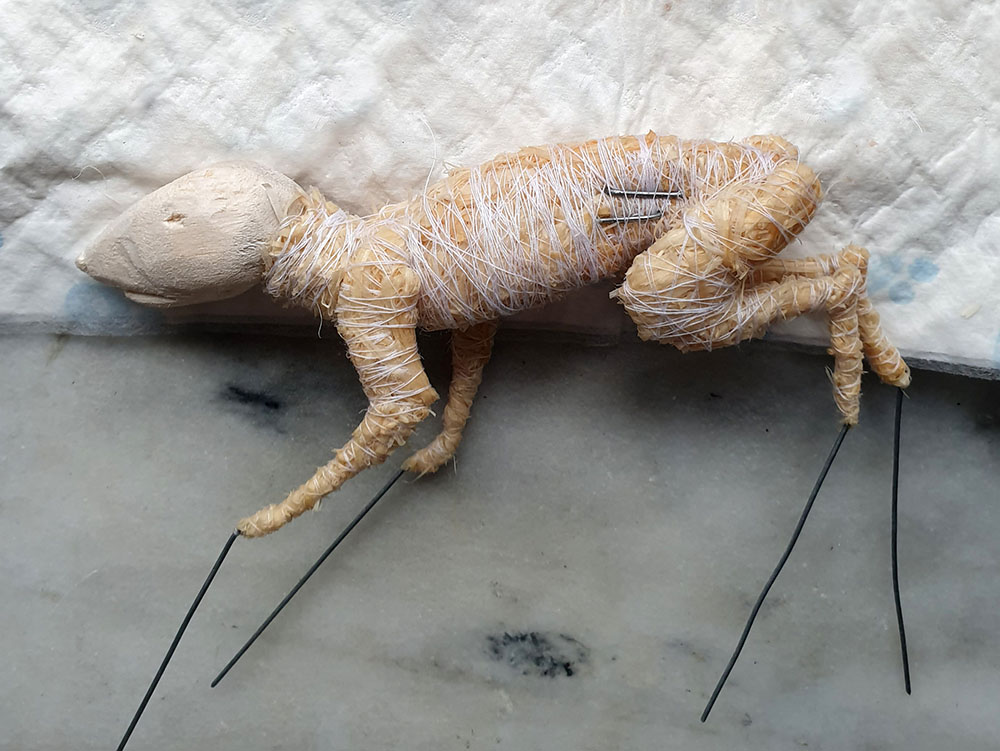
My next process was to create the body form over which the skin would be fitted. For mammal taxidermy, I usually carve or cast a head out of balsa wood or PU foam and make a bind up copy of the body and limb shape from woodwool.

With the head essentially being a non-existent shape, I copied the paleo-art and carved a small balsa block to a similar shape as a large shrew. The body was very similar to the young squirrel already so that was a simple workaround.

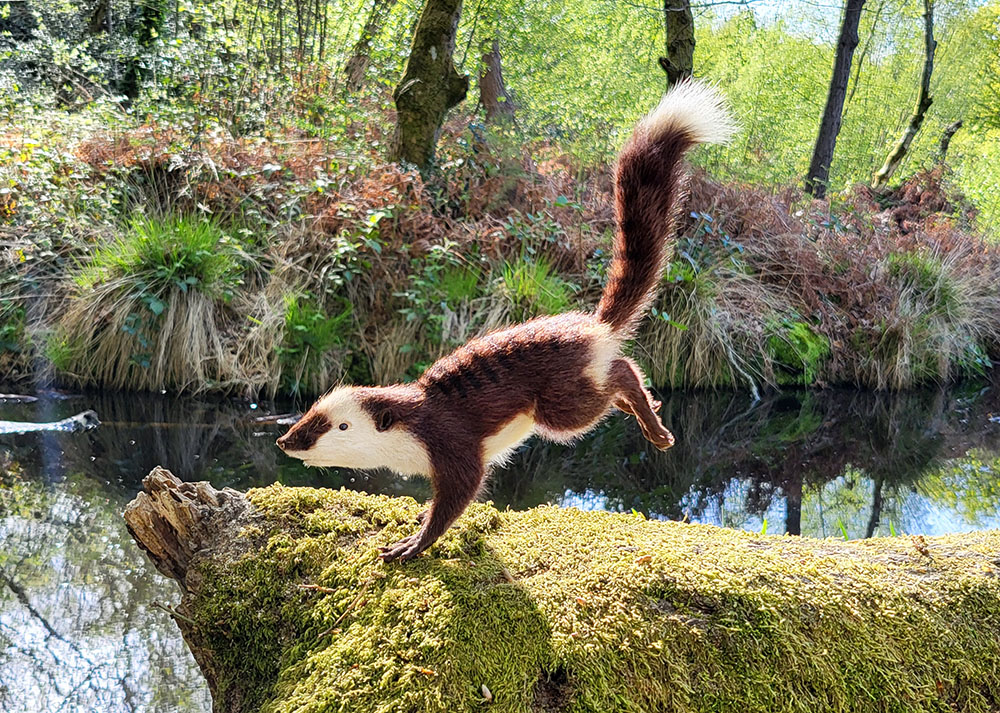
With the nature of its surroundings and the looming Megalosaurus, I imagined this creature was indeed, always on the run. So, an action pose was created, mid run, which highlighted its slight build and balancing tail very nicely.

When dressing the skin, the biggest alteration was the eye and ear placement. The young squirrel had eyes around 8mm, whereas Phascolotherium measured in at 4mm. Not to mention they were set further back and lower, as were the ears at two thirds their original size and shape. I made an incision across the eyelid and manipulated the skin to fit its new size and position, copying the same methodology for the ears. Almost instantly, a face that hadn’t been seen for 165 million years was right there looking back at me.

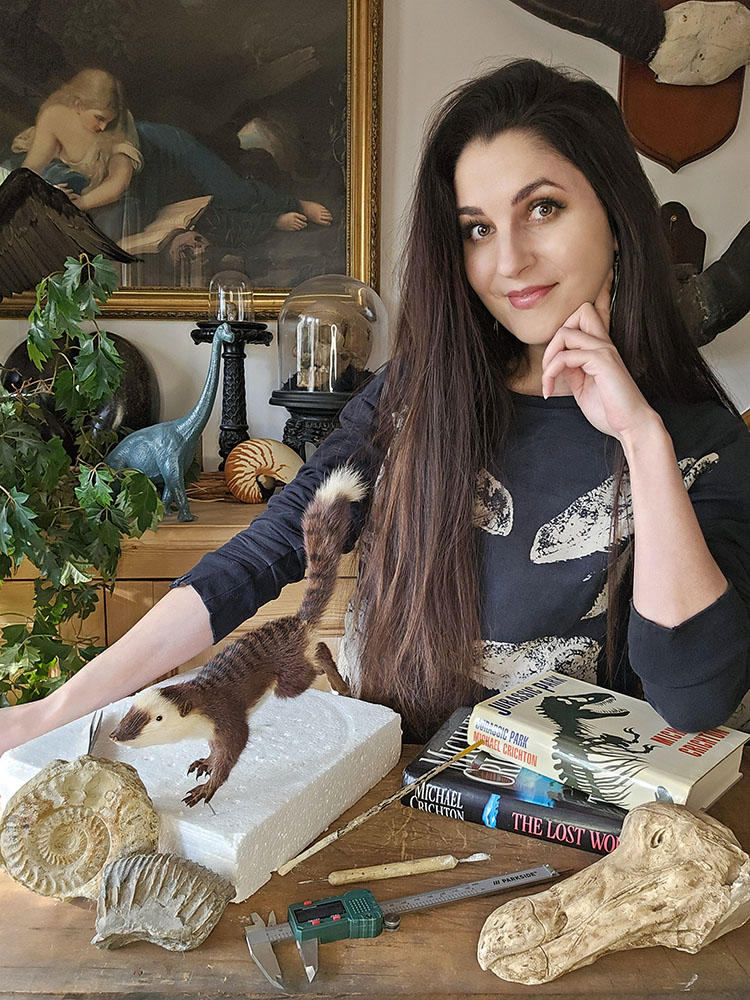
Me with the completed Phascolotherium

I have been fortunate enough to work with the Museum of Natural History on a few projects now and it’s safe to say this project has been one of my biggest challenges and greatest pleasures to date.

www.alexandrarosetaxidermy.co.uk

Instagram: @alexandrarosetaxidermy

Facebook: @alexandrarosetaxidermy

A Botanical Journey In Time

Following the completion of our Life, As We Know It redisplay project earlier this year, we are taking a look at some of the exceptionally skilled people who helped to bring it all together. In this article, model maker Inese Veismane recalls some of the weird and wonderful extinct plants that we needed for our new displays…

I remember the exact moment I saw the message from the Museum of Natural History. I had just returned home from a trip, switched my phone back on after the flight, and there it was – waiting for me to jump into the unknown. It came at a time when my personal life was shifting in a difficult direction, and in an unexpected way, this project became something that held me steady.

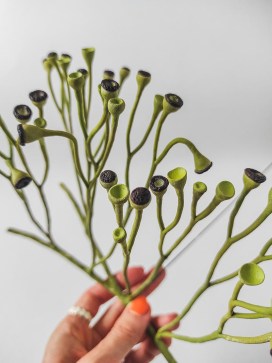
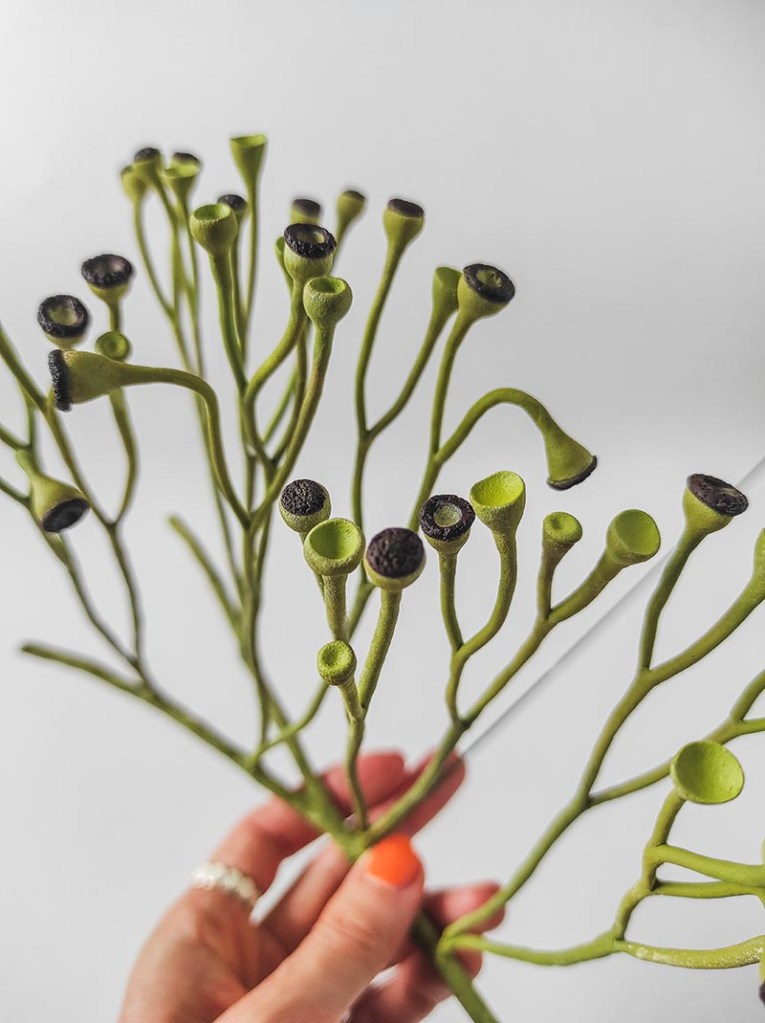
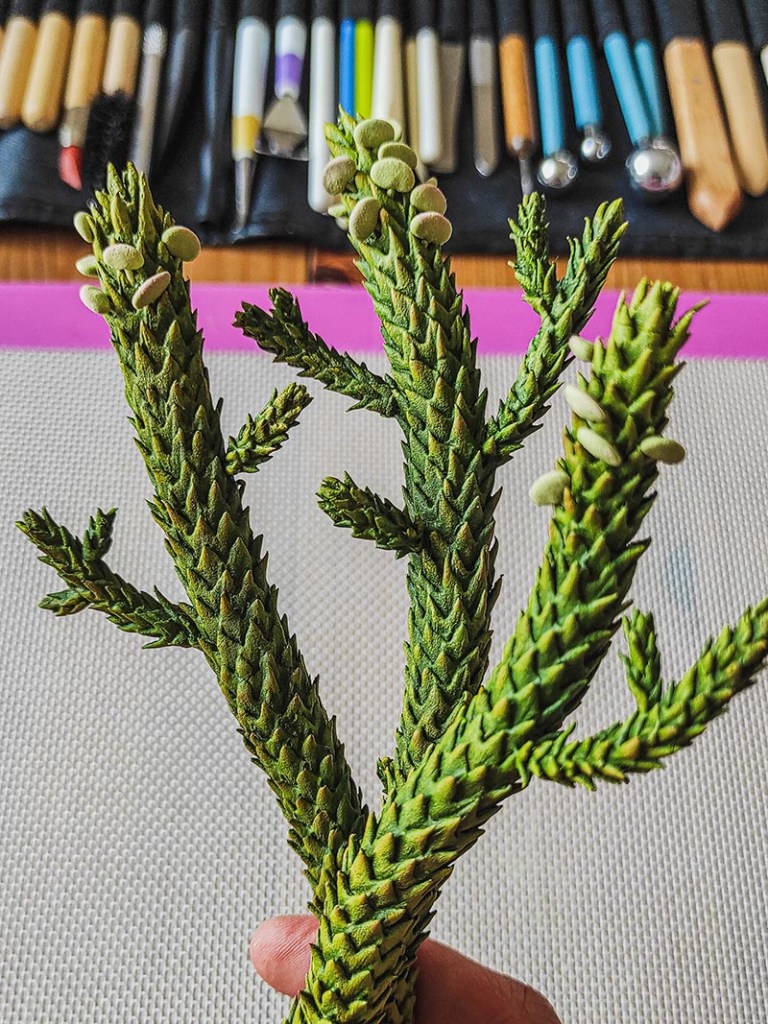
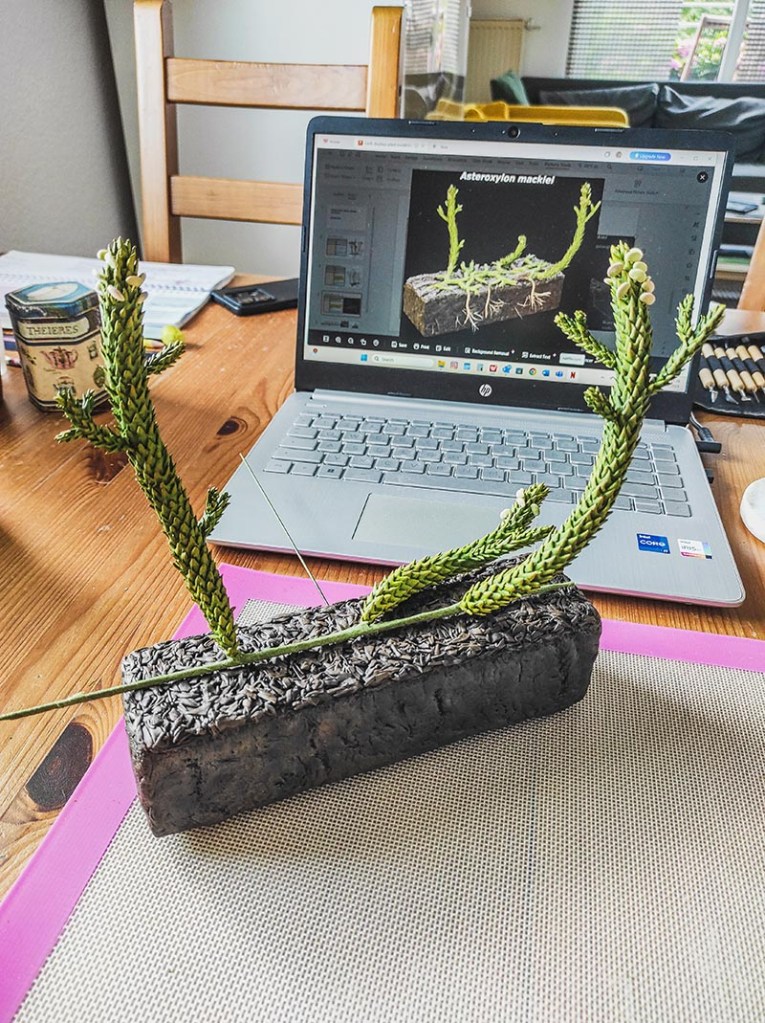
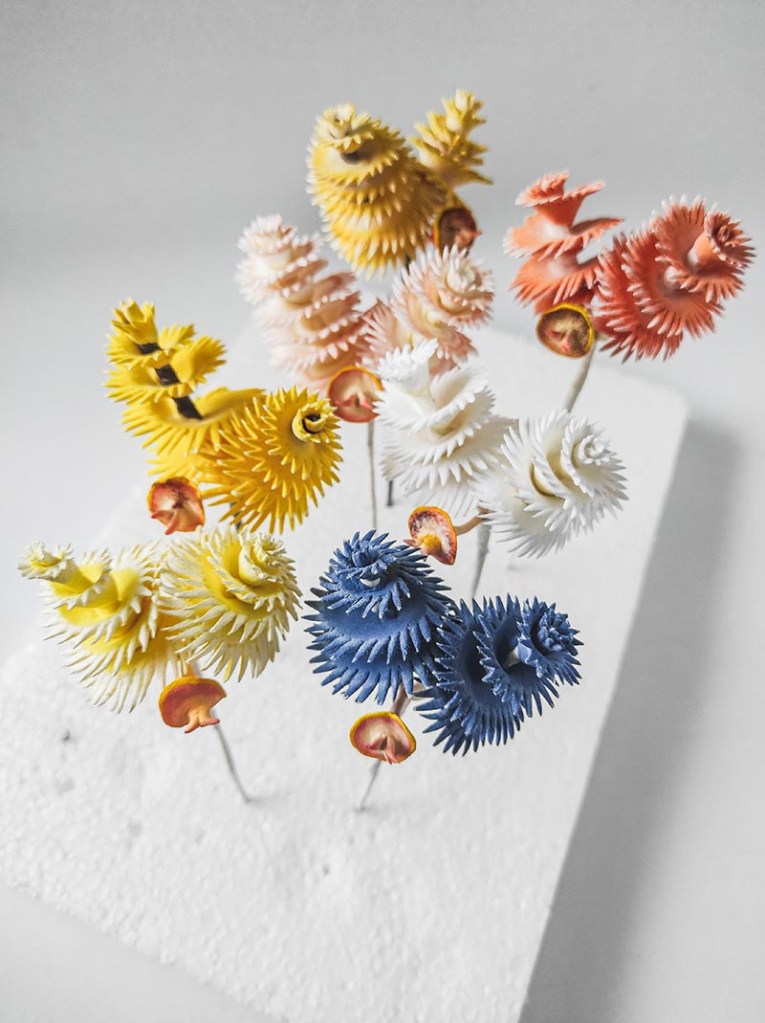
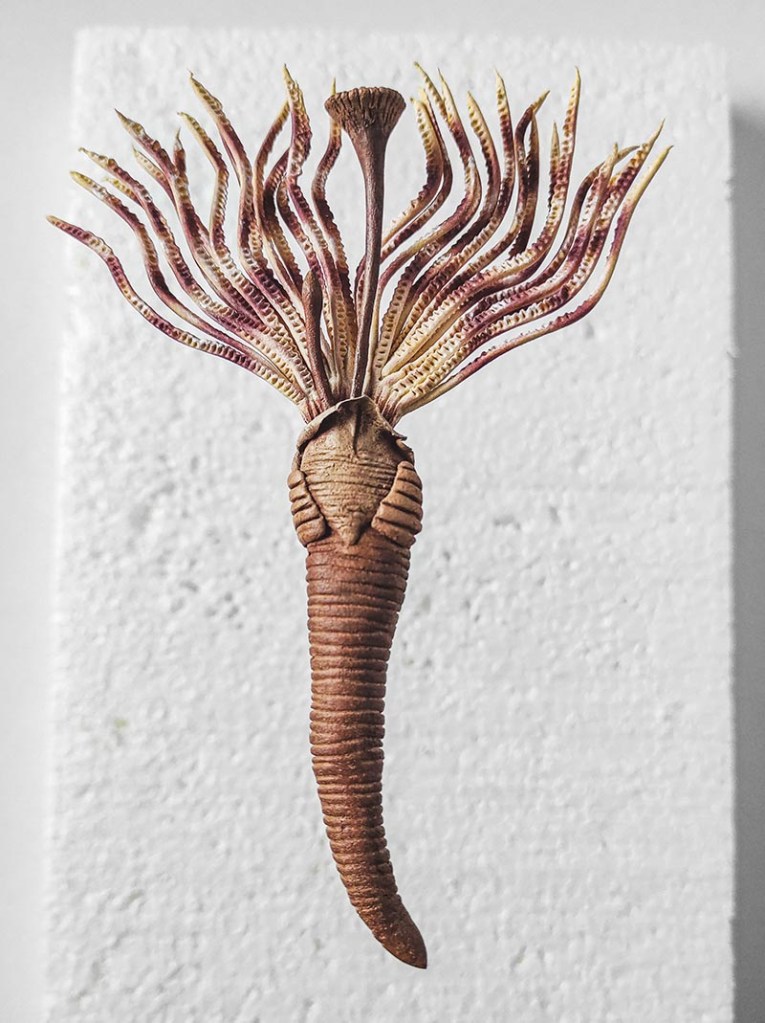
My work usually lives in the botanical world – delicate flowers, soft forms and colours, artsy details ­– so stepping into a space shaped by scientific accuracy and unfamiliar subjects felt like entering a new landscape. This time, I was asked to create not only plants but organisms like worms, including the intricate and challenging Christmas tree worms.

The commission began in 2023, and from the very start, it was clear that this would be a different kind of creative process. Instead of observing a living plant or working from my own references, I was guided by scientific material provided by the museum. There was a responsibility to honour not just the visual beauty of each subject but also its structure, proportions, dimensions, and defining characteristics.

I work with air-dry clay, building each form slowly by hand. My process is intuitive but also very attentive – I spend time studying botanical forms and shapes and then transforming that into something tangible. With these models, I had to balance that intuitive, artistic approach with careful observation. It became a dialogue between art and science.

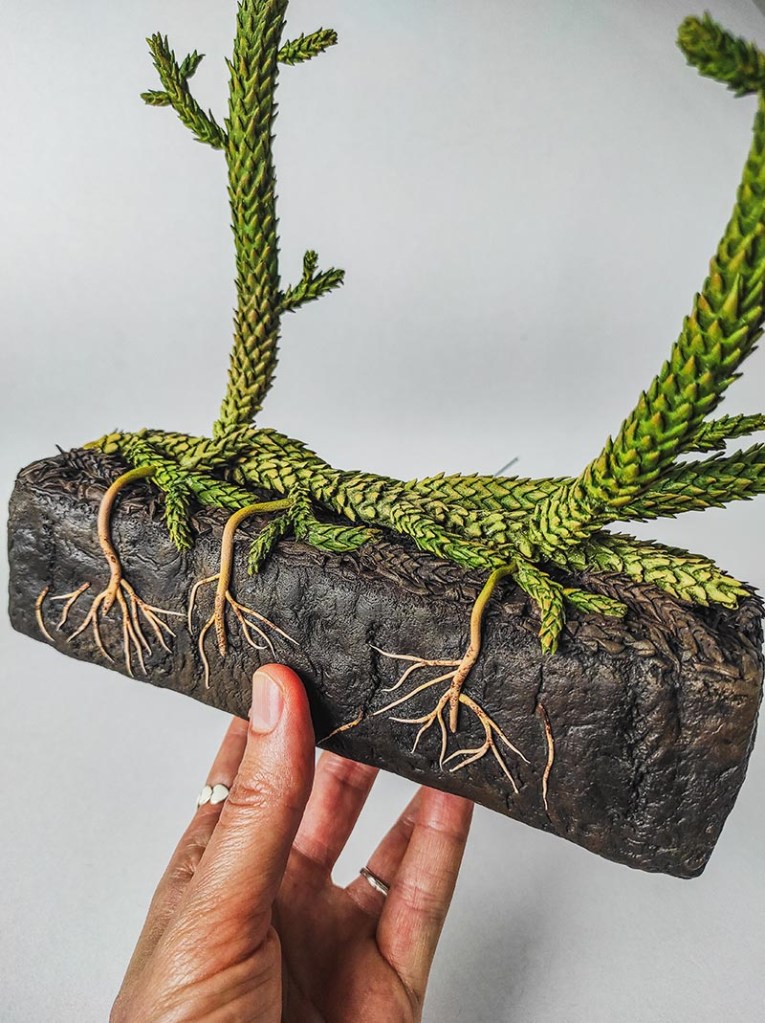
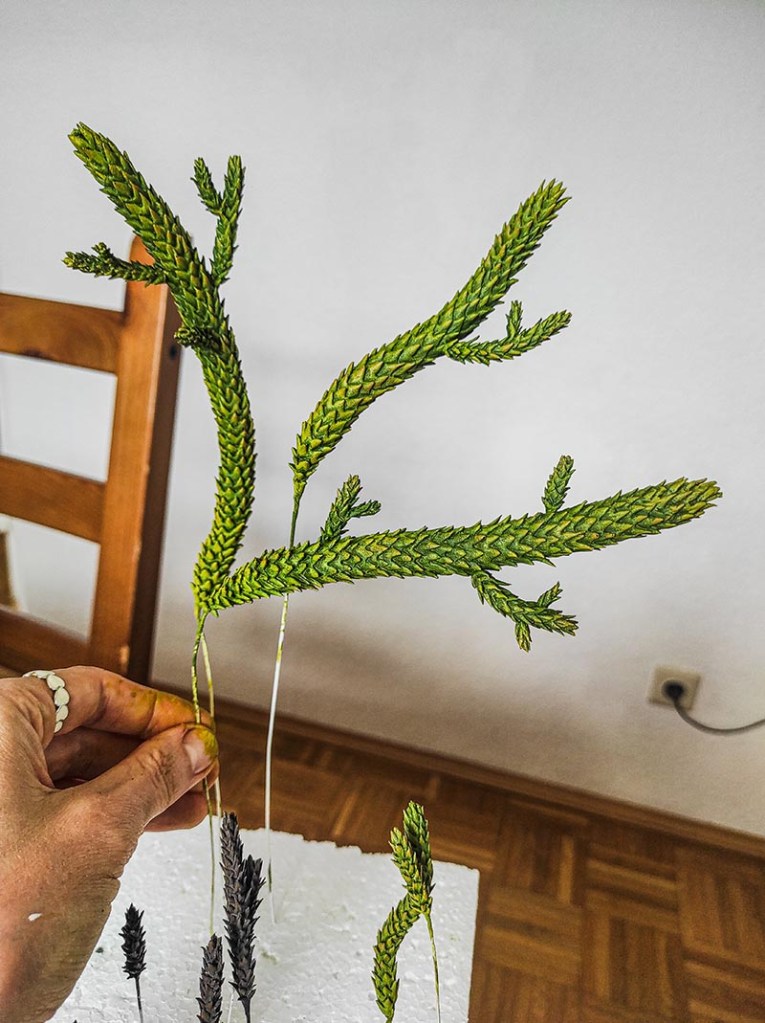
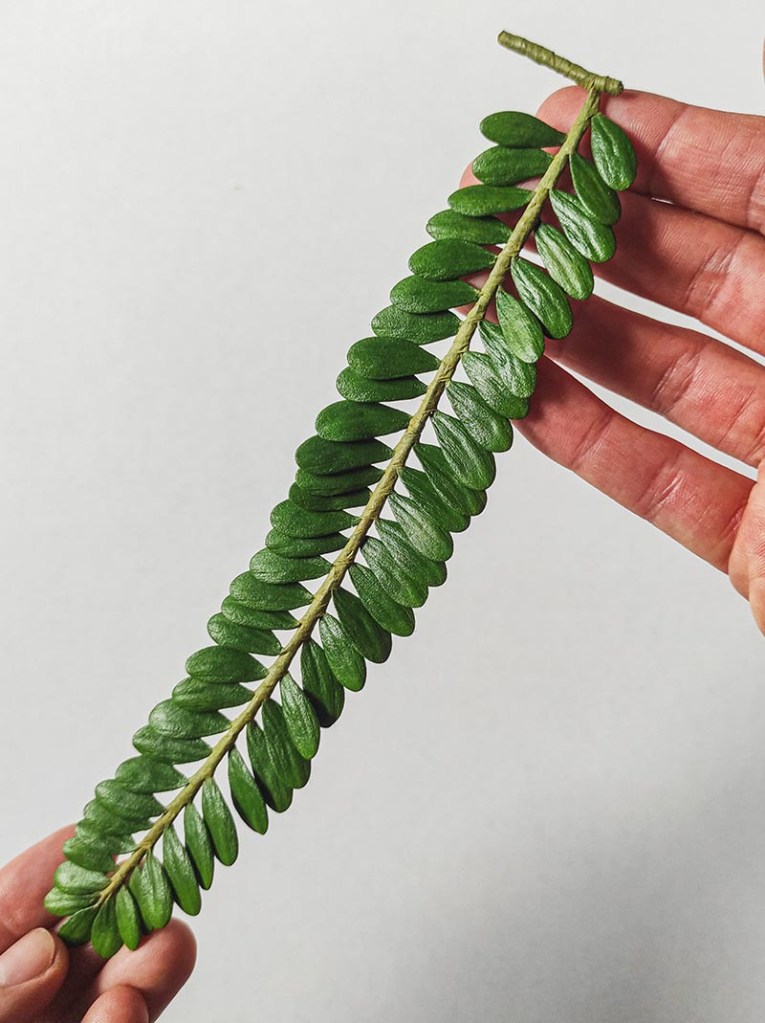
Working on the early plants became one of the most interesting parts of the project. Recreating species like Asteroxylon mackiei, Rhynia, and Cooksonia felt like reaching into a distant past. These are plants that no longer exist, known only through scientific study and careful reconstruction. There was something deeply humbling in shaping them by hand – giving form to something that once lived hundreds of millions of years ago. It felt like a journey back in time. I had to rely entirely on references and guidance while still allowing the forms to come alive through my own interpretation.

One of the most meaningful parts of this creative process has been witnessing the transformation of each piece – from a simple beginning to something that holds presence and detail. I also find importance in sharing these stages on my social media. It creates a sense of continuity – an archive of the work that can be returned to over time.

Looking back, this experience has expanded the way I see my work. It reminded me that even when we step outside of what feels familiar, the essence of creating remains the same: to pay attention, to be patient, and to trust that something will slowly take shape.

There is also something special in knowing that these handmade models will live within the Museum and become a part of a much larger story – held in a space where art and science meet.

*

See more of Inese’s work at: www.instagram.com/cooleblumen/

‘Deadly Six’ deinstall

Bethany Milne from the Museum’s Visitor Experience team has spent some time working alongside the Exhibitions team to deinstall a temporary art exhibition. She has reflected on the day – what she enjoyed and what she learnt along the way.

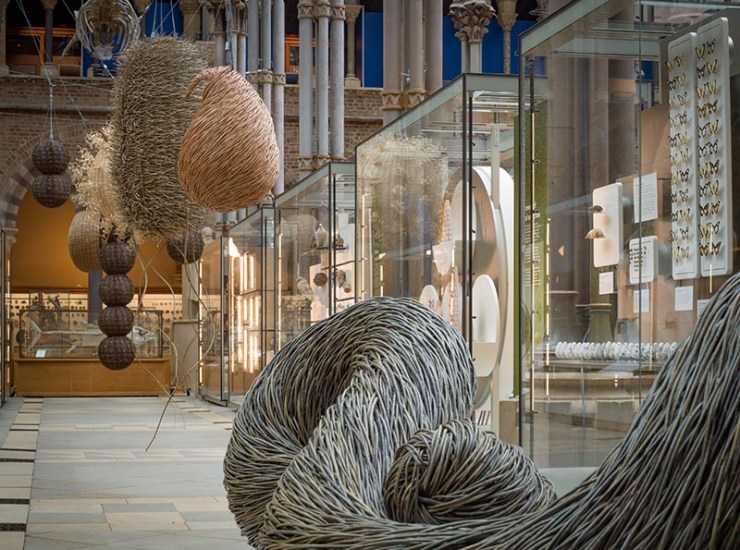
The deinstall of the Museum’s Deadly Six art installation is my first introduction into the world of exhibitions and an exciting one to start with. I have seen the display since it was first installed in September 2024 and I began working at the museum, watching it on my patrols of the court to make sure it stays intact and safe from all the little hands that pass through our doors every day. I didn’t imagine what it would be like to touch them myself until I found out I had the opportunity to join the team in taking them down.

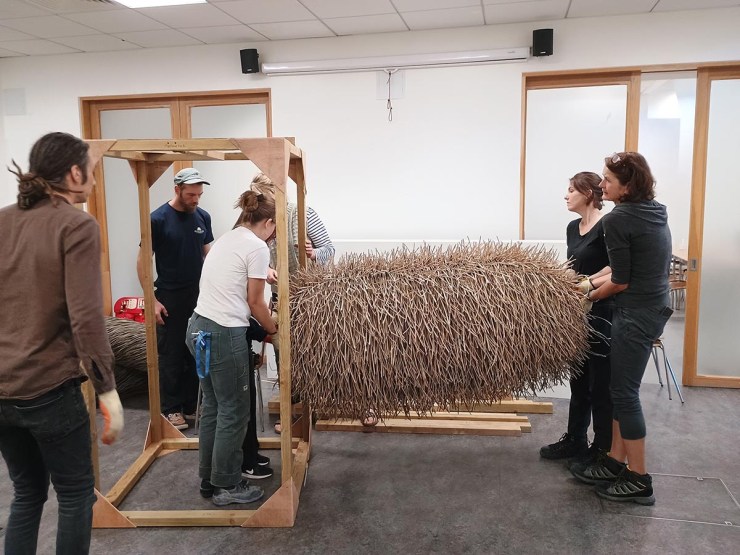
On September 8th I came into the museum at 8:30am to shadow the exhibitions team as a development day. Most of the staff and contractors were already there and so I started by talking to the Head of Exhibitions, Rachel, about what needed to be done. She showed me her schedule of the day, starting at 8am, going through to 5pm, in which we would derig all the sculptures and get them set up safely out of the public areas and into storage. After, I helped set up hoarding to keep the aisle where the work was being done secluded, as the museum would be open to the public as usual around us. This aspect was an interesting learning opportunity for me as I have no earlier experience with the manual labour aspect of the work, but I enjoyed being hands-on.

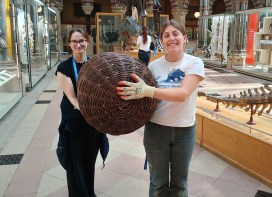
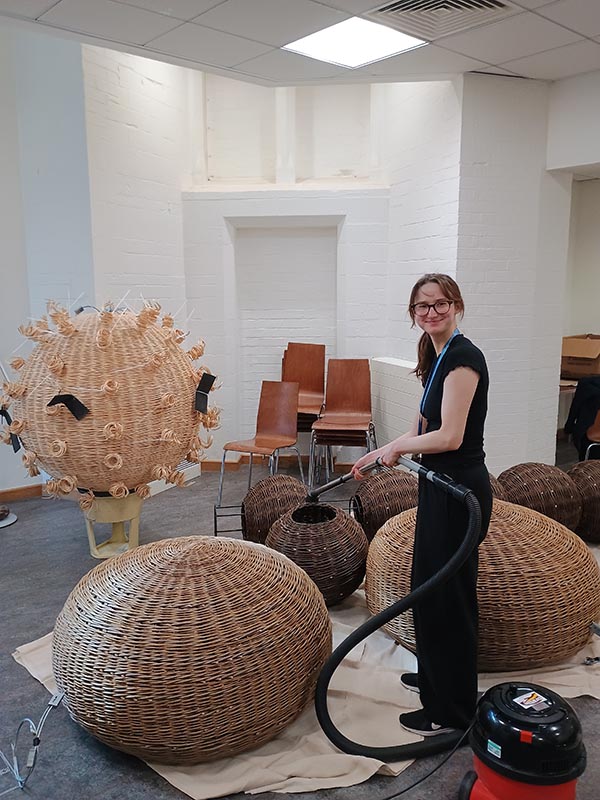
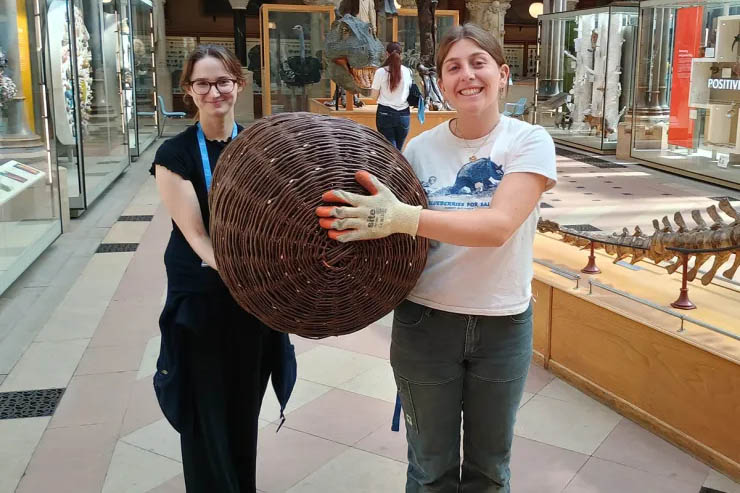
As I was doing this, the team from Outback Rigging worked on carefully lowering the suspended works to the ground and to our surprise; the take down was ahead of schedule. Most of them were removed by the middle of the day and these ones were simple to move. This was interesting to me as they seem so delicate, being large structures made of woven willow, but they proved sturdier than I thought. However, some were more difficult to take down than others, including the COVID sculpture. This was the most difficult to get down to the storage space, due to its intricate structure and its large size. Too wide to take down the stairs we usually use, Rachel organized with the Pitt Rivers to take it through their door, along the road and back into the Museum of Natural History through another door! What made this procedure more complicated was the sculpture itself, as its round construction meant there were no handholds. Luckily, the artist Issy Wilkes created some by looping some zip ties through the metal frame and, learning from the setup of the exhibition, used foam sheets to wrap around these painful to hold ties, to make the journey even easier. I felt it was an extremely rewarding process when we were finally able to put it down, as it required a lot of teamwork and shimmying about corridors to make it – I was very relieved we were able to keep it in one piece.

As the day went on and the sculptures were down and put away safely, I began to do smaller, but equally important tasks. The works themselves weren’t the only part of the exhibition, so I aided in removing the signage that was in the aisle that explained the meaning of each part. We also moved these down to the storage room, out of the way of the surrounding visitors and I began the task of removing the labels from inside. Another small step was vacuuming the sculptures. Despite regular conservation cleaning, hanging up in the court for so long had meant they had accumulated a lot of dust, which had to be cleaned out before they moved to their next home. These tasks were ones I wouldn‘t have thought of before the experience, but I realise that the smaller aspects are just as important as the larger ones when it comes to taking care of the exhibitions. It is our job to not only display the works as best we can, honouring their artistic intent and presenting to the audience in a way they understand, but this experience showed me how important the after care is, ensuring that they are well maintained to carry on their purpose and that the museum is returned to its original state.

A Seed of Doubt

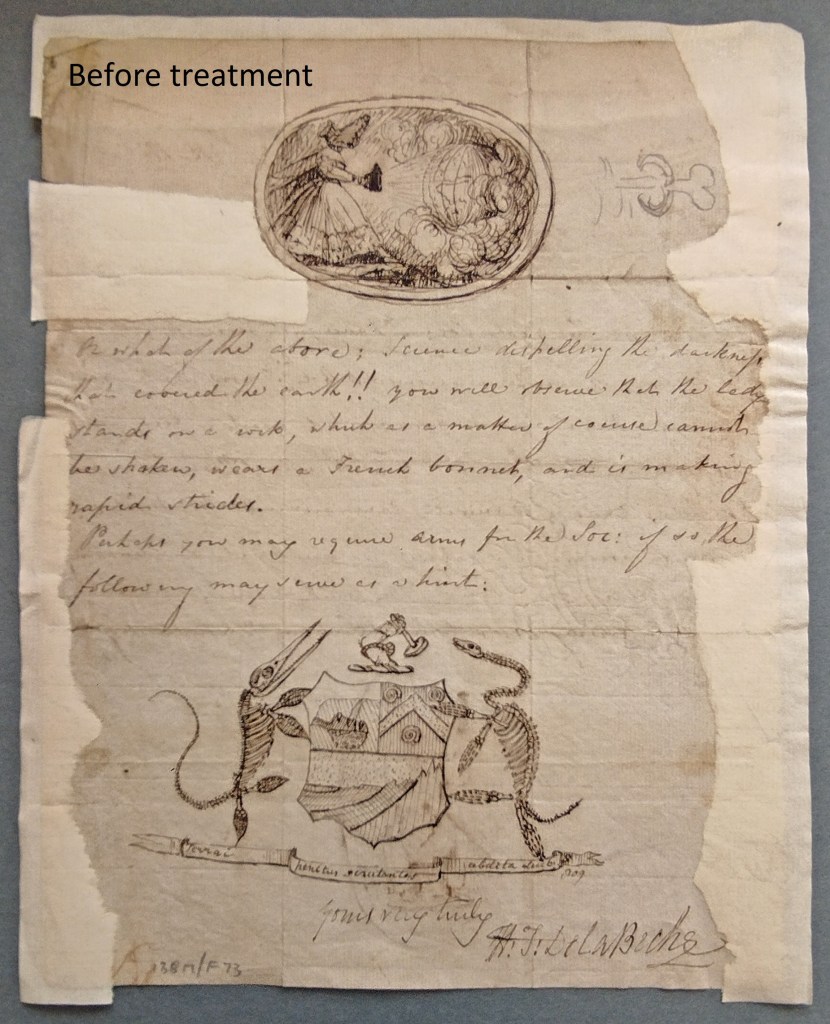
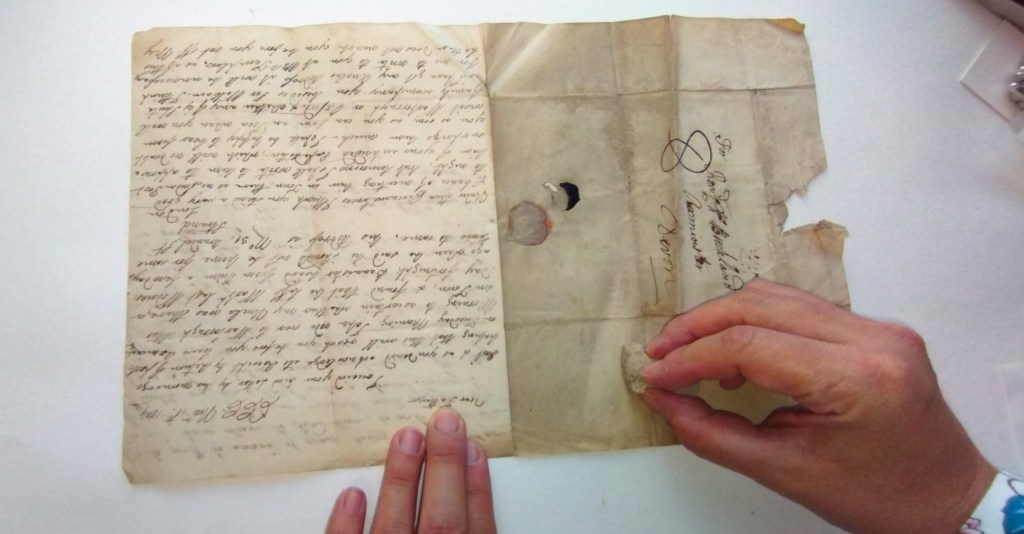
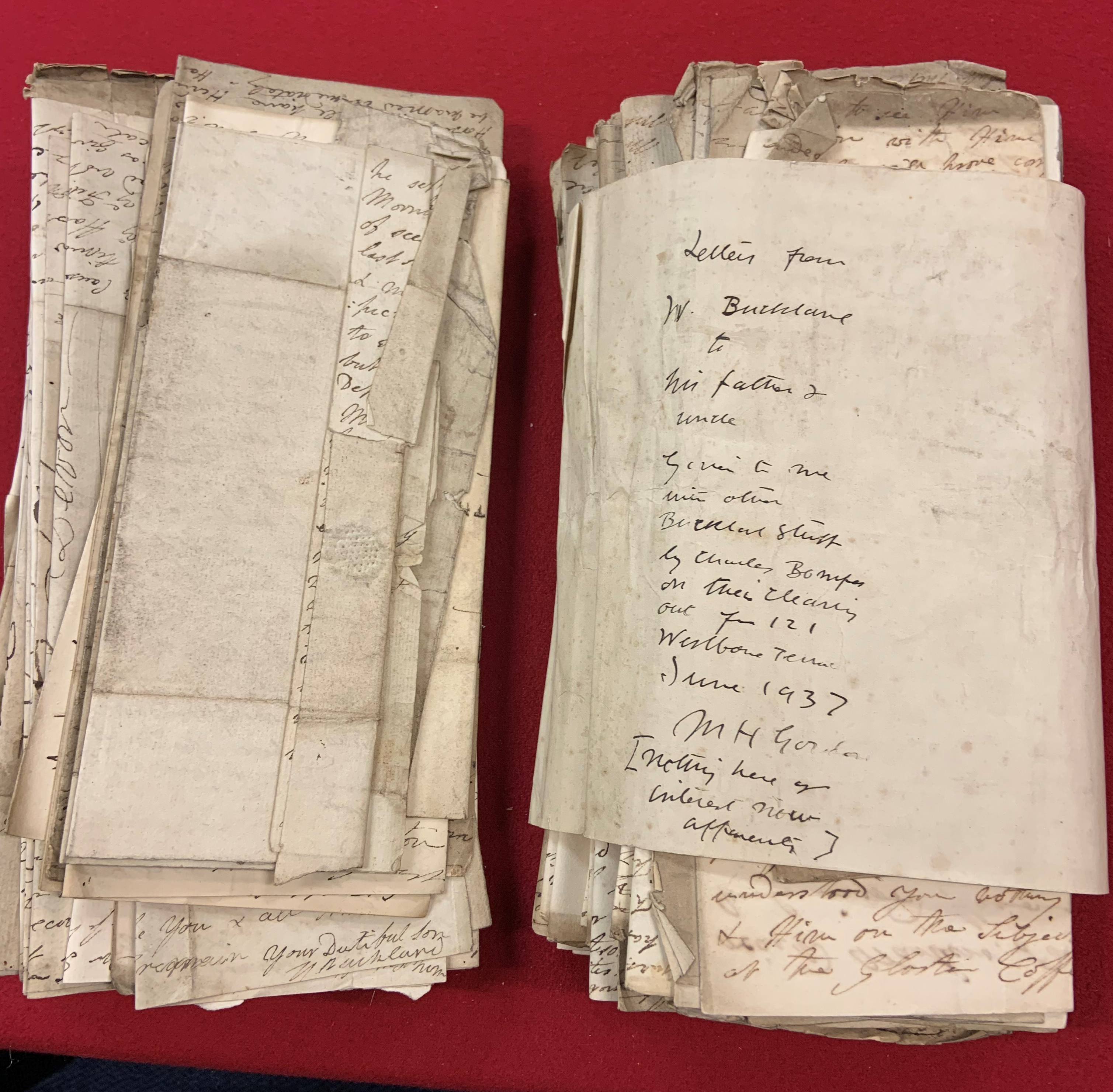
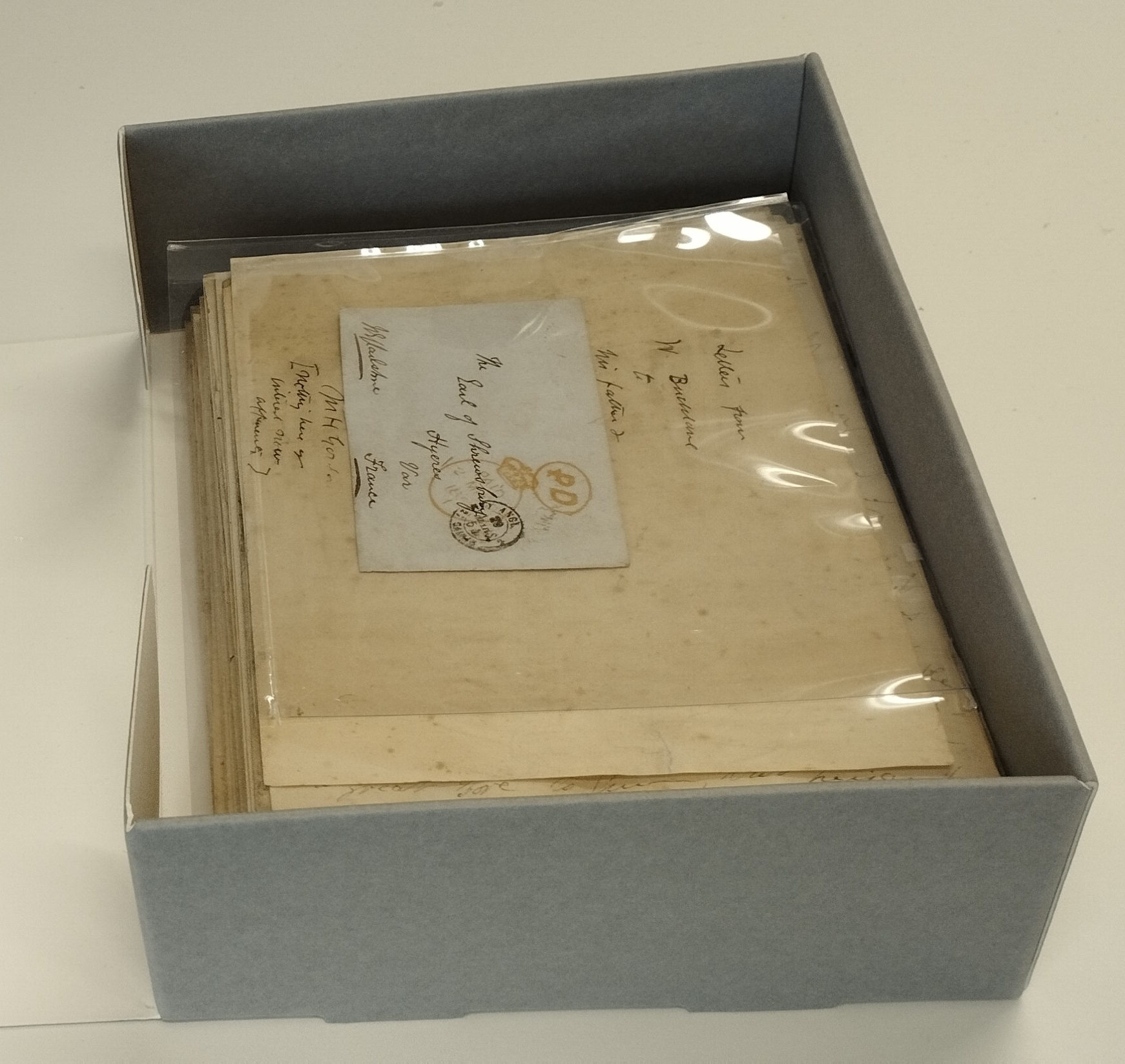
In February 2023, the Museum was lucky enough to acquire an important historical archive – a collection of notes, correspondence, artworks, photographs and family documents belonging to geologists William and Mary Buckland. But before the archive can be enjoyed by visitors and researchers, it must first be cared for, ensuring its preservation for generations to come. Thanks to generous funders, the Museum was able to hire a Project Paper Conservator, Anna Espanol Costa. Considering the Museum had not had a paper conservator since the mid-1990s, Anna was incredibly resourceful with her use of tools and materials, utilising everything from makeup sponges and soft brushes to tweezers and dental picks. In this blog post, we share insights from the eight months she spent assessing, cleaning and repairing some of the most at-risk and important material in the archive, as well as some unexpected surprises she found along the way…


Paper can be used to store information for decades, if not centuries, but it is still vulnerable to frequent handling and poor environmental storage conditions. When the Museum acquired the Buckland archive it was around two hundred years old and, unsurprisingly, many of its items needed care and restoration. Over the years, the papers had been housed in the standard file folders and boxes you would use for office documents, rather than an important historical archive. Many of the folders were overcrowded and had been tied together with string. Some manuscripts had been damaged due to too many items being stored in the same folder, and there were places where the string had cut into the larger pieces of paper causing tears. The most fragile and vulnerable items showed signs of chemical and physical damage, including iron-gall ink corrosion; chemicals in the ink had started to eat through the paper, causing cracks and loss of ink, and consequently text, in some areas.

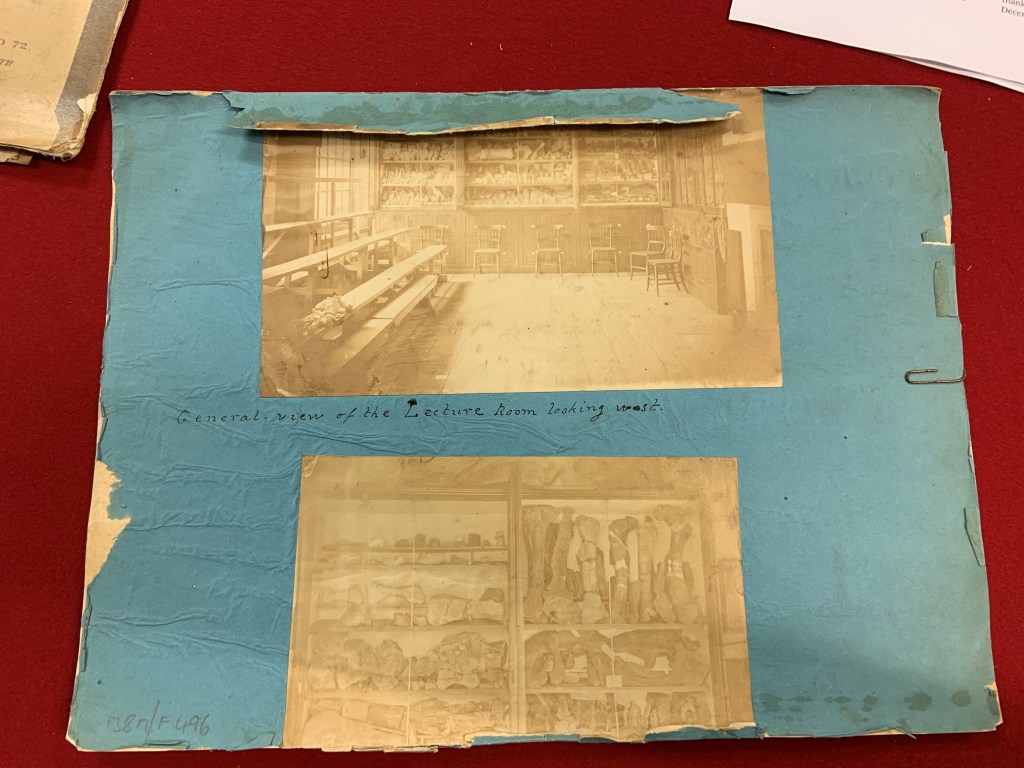
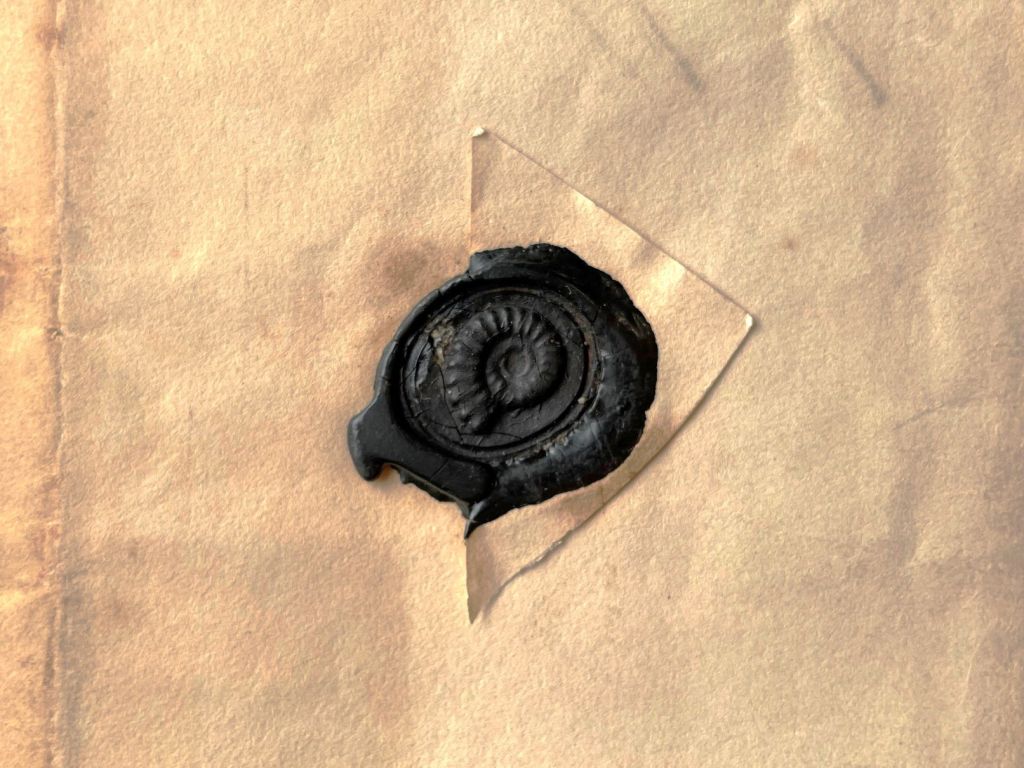
Past efforts had been made to restore the documents, but sometimes these had disfigured the original manuscripts: “in-fills” had been made with unsuitable paper, and backing sheets had been added in bright colours like blue or green. The archive was also being held together with unstable and rusty paper clips, and many of the original wax seals had cracks. It would have been a great shame to lose any of the seals, which feature beautiful examples of natural history icons, like ammonites and cephalopods.

PRESERVING HISTORY

The objective of my work was to stabilise the Buckland archive to ensure its long-term preservation and restore the appearance of the collection so it could be safely handled, digitised and exhibited in future.

One of the most important principles behind conservation is doing the ‘least amount to do the most good’. Conservation aims to slow down the ageing and deterioration process by using treatments that will not damage or disfigure the integrity of the original document. Conservation may be preventative — for instance, moving documents to a new box that creates the right ‘microclimate’ for their preservation. It may also be interventive — e.g. repairing with non-acidic and reversible materials that can be easily removed at any time, and that also can stand the test of time.

During my time at the Museum, I have been able to conserve a number of the most at-risk and important pieces of archival material. In some cases, this involved a light clean with a soft brush and re-housing of the most overcrowded items. In other cases, I performed more interventive and invasive conservation treatments including mechanical surface cleaning with smoke sponges, relaxing folds with paperweights or steam, stabilising iron-gall inks with gelatin to prevent further corrosion, mending tears with different grades of Japanese papers and tissues, and cleaning and consolidating cracks in the wax seals on the letters to prevent further loss. I also tackled some of the previous ‘repairs’ by eliminating old animal glue which had left the manuscripts shiny in places, carefully removing the unsuitable paper, and adding supports where necessary, thus leaving no traces of the bright blue backing paper.

INTERESTING AND UNEXPECTED STOWAWAYS

As well as undertaking conservation repairs, I also documented the condition of the items; photographing the manuscripts before and after conservation treatments to ensure the Museum, or any other future conservators, have a record of my work. Whilst undertaking conservation treatments, I found some interesting and unexpected stowaways in the archive. What looked to be small holes in one of the pages of a letter ended up being recognised by one of the Museum’s entomologists as spider frass (poop). A moth had also decided to call the papers home at some point in the last two hundred years as I came across a small cocoon that was now long dead, desiccated (dry) and dusty. The most unusual find, however, was a small black dot that I initially thought was an insect. However, employing the help of a microscope and one of the Musuem’s entomologists, we realised that it was actually a seed! What kind of seed, and how or when that seed came to reside in the Buckland archive, we don’t know, but it shows the archive had a life and story of its own long before it came to rest here in the Museum.

A JOB WELL DONE

Overall, I was pleased with the amount of work I was able to accomplish at the Museum. I managed to conserve a significant amount of the archive and was fortunate enough to work with, and learn from, a range of museum staff, including palaeontologists, geologists, zoologists, entomologists and the Life and Earth collections conservators. It has been a privilege to share and exchange knowledge with my colleagues and work collaboratively on the preservation of an important archive. I look forward to hearing about some of the research findings it produces, and to see it shared with the public in future exhibitions and displays.


Thank you to the National Manuscripts Conservation Trust and Helen Roll Charity for funding Anna’s work. Items from the Buckland archive will feature in the Museum’s upcoming exhibition ‘Breaking Ground’ opening 18th October 2024.

“The True Nature of Nature Itself”

MAKING ART WITH SWIFTS FROM THE MUSEUM’S COLLECTIONS


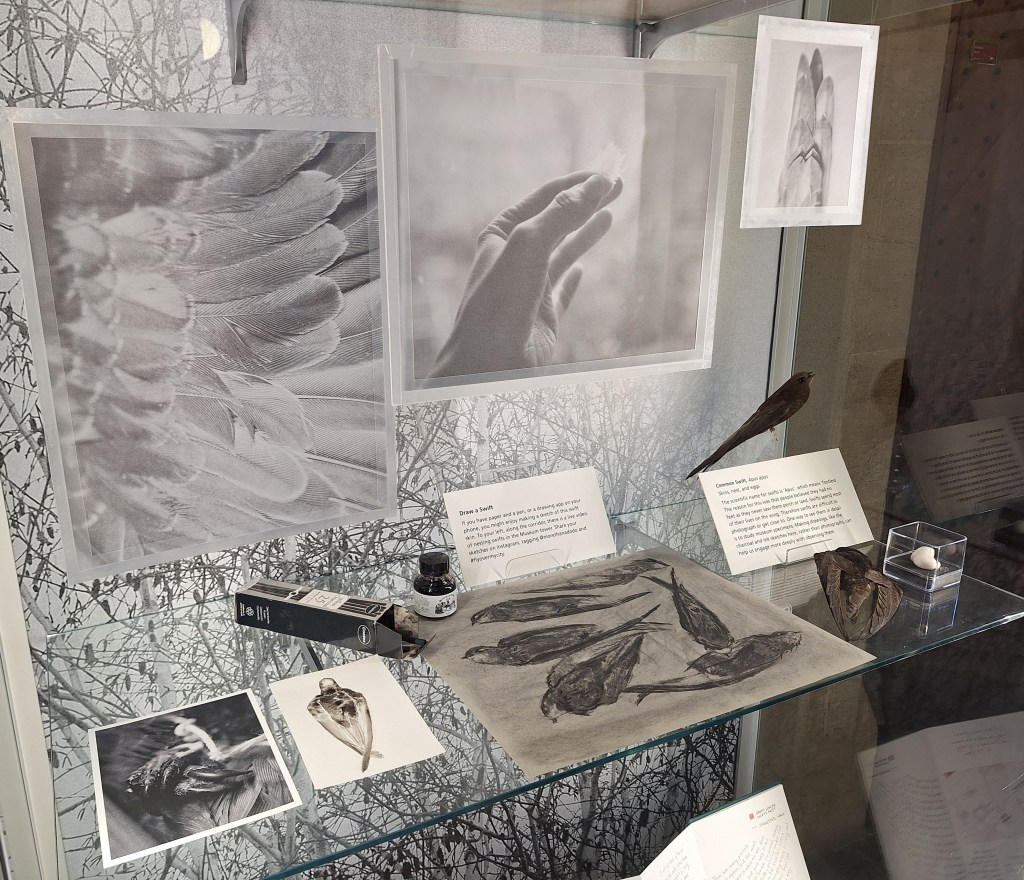
Between 14th May and 21st July, the mixed media artwork Fly Over My City was on display at the Museum of Natural History, delighting visitors with a visual and auditory exploration of swifts and the threats they face in urban environments. In this blog post, artist Becca Jeffree discusses working with Museum collections to create the piece, and the value of museums as venues for combining art and sciences.


While studying at London’s Natural History Museum years ago, another student had become upset with a group of artists who were drawing from the floor of the birds gallery, blocking his way. Studying birds in a cabinet was not as worthwhile, he felt, as studying in the field. Moreover, drawing seemed to him out of place within a science museum. Yet sketching specimens has historically played an important role in learning about biodiversity, and is particularly important for those whose access to wildlife is restricted.

Perhaps it is unsurprising that this discord arose in a natural history museum. Art is often separated from science in society and culture, with science tending to dominate debates about understanding nature. Museums, however, are rare places where art and science are welcomed equally and beautifully combined. Few places embody this better than Oxford University Museum of Natural History — a work of Victorian art shaped by the idea that art and science can take one another to higher levels. As historian John Holmes puts it in The PreRaphaelites and Science, the building expresses the “true nature of nature itself” through its architecture. It is a place where the study and interpretation of the natural world are cross-disciplinary.

Fly Over My City (2023) by Becca Jeffree, on display at the Museum of Natural History

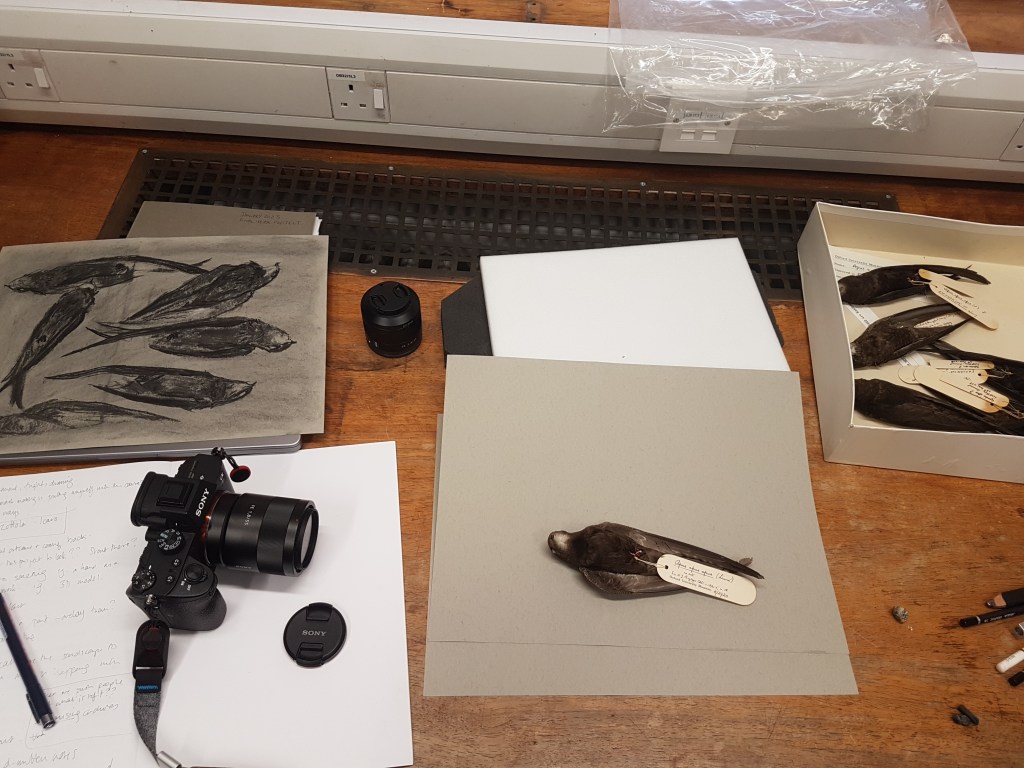
I recently collaborated with the Museum when making my artwork about the built environment and the common swift (Apus apus). Swifts are transient animals and as they rarely land they are difficult to see up close. They are found in the UK for only a short time each summer, fly fast, and are in decline. Through access to the Museum’s avian collections, I had a unique opportunity to see swift bodies up close and observe them in detail through drawing. Most of the specimens are bird skins; the skin, plumage, wing bones, skull and feet are preserved but not the internal organs, and they are not mounted like the ones we often see in cabinets. When I handled the swifts, I was asked to wear gloves to protect the specimens and avoid exposure to any harmful chemicals that may have been used to preserve them. Even though I couldn’t touch the swifts directly, I could still get to know their weight, size, colour, and notice interesting details like the shape of their chest feathers which are similar to their hummingbird relatives’.

Photographing, sketching and studying swifts from the Museum’s collections

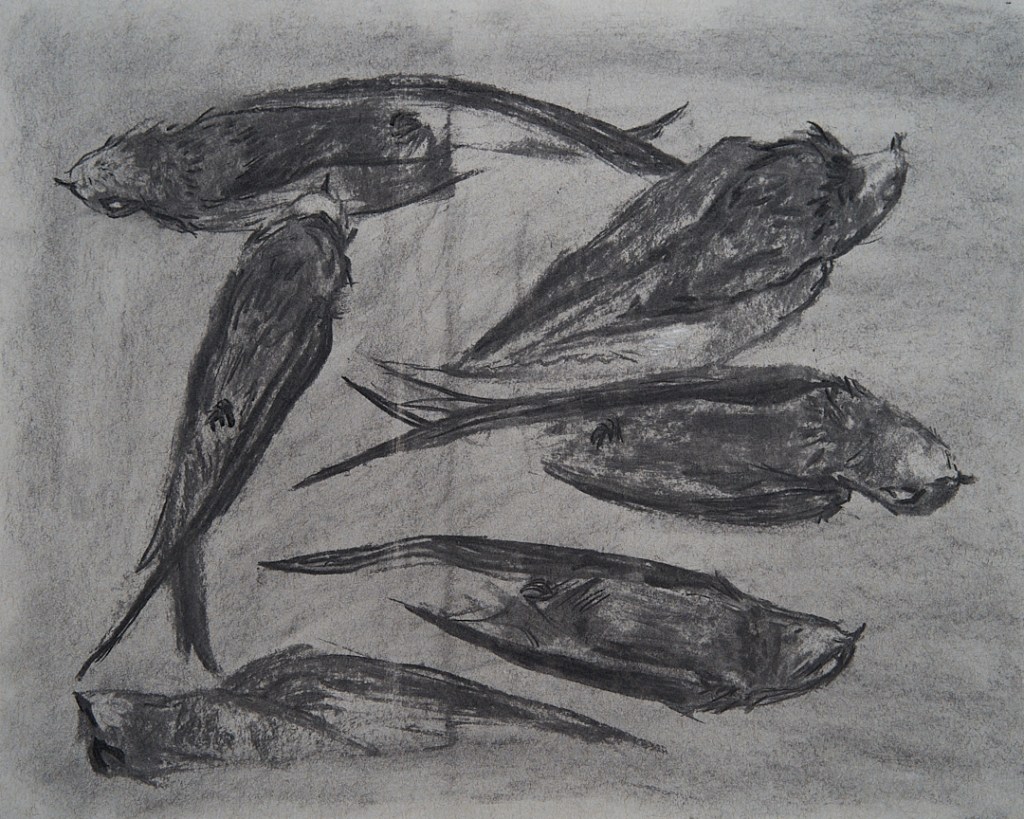
Having physical access to museum specimens allowed me to root my artwork more in science, but also to draw out further layers of meaning, by responding to my own feelings and senses. The materials I included in the work – charcoal and tracing paper – were inspired by the swifts’ weightlessness, their texture, colour and the urban environment they often inhabit. The PreRaphaelites, whose worldview infuses the Museum building, regarded art as a valid investigative method. As John Holmes puts it, “if observation yields a true knowledge of nature, then making art that records and synthesises these observations is at once a disciplined method for conducting research and the best means to convey that knowledge.” I am grateful that the Museum continues to embrace this idea today, and for the value placed on artists as researchers and communicators of its collections.

Charcoal sketch of swifts, made using Museum specimens. From Fly Over My City (2023)

Visit Becca Jeffree’s website to find out more about the piece, and her other artwork