Making a splash

NIKON D700 - 0063
Credit: Mike Peckett

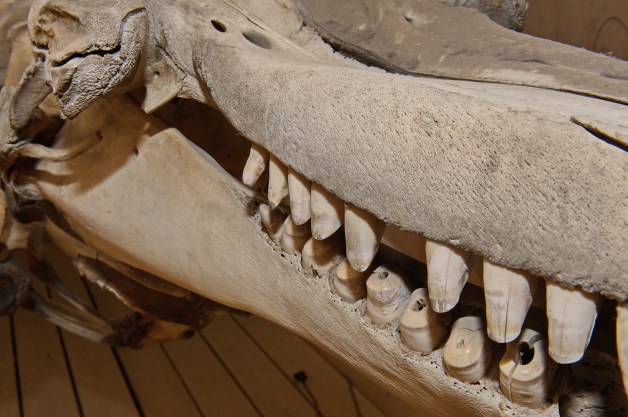
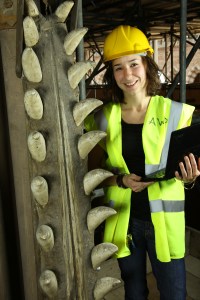
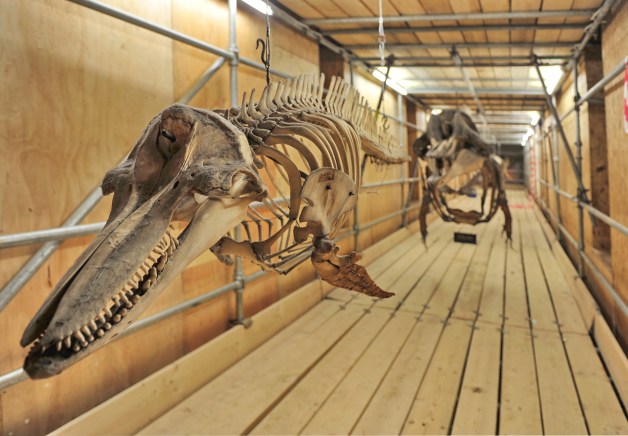
We have a new blog in the Museum of Natural History family! Once in Whale is an exciting new site all about our whale skeleton conservation project. Visitors to the Museum will remember being greeted by an enormous jaw bone, which belonged to a sperm whale. Exploring further you would have seen spectacular skeletons suspended from the roof.

Bethany Palumbo
Bethany with the sperm whale jaw

After over 100 years on display, the whales are unsurprisingly looking a little worse for wear. Dust, decay and water that dripped through the roof have all taken their toll. It’s time for a bit of TLC and the Museum’s year of closure has provided the ideal opportunity.

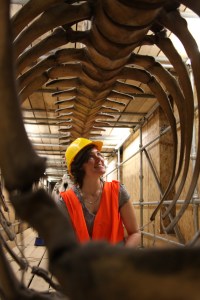
So, who is behind this conservation project? The team is headed by Bethany Palumbo, Conservator of Life Sciences at the Museum of Natural History. Donning her hard hat to work alongside Bethany is Gemma Aboe, recently appointed as Assistant Conservator.

Gemma Aboe
Gemma Aboe


So far, there are just 2 posts up on the Once in a Whale blog, but already I’ve learned a huge amount about whales and their conservation. For example, did you know that the Lesser Fin Whale is the second longest animal in the world?! Each post by the ‘whale team’ will tell you about the different whale specimens involved and the conservation treatments they’ll be experiencing. Keep following for progress updates and to see the big reveal of the finished sparkling skeletons.

Rachel Parle, Education Officer


Great big rotters

Pyrite decay

Fossils have an air of timeless imperturbability, yet the fact they were preserved at all is one of the most remarkable things about them. The fossil record represents at most around one per cent of all the species that ever lived, and a tiny fraction of a per cent of all the individual organisms once living.

Having eluded the grasp of fate and survived millions of years unmolested by our planet’s tendency to recycle its surface layers, we don’t then expect fossils to vanish from our collections! Yet a significant number have done just that, and continue to do it, through no fault of curators and conservators.

Fossilisation takes many forms, typically by the replacement of hard tissues, like shell or bone, with mineral substances. Occasionally, soft, organic tissues are preserved, but only rarely does this happen with much fidelity (alas!). Yet the burial of soft tissues in sediments can act as the catalyst for mineral formation.

The most common mineral formed this way is called pyrite, or iron sulphide. In its crystalline form it’s known as “fool’s gold”, being weighty, shiny, brassy and… worthless. It is most often found in clays and shales, and frequently in-fills the shells of ancient creatures such as ammonites, forming perfect internal casts.

For the curator and conservator this can be a major problem because iron sulphide is unstable in a normal atmosphere. It reacts with oxygen and water vapour to form iron oxides, sulphates and sulphuric acid. The result can be a heap of white crystals where your fossil once was, plus acid burns to specimen labels. Some large specimens can produce so much sulphuric acid they eat through numerous drawers in a collection cabinet, leaving holes all the way to the floor!

CrocodileSo work is underway at the Museum to re-evaluate our holdings of pyritic fossils. We are studying causes and effects, and hope to implement new treatments to better secure our collections, and perhaps help others do the same.

Of special concern are the large Mesozoic marine reptiles – extinct creatures like ichthyosaurs and plesiosaurs, and also crocodiles. Specimens from some Jurassic shales may have parts of the digestive tract preserved in pyrite. This may be because many ate a diet of spiky, indigestible prey such as belemnites, so it’s likely their gut had to be very tough to avoid perforation; this in turn was slow to decay and so acted as the nucleus for pyrite deposition.

A century and a half after these specimens came to the Museum, their pyritic midriffs sometimes show signs of decay. The example above is the long extinct early Jurassic marine crocodile Steneosaurus. This specimen comes from the Posidonia Shale “Lagerstätten” (an exceptionally preserved fossil deposit) of Holzmaden in Southern Germany. At 4m long, it’s a substantial crocodile, with a snout full of sharp teeth and bony armour plates studding its body.

In the picture at the top of this post you can see a dark mass tucked under the ribs. We are concerned about the yellow deposit coating here – a residue of sulphur and iron compounds resulting from pyrite decay. The good news is there is not much of it and very little damage apparent. But we need to know if the decay is recent and active, or if it dates from years ago and is now stable. If the decay is inactive, the best treatment is usually no treatment at all, aside from a little cleaning and stabilisation. If the decay is active, we will need to devise a treatment regime: no easy matter for so large and delicate a specimen.

These photographs will form part of a larger series of affected specimens, helping us to accurately monitor their condition. Conservation photographs will be produced as uniformly as possible to include scale and colour charts for comparison. This will provide invaluable data allowing us to study the processes of decay, and to link them to environmental data.

This all takes time, but as things develop, we’ll keep you posted.

Paul Jeffery, Assistant curator, Geological Collections

It’s all relative

_DSC2241

A while back we featured a great little story about some graffiti, which was discovered high up on the Museum roof. You may remember that it was painted by two of the craftsmen responsible for creating our beautiful Victorian building. The graffiti reads “This roof was painted by G. Thicke and J Randall, April 1864″

Roof graffiti
The graffiti in the rafters of the roof

The story picked up quite a lot of press attention, featuring in the Oxford Mail and BBC Oxford, and that blog post is our most-read so far. But one reader’s attention was particularly attracted by the names of the painters. Oxford resident Debbie Moorwood has been tracing her family history for some time, so when she spotted the familiar name G. Thicke, she decided to do some extra digging.

After consulting the Victorian censuses and tracing back through her family tree, Debbie revealed that painter George Thicke was actually directly related to her husband, Steve Moorwood. Steve is George’s great great great grandson!

_DSC2266
Staff from Beard and Purcell join Steve and Debbie in the roof rafters.

Excited by her discovery, Debbie contacted us directly through this blog and we thought this was a fantastic opportunity for the graffiti artist’s relatives to see his work up close.

So, last week I had the pleasure of meeting Debbie and Steve Moorwood and we joined staff working on the roof project to climb high up into the roof. It was also a good opportunity for Debbie to share her discoveries about her distant relative, George Thicke. He was born in Glastonbury in around 1809, so would have been roughly 55 when he painted the graffiti on our roof. He is first spotted living in Oxford in the 1841 census, when he was a resident of the Cowley Road and, most importantly, listed as a painter! Later he moved around the area, living in St Clements, Headington and finally Shotover, before his death in 1887.

_DSC2231

Debbie said of the experience: “We had an amazing time visiting the Museum roof. We never expected to get a full guided tour of the whole building and Steve loved it, especially the building works. We can’t wait for the roof to be finished and for the Museum to open again, when we’ll be dragging our kids & family in to have a look. I think the museum has become quite a special place for us now.”

We now have a good picture of one of our infamous roof painters, but J Randall remains a bit of a mystery to us. So far, we think he was John James Randall of St Ebbes, Oxford, but we know very little else. Wouldn’t it be wonderful if we could track down one of his relatives next?

Rachel Parle, Education Officer

Once in a whale

NIKON D700 - 0057
Orca skeleton
Credit: Mike Peckett

Among the Museum’s large collection of mammal skeletons are five whales (Cetacea), each suspended from the roof in the main gallery. As part of the Museum renovation efforts, it was decided to give these specimens some much needed conservation treatment: 150 years of continuous exposure to light as well as fluctuating temperature and humidity levels has left these skeletons in a poor condition. The types of damage noted include: a big build-up of dust and dirt; cracking of the bone material; secreting of fatty oils; missing sections, such as fingers and ribs; and the corrosion of metal areas, as well as water-stains from the leaking roof!

8374647046_4967936cbc_h
The whales hung from scaffolding ready for conservation
Credit: Mike Peckett
NIKON D700 - 0033
150 years of dust gathered on the skull of a Lesser Fin Whale
Credit: Mike Peckett

Thanks to a successful PRISM grant from the Arts Council England, we have very recently hired an Assistant Conservator to help me complete this huge task. Together we will have six months to complete the treatment which will include in-depth cleaning of the specimens, stabilising loose or cracked areas, and replacing missing segments and corroded wires. We’re aiming to have five beautiful whale skeletons which look clean and scientifically accurate, as well as being stable enough to withstand another 100 years on display.

NIKON D700 - 0101
Credit: Mike Peckett
NIKON D700 - 0047
Credit: Mike Peckett
NIKON D700 - 0211
Credit: Mike Peckett

Although we’re closed for 2013, many visitors are still passing through on their way to the Pitt Rivers Museum. We thought they would like to see what’s going on, so we’ve built a window in the construction boards, enabling the public to see the whales. If you’re visiting, pop by to see our conservators undertaking this exciting and important work.

Bethany Palumbo, Conservator of Life Sciences

Archiving the Aardvark

DMC-LX3 - 0026
Image: Mike Peckett

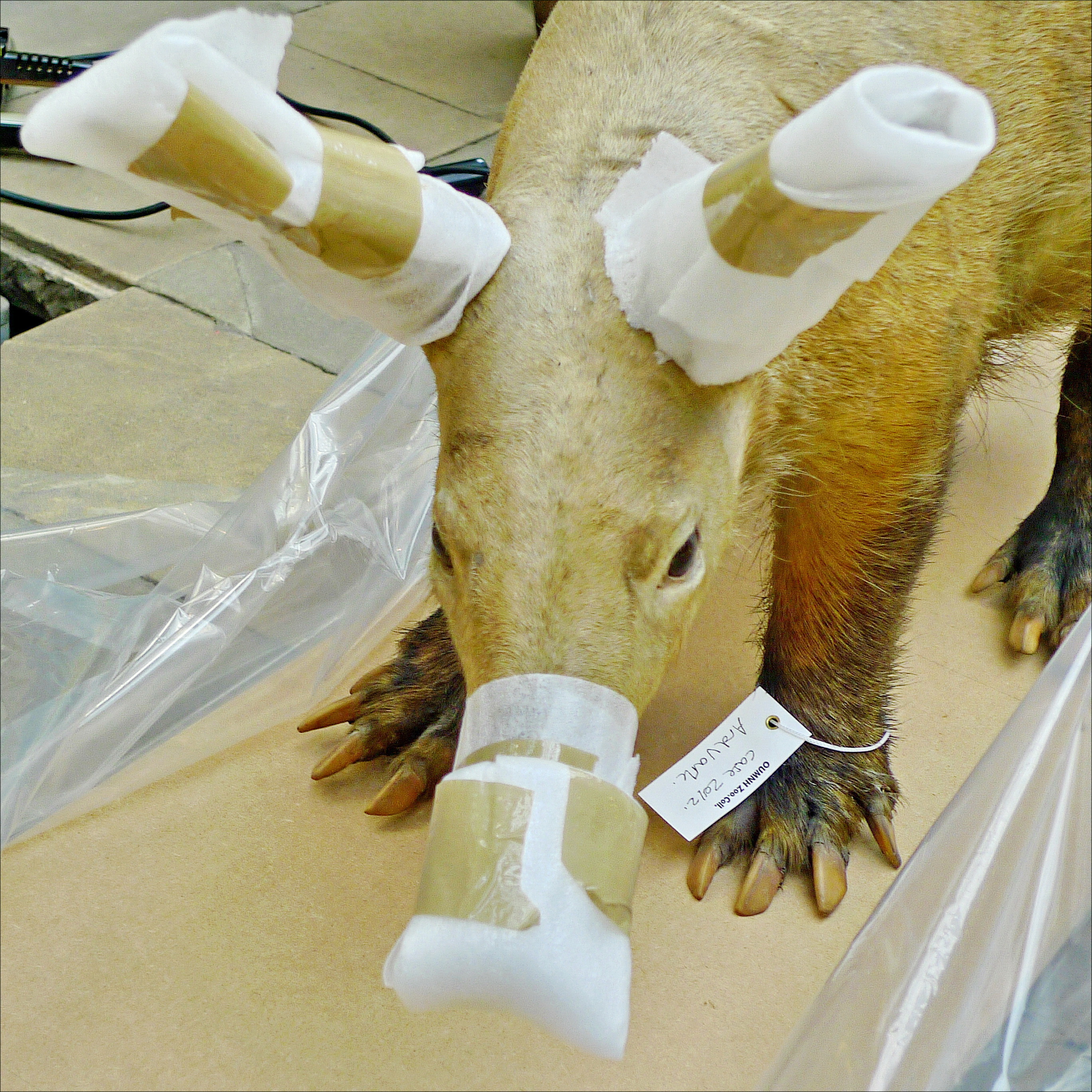
This aardvark is looking decidedly grumpy but this undignified treatment is for his own good!

With scaffolding rapidly filling the Museum, almost all of our specimens have been moved, boxed or wrapped to protect them during our closure year. For many, this is simply to make sure they don’t get a bump or a scratch while all the roof repairs are going on, but for our furry and feathered friends, we have other concerns.

Bethany Palumbo, Conservator of Life Sciences explains:

“As the display cabinets were boxed up for the duration of the renovation, we felt it was important to remove taxidermy specimens that were vulnerable to insect pest attack. Specimens such as birds and mammals have fur and feathers which are very appetising to a variety of small insects, including Webbing Clothes Moth (Tineola bissilliella). These moths can destroy entire specimens in a relatively short time, eating both the fur or feathers and the skin.  If an infestation occurred within a display case, we wouldn’t know about it until it was too late. So, we spent a week removing and safely packing up many display specimens. They now are stored on the upper gallery and are accessible to staff who might want to use them. The conservation department will be documenting the condition of the specimens and will clean them up before they return to display”.

DMC-LX3 - 0032
Image: Mike Peckett

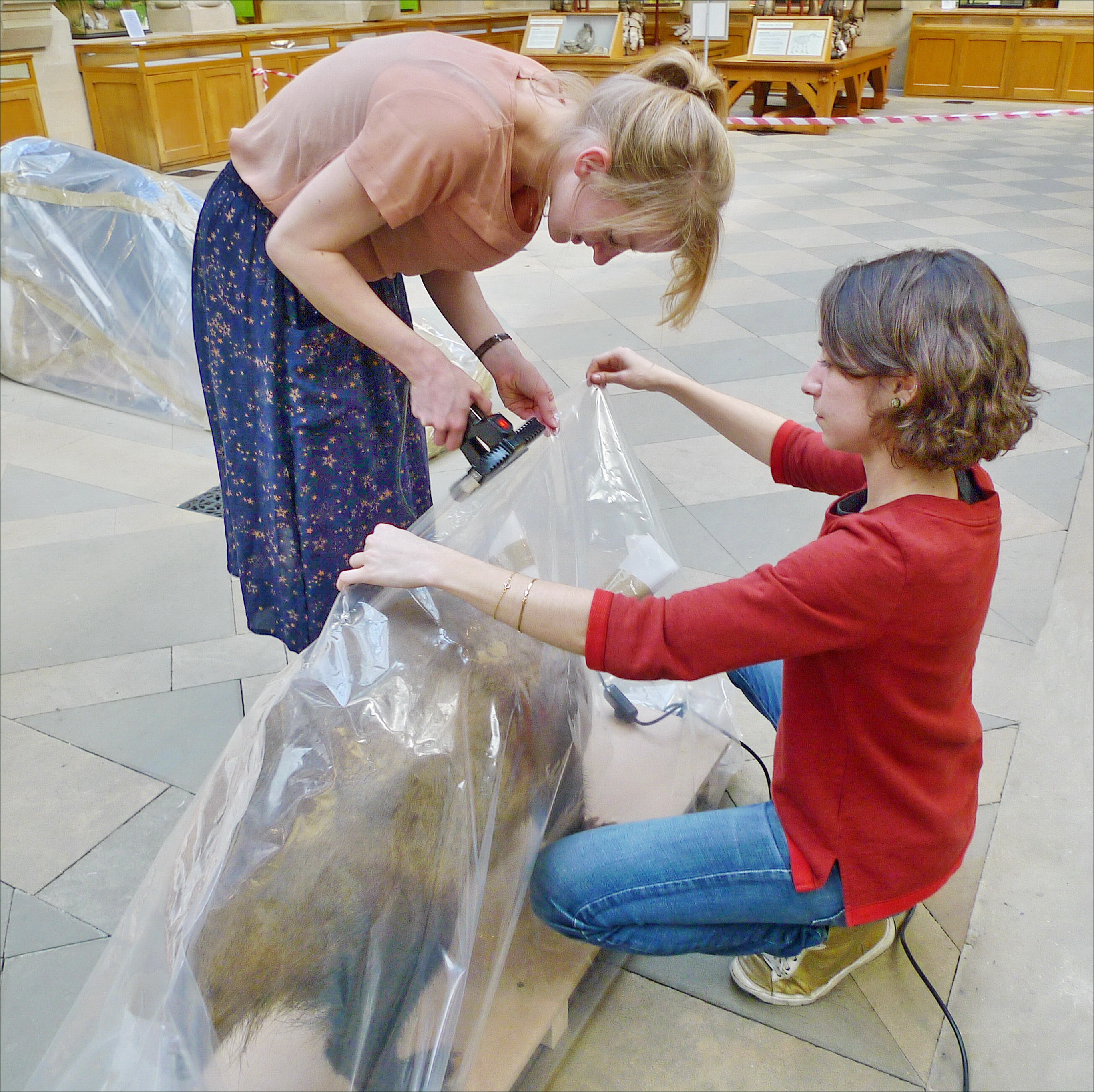
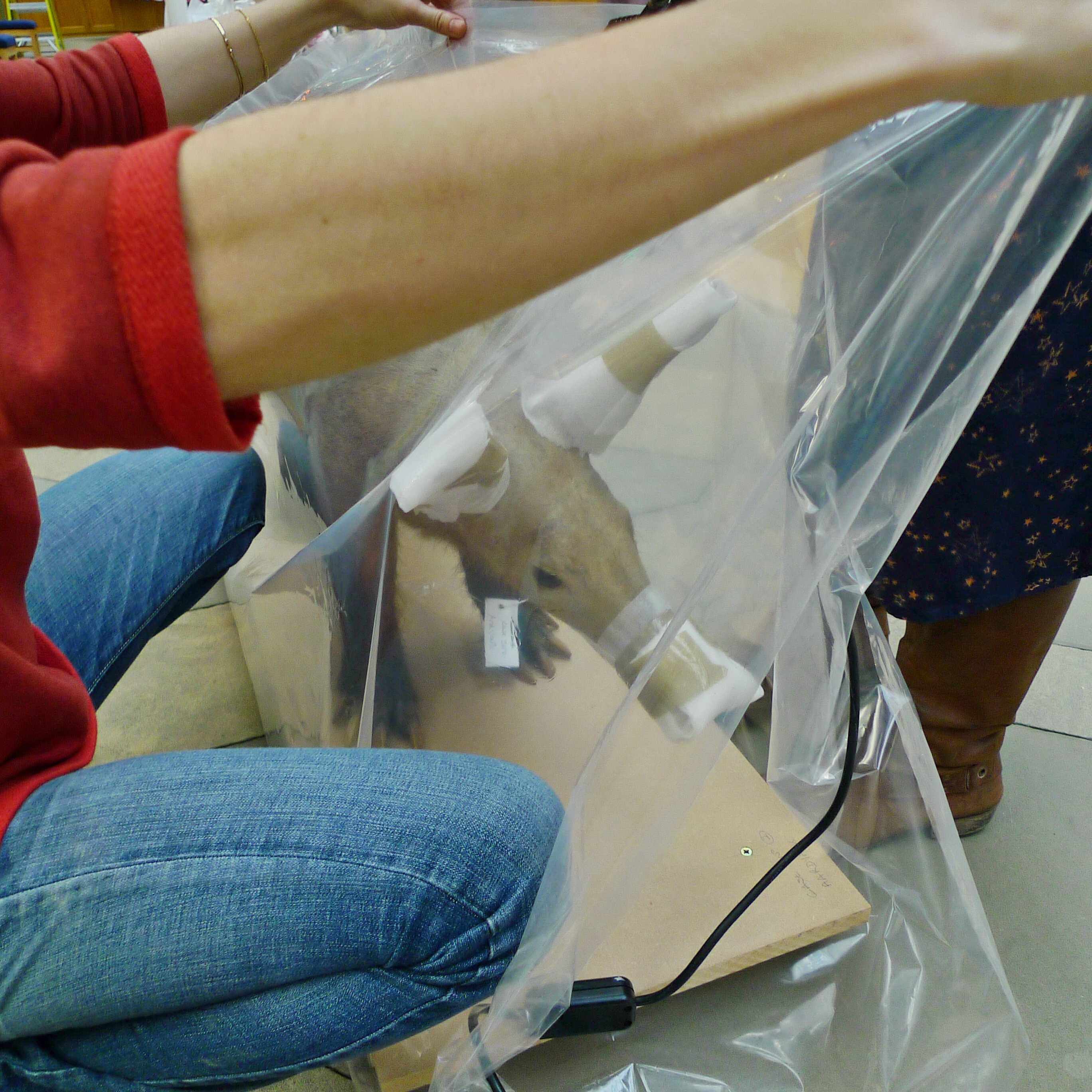
Here, Education Assistant Simone Dogherty (left) is helping Bethany (right), to carry out final preparations before the aardvark joins his companions in the Museum’s storage space. So the aardvark’s neatly wrapped snout and ears will ensure he doesn’t get damaged and the well-sealed bag will guarantee he remains pest-free for the year ahead.

DMC-LX3 - 0033
Image: Mike Peckett

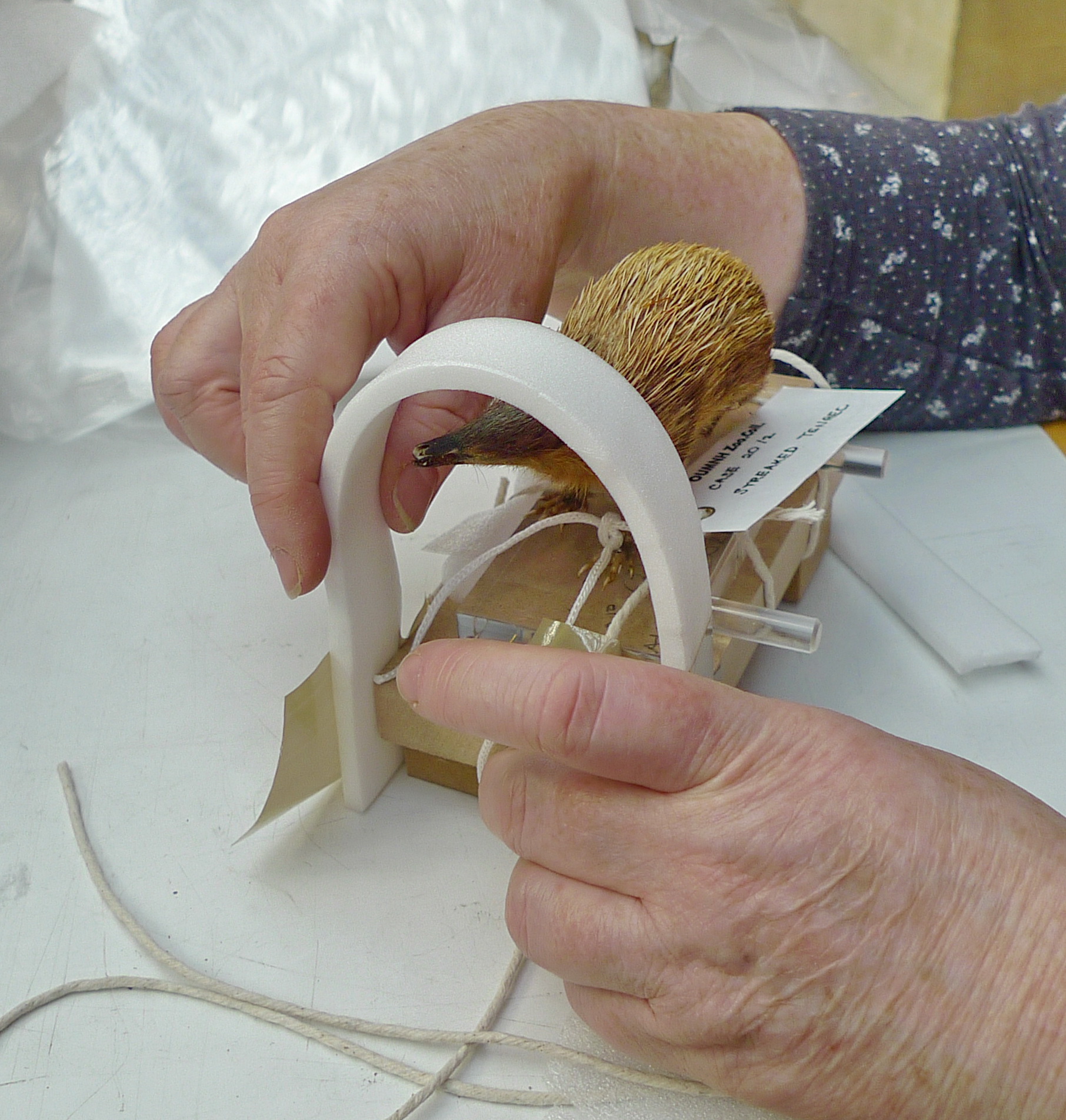
I must also include this lovely photo of a little tenerec getting the VIP treatment for his year in storage.

DMC-LX3 - 0034 - Copy
Image: Mike Peckett

I look forward to seeing the aardvark and all our other animals back on display and looking their very best (with no nibble marks!) next year.

Rachel Parle, Education Officer