The outside and inside of a box, showing its contents

Boxes, Bags, and Bones

NO, THERE WEREN’T HARMONICAS IN THE JURASSIC!


Looking through the collections at OUMNH never gets boring, but sometimes a drawer will open up to reveal something even more eye-catching than the fossils usually found inside. Whilst working on the Museum’s Jurassic marine reptiles a few weeks ago, I came across something particularly surprising: a jewel-green box with a fantastic piece of art on the front. I was instantly intrigued and reminded of all the other times I had encountered a holder as fascinating as the specimen inside it.

Storage in museum collections is an ongoing pursuit of balance between ideal environmental conditions, specimen accessibility, and efficient use of space. This balance applies to all levels of storage: from building to room, cabinet to specimen tray. OUMNH’s Earth Collections are stored in conservation-grade, acid-free boxes or trays made of plastic or cardboard. These boxes are sometimes layered with low-density foam or ‘plastazote’ which can be carved to fit the specimen and keep it from being jostled or damaged. Holders with lids can also provide a micro-environment for specimens to help minimise their exposure to changes in humidity and temperature. The use of these standard materials not only helps protect specimens from degradation but can also deter pests from harbouring in collections spaces.

However, historical collections like those at OUMNH may retain holders that are not standard use. Sometimes, a clean and empty plastic Ferrero Rocher box is the perfect size for that small mammal skeleton that needs storing! Other times, an unusual holder might have been the only thing a field collector had on hand to transport a specimen to the Museum.
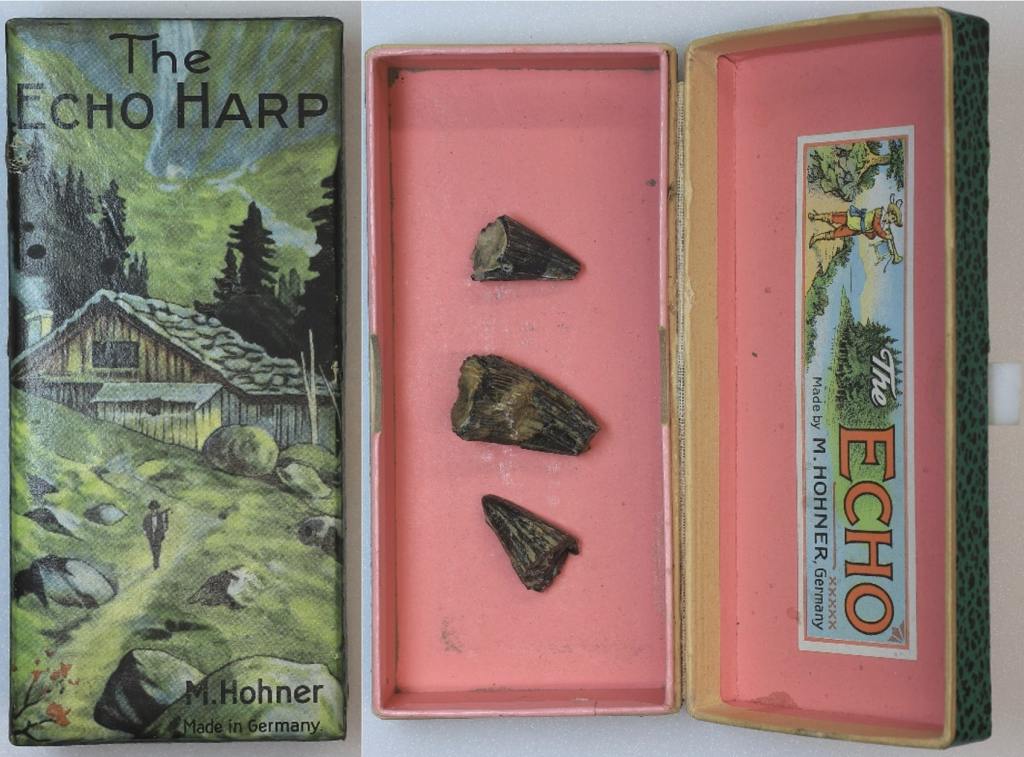
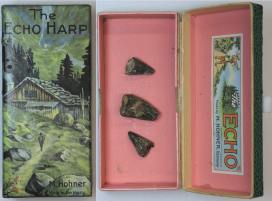
A harmonica box containing pliosaur teeth, a marine reptile that lived during the Jurassic (145.5 million – 201.6 million years ago).

One example of an unusual specimen holder is this ‘Echo Harp’ box by pre-eminent German harmonica manufacturer Hohner, likely from the 1960s. The box no longer holds a harmonica, but instead accompanies pieces of Jurassic pliosaur teeth from Weymouth, Dorset. Pliosaurs were a kind of carnivorous marine reptile related to plesiosaurs, with four flippers, and long tails and necks. If they hadn’t gone extinct in the Cretaceous-Paleogene extinction event 66 million years ago, perhaps they would have come to appreciate the harmonica and its artistic packaging!

Aside from their artistic value, museums may sometimes retain unusual holders because they contain primary source information on the specimen. One such example is a ‘Bryant and May’s Patent Safety Matches’ box in our Earth collections, bearing a packaging design from the early 1900s. The box actually houses a chicken tarsometatarsus bone excavated from “High St. New Schools” in Oxfordshire and is accompanied by a label which describes the particular layer of gravel the specimen was found in — important information for any archaeological or palaeontological find. Although the specimen is stored alongside Pleistocene fossils (10,000 – 2.6 million years ago), chickens did not originate in the UK, so the bone is likely from much more recent times. Someone still must have thought it was important enough to keep in its own special holder!

A Tate and Lyle sugar bag containing a Jurassic specimen, with handwriting on the outside describing the stratigraphy the fossil was found in.

Similarly, this ‘Tate and Lyle Granulated Sugar’ paper bag features a handwritten original notation in blue pen on the outside. The bag originally contained a specimen found in a collection of Jurassic gastropods and bivalves from Somerset, with the handwriting describing the fossil’s stratigraphic information. The bag also features a recipe for cinnamon apples on the reverse, which we have yet to try!

A wooden box and the Quarternary fossils (up to 2.6 million years ago) it originally housed. An accompanying letter describes the delivery of the fossils to William Buckland, Oxford University’s First Reader in Geology.

In addition to primary source information, original holders may also provide specimens with provenance. This ovular wooden box filled with organic stuffing material originally contained Quarternary fossil specimens found in Peak’s Hole, Derbyshire. The Museum archive also holds a handwritten letter describing the specimens inside the package and how they were found. The letter dates to 1841 and is addressed to Oxford University’s first Reader in Geology, William Buckland.  The specimen holder forms part of a group of objects with such a strong interconnection, and such strong documentation, that retaining the box is a matter of course.

All in all, it’s great that we’ve come so far in the advancement of safe and stable housing for specimens. At the same time, it’s always fascinating to see what else has made its way into collections, just by nature of being able to hold things, either for a short time or a long one. Despite living in the Earth Collections – among fossils, rocks, and the geological past – these objects offer us a little bit of human history too.


By Brigit Tronrud, Earth Collections Assistant
Crunchy on the outside

By Susie Glover, HOPE Learning Officer

We have an ambitious project underway at the Museum, to preserve a unique and scientifically important collection of over one million British insects. It’s called HOPE for the Future, after the Hope Entomological Collections, and we are keen to shout about how these specimens can help us understand biodiversity, habitats and ecologies.

The learning team behind the project are today launching a new blog for young people interested in entomology. Intriguingly, it’s called Crunchy on the Outside, but please don’t confuse this with the similar, but fundamentally different, mid-’90s advertising campaign for the Dime bar.

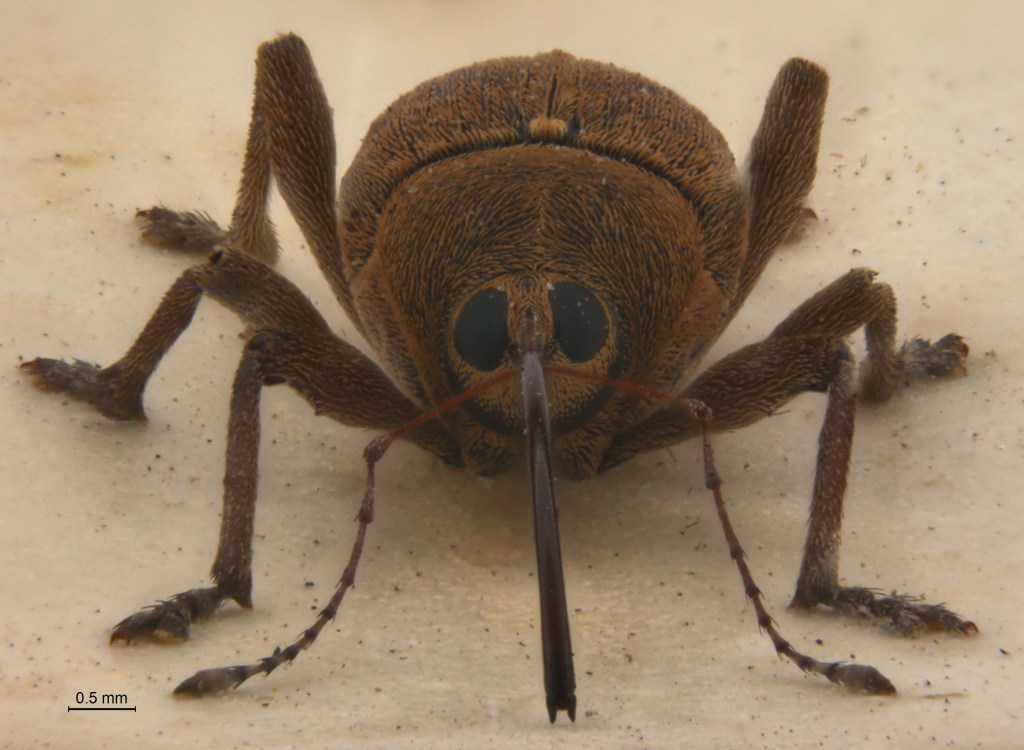
A high magnification image of an insect, face-on, showing large proboscis and brown body.
One of many weird and wonderful specimens from our collection, the Acorn Weevil (Curculio glandium).
Here is a peek at some of the tools of the trade, used to move and mend specimens like this moth.

Crunchy will be crammed full of interesting insect info, fun things to make and do, a peek behind the scenes at the Museum, and news from people, past and present, who work in the field of entomology. The odd bad joke may also worm its way in (What do butterflies sleep on? Cater-pillows).

The blog will also be a platform for young people to have their say, about the topics covered on Crunchy itself, as well as on the activity of the Museum. It will give them first dibs on access to related events too. You can check it out, follow, and share at crunchyontheoutside.com.

HOPE for the Future is funded by the National Lottery Heritage Fund.

Excavating amber

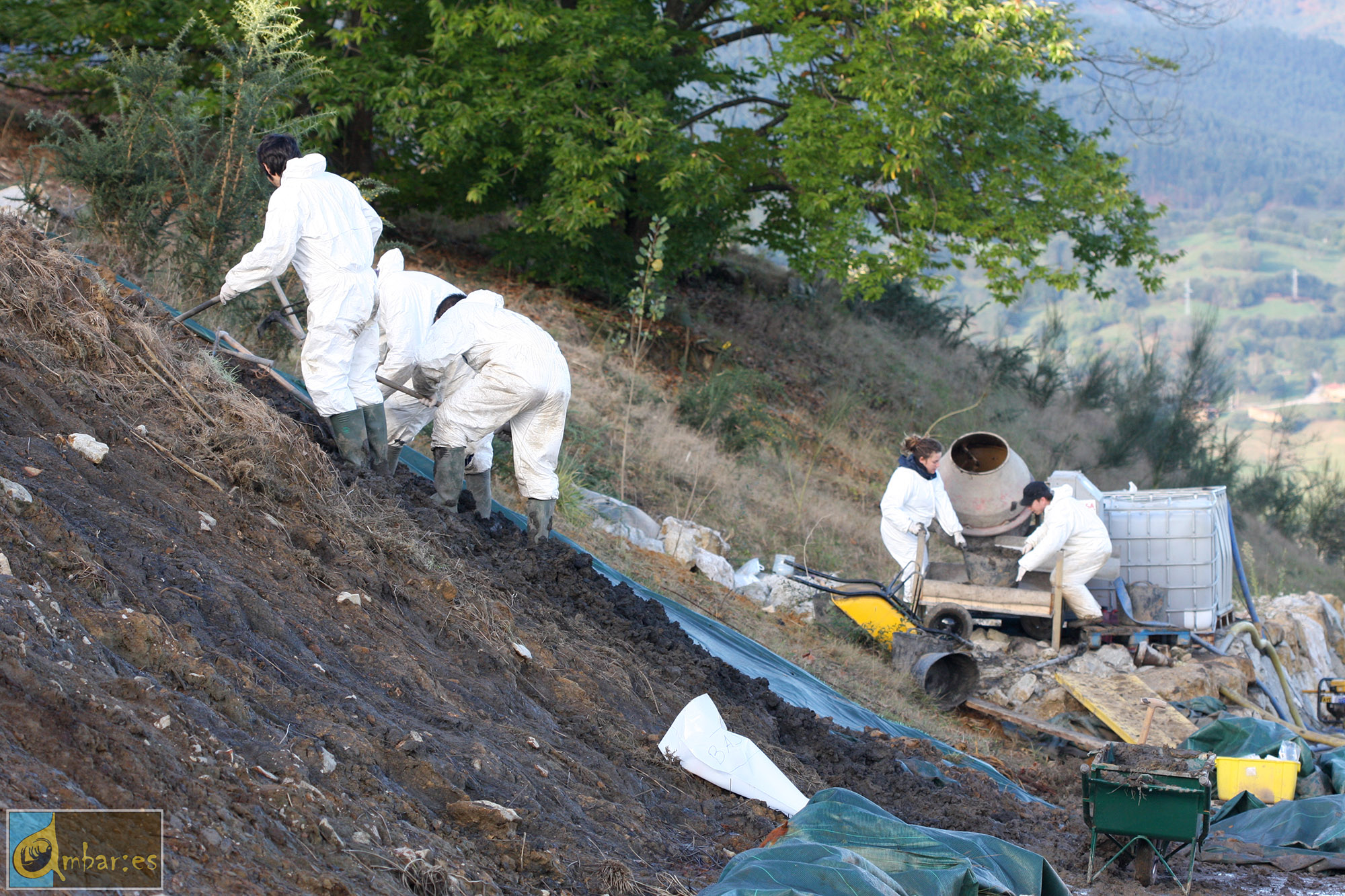
First amber excavation in the El Soplao outcrop, Cantabria, N Spain in 2008. Credit IGME-UB.

By Dr Ricardo Perez-De-La Fuente, Research Fellow

Amber, or fossilised plant resin, is a unique material to learn about the history of life on Earth. Its incredible preservation and ability to capture life “in action” are well known thanks to the Jurassic Park saga, but fewer people know where amber is found, what it looks like in the field, and how it is gathered.

Cretaceous amber, about 130 to 70 million years old, is the oldest amber that provides abundant fossils, specifically insects and spiders. Ecosystems drastically changed during this period due to global greenhouse conditions and the diversification of flowering plants, among other factors. Amber from that time has been discovered in Lebanon, Spain, France, Myanmar, eastern United States, Canada, and northern Russia.

My research team and I carry out regular amber excavations in northern Spain, working in teams of six to ten people. The outcrops that we excavate are often located next to roads and highways because amber is typically uncovered during roadworks. Excavations take place during the summer or fall to try and minimise the risk of rain, and we usually embark on one field trip each year.

The goal is to recover as much amber as possible – usually a few kilograms – from the muddy and sandy sediments. These materials were transported downstream tens of million of years ago by heavy rain and river swellings from the forests where the resin was produced, before being finally deposited in near-shore areas.

Manual extraction of amber. Credit IGME-UB
Manual extraction of amber in the El Soplao outcrop, Cantabria, northern Spain in 2008. Credit: IGME/UB.

I find amber excavations quite romantic. In the field, amber has a dull appearance that makes it difficult to distinguish from rocks or woody remains. This is due to an opaque crust resulting from oxidation in the sediments and other processes.

This outer layer makes detecting potential fossils inside the amber highly unlikely while the excavation is ongoing. So, in the field we just gather as many amber pieces as possible, and hope for the best.

Only when amber is polished – or shows broken surfaces – does its distinct yellowish to reddish shine emerge, and any possible fossils within become evident. Some ambers are highly fossiliferous, while others are very poor in fossils.

Amber can be gathered by hand using regular tools such as hammers. However, the most efficient method to extract amber from soft sediments is with concrete mixers! This rather unsophisticated piece of equipment provides the best way to recover medium quantities of amber in the field.

We charge water and amber-bearing sediments into the mixer, and after stirring for a while amber floats to the top because it is less dense than muddy water. Then, the surface of the water containing the amber is poured into sieves, which separates even the tiniest pieces.

Amber pieces recovered in a sieve after washing
Amber pieces recovered in a sieve after having been “washed” from their sediment. First amber excavation in the La Manjoya outcrop, Asturias, northern Spain in 2017.

After fieldwork, many hours will be spent looking for fossils within the amber and preparing them. Gathering raw amber is just the first part of a process in unearthing the secrets held within – fragments of encapsulated time.

Top image: First amber excavation in the El Soplao outcrop, Cantabria, N Spain in 2008. Credit: IGME/UB.

Through the looking glass

With our Life, As We Know It redisplay project now underway, our Senior Archives and Library Assistant Danielle Czerkaszyn takes a behind-the-scenes look at how we captured the contents of the current displays for the Museum’s archive.

The archive here holds a unique collection of natural history books, journals and documents covering a wide range of subjects related to the Museum’s collections and research. It also contains papers and objects on the history of the building, providing an institutional memory of Oxford’s ‘University Museum’ since its foundation in 1860.

From an archive perspective it was really important to document the current layout of the cases, their specimens and text before they were removed from the court to make way for the new showcases in the first phase of our redisplay work.

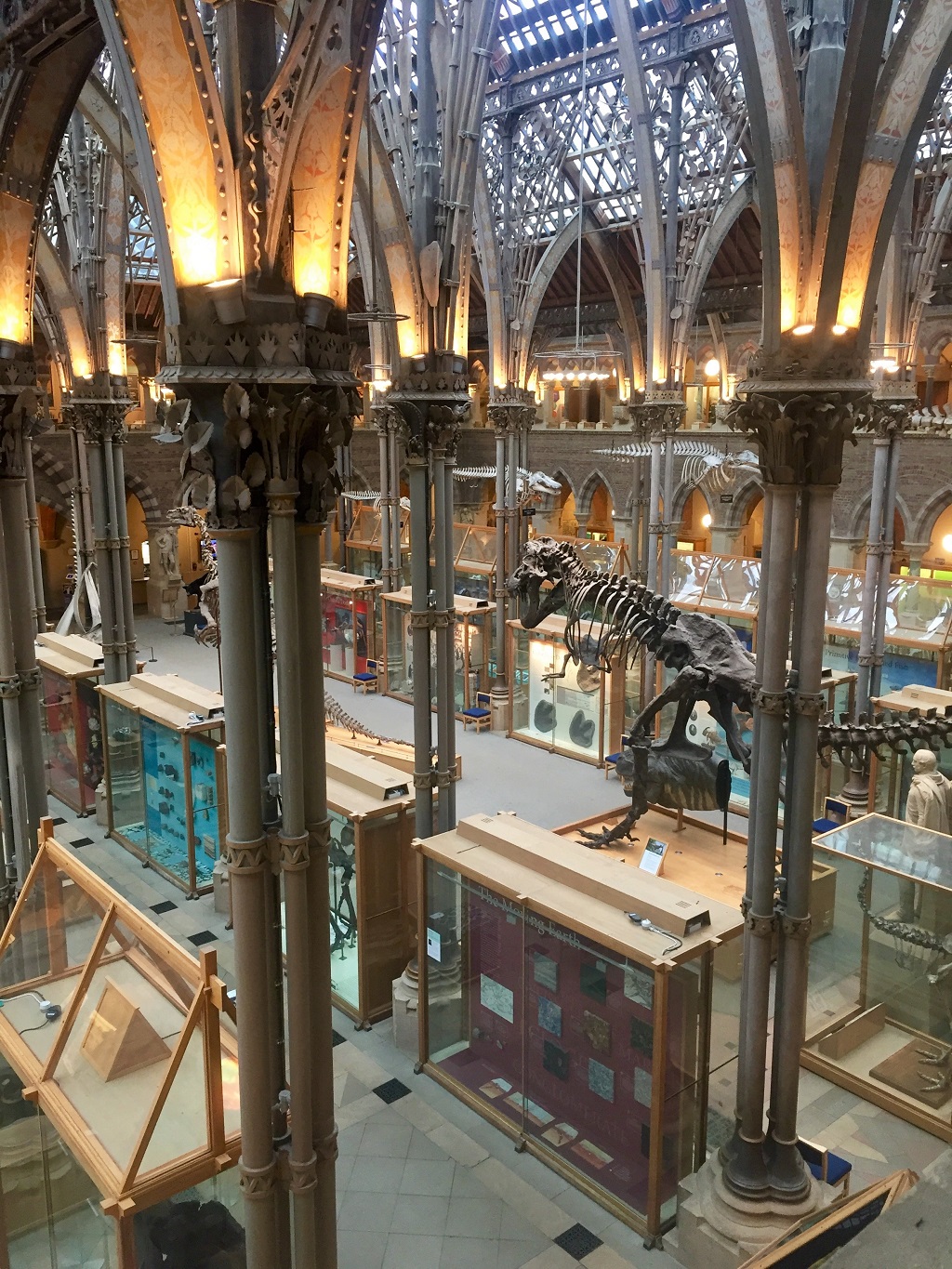
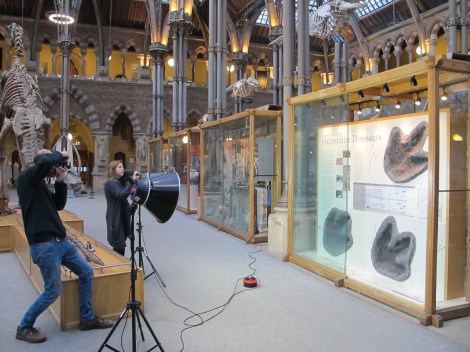
The museum in late 2019

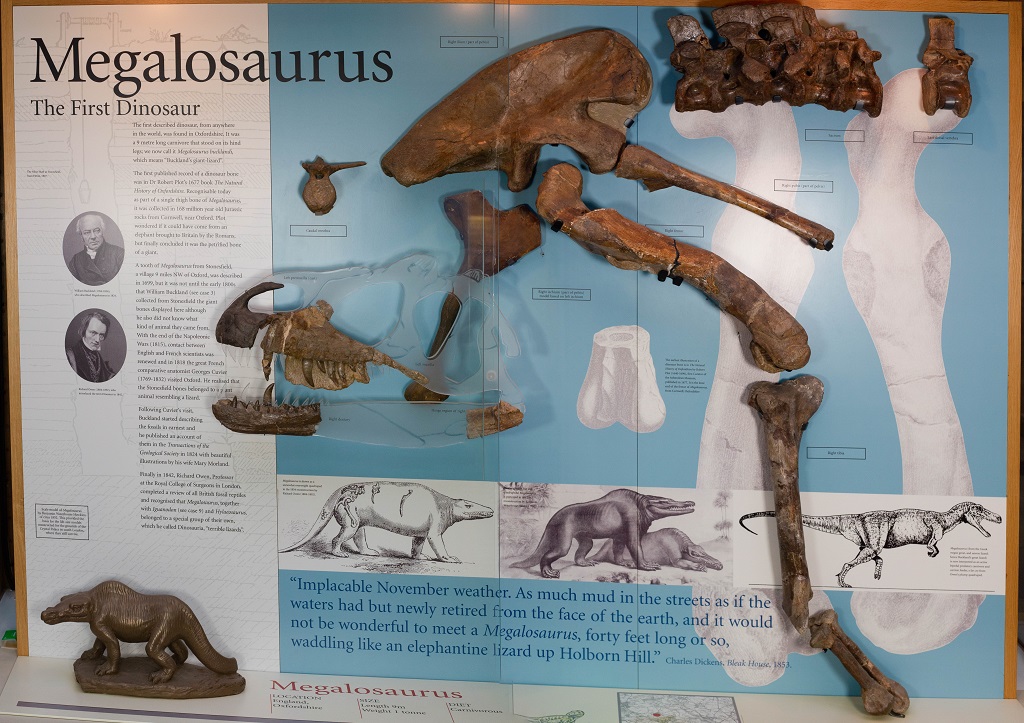
The displays as we know them – with exhibitions on the Oxfordshire dinosaurs, Alice in Wonderland, the Oxford Dodo, and more – were last changed in 2000. For the last 20 years visitors to the Museum would remember their first time being wowed by the Megalosaurus jaw – the world’s first scientifically-described dinosaur – or charmed by the Dodo made famous in Lewis Carroll’s Alice Adventures in Wonderland.

Although after 20 years it is time for a change, the stories and information in the displays are too good to be forgotten. So before anything was removed we began to build the archive for the future.

A display of the fossilised remains of Megalosaurus
The previous display on Megalosaurus: The First Dinosaur

The best way to capture all the information of the displays was through high resolution photography, but this was not as straightforward as we hoped.

The first two obstacles to good photographs are pretty obvious to anyone looking at the cases: glass causes huge amounts of glare; and each case has a big dividing line down the centre where the two sliding glass doors meet, cutting what should be a lovely seamless image into two halves.

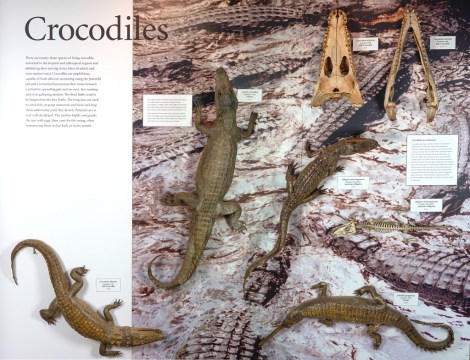
To avoid glare and the solve the problem of the dividing line, our photographer Scott opened each individual side of the case, photographed two or three images of the display, and then stitched the separate photos together using Photoshop.

Each case was photographed in two or three segments

The segments were then stitched back together and adjusted for exposure and colour balance to create the final image

Another obstacle to taking good photographs of the displays came from the Museum itself. Some of our larger display furniture, such as the glass case for the Atlantic Bluefin Tuna or the huge T. rex plinth – got in the way of a nice straight shot. Because these items are so large and heavy they were impossible to move, so we had to improvise and do our best.

Capturing the displays before the current cases were removed allowed us to keep an archival record of their contents

Thankfully, we managed to get shots of all 24 displays before they were removed and so a record of each case now rests with the Museum’s archive. If anyone wants to know what the display cases in the court looked like from 2000 to 2020, they will now be able to look back at the images in the archive and recall the magic of the Oxford Dodo exhibit that perhaps first made them fall in love with the Museum.

Our new displays are now in development, and will include some beautiful presentations of the diversity of life, looking at the importance and fragility of biodiversity and human impact on the environment. These new exhibits will show how the biological processes of evolution combine with the geological processes of our dynamic Earth to give rise to the immense, interconnected variety of the natural world.

We look forward to telling you more about that here as the project progresses.

The Life, As We Know It redisplay project is supported by a generous grant from FCC Communities Foundation.

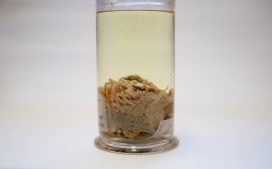
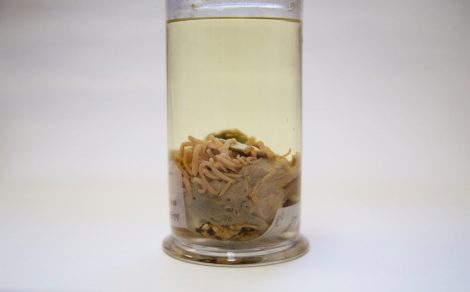
Close up of OUMNH-ZC-7483 Section of blue whale intestine with mysterious acanthocephalan parasites

Worms of Discovery

By Mark Carnall, Life Collections manager

The Museum’s zoology collections contain a dizzying diversity of animal specimens. It is a collection that would take multiple lifetimes to become familiar with, let alone expert in. So we benefit hugely from the expertise of visiting researchers – scientists, artists, geographers, historians – to name just a few of the types of people who can add valuable context and expand our knowledge about the specimens in our care.

Earlier this year, Dr Andrew McCarthy of Canterbury College (East Kent College Group) got in touch to ask about our material of Acanthocephala, an under-studied group of parasitic animals sometimes called the spiny-headed worms.

Although there are around 1,400 species of acanthocephalans, they are typically under-represented in museum collections. Dr McCarthy combed through the fluid-preserved and microscope slide collections here, examining acanthocephalan specimens for undescribed species, rare representatives and unknown parasitic associations.

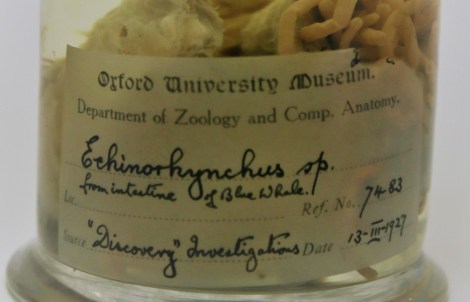
Close up of OUMNH-ZC-7483 Section of blue whale intestine with mysterious acanthocephalan parasites

One such specimen, catchily referenced OUMNH.ZC.7483, was of particular interest. It is a section of blue whale intestine packed with acanthocephalan adults, labelled ‘Echinorhynchus sp. “Discovery Investigations”’, and dated 13 March 1927. Drawing on his expert knowledge, Dr McCarthy spotted an unusual association here because the genus Echinorhynchus was not known to infect Blue Whales, meaning the specimen could represent a species to new science.

However, identifying different species of acanthocephalans cannot be done by eye alone, so Dr McCarthy requested to remove one of the mystery worms from the intestine and mount it on a slide to examine its detailed anatomy. When we receive a destructive sampling request like this it triggers an investigation of the specimens in question: we need to weigh up their condition, history, and significance against the proposed outcome of the research before we decide whether the permanent alteration of the specimen justifies the outcome.

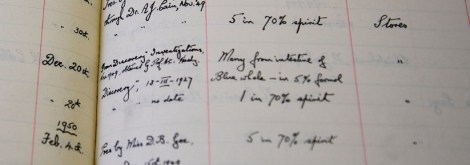
Image of Oxford University Museum of Natural History zoology collections accession register entry for this specimen showing the donation of the specimen and collector information.

This particular investigation began to yield a much richer story than the Museum’s label suggested. It turned out that the specimen was collected by Sir Alister C. Hardy who was serving as zoologist on RRS Discovery’s scientific voyage to the Antarctic. Fortunately, Discovery’s scientific findings were meticulously documented and published by many libraries of the world, including the fantastic Biodiversity Heritage Library where it was easy to find the report mentioning acanthocephalans collected during the voyage.

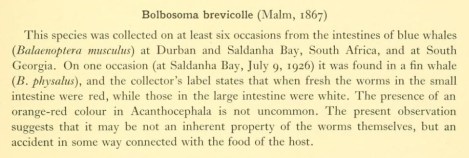
Alongside descriptions of acanthocephalans from seals, dolphins and icefish there is no mention of Echinorhynchus sp. from Blue Whales, though there are a few references to another genus, Bolbosoma, collected from Blue Whales on seven occasions: a single individual of Bolbosoma hamiltoni, so obviously not this specimen, and six occurrences of Bolbosoma brevicolle from the intestines of Blue Whales from South Africa and South Georgia.

These specimens and others reported in the Discovery reports. Image from Biodiversity Heritage Library

Piecing together the evidence, the association with Hardy, the dates, and the descriptions of RRS Discovery’s acanthocephalans, it seems likely that our specimen is one of the six samples of Bolbosoma brevicolle and not Echinorhynchus at all. So in this instance we decided not to grant destructive sampling as the likelihood of identifying a new species seemed much lower when all the information was brought together.

Although sampling wasn’t granted, Dr McCarthy was delighted that his initial research request had prompted the discovery of some important historical connections to the humble specimen, and the new identification seemed to fit.

We still weren’t sure when or why this specimen was mislabelled some time between the Discovery reports and its donation to the Museum in 1949, so Dr McCarthy conducted some further investigations. He found out that Echinorhynchus was the original name combination for Bolbosoma brevicolle, and that H. A. Baylis, a parasitologist and author of Discovery reports, had links with the University of Oxford.

This story is just one example of how visiting researchers enrich knowledge and information about our collections, and it illustrates nicely why our work with broader research communities is so important.

On the trail of the Piltdown hoax

The latest display in our single-case Presenting… series takes a look at the famous Piltdown Man hoax, and Life Collections manager Mark Carnall tells us how the display came about…

Visiting researchers to the zoology collections at the Museum often give us an excuse to dig deeper into our own material, and one such recent enquiry led me into the intriguing story of the Piltdown Man hoax.

Professor Andrew Shortland from Cranfield University contacted us to enquire about the Piltdown Man material in our collections, as part of research for a book on hoaxes and forgeries in anthropology that he is writing with Professor Patrick Degryse of KU Leuven.

I knew we had some Piltdown material here thanks to this page written by Malgosia Nowak-Kemp, but I hadn’t had an excuse to investigate any further. The enquiry was also timely as we’d just transferred a collection of palaeoanthropology casts, models and reconstructions from our Earth collections to bring our human collections into one place. I knew from our move project team that there was some Piltdown material awaiting processing – perfect.

For those who don’t know the Piltdown Man story, a short history is in order. In the early 20th century, amateur fossil hunter Charles Dawson brought a collection of human remains excavated from gravel pits in Sussex to the attention of Arthur Smith Woodward, then Keeper of Geology at the British Museum (Natural History). Woodward and Dawson collected further material and presented the remains as those of Eoanthropus dawsoni (‘Dawson’s dawn man’), an important fossil human from Britain.

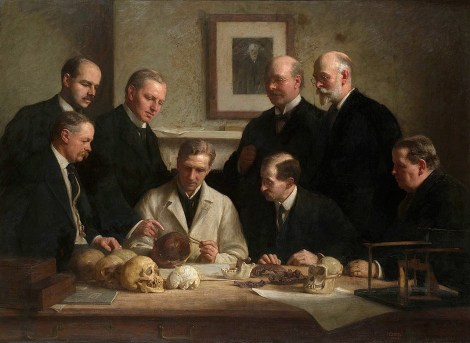
Group portrait of the Piltdown skull being examined. Back row (from left): F. O. Barlow, G. Elliot Smith, Charles Dawson, Arthur Smith Woodward. Front row: A. S. Underwood, Arthur Keith, W. P. Pycraft, and E. Ray Lankester. Charles Darwin looks on from a portrait on the wall. Image via Wikipedia.

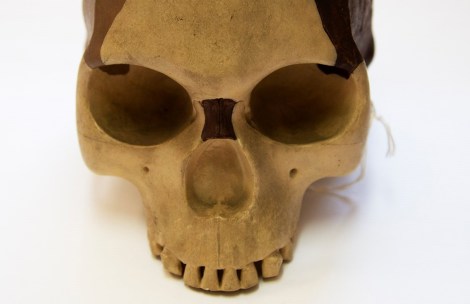
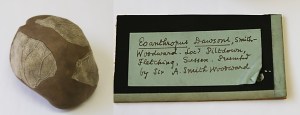
R.F. Damon-produced endocast and associated label recording the presentation of this specimen to the Museum by Arthur Smith Woodward

The discovery looked set to put Britain on the map when it came to evidence of human evolution, but suspicions were quickly raised about the authenticity of the material. Such was the skill of the forgery – meticulous breaking, abrading and staining of various archaeological and historic specimens – that it wasn’t until dating techniques, chemical analyses and some experimental palaeoanthropology in 1953 that the hoax was conclusively put to bed.

In turned out that the Piltdown ‘remains’ were a mix of medieval bone, an orangutan jaw, and chimpanzee teeth maltreated to look like an evolutionary intermediate between humans and other apes.

For 40 years or so the hoax refused to go away and numerous casts, models and reconstructions of Piltdown Man were made, sold, exchanged and gifted to museums and universities. These included casts of the original material as well as reconstructions of the skull and even reconstructions of the endocast – a cast of the inside of the skull.

The Museum has a selection of this material, but as Professor Shortland examined the collections, two specimens stood out.

The first is an R. F. Damon-produced endocast presented to the Museum by Arthur Smith Woodward himself. Smith Woodward was known as an expert on fossil fish but published widely on zoological topics. As a scientist of some repute there’s been long-standing speculation about his role in the hoax. Was he wholly duped by Dawson, or was he in on the hoax from the beginning? If it’s the former, then the presentation of this endocast shows Smith Woodward disseminating research he presumably took some pride in. If it’s the latter, perhaps it was a way of cementing the hoax as legitimate by spreading specimens far and wide.

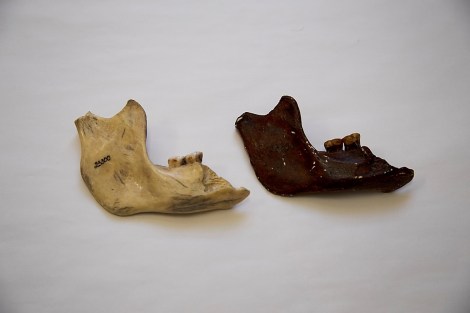
Joseph Weiner’s experimental fake created by modifying an orangutan jaw, alongside a cast of the Piltdown jaw

The second significant specimen is a worked orangutan jaw produced by Joseph Weiner, one of the three authors who debunked the hoax in a 1953 Nature paper titled The Solution of The Piltdown Problem. Weiner modified the orangutan jaw to replicate the original hoax specimen. Thanks to Professor Shortland’s knowledge of the hoax, he sent through a copy of Weiner’s book on the Piltdown Man where this exact specimen is pictured.

The Piltdown Man hoax wasn’t the first and certainly won’t be the last hoax, fake or forgery in the history of science, but it remains one of the most well-known and stands as a warning of the dangers of hubris in the discovery and description of the natural world.

The Weiner jaw and Damon endocast will be on display alongside other Piltdown Man material in our Presenting… case from 9 January to 8 March 2020.