
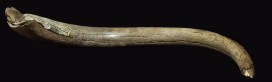
Mammoth tusks and cocktail sticks

By Pete Brown, Move Project Assistant

As part of the Museum of Natural History Move Project Team I have helped move and repackage tens of thousands of specimens since 2017, removing boxes filled at any time over the last 150 years from their old storage location in a deconsecrated church building near Oxford.

At our new facility we have been documenting and repacking the contents in new, clean containers and placing them in environmentally stable, safe warehouses specially adapted for museum storage.

Some objects are trickier to store than others. Things that are long, heavy, curvy and fragile are tricky. Mammoth tusks are long, heavy, curvy, and fragile. This means:

  1. They’re not going to fit in a normal box.
  2. They’re going to be difficult to move around.
  3. That beautiful curve will mean that all the weight of the tusk may be bearing down on just two small contact points where the tusk meets the storage surface.
  4. Because those points are fragile, they’re likely to get damaged.
A lot of weight can rest on small areas of the tusk, putting strain on the specimen and potentially causing damage

The tusk in this article is a prime example. The area nearest the camera in the photo above provided just a tiny point of contact with the floor and was very loose, almost to the point of detaching. It needed to be repaired, and stored in such a way that it wouldn’t get damaged again.

Pete Brown carries out delicate conservation work on the mammoth tusk

I filled some of the missing areas around the fragile area with an easily removable fine acrylic putty to prevent further movement and loss of the original material. A cotton tape sling helped to suspend the fragment in place during the work.

Thick plastazote provided a sturdy, slightly yielding bed for the tusk to lie on in storage, but to prevent the tusk from getting damaged again more needed be done to reduce the pressure on the points of contact.
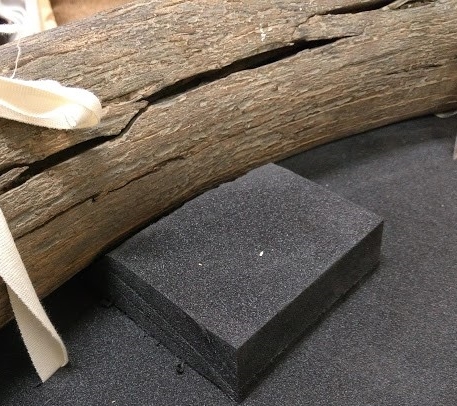
The dark grey foam material, plastazote, is often used as a cushioned support for museum objects

I cut depressions into the plastazote where the tusk naturally lay to increase the total surface area supporting the weight of the tusk, and fixed plastazote wedges and supports in place with cocktail sticks to again increase the contact area and prevent movement. Cotton fabric ties, fed through slits in the plastazote, also helped to guard against unwanted movement.
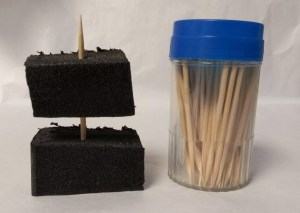
Cocktail sticks: not just for cheese and pineapple

The repaired end of the tusk is now only supporting a fraction of the weight it used to, and once the tusk and the plastazote bed are placed into their new custom-made crate it will be ready for long-term, safe, damage-free storage!
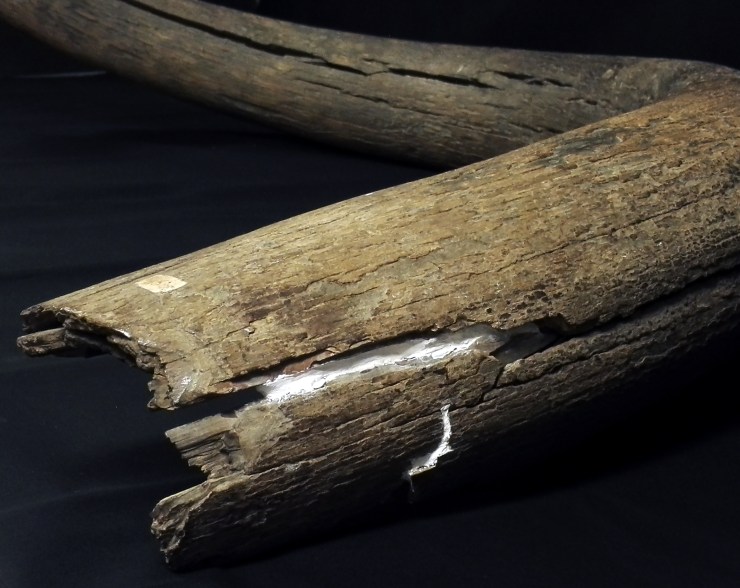
The end of the tusk after treatment

To keep up with all the move project action, follow the museum hashtag #storiesfromthestore on Twitter @morethanadodo.


Temporarily misplaced

When I started work on the Lyell project in July of this year, I was very keen to know more about the history of the collection, both before and after it arrived at the museum. Collections often arrive at the Museum with associated material such as catalogues, letters or notebooks and after they arrive any activity related to the collection should be documented.

The first step in investigating the history of the collection was to find out what was in the Museum’s records. I began by looking at the donors database; this recorded the date that the Lyell collection arrived (1903) and the donor, Sir Leonard Lyell, Charles Lyell’s nephew. There was a little more information in the donors card index, which mentioned the fact that the collection came in two parts, the bulk of the collection in 1903 and then additional Italian specimens in 1907. The Collections Manager, Eliza Howlett, also directed me to the annual reports of the Museum for 1903 and 1907, which noted the two donations, and to the Earth Collections Lyell file, but this started in the 1960s and was entirely related to the use of the collection.

I wondered if there was a book of acquisitions that recorded the information that went into the annual reports. A colleague had vague memories of some early donation books, so I decided to go on a hunt to see if that would yield more information. I checked many shelves, climbing up ladders and peering into boxes all over the Museum. My search eventually narrowed down to a cupboard full of folders taken from a former curator’s office. The donor book was there (and interestingly included library books as well as fossils) but it started in 1929 so it didn’t cover the years that I was interested in. I delved further into the pile and noticed that a tattered box file was labelled “Lyell Collection” among other things. Bingo!

Or so I thought. After carefully searching through the box, there was nothing Lyell related at all. There was quite a bit of space, so clearly something had been removed. I kept on searching, roping in various colleagues to help me think of new possibilities, which involved more ladders and delving into cupboards that hadn’t been disturbed for years. I found some interesting things but nothing on Lyell and I started to think that whatever had been in the file was already in our Lyell folder.

Then one day, a month or so later, I came in to work to find a mysterious cardboard box on my chair. Inside was some old notepaper, photocopies of most of the 1980-1990s catalogues, and a marble bound notebook with “Lyell Collection” on the front. It was the missing piece! It took me a while to work out where it came from but it turned out that one of our Honorary Associates had found it on the top of a filing cabinet while looking for something else.

Photograph of original Lyell Collection catalogue
Original Lyell Collection catalogue

It was fascinating to read. Inside was a complete, drawer by drawer listing of the species and localities of specimens from the collection. There were references to the places in which they were published, and references for further information as the cataloguer worked out where the localities were and how the stratigraphy fitted together.

The book contained two sets of handwriting. it became clear that this was a document created after the collection was presented to the Museum, as we identified the first set as that of Maud Healey, who worked as Assistant to Professor W.J. Sollas, Keeper of the University Museum, between 1902 and 1906. We know that she did a lot of cataloguing and arranged displays, and the 1903 annual report gratefully notes how the “work of reorganization of the fossils of the Museum Collection … has … progressed … at a much more rapid rate during this year, a result entirely due to the devoted efforts of Miss Healey.”

It seems Miss Healey may have pushed herself too hard; the 1906 annual report notes that the ” Professor regrets to have to record the loss of the invaluable services of Miss Healey, who as a result of overwork has been recommended to rest for an indefinite period. This will prove a serious check to the rate of progress which has for some time been maintained in the work of rearrangement, and it is to be hoped that her retirement may be only temporary. ”

We haven’t yet identified the second set of handwriting, but the owner recorded the specimens that arrived after 1907, when Miss Healey had left. We suspect that it belongs to a C.H. Dunham or Durham, whose name is written on the book along with the date December 1907, but research so far hasn’t come up with any more information. If anyone reading this recognises the name or can suggest anywhere to look, we would love to hear from you!