A poetic ending

steven-matthews

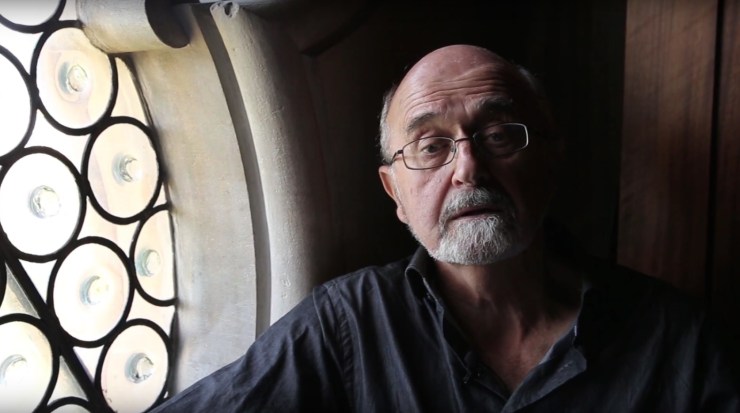
Steven Matthews, one of our three Poets in Residence, reflects on his residency at the Museum during our Visions of Nature year.

It is sad that our poetry residency is at an end; I shall miss the frequent escapes for the hustle of the everyday Oxford streets into the light and space of the Museum.

As a resident in Oxford for over twenty years, I had gradually accumulated a bit of knowledge about the building. I had, like so many local parents, hugely enjoyed taking our two sons there when they were young, and loved to see their delight at the displays. Seeing the fossil, mineral, and animal world, as it were, through their eyes, really re-engaged me with its wonders.
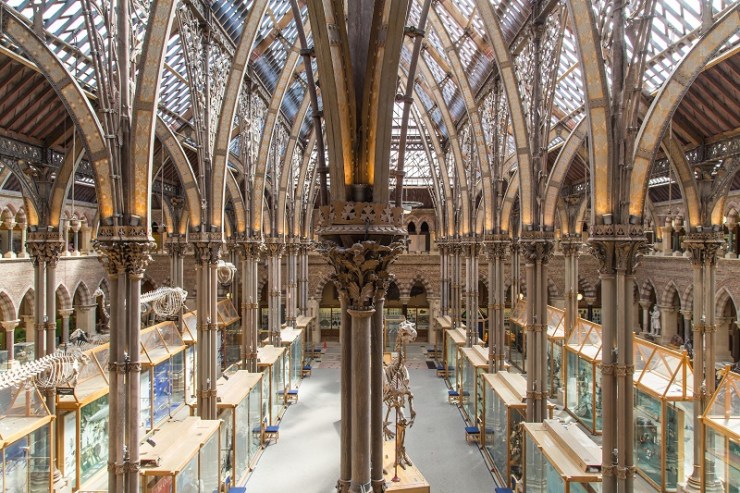
The Museum's centre court
The Museum’s centre court

I have been very privileged, then, to go ‘behind the scenes’ at the Museum, and to speak to the scientists engaged in research into its collections and history. They are bringing new knowledge and understanding to bear at a moment when, let’s face it, humankind has inflicted catastrophe upon the natural world, and so upon itself.

The Victorian spirit and vision which instigated the building of the Museum, a spirit revelling in creation and in exorbitant creativity, seems very remote. This is tragically borne home when looking at the cabinets of butterflies and moths, the Lepidoptera, where the majority of the specimens are of species that no longer exist.
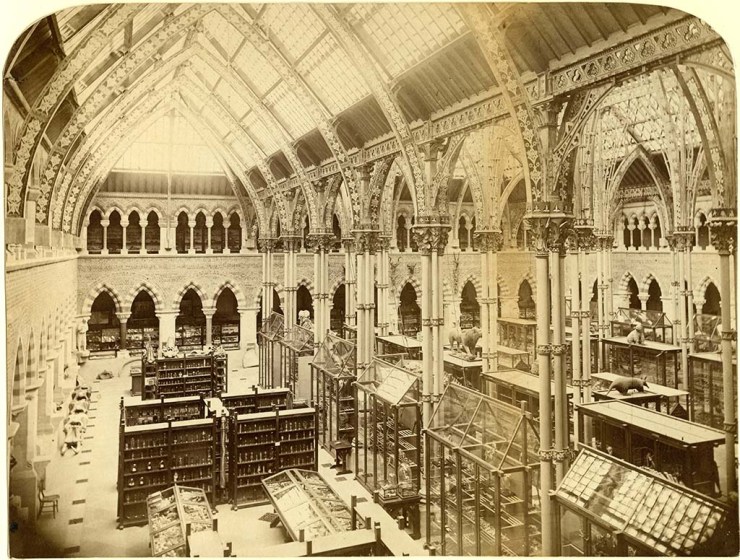
xcgfdfdg
A photograph from the Museum Archive showing the construction and layout of the building in the mid-19th century

The prime mover behind the Museum, the Victorian Henry Acland, said in an early promotional lecture that the ambition behind it was to show that all branches of science needed to work together to produce a greater understanding of the world. The zoologist could not understand the physiological structure of animals without deploying information and knowledge held in common with the geologist and the anatomist.

The Museum should be a place where that type inspiring dialogue could occur daily. It feels as though we are in a moment now where that collaboration, and collective and imaginative ingenuity, is hard-pushed to find solutions to the divided interests and dire afflictions of the world.

The Visions of Nature year at the Museum, which brought artists and us poets together with the scientists, has been one way in which all of these things have been, for me excitingly, furthered. It has been a challenge and a thrill to imagine and write – ‘in their own voices’ –  lives for some of the Museum’s specimens which have particularly fascinated or moved me. But also a great delight, for which I’ll always be grateful.
The power of real

mnh-badger

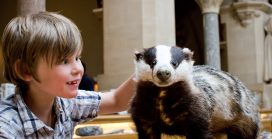
Of all the questions that curious children ask about specimens in the Museum, the most frequent by far is ‘Is it real?’. It’s a surprisingly complex question, mixing ideas of authenticity with more basic confusion over whether something is, was, or wasn’t ever alive.

So what do children make of all the weird and wonderful things on display in museums and how does it affect their experiences? Research by psychologist Dr Louise Bunce aims to find out, as she explains here…

If you want to know when dinosaurs roamed the Earth, or how bees extract nectar from a flower, or what meteorites are made of, what would you do to find out? Search the web perhaps? The answers to all these questions, and many more besides, can be found on the internet, so why visit a museum instead to learn about the natural world?

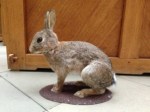
Example animal used in the research - Oryctolagus cuniculus and the toy rabbit
A taxidermy rabbit (Oryctolagus cuniculus), used in the research in the Museum…

Despite the wealth of information available online, the objects in museums continue to captivate visitors and offer something that the internet can’t. There’s something about ‘the real’ that has a certain power. Standing close to, and sometimes even touching, the genuine article – whether that be the head of a Dodo, or a painting by a Dutch Master, or a fossilised dinosaur skeleton – can induce goose bumps in museum visitors. But where does this potent effect come from?

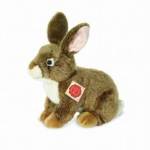
... and a soft toy rabbit. Even younger children know the toy rabbit is not 'real'.
… and a soft toy rabbit. Even younger children know the toy rabbit is not ‘real’.

To begin to look at this question I have studied the importance and understanding of the ‘real’ in children visiting museums. When do children develop an understanding that they are looking at the real thing as opposed to a copy or model?

I conducted research with children visiting the Oxford University Museum of Natural History to see whether they understood that displays are of genuinely real animals, not manufactured models or replicas. And if they think they are models, how does that affect their experience?

The results were quite striking. Most 4- to 5-year-olds believed that the animals on display were not real because they were not moving, or because they were not alive. Consequently their reaction was somewhat dismissive.

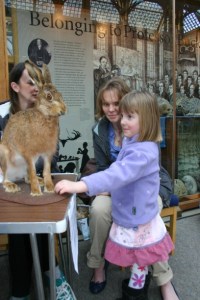
A child participating in the research at the Museum

In contrast, most older children, those from the age of around 8 years, said that the animals were real because, for example, they had the real animal’s fur, or other authentic features. These children were also more curious about the animals because they were more likely to ask a question about the displays than children who perceived the specimens as not real.

So if younger children were missing out on the power of the real, I wondered whether there was something we could do to help them. I repeated the experiment but this time introduced children to toy animals and asked them to compare them to the museum animals. Now the majority of 4- to 5-year-olds seemed to gain a sense of awe because they perceived the museum animals as genuinely real in comparison to the toys, which they knew were not real.

These experiments seem to indicate that children do not necessarily perceive museum objects in the same ways as adults, but that we can help to give them meaningful encounters with museum specimens to create an inspiring museum visit. So don’t just Google it – grab the kids, a cuddly toy prop, and get down to the museum – or indeed out into nature – to be inspired by the real.

AAA (Adam Apprentice Award)

Edmontosaurus re-instate 011

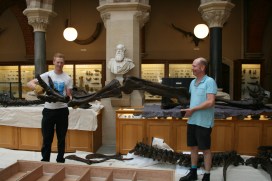
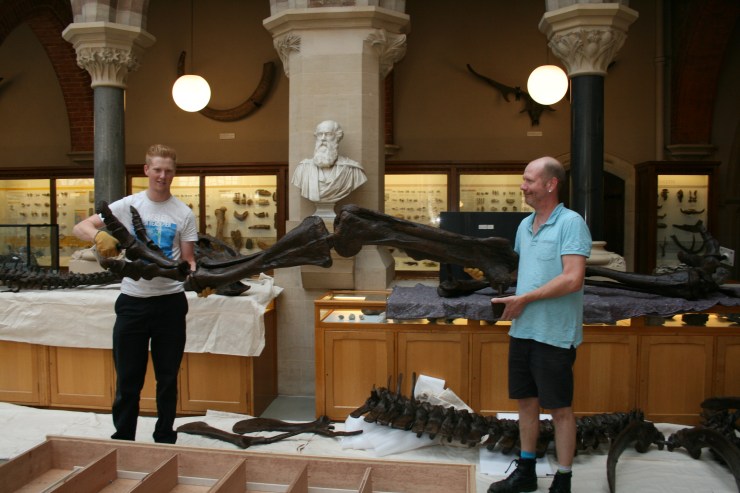
Last year we introduced you to Adam Fisk, our (then) new apprentice. He’s the slightly younger-looking one in the photo above; on the right is Pete Johnson, the Museum’s technician and Adam’s mentor and supervisor. Together, the two are a vital component that keeps the Museum machinery a-turning.

Over the past twelve months or so Adam has busied himself with many vital tasks: installing and de-installing our exhibitions, including Kurt Jackson’s Bees (and the odd wasp) in my Bonnet and Microsculpture; reconstructing an Edmontosaurus; and, more recently, sporting an excellent Star Wars Christmas jumper.

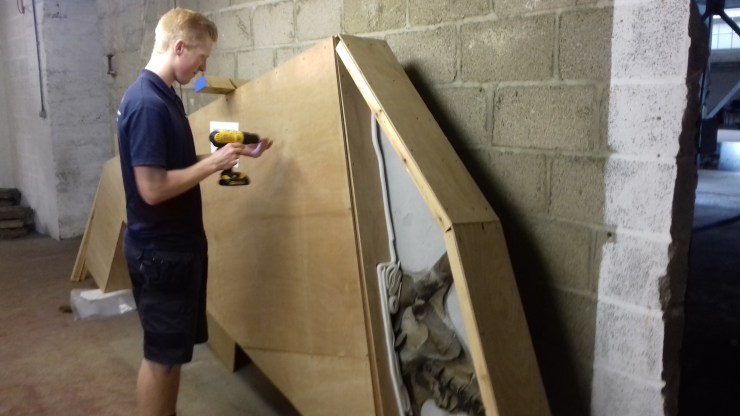
Packing an Attenborosaurus ready for transit

We’re therefore exceptionally pleased to announce that Adam has just been selected as a winner in the Annual University of Oxford Apprenticeships Awards. This calls for a small whoop, and a large ‘Well done Adam!’.

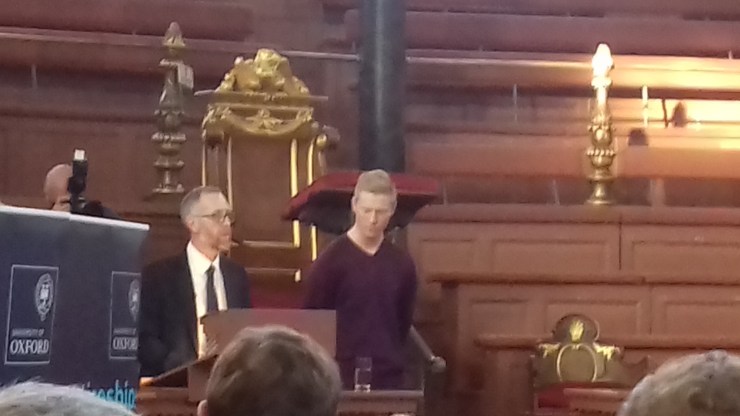
The awards, which celebrate the achievements of the University’s apprentices, supervisors and departments, were given out at a ceremony at the rather grand Sheldonian Theatre this afternoon.

Adam collecting his award at the Sheldonian Theatre in Oxford

When Adam joined the Museum last summer for his three-year apprenticeship he had just finished his GCSEs. Now he’s walking the stage at the Sheldonian… As Pete says:

Adam’s contribution to all aspects of work from maintenance and workshop demands to exhibition installation and Collections assistance has been outstanding. We have all benefitted greatly from his input, and he has helped us to achieve a high standard of public service.

Thanks for all the hard work Adam and we look forward to the next 18 months with you on the team.

The stars our destination?

john-barnie

John Barnie, one of our three Poets in Residence, reflects on claims that the future of life from Earth lies deep in the Solar System…

In a recent article in The New York Review of Books, physicist Freeman Dyson speculates that in three or four hundred years it may be possible to seed promising planets and moons in the solar system with organisms genetically engineered to withstand their harsh conditions, eventually transforming them into environments which could support humans – fleeing, perhaps, from an irreparably damaged Earth.

297191main_enceladus_full
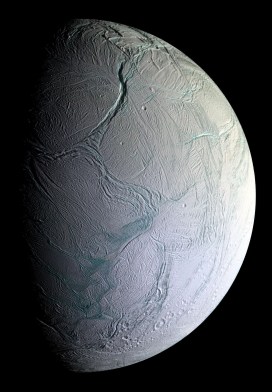
Does Saturn’s moon, Enceladus, offer a viable site for the seeding of life? Image: NASA/JPL/Space Science Institute

Saturn’s moon Enceladus is one example he gives; geysers pierce its hostile icy surface, and Dyson hypothesises a warm sea hidden below. The process would be achieved by landing ‘pods’ of self-sustaining life forms – ‘Noah’s Arks’ he calls them. The rocket technology is well on its way, he argues, and will be perfected by small cost-effective space companies rather than lumbering giants like NASA. Biotechnology, too, will develop by leaps and bounds to produce, for example, ‘warm-blooded plants’ that would absorb energy – on Saturn’s moon Enceladus, say – concentrated from starlight and the distant rays of the Sun.

In the increasingly stressed and chaotic twenty-first century, it is impossible to predict what will happen in two or three years, let alone two or three hundred. In the meantime, while Professor Dyson elaborates his techno-fantasies, we are here, on the only Ark we have, and the only one, I’d say, we are ever likely to have.

asfas
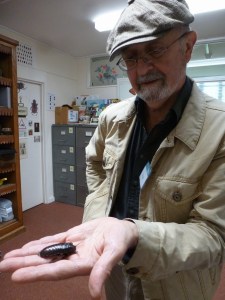
John Barnie meets some of our live residents, the Madagascar Hissing Cockroaches, during his residency at the Museum

My year at the Museum has been a fascinating and unforgettable reminder of this, the Museum itself forming an ark within an ark, celebrating the extraordinary diversity of multicellular life as it evolved over 650 million years. Many of its specimens, of course, represent extinct species, and they, too, are a reminder – of how life on Earth is fragile but also robust, endlessly reacting and adapting to changing circumstances. Life has survived at least five mass extinctions in the geological record, and will survive the largely human-induced one many biologists and naturalists, from Niles Eldredge to David Attenborough, think we are entering now – though our species may not be around to see what gets through the inevitable extinction bottleneck.

For techno-utopians like Freeman Dyson, the future is out there in space, not here where we evolved, where we have the grounding of our being. The new biotechnology, he argues, will have to be perfected on Earth first, filling ‘empty ecological niches’. They may, he suggests, ‘make Antarctica green before they take root on Mars’. There are so many things wrong with this it is difficult to know where to start. Luckily for us, the Museum of Natural History represents a very different vision of the Earth, its creatures, and our place among them.

Nature’s medals

By Sarah Joomun, Documentation officer

In the 1820s a young geologist named Charles Lyell travelled around France studying the landscape and rock formations to try and work out the processes that created them.

In between these field-trips, he met the people who had been studying the geology of France and from these discussions and his observations he created The Principles of Geology, one of the first significant popular science books on the subject and a foundation for the methods of modern geology.

pal_cl01718_01

Lyell collected many samples from the rocks he studied, amassing thousands of fossils during his lifetime. The Museum has a collection of some 16,000 of them, around 90 per cent of which are shells, mostly gastropods (snails) and bivalves (clams), many collected during his travels in France.

The reason for this prodigious collection of fossil shells, or testacea as they were then known, was that Lyell believed them to be the most useful clue to understanding the Earth’s history.

The testacea are by far the most important of all classes of organic beings which have left their spoils in the subaqueous deposits : they are the medals which nature has chiefly selected to record the history of the former changes of the globe.

– Lyell’s Principles of Geology, Vol III, 1833.

Fossil shells can show how the animal that lived inside the shell behaved, and whether it lived on the land, in freshwater or in the sea. Species of shelled animals have a wide geographical range and individual species survive for a long time, so they can be compared across time and space.

pal_cl01742_02

This allowed Lyell and his colleagues to determine the relative ages of the rock layers that the fossil shells came from. He looked at the proportion of shells that belonged to living species and determined that the rock layers with the lowest proportion of living species were likely to be older than rocks with higher proportions of living species.

And so three main groups of rock layers were found: the Eocene, containing fewer than 4% living species; the Miocene, with fewer than 18% living species; and the Pliocene, with more than a third of living species.

Although what is now known as the Eocene (from 56 to 34 million years ago), Miocene (23 to 5.3 million years ago) and the Pliocene (from 5.3 to 2.6 million years ago) don’t denote exactly the same periods as Lyell described, we still use these terms for some of the youngest geological epochs today.

Tales from the Jurassic Coast

marybuckland_philpot_2

Britain’s Jurassic Coast is a famous location for fossil hunters. Dorset’s Lyme Regis in particular was a collecting ground for two very important Victorian palaeontologists – Elizabeth Philpot (1780-1857) and Mary Anning (1799-1847) – and the site yielded some of the earliest specimens of Ichthyosaurs and Plesiosaurs.

Last weekend Channel 4’s Walking Through Time series focused on the Jurassic Coast and featured two members of staff from the Museum, Eliza Howlett and Hilary Ketchum from our Earth Collections. To coincide with the programme, Eliza here delves into the Museum’s Philpot archive to paint a picture of the relationship between Elizabeth Philpot, Mary Anning, and Oxford University’s first Reader in Geology, William Buckland.

*

Elizabeth Philpot moved to Lyme Regis around 1805 with two of her three sisters, Mary and Margaret, where they soon became involved in fossil collecting and where they remained for life. At this time Lyme-born Mary Anning was still a young girl, but so began an affectionate relationship with the Philpot sisters which transcended any barriers of age, social origins or educational background.

Caption
A letter from Elizabeth Philpot to Mary Buckland dated 9 December 1833.

As the Philpots’ fossil collection grew it became known in the geological community. One familiar visitor was William Buckland, whose earliest published reference to the ‘Miss Philpots’ is in his 1829 paper on the pterosaur found at Lyme by Mary Anning.

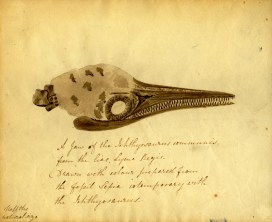
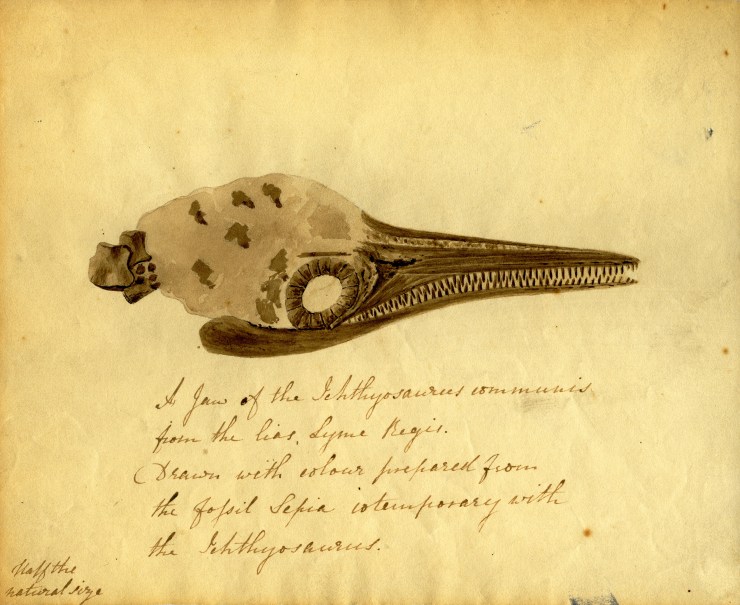
In one letter to Buckland’s wife, Mary, dated 9 December 1833, Elizabeth Philpot enclosed a sketch of an ichthyosaur head that she had painted using ink from a fossil squid of the same age as the ichthyosaur, 200 million years old; this is pictured at the top of the article. The letter also contained a colourful description of Mary Anning’s escapades:

Yesterday [Mary Anning] had one of her miraculous escapes in going to the beach before sun rise and was nearly killed in passing over the bridge by the wheel of a cart which threw her down and crushed her against the wall. Fortunately the cart was stopped in time to allow of her being extricated from her most perilous situation and happily she is not prevented from pursuing her daily employment.

Next, it sends a reminder to William Buckland, a man well-known for forgetting things:

May I beg you to remind Dr. Buckland that he has borrowed from me some Plesiosaurus vertebre. As it is some time since I will mention that it is a section of a vertebre, one with the process, ten others, and a chain set in a box.

These letters from Elizabeth Philpot are now held by the Museum, along with the Philpot collection of around 400 fossils. Mostly from Lyme Regis, this collection includes more than 40 type specimens, the reference specimen for a new species, which is a remarkable total for any collector. A brief list of people known to have examined the collection is practically a roll call of the key figures in 19th-century palaeontology: William Buckland, William Conybeare, John Lindley and William Hutton, Richard Owen, James Sowerby, and (from Switzerland) Louis Agassiz.

But the collection was also made available to the ordinary people of Lyme, and the handwritten labels by Elizabeth Philpot sometimes included detailed explanations of what these extinct animals would have looked like. Both the letters and the specimens remain deeply evocative today, conjuring up visions of what it must have been like to call on these three remarkable sisters.

Because of the risk of light damage the material is not normally on display, but it can be viewed by appointment. Email library@oum.ox.ac.uk or earth@oum.ox.ac.uk for more information.