In our Bacterial World exhibition we offer a selection of ten bacteria that have changed the world, some in profound ways. In this series of short fact-file posts we present one of the ten each week. This week’s bacteria are…
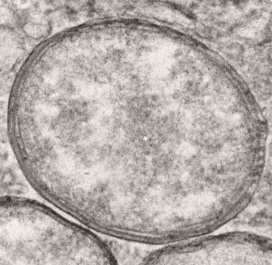
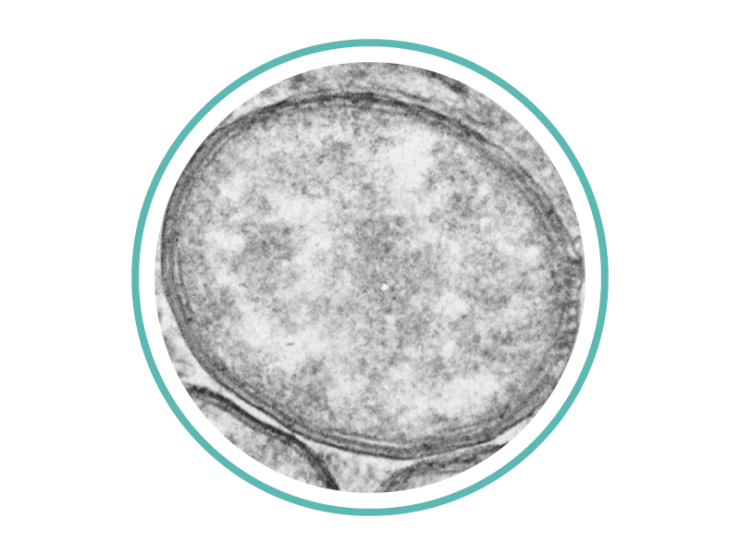
Wolbachia
– the man-killers
Where they live Up to 60 percent of insect species are infected with the bacterium Wolbachia, as are other species such as nematode worms.
Why they are important Wolbachia selectively kills off males in many species of insect and alters the sex ratio of the population to its own advantage. However, some species of insect rely on it for protection against other threats.
How they are named
The bacteria take their name from Simeon Burt Wolbach, who along with Marshall Hertig co-discovered Wolbachia in 1924 in a mosquito.
How they work Infected female insects pass the Wolbachia to their offspring – so the bacteria do everything they can to ensure females survive. Their strategies include killing male larvae, making males infertile, and rendering females able to reproduce without males.
Top image copyright: Joshua Blight (University of Oxford) & Steven Sinkins (University of Glasgow)
In our Bacterial World exhibition we offer a selection of ten bacteria that have changed the world, some in profound ways. In this series of short fact-file posts we present one of the ten each week. This week’s bacteria are…
Escherichia coli
– the medicine-manufacturers
Where they live Millions of Escherichia coli live harmlessly in your gut, keeping more dangerous bacteria at bay. A few strains cause food poisoning.
Why they are important E. coli can act as a protein factory, accepting genes from other species and reproducing them. By combining DNA from more than one source, scientists can manipulate E. coli so that it manufactures human insulin.
How they are named Escherichia coli’s name reflects its discoverer, Theodor Escherich, and the fact that he found it in the human colon.
How they work Bacteria often contain plasmids, extra DNA rings that confer particular properties. Researchers can introduce genes into E. coli using plasmids, enabling the bacteria to make all kinds of biotechnology products from foods to medicines.
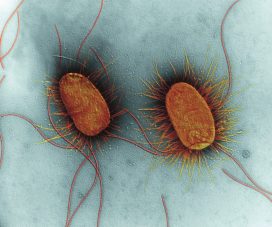
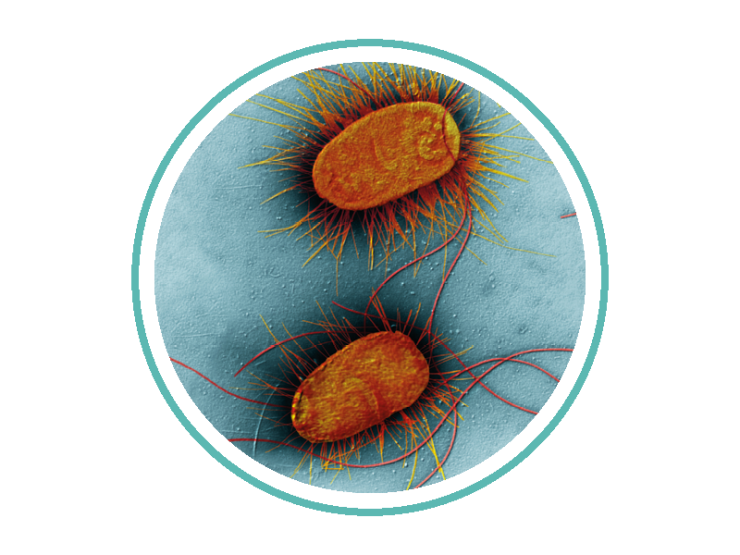
Top image: Coloured transmission electron micrograph (TEM) of two Escherichia coli bacteria. E. coli are Gram-negative bacilli (rod-shaped) bacteria. Long flagellae (thin thread-like structures) are used by the bacteria to move themselves. The spiky filaments on the sides of the bacteria are pili, thin strands of protein used when two bacteria conjugate (transfer DNA). E. coli is a normal inhabitant of the human intestine. However, under certain conditions its numbers may increase, causing infection. Magnification: x17,200 at 10 centimetres high. Copyright: Science Photo Library
Today is the 250th birthday of the remarkable English geologist William Smith, creator of the first geological map of England and Wales – ‘the map that changed the world’. Here Danielle Czerkaszyn, Senior Archives and Library Assistant, tells us more about Smith’s achievements and his relationship to the Museum.
William Smith (1769-1839)
William Smith (1769-1839) began his career as a land surveyor’s assistant in his home village of Churchill, Oxfordshire. He soon travelled the country working on mining, canal and irrigation projects. This gave him the opportunity to observe the patterns in layers of rock, known as strata, and to recognise that they could be identified by the fossils they contained. This would earn him the name ‘Strata Smith.’
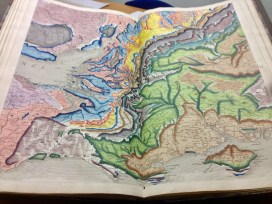
Smith’s observations of strata over hundreds of miles led to the ground-breaking 1815 publication of his map A delineation of strata of England and Wales (pictured top) that ultimately bankrupted him.
Smith’s map set the style for modern geological maps and many of the names and colours he applied to the strata are still used today. While Smith’s accomplishment was undoubtedly remarkable, he was only officially recognised for his discoveries late in life. His lack of formal education and his family’s working class background made him an outcast to most of higher society at the time.
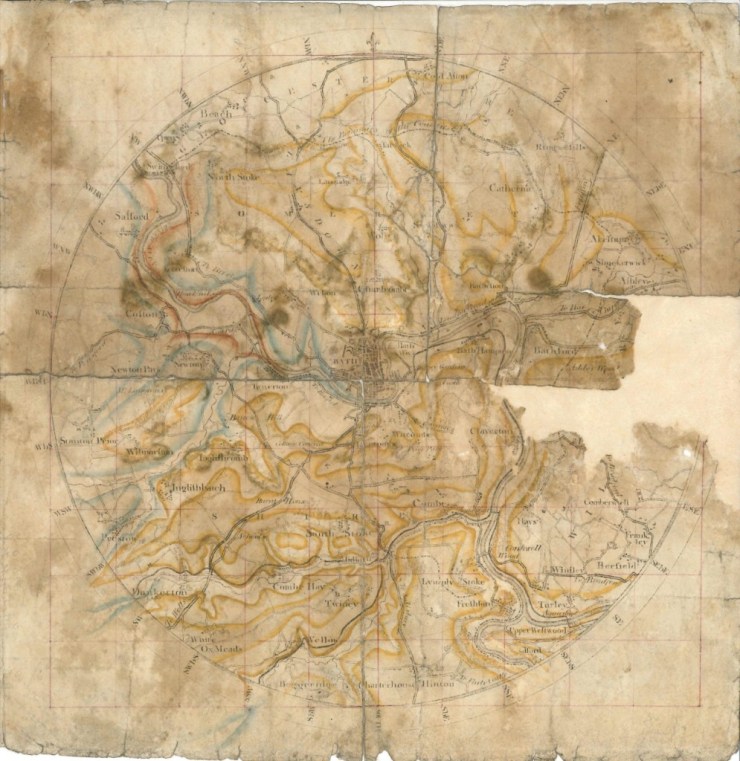
Geological Map of Bath, 1799. This map is considered to be one the earliest geological maps ever created. It demonstrates an early use of Smith’s ‘fading’ colouring technique which emphasised the outcrops of each stratum. The yellow tint represents the Bath Oolite, the blue marks the base of the Lias, and the red the base of the Trias.
It wasn’t until a few years before he passed away that Smith received any recognition for his contribution to the science of geology, receiving a number of awards, including the prestigious Wollaston Medal from the Geological Society of London in 1831, and an honorary degree from Trinity College Dublin in 1835.
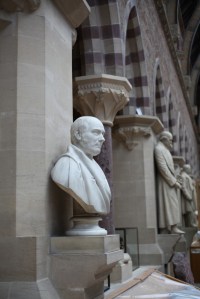
A bust of William Smith is on display in the Museum’s court
His legacy lived on with his nephew John Phillips, one of our Museum’s founders and Professor of Geology at Oxford. Recognising its importance, Phillips left Smith’s archive to the Museum on his death in 1874. Thanks to generous funding from Arts Council England a few years ago, the Smith collection has been catalogued, digitised and is available online to the public.
Few men in the history of science contributed as much, but are as little known, as William Smith. He was a hardworking and determined man who dedicated his life to understanding the world beneath us. So here’s a big Happy 250th birthday to William Smith – the ‘Father of English Geology.’
In our Bacterial World exhibition we offer a selection of ten bacteria that have changed the world, some in profound ways. In this series of short fact-file posts we present one of the ten each week. This week’s bacteria are…
Rhizobium leguminosarum
– the Crop-Boosters
Where they live Rhizobia leguminosarum have a special relationship with plants, living inside little nodules on their roots and receiving shelter and food from them.
Why they are important
In return for its comfortable life, the bacteria bring about hugely increased crop yields. They enable the plant to use nitrogen from the air as a fertiliser, a process called nitrogen fixing.
How they are named
The family of bacteria called Rhizobia got its name in 1889 – it means ‘root living’. Leguminosarum indicates that the species lives in leguminous plants such as peas, beans and lentils.
How they work
The two-way relationship between plants and rhizobia is called mutual symbiosis. Scientists boost crop yields even further by selecting the best strains of bacteria to pair up with plants in specific environments.
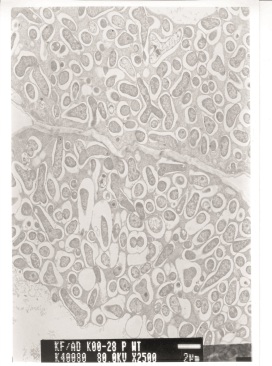
Top image: Electron micrograph of root nodules with Rhizobium leguminosarum bacteria grown by The Rhizosphere Group (University of Oxford)
Copyright: Kim Findlay (John Innes Centre)
This article is taken from European research magazine Horizon as part of our partnership to share natural environment science stories with readers of More than a Dodo. Our Bacterial World exhibition is open until 28 May.
A study in mice has indicated that the make-up of bacteria in the gut is linked with learning abilities and memory, providing a potential avenue of research into how to maintain cognitive functioning as we age.
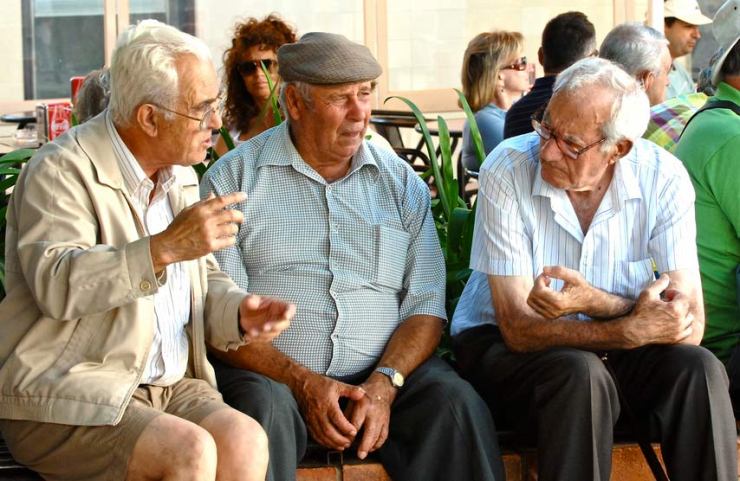
It’s part of a field of research looking at the link between gut bacteria and ageing to help people live healthier lives in old age. The proportion of the EU population aged 80 or over is predicted to more than double between 2017 and 2080, with those aged 65-plus rising from 20 to almost 30%.
However, the connection between the make-up of microbiota in the gut, brain functions and ageing has been unclear – with cause and effect difficult to establish. Dr Damien Rei, a postdoctoral researcher into neurodegenerative and psychiatric diseases at the Pasteur Institute in France, decided to examine the different types of microbiome that appear in younger and older mice to understand better what might happen in people too.
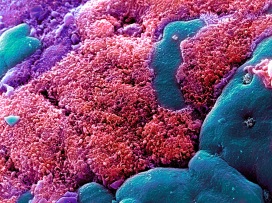
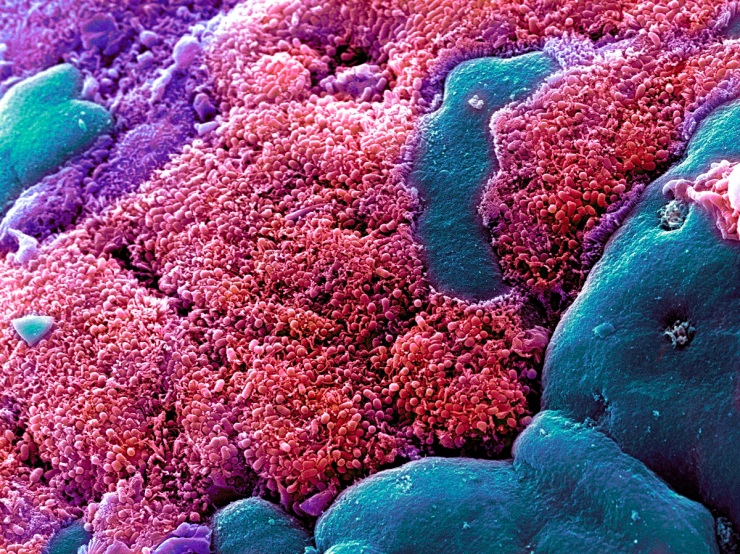
Coloured scanning electron micrograph (SEM) of Escherichia coli bacteria (red) taken from the small intestine of a child. E. coli are part of the normal flora of the human gut, though some strains cause illness.
He found that when he transferred gut bacteria in older mice to young adult mice, there was a strong effect on reducing learning and memory. And when the opposite was done, with older mice receiving microbiota from younger mice, their cognitive abilities returned to normal. The older mice were aged about a year and a half – equivalent to about 60-plus human years.
‘Despite being aged animals, their learning abilities were almost indistinguishable from those of young adult mice after the microbiota transfer,’ said Dr Rei – adding that this indicated strong communication between the gut and brain. ‘When I saw the data, I couldn’t believe it. I had to redo the experiment at least a couple of times.’
Furthermore, by seeing what was happening to the neuronal pathways of communication between the gut and brain when the aged microbiota was transferred to the younger mice, they were then able to manipulate these pathways. By doing this, he says they could block or mimic the effects of the aged microbiota.
Dr Rei’s study, which was carried out as part of a project called Microbiota and Aging, has not yet been published, but he hopes this could happen by the end of the summer. He is also looking into human gut microbiota in older people and those with Alzheimer’s disease, but said it is too early to reveal further details about this research.
Translating
However, Dr Rei pointed out that there is a big challenge in translating results in mice to people, not only because of the significant ethical barriers, but also the differences in physiology. ‘The immune system of a mouse is very different to one of a human. The gut microbiota is also very different because mice eat very different things to what we do,’ he said.
Research is still a long way off from making real inroads into using this type of research to combat neurodegenerative diseases such as Alzheimer’s, says Dr Rei. Indeed, he says, there is no convincing evidence yet that looking at the gut microbiota is the way to go. But he believes the mouse study opens doors to further investigation into mechanisms behind age-related changes.
‘The data on the mice was really the first stepping stone, and it was a way for us to understand the potential of manipulating the gut microbiota,’ said Dr Rei.
Pinning down the link between gut bacteria and ageing is not straightforward, according to Dr Thorsten Brach, a postdoctoral researcher at the University of Copenhagen in Denmark. ‘It’s known that ageing is a multifactorial process and it’s hard, especially when it comes to the microbiome, to separate the effects of ageing specifically from all other aspects,’ he said.
He worked on a project called Gut-InflammAge, which looked at the link between gut microbes, inflammation and ageing, led by associate professor Manimozhiyan Arumugam.
As part of their work, the team investigated the effects of mild periodic calorie restriction in mice to explore the potential impact of healthy-ageing diets involving fasting. Unexpectedly, calorie-restricted mice accumulated more body fat – which the researchers speculate may have been down to overeating between these periods – but also saw a mild ‘rejuvenation’ of their blood profile so it more closely resembled that of younger mice.
Despite being aged animals, their learning abilities were almost indistinguishable from those of young adult mice after the microbiota transfer.
Damien Rei, Pasteur Institute, France
The researchers did observe a difference between the microbiota composition in the different groups, but overall in the study the differences found were not big enough to suggest more than healthy variability between individuals. The study therefore supported the view that diet and lifestyle are more critical than age and gender in shaping the microbiota, said the researchers – though Prof. Arumugam said it would be more revealing to follow changes in individual people’s microbiomes over time.
The studies carried out so far indicate there is still a long way to go in painting an accurate picture of the link between microbiota and the ageing process. Prof. Arumugam also pointed out that microbiome analysis is lagging behind technologically compared with genetics research, with disease cause and effect harder to establish than with genes.
But research is gradually improving our understanding. Prof. Arumugam said that though his team’s study did not achieve a ‘breakthrough’, it helped give more insight into this area and raised questions over previous assumptions.
And research in this area could ultimately change how we view ageing, says Dr Rei, seeing it as more fluid than just ‘a totally one-way road with no turning back, except in the movies like Benjamin Button.’
The research in this article was funded by the EU.
In our Bacterial World exhibition we offer a selection of ten bacteria that have changed the world, some in profound ways. In this series of short fact-file posts we present one of the ten each week. This week’s bacteria are…
Alcanivorax borkumensis
– the oil-eaters
Where they live
Seas around the world are host to small numbers of Alcanivorax borkumensis. But if there is an oil spill, its numbers skyrocket, as the species feeds on crude oil.
Why they are important
After the Deepwater Horizon oil spill, when the equivalent of 4.2 million barrels of oil gushed into the sea off Houston, Texas, Alcanivorax borkumensis unexpectedly helped reduce the environmental impact of the disaster.
How they are named Alcanivorax borkumensis voraciously eats oil molecules called alkanes, giving the first part of the name. The second part recalls where scientists first spotted the species, around Borkum Island in the North Sea.
How they work
The species breaks down crude oil using a range of enzymes it produces naturally. It can consume a wider range of alkane molecules than other bacterial species, and so it becomes the dominant species in a contaminated area.
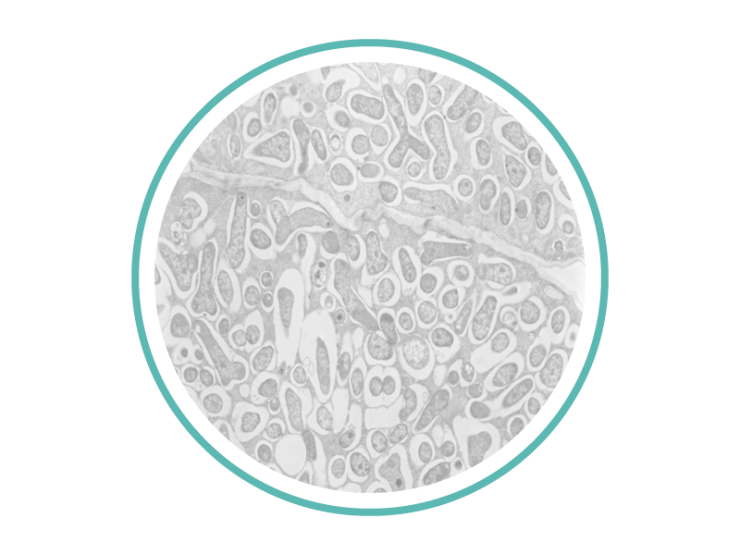
Top image: : Dr. Joanna Lecka, Tayssir Kadri, Prof. Satinder Kaur Brar (INRS)




 More Than A Dodo