

Presenting… Bruno’s fossil find

 You’ve read about it in the press (probably), but now you can see Bruno Debattista’s rare trace fossil find for yourself in our Presenting… display, just inside the entrance of the Museum. Although we are closed, this changing exhibit can be seen by visitors coming through the building to the Pitt Rivers Museum.
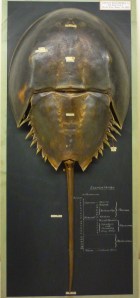
On display we have Bruno’s shale rock, found in Bude, Cornwall last year, which shows faint tracks left by a pair of horseshoe crabs as they crawled up an ancient, muddy shore more than 300 million years ago. Although the species of horseshoe crab which made these tracks is long extinct, we are displaying two modern specimens for comparison. One is around the size of the animal which left the original trackway; the other is a full size horseshoe crab which lives in the Atlantic Ocean – Limulus polyphemus.
We should also point out that horseshoe crabs aren’t really crabs at all. Crabs are crustaceans, but horseshoe crabs are more closely related to the arachnids, such as spiders and scorpions.
Scott Billings – Communications coordinator

 More Than A Dodo