Wow, we have an award-winning blog! I’m pleased to say that Darkened not Dormant was announced as a runner up for an OxTALENT award this evening. The awards “recognise and reward excellence in teaching and learning supported by ICT” within Oxford University.
Communications Officer Scott Billings and I attended the celebrations and we were genuinely flattered to have been nominated, let alone get a prize.
Celebrations after the awards
The blog was recognised in the Use of Technology for Outreach and Engagement category, and there was also a mention of the Museum’s Twitter account @morethanadodo. It turns out that the Dodo has quite a following around Oxford!
A while back we featured a great little story about some graffiti, which was discovered high up on the Museum roof. You may remember that it was painted by two of the craftsmen responsible for creating our beautiful Victorian building. The graffiti reads “This roof was painted by G. Thicke and J Randall, April 1864″
The graffiti in the rafters of the roof
The story picked up quite a lot of press attention, featuring in the Oxford Mail and BBC Oxford, and that blog post is our most-read so far. But one reader’s attention was particularly attracted by the names of the painters. Oxford resident Debbie Moorwood has been tracing her family history for some time, so when she spotted the familiar name G. Thicke, she decided to do some extra digging.
After consulting the Victorian censuses and tracing back through her family tree, Debbie revealed that painter George Thicke was actually directly related to her husband, Steve Moorwood. Steve is George’s great great great grandson!
Staff from Beard and Purcell join Steve and Debbie in the roof rafters.
Excited by her discovery, Debbie contacted us directly through this blog and we thought this was a fantastic opportunity for the graffiti artist’s relatives to see his work up close.
So, last week I had the pleasure of meeting Debbie and Steve Moorwood and we joined staff working on the roof project to climb high up into the roof. It was also a good opportunity for Debbie to share her discoveries about her distant relative, George Thicke. He was born in Glastonbury in around 1809, so would have been roughly 55 when he painted the graffiti on our roof. He is first spotted living in Oxford in the 1841 census, when he was a resident of the Cowley Road and, most importantly, listed as a painter! Later he moved around the area, living in St Clements, Headington and finally Shotover, before his death in 1887.
Debbie said of the experience: “We had an amazing time visiting the Museum roof. We never expected to get a full guided tour of the whole building and Steve loved it, especially the building works. We can’t wait for the roof to be finished and for the Museum to open again, when we’ll be dragging our kids & family in to have a look. I think the museum has become quite a special place for us now.”
We now have a good picture of one of our infamous roof painters, but J Randall remains a bit of a mystery to us. So far, we think he was John James Randall of St Ebbes, Oxford, but we know very little else. Wouldn’t it be wonderful if we could track down one of his relatives next?
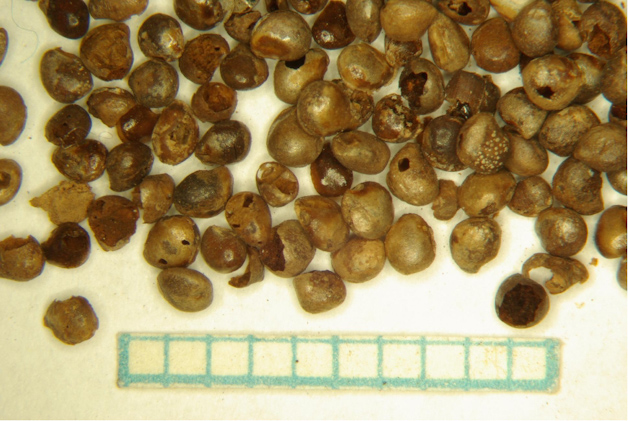
I’ve just been getting our fulgurites out of their drawer for their second outing to London. ‘What’s that?’ I hear you ask. Well, the clue’s in the name, for ‘fulgur’ is Latin for lightning. Fulgurites form when lightning strikes the ground; and if the ground happens to be made of sand, the intense heat of the lightning melts the grains of sand to form a tube of natural glass. The longest known fulgurite is nearly five metres long, but they are always very fragile things.
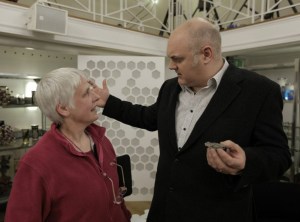
A bit of discussion about fulgurites at the end of filming the pilot programme. Presenter Dara Ó Briain is holding the Drigg fulgurite. Photo: Alastair Duncan
So why is a fulgurite going to London? We get all sorts of requests to see specimens, from researchers, amateur enthusiasts, students and artists, and even people who are just curious. Our collections are there to be used and enjoyed after all. But in this particular case the producers of the BBC4 programme Science Club were making a pilot for their new series and were looking for a fulgurite to star in the show.
I took two different fulgurites to the recordings, both found in the early 19th century. One is a piece labelled as coming from Drigg in Cumberland. This was a famous discovery; even Charles Darwin knew about them, for he wrote that the fulgurites he discovered in South America were very like those of Drigg in appearance. The second was found in Westphalia, Germany, and it shows a glassy trace of the lightning’s path as it passed through the sand.
Mark was determined to have his photograph taken holding a fulgurite! Photo: Alastair Duncan
For this pilot programme Science Club was investigating natural disasters. Presenter Dara Ó Briain was joined by expert demonstrator Professor Mark Miodownik who had quite a shocking experience with a lightning machine! We were also shown why it is dangerous to stand under a tree during a thunder storm, and we heard about the lucky escapes some people have when struck by lightning.
Fulgurites are rather rare and special, and as the pictures show, both presenters enjoyed a chance to get a close look at these natural curiosities.
The pilot programme was successful, and one of our new Education trainees, Liz Danner, will be taking the fulgurites back for the final filming of Science Club this week. If you would like to see them too, they will feature in our next ‘Presenting…‘ display soon. Follow the blog and we’ll let you know when
Watch out for more Science Club on BBC4 – it’s fascinating and fun.
Monica Price, Assistant curator, Mineral Collections
You’ve read about it in the press (probably), but now you can see Bruno Debattista’s rare trace fossil find for yourself in our Presenting… display, just inside the entrance of the Museum. Although we are closed, this changing exhibit can be seen by visitors coming through the building to the Pitt Rivers Museum.
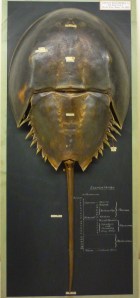
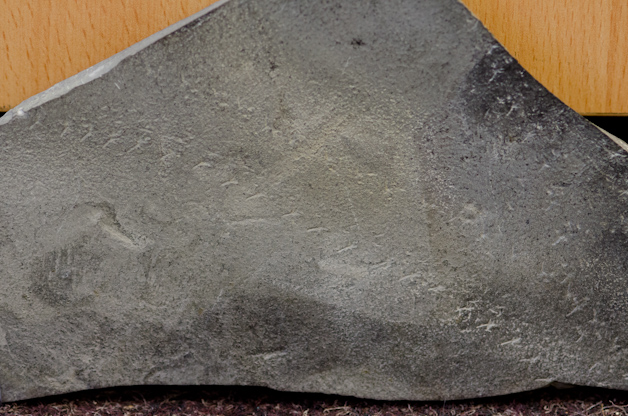
On display we have Bruno’s shale rock, found in Bude, Cornwall last year, which shows faint tracks left by a pair of horseshoe crabs as they crawled up an ancient, muddy shore more than 300 million years ago. Although the species of horseshoe crab which made these tracks is long extinct, we are displaying two modern specimens for comparison. One is around the size of the animal which left the original trackway; the other is a full size horseshoe crab which lives in the Atlantic Ocean – Limulus polyphemus.
We should also point out that horseshoe crabs aren’t really crabs at all. Crabs are crustaceans, but horseshoe crabs are more closely related to the arachnids, such as spiders and scorpions.
At 9pm today BBC2 is broadcasting The Other Pompeii: Life and Death in Herculaneum, a documentary following The Herculaneum Conservation Project, which aims to find out what life was like in the small Roman town of Herculaneum, moments before it was destroyed by the famous eruption of Mount Vesuvius in 79 AD. This project involves work both in the field and in the Museum by our Environmental Archaeology Unit, led by Mark Robinson.
The sewer in Herculaneum
One of the problems faced by the conservators at Herculaneum is that they need to remove rainwater from the site. To this end, a Roman sewer was to be excavated so that it could act as a conduit for new plastic drain pipes. The Museum’s Environmental Archaeology Unit was brought in to investigate the contents of this sewer for evidence of Roman diet. Biological remains from Herculaneum were transferred to the Museum for detailed analysis by Mark and Erica Rowan, a doctoral student in the Environmental Archaeology Unit.
The numerous fish bones, sea urchin fragments and so on suggested that the occupants of the town enjoyed a varied marine diet. There was also evidence of the plant component of their diet, including a major consumption of figs and the use of food flavourings such as coriander and even black pepper, which would have been imported from India. Remains of fly pupae suggest unhygienic conditions.
Sorting in the field at Herculaneum
Look out for more on this research, including footage filmed in the Museum, in the BBC 2 documentary tonight. The programme is being broadcast to coincide with the opening of the Life and Death: Pompeii and Herculaneum exhibition at the British Museum.
Mark Robinson, Head of the Environmental Archaeology Unit
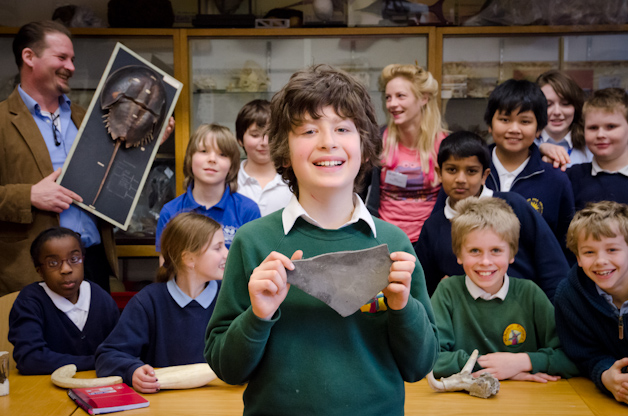
We’ve been looking forward to sharing this story with everyone for a while and following a big splash in the national media here this morning we can now post it on the blog too. The picture above is of our Education team’s Natural History After-School Club and in the front is Bruno Debattista, a 10-year-old pupil from Windmill Primary School in Oxford.
What’s exciting is what Bruno is holding in his hand: a piece of shale that he collected while on holiday in Cornwall and correctly identified as containing a faint fossilised imprint. Members of the After-School Club are encouraged to collect specimens and bring them in each week to identify and talk about them. When Bruno brought his rock along we were somewhat stunned by what appeared to be a very rare trace fossil – a fossilised mark or imprint, rather than the more common fossilised body parts.
There was some discussion and microscope-peering amongst our expert geologists before the fossil find was finally confirmed by the Museum as being the foot and tail prints left by a pair of mating horseshoe crabs, crawling up a muddy shore around 320 million years ago. You can see in the picture here what a fully grown horseshoe crab looks like; a specimen of the size that made the trackways is perched on top of Bruno’s fossil.
The footprints left by the horseshoe crab can be seen in a trail running from the top left to the bottom right of the shale slab.
It takes a very keen eye to spot such faint tracks and plenty of enthusiasm to go hunting for them. It’s exactly this kind of enthusiasm that the Natural History Club is trying to nurture, so we’re delighted to be able to report Bruno’s incredible find and we are especially pleased that Bruno and his family have decided to donate the fossil specimen to the Museum’s collection.









 You’ve read about it in the



 More Than A Dodo