

Category: Uncategorized
Goes to Town
A new exhibition is opening up around Oxford city centre. While the Museum of Natural History is closed in 2013, some of the inhabitants have made their way to Oxford town centre. Find them all before January 2014, record their Danger and Rarity ratings and enter our competition at the Goes to Town website.

The Hope Entomological Collections are missing a few of their insects. There are two displays featuring bugs around and about town which we hope you will enjoy. The first features the beautiful bookworm, literary critic and the second a selection of edible insects. Yes, insects that you can eat rather than ones that eat you.
 |
| The bookworm bites back- installation of the bookworm damaged book is complete! |
If you are in Oxford town centre today (July 1st) then you might be lucky enough to see some members of the installation team that are out and about putting the various objects on display. They are easily spotted by their white lab coats emblazoned with the Goes to Town logo (as sort of seen in the above photo). Below is a sneak preview of the edible insects case:
 |
| Fancy a quick bite? Have alittle nibble on one of these tasty critters. |
Ode to a Dodo

Now here’s a sad story
That you all should hear
About a funny old bird
Who had never known fear
Till explorers landed
Upon the isle of Mauritius
And the creatures they brought
Found this Dodo delicious
Too docile to fight
Too flightless to flee
Now a head and a foot
Are all you can see
There’s a rather nice article on the Guardian website today all about our famous Dodo remains. Journalist Henry Nicholls interviewed our zoological collections manager Malgosia Novak-Kemp, who showed Henry the only known surviving soft tissue remains from the extinct Dodo.
The article includes a reference to Hilaire Belloc’s poem, so it seemed appropriate to share this little Ode to a Dodo with you. We wrote it as part of our Goes to Town trail, which is launching in Oxford next week.
You can watch a short trailer about this at goestotown.com, but suffice to say that the Dodo will feature, along with his Ode, in one of our partner venues. See if you can find him and all the other exhibits from Tuesday next week.
Scott Billings, Communications coordinator
Saga pedo – the Spiked Magician
 |
| Saga pedo, a species of bush cricket. Photograph courtesy of M. Steadman. |
We get a number of enquiries each year from the general public asking us to identify various insects that they have found in their homes or gardens. The majority of these enquiries are of British insects (as you might expect) but we also get a handful of more exotic and exciting insects that people have seen whilst on their travels in other countries.
The photograph above was sent to us by Mr M. Steadman and was taken whilst on holiday in Turkey.
The large and very impressive insect pictured is Saga pedo- a species of cricket belonging to the family Tettigonidae. It is an unusual species for a number of reasons but in particular because it is predatory. Nearly all crickets are herbivores, feeding on a wide variety of plant species. Saga pedo feeds primarily on insects and has been known to cannabilise members of its own species. There are even a number of reports of this species hunting small reptiles and young birds.
This species is also unusual because it appears to reproduce asexually by parthenogenesis. Specimens are therefore female and can be identified by the long spear shaped ovipositor at the rear of their body (as seen in the photograph above). There has yet to be a reliable sighting of a male specimen of Saga pedo.
What’s on the van- Rhino tooth

This week’s What’s on the van? comes from Malgosia Nowak-Kemp, Collections Manager in the Museum’s Zoological Collections.
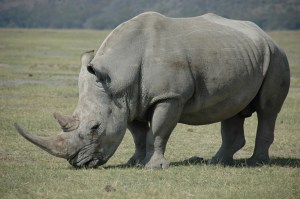 This huge molar tooth belonged to a wide-lipped or white rhinoceros living in Africa. This species, whose scientific name is Ceratotherium simium, is one of the five species of rhinos that are still alive today in Asia and Africa.
The tooth was brought back to England by William Burchell, a naturalist and explorer of South Africa and Brazil. Burchell was born in Fulham, London, and left England in 1805 to seek his fortune in St. Helena. He worked there as a botanist and a teacher, but in 1810 decided to travel in South Africa, from Cape Town into the inhospitable plains of the Karoo. In preparation for the expedition, he designed a travelling wagon, which was to serve as a place to sleep, eat and keep all the specimens he collected during his travels. The wagon was pulled by 8 oxen and was followed by a flock of sheep to provide fresh meat in case hunting proved unsuccessful. During his 5 year journey Burchell collected many mammals, insects and minerals, including this rhinoceros tooth. When he returned to England Burchell offered most of his collection to the Natural History Museum in London and then spent some time describing all the unknown species in scientific papers. In 1817 he described the wide-lipped rhinoceros, Ceratotherium simium and this tooth is the “type” specimen, which means the first specimen to be described and written about as a new species. Sadly, Burchell committed suicide in 1863, and his sister offered the remaining items in his collection to Oxford University.

Spot the difference!
We are having rather a busy time of it in the department at the moment with lots of visitors, volunteers and outside activities including the ‘Creatures of the Night!’ late night event that was held at the Museum of the History of Science last Friday evening.
After all the hard work we decided that it was time for something fun so here is a five minute distraction for you whilst you have a cup of tea and a biscuit.
The rather stunningly handsome beetle below is a member of the genus Megaphanaeus. He is complete in the first picture but FIVE things have changed by the time we get to the second photo. See if you can spot them all!
 |
| Complete beetle |
 |
| What’s missing here? Can you spot the five differences? |
 More Than A Dodo