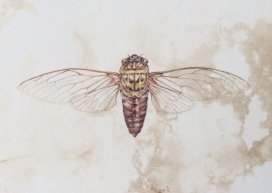
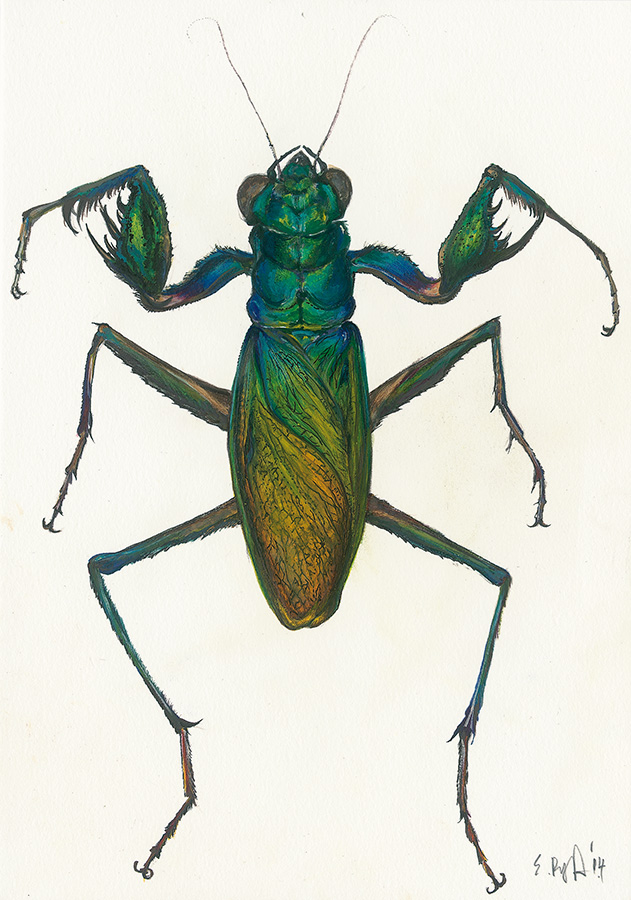
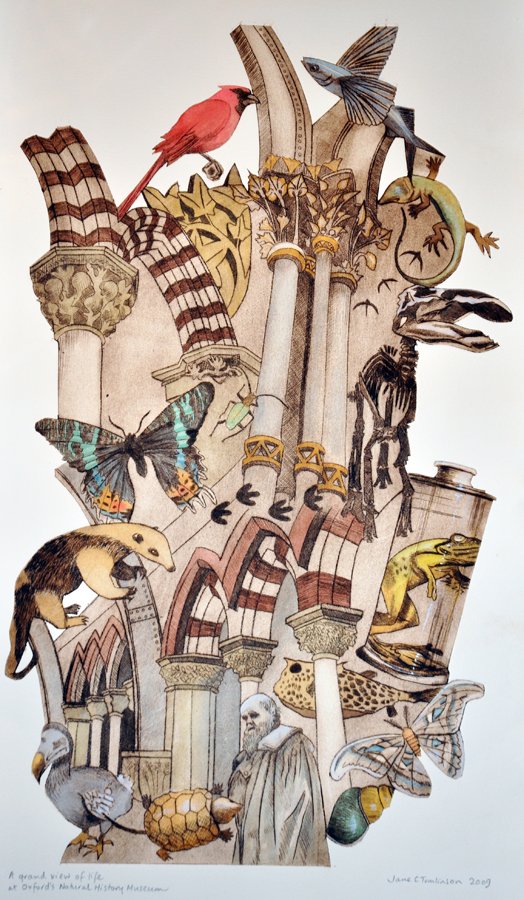
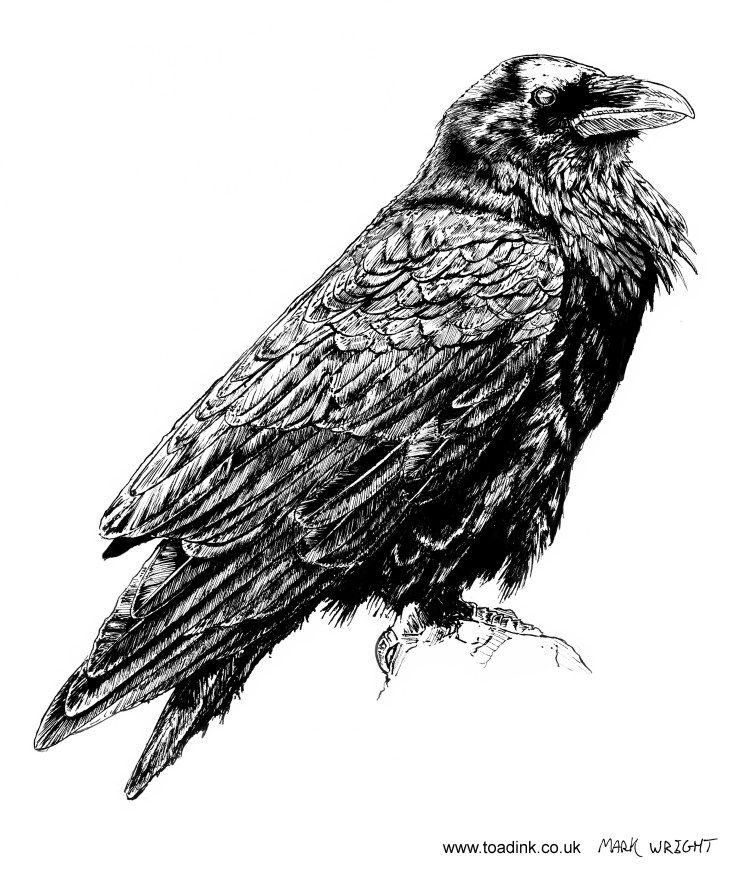
As part of our Visions of Nature year in 2016, we invited you to send in your own ‘visions of nature’. We didn’t know what to expect, but week after week we received pictures of beautiful paintings, drawings, photographs, and textile art, all inspired by the natural world or by the Museum and its collections.
All of these artworks can now be found in the online gallery, but we’ve picked out a few here to show you and to mark the end of the project. Thanks very much to everyone who took part.
Emma Reynard
Jake Spicer – Main court Oxford University Museum of Natural History
Jane Tomlinson – Oxford University Museum of Natural HistoryDeidre Bean – Cicada
It is sad that our poetry residency is at an end; I shall miss the frequent escapes for the hustle of the everyday Oxford streets into the light and space of the Museum.
As a resident in Oxford for over twenty years, I had gradually accumulated a bit of knowledge about the building. I had, like so many local parents, hugely enjoyed taking our two sons there when they were young, and loved to see their delight at the displays. Seeing the fossil, mineral, and animal world, as it were, through their eyes, really re-engaged me with its wonders.
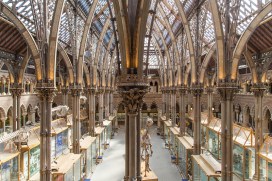
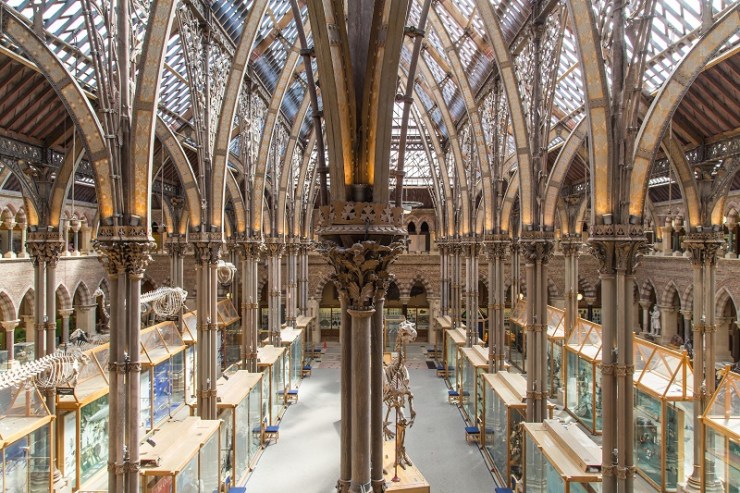
The Museum’s centre court
I have been very privileged, then, to go ‘behind the scenes’ at the Museum, and to speak to the scientists engaged in research into its collections and history. They are bringing new knowledge and understanding to bear at a moment when, let’s face it, humankind has inflicted catastrophe upon the natural world, and so upon itself.
The Victorian spirit and vision which instigated the building of the Museum, a spirit revelling in creation and in exorbitant creativity, seems very remote. This is tragically borne home when looking at the cabinets of butterflies and moths, the Lepidoptera, where the majority of the specimens are of species that no longer exist.
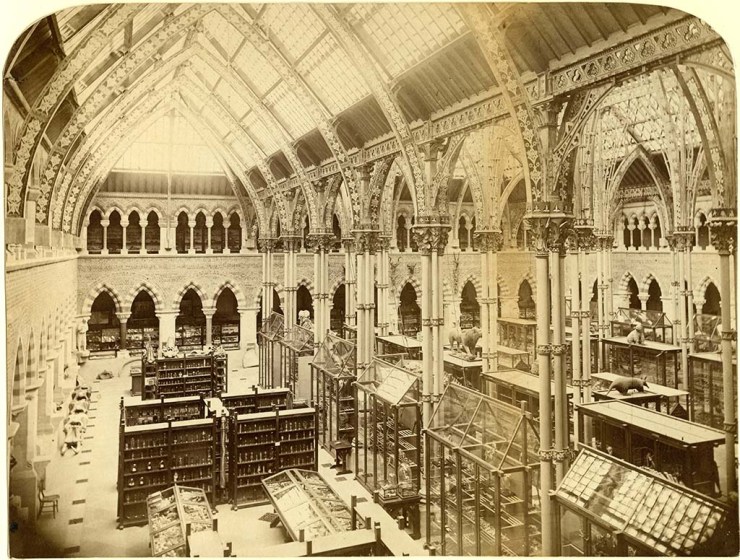
A photograph from the Museum Archive showing the construction and layout of the building in the mid-19th century
The prime mover behind the Museum, the Victorian Henry Acland, said in an early promotional lecture that the ambition behind it was to show that all branches of science needed to work together to produce a greater understanding of the world. The zoologist could not understand the physiological structure of animals without deploying information and knowledge held in common with the geologist and the anatomist.
The Museum should be a place where that type inspiring dialogue could occur daily. It feels as though we are in a moment now where that collaboration, and collective and imaginative ingenuity, is hard-pushed to find solutions to the divided interests and dire afflictions of the world.
The Visions of Nature year at the Museum, which brought artists and us poets together with the scientists, has been one way in which all of these things have been, for me excitingly, furthered. It has been a challenge and a thrill to imagine and write – ‘in their own voices’ – lives for some of the Museum’s specimens which have particularly fascinated or moved me. But also a great delight, for which I’ll always be grateful.
To coincide with our display of the Oxford Photographic Society‘s annual show, here Society member Ron Perkins recounts how he captured these great shots of the magnificent Bald Eagle.
Bald eagles, the national birds of the USA, are charismatic, powerful creatures. Young eagles are tawny brown but acquire their majestic black plumage, with white heads, after two years.
In early winter the Alaska Chilkat Bald Eagle Preserve attracts up to 3,000 eagles which pause on their seasonal migration to the south in order to feed on the salmon that swim up the river to spawn.
A Bald Eagle eating salmon on the river bank
Having discovered this photo opportunity via the internet I easily recruited three Oxford Photographic Society members to travel to Alaska. The journey took two and a half days via Seattle and Juneau by air and on to the small town of Haines by an 80-mile ferry trip. Haines is near the Pacific coast so although there was snowfall most days the daytime temperatures were about -5C. Each day we drove 20 miles along the banks of the river to the best photographic locations to get our shots.
An adult eagle attacking a juvenile
After spawning, the fish die in the shallows at the edges of the river. Then the eagles drag the dead salmon onto the snow-covered banks. The fish weigh up to 15 pounds so moving them is difficult; some adult eagles watch juvenile birds moving the salmon onto the riverbanks and then attack to drive away the juveniles.
Arriving at the preserve
Eagles always attack into the wind, so it is easy to plan and position yourself to capture these shots. And the combination of large numbers of eagles with frequent dramatic action is a powerful attraction for wildlife photographers.
Oxford Photographic Society’s Natural World exhibition runs until Sunday 22 January in the Museum’s Café Gallery.
John Barnie, one of our three Poets in Residence, reflects on claims that the future of life from Earth lies deep in the Solar System…
In a recent article in The New York Review of Books, physicist Freeman Dyson speculates that in three or four hundred years it may be possible to seed promising planets and moons in the solar system with organisms genetically engineered to withstand their harsh conditions, eventually transforming them into environments which could support humans – fleeing, perhaps, from an irreparably damaged Earth.
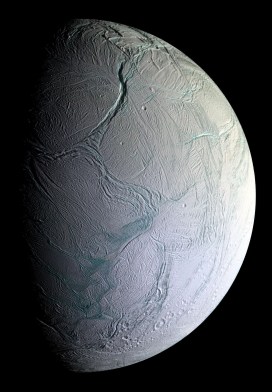
Does Saturn’s moon, Enceladus, offer a viable site for the seeding of life? Image: NASA/JPL/Space Science Institute
Saturn’s moon Enceladus is one example he gives; geysers pierce its hostile icy surface, and Dyson hypothesises a warm sea hidden below. The process would be achieved by landing ‘pods’ of self-sustaining life forms – ‘Noah’s Arks’ he calls them. The rocket technology is well on its way, he argues, and will be perfected by small cost-effective space companies rather than lumbering giants like NASA. Biotechnology, too, will develop by leaps and bounds to produce, for example, ‘warm-blooded plants’ that would absorb energy – on Saturn’s moon Enceladus, say – concentrated from starlight and the distant rays of the Sun.
In the increasingly stressed and chaotic twenty-first century, it is impossible to predict what will happen in two or three years, let alone two or three hundred. In the meantime, while Professor Dyson elaborates his techno-fantasies, we are here, on the only Ark we have, and the only one, I’d say, we are ever likely to have.
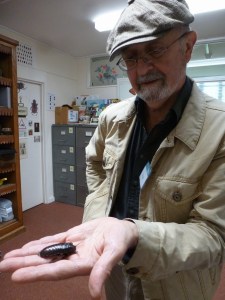
John Barnie meets some of our live residents, the Madagascar Hissing Cockroaches, during his residency at the Museum
My year at the Museum has been a fascinating and unforgettable reminder of this, the Museum itself forming an ark within an ark, celebrating the extraordinary diversity of multicellular life as it evolved over 650 million years. Many of its specimens, of course, represent extinct species, and they, too, are a reminder – of how life on Earth is fragile but also robust, endlessly reacting and adapting to changing circumstances. Life has survived at least five mass extinctions in the geological record, and will survive the largely human-induced one many biologists and naturalists, from Niles Eldredge to David Attenborough, think we are entering now – though our species may not be around to see what gets through the inevitable extinction bottleneck.
For techno-utopians like Freeman Dyson, the future is out there in space, not here where we evolved, where we have the grounding of our being. The new biotechnology, he argues, will have to be perfected on Earth first, filling ‘empty ecological niches’. They may, he suggests, ‘make Antarctica green before they take root on Mars’. There are so many things wrong with this it is difficult to know where to start. Luckily for us, the Museum of Natural History represents a very different vision of the Earth, its creatures, and our place among them.
As part of the Museum’s Visions of Nature year in 2016, we have had the pleasure of hosting three poets in residence: John Barnie, Steven Matthews, and Kelley Swain. During the year the poets worked alongside staff in the collections and out in the Museum itself to gain inspiration for their writing. A small anthology of the resulting poetry is published at the end of 2016.
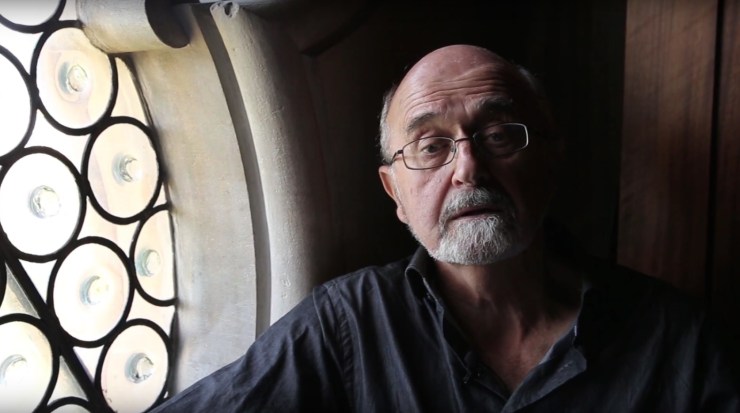
In this video Steven Matthews reads his poem “Yet With Time’s Cycles Forests Swell”. The title is taken from a line in a poem called Emblems by one the founding members of the Pre-Raphaelites, Thomas Woolner.
As part of the Museum’s Visions of Nature year in 2016, we have had the pleasure of hosting three poets in residence: John Barnie, Steven Matthews, and Kelley Swain. During the year the poets worked alongside staff in the collections and out in the Museum itself to gain inspiration for their writing. A small anthology of the resulting poetry is published at the end of 2016.
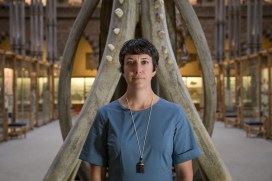
In this video Kelley Swain reads two of her poems To The Palaeontologists and Rorqual. Kelley is a poet, writer and editor.
You can meet Kelley at the Museum for National Poetry Day on Thursday 6 October 2016.









 More Than A Dodo