What’s on the van? – Aragonite

_DSCN8449

This week’s What’s on the van? comes from Monica Price, Head of Earth Collections.

Can you believe your eyes?
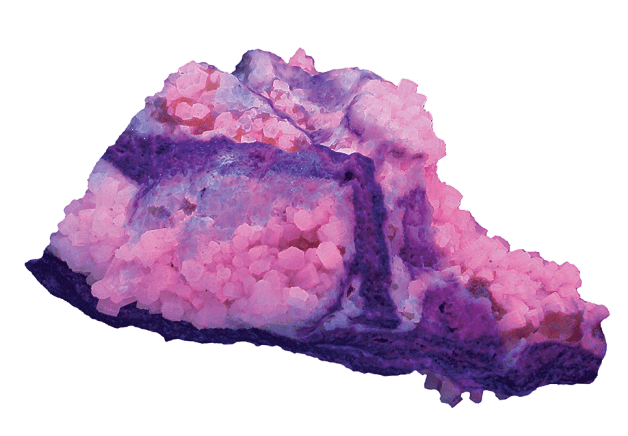
If I were to tell you that these crystals of aragonite (composed of calcium carbonate) from Sicily are a dull grey colour, you might not believe me. Look at them in daylight or under ordinary room lights, and you will see that they really are! The picture on the van shows how they look when they are fluorescing – glowing pale salmon pink under an ultraviolet light.

Ultraviolet (UV) light is part of the electromagnetic spectrum, like visible light, microwaves, radio waves and X-rays. Humans cannot see UV light, which is why we sometimes refer to it as ‘black light’. It has just a little bit more energy than the visible light which we can see.

Some minerals contain a chemical activator which allows them to fluoresce. When UV light shines on a fluorescent mineral, the energy bounces some of the mineral’s electrons out of their orbitals. A tiny bit of the energy is converted to heat, so that when the electrons fall back, the rest of the energy is emitted again, but now it is visible light. The mineral literally glows in the dark.

As long as ultraviolet light shines on the mineral, it will continue to glow. You will be able to see lots of fluorescent minerals when the Museum reopens next year!

What's on the van?

What’s on the van? – Four-horned trunk fish

_17320a

This week’s What’s on the van? comes from Malgosia Nowak-Kemp, Collections Manager in the Museum’s Zoological Collections.

The name “four-horned trunk fish”, Acanthostracion quadricornis, comes from this animal’s unusual appearance. The fish looks rather like a stiff box or trunk with solid walls that allow only small openings for the tail, fins, eyes and mouth, but keeps all the internal organs safe from predators. Some members of this group are not only protected by the box’s shape and its structure, but also have the ability to release a poison when threatened. Acanthostracion quadricornis, can be easily identified by the presence of four “horns”, two at the front of the head and two at the back of the body. The animal’s other name of “cowfish” makes a clear reference to them. This and other members of its family, Ostraciidae, live in shallow waters of oceans: Atlantic, Indian and Pacific

This particular example is one of the oldest specimens in the country, as it dates from the seventeenth century. It belonged to the Tradescant Collection, also known as the “Tradescant Ark”, assembled by the two John Tradescants, father and son. Their collection of “Naturalia” and “Artificialia” contained not only exotic, hitherto unknown animals and plants, but also portraits,  clothes, weapons and jewels brought by sailors and traders from newly discovered  lands. The collection was displayed for many years at the Tradescants’ home in Lambeth, London and all the specimens were listed in 1656 in the very first printed museum catalogue in the country.

In 1678 their collection became the property of Elias Ashmole, who in turn offered it to Oxford University. In 1683 fourteen carts containing the collection travelled on barges to Oxford to be displayed in the newly built Ashmolean Museum, then located on Broad Street. This ancient fish is now one of the real treasures of the Museum of Natural History’s collection.

What's on the van?

What’s on the van? – Cold Bokkeveld meteorite

_MeteoritePic1

This week’s What’s on the van? comes from Monica Price, Assistant Curator, Mineral Collections.

“The loudest thunder we had ever heard…”
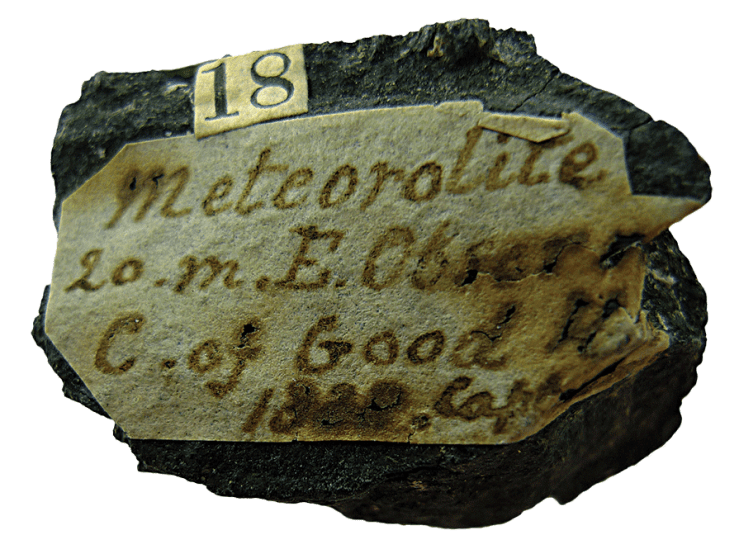
It’s a very good thing this little piece of dull grey rock, less than 30mm across, has a label on it to say what it is! ‘Meteorolite’ is an old name for a meteorite, and this is part of one that fell over the Cold Bokkeveld valley, Cape Province, South Africa, on 13 October 1838. Kieviet, a servant out collecting wood, gave an eye witness account:

 ‘It was a fine clear morning; there were no clouds in the sky, and there was no wind. At about nine o’clock a.m., whilst we were busy loading the waggon with wood, close to the foot of the mountain, we heard a strange noise in the air resembling the loudest thunder we had ever heard, and on looking up we perceived a stream passing over our heads, issuing a noise which petrified us with terror; a burst took place close to the waggon, when something fell and a smoke arose from the grass. My master sent me to look what it was that had fallen, when I found a stone quite warm, so much so that I could not hold it in my hands’.  (Phil.Trans.Roy. Soc., vol. 130, 1840, 177-182)

The Cold Bokkeveld meteorite came all the way from the asteroid belt, where large and small chunks of rocky debris, left over from the formation of the planets, orbit in a band between Mars and Jupiter. When asteroids collide with each other and get knocked out of their orbits, some pieces find themselves on a collision course with Earth to become meteorites.

Meteorite
The other side shows the meteorite itself

This one is a ‘carbonaceous chondrite’, a kind of meteorite that is particularly interesting for scientists because it contains large organic molecules such as amino acids. These are also essential for living organisms; just possibly, meteorites played a role in the origin of life on Earth. It also contains minute diamonds.

The meteorite is about 4.5 billion years old, as old as the Earth itself. The diamonds in it are much older – real star dust from outer space!

What's on the van?

What’s on the van? – Stag beetle

_OUM1

This week’s What’s on the van? comes from Amo Spooner, of the Museum’s Hope Entomological Collections.

Reverend Frederick William Hope (1797- 1862) was a British entomologist whose interest in insects began in 1817 and his main passion was for beetles. He founded the Museum’s Hope Entomological Collection and in 1849 gave his entire invertebrate collection, along with his substantial library and collection of portraits and engravings to Oxford University.

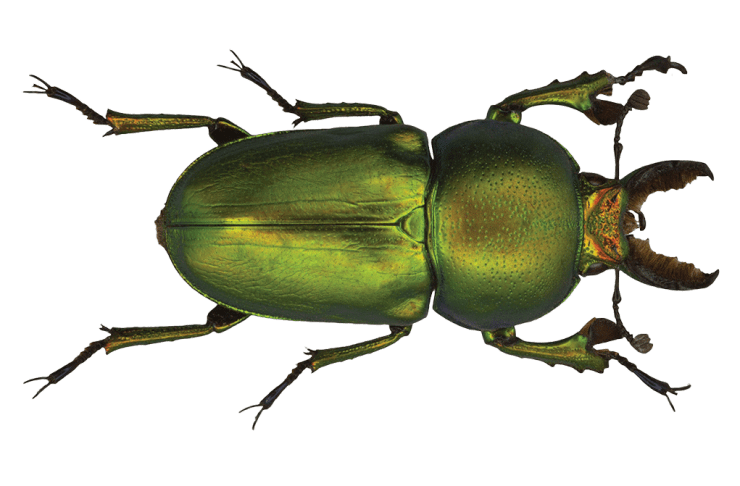
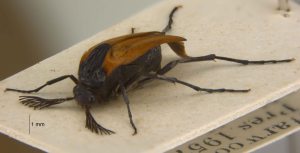
Hope’s fascination with beetles seemed mainly focused on the large, shiny ones! One of his particular favourites was the Lucanidae, commonly known as Stag beetles. This specimen is Lamprima schreibersi, found by Hope in 1845. This is the only specimen housed in the HEC. It is a type specimen; these are the most important specimens within a collection, because they are the ‘original’ specimen to which all others are compared. In the original description they are usually designated to an entomological collection within a museum, this allows them to be kept safe and be accessible to researchers.

Larvae of stag beetles feed on rotten wood; they become adult once they have finished their three larval stages. The adults feed on tree sap and rotten fruit. Lamprima schreibersi is an Australia species, so it is likely that they would feed on Eucalyptus trees. However, limited research has been done into the behaviour of this species, so no conclusive information can be given.

What's on the van?

What’s on the van? – Seahorse

Seahorse

This week’s What’s on the van? comes from Malgosia Nowak-Kemp, Collections Manager in the Museum’s Zoological Collections.

Although called a “seahorse”, it is of course a fish and its name Hippocampus comes from the Greek “hippo” meaning a horse and “kampus” meaning a “sea monster”. But it certainly does not look like a monster. Seahorses live in tropical or temperate seas where the water is shallow, with plenty of plants, reefs or mangroves. Different species are of different sizes, ranging from tiny ones measuring less than 2 cm to much bigger ones reaching about 36 cm. They are quite unlike any other fish as they swim upright with the head high up and the tail below and not like other fishes that swim in a horizontal position.

Their body also lacks the typical covering of a fish –the fish scales, but has special plates that are arranged in rings and covered by skin. The number of rings is most helpful in the identification of the 50 or so species of Hippocampus.

The seahorses are famous for the male carrying the fertilised eggs in a special body pocket, or pouch. Laying and fertilising the eggs is preceded by a courtship where the male and female swim together and engage in a courtship dance, after which the male becomes responsible for the care and protection of their brood. When the young are ready, a process similar to giving birth takes place. The male contracts the muscles and thus expels the young fish into the water. Although most of the seahorses release a large number of young, less than 1% survive and the urgent need for protection of most species is now recognised by marine conservation bodies.

If you want to learn more about these fascinating animals, then do check The Seahorse Trust website: www.theseahorsetrust.org and www.britishseahorsesurvey.org

What's on the van?

What’s on the van? – Social wasp

_3011789_2This week’s What’s on the van? comes from James Hogan, of the Museum’s Hope Entomological Collections.

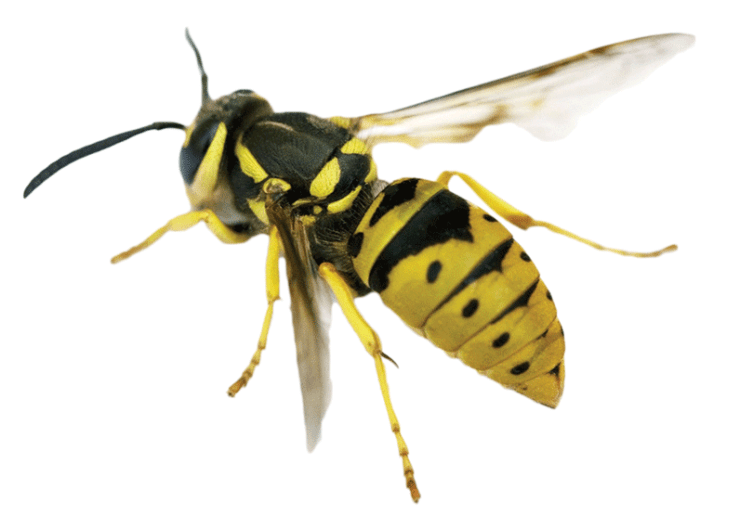
Social wasps are a group of insects belonging to the family Vespidae. In Britain we have 8 species of social wasps (species of Vespula and Dolichovespula) and the hornet (Vespa crabro).

Social wasps are viewed rather negatively by many people, perhaps understandable considering their stings and habit of building nests in houses. Despite this, I would argue that social wasps are much maligned creatures and play very useful roles as pollinators and pest controllers in the garden. During much of the spring and summer, social wasps are working away unseen, consuming large amounts of other insects such as flies, caterpillars and aphids. It is only in late summer when their normal food supplies are running out that they can make unwanted visits to picnics.

Paradox beetle
Paradox beetle – Metoecus paradoxus

In a wider and less human-centred context social wasps are part of the food chain, providing food for other animals such as birds and spiders. One very interesting aspect of the ecology of social wasps is that their nests provide a home for a whole range of insects found nowhere else. Two good examples are some of Britains largest hoverflies (species of Volucella) and the strange ‘paradox beetle’ (Metoecus paradoxus). The paradox beetle (Metoecus paradoxus) is a parasite of social wasps. This particular specimen was collected from a nest in a house in Yeovil.

So spare wasps a thought before reaching for that rolled-up newspaper!

What's on the van?