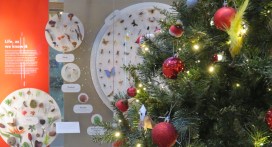
Crunchy Christmas Quiz 2022

This year, our Christmas quiz features 12 questions about the Crunchy on the Outside blog, one for each month of the past year. Don’t worry if you have only just started reading the blog because we’ve included a link to each of the articles. It’s just a bit of fun; we’ll post the answers in the New Year.

January: What is the scientific name of the red-tailed bumblebee found by Lincoln Kwong?

In February, researcher Ricardo Pérez-de la Fuente told us about a substance that can preserve insects for millions of years. What is it?

Who did Kate interview for this post in March? They told us about their favourite insect, the Bee-fly.

In April, which Crunchy on the Outside event did we run at the Museum?

Which visiting researcher shared her fascination with fig wasps in this blog post from May ?

Which useful piece of collecting equipment did we show you how to make in June?

In July, Head of Life Collections Zoë Simmons showed us some Pleasing Fungus Beetles. What do they do if you annoy them?

Which type of beetle did Susie show us how to make from Origami in August?

In September, we wrote about a solitary bee that nests in burrows and loves to feed on ivy flowers. What is it called?

Where could you meet us among the trees for an autumn event in October?

In November, which type of insect did we ask you to help scientists count?

Which festive plant, which is a food source for many insects, featured in this December blog post?
If you enjoyed that, you might like to have a go at our ‘Answer Smash’ quiz from last Christmas.

Have a very happy holiday and remember, the Museum is closed 24-26 December.
Christmas Quiz Answers

We hope you enjoyed our Crunchy Christmas Quiz! Here are the answers.

  1. The holly and the ivy mining bee
  2. Adventomologists
  3. The Grinchafer
  4. The most wonderful time of the yearwig
  5. Snowmantis / Snowmantid
  6. Bethlehemiptera
  7. Myrrhino beetle
  8. 25 December moth
  9. Angelytra
  10. Yulepidoptera

Have fun over the holidays and have a Happy New Year!

Christmas Quiz 2021

To round off an eventful year here at Crunchy on the Outside, we have put together a quiz for you combining our two favourite things: Insects and Christmas!

There are ten questions in the video. Each of the answers is formed by smashing together the two clues. One clue is about insects, the other about Christmas. We’ve included a couple of examples at the start to help you get the hang of it. Don’t worry if a question seems tricky, it’s just for fun and we’ve included some clues below.

Clues

  1. The scientific name of this insect is Colletes hederae.
  2. You will find out about what these scientists study here: https://crunchyontheoutside.com/category/people/
  3. We wrote about these insects in the summer: https://crunchyontheoutside.com/2021/07/05/chafers/
  4. Complete title of the song: Clue: “It’s the most wonderful….”.
  5. This insect may seem holy, but it’s looking for prey.
  6. Find out the name of this group of insects here: https://oumnh.ox.ac.uk/files/2insectidpdf-0
  7. This beetle is named after another horned animal.
  8. We wrote about this insect recently: https://crunchyontheoutside.com/2021/11/29/the-delightful-december-moth/
  9. You’ll need to know the scientific name for the wingcases/hardened forewings of a beetle.
  10. Find the name of this group of insects here: https://oumnh.ox.ac.uk/files/2insectidpdf-0

Answers

Good luck! We’ll publish the answers on the blog on Christmas Eve, so keep an eye out for them. Let us know how many you got right!

Best wishes for Christmas and the new year from all of us at the Crunchy blog!

Kate, Rodger & Susie

Steven’s Christmas spiders

by Steven Williams, Oxford Brookes University research student

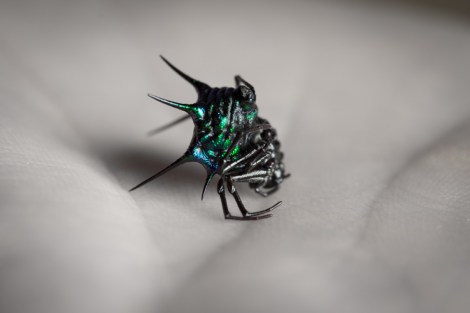
Described by A.G. Butler in 1873 as ‘the most gorgeously coloured spider in this genus’, Gasteracantha scintillans, with its metallic green iridescent abdomen, is the first of my Christmas Spiders.

img_0532
Spiky and sparkly: Gasteracantha scintillans

The beautiful colour of the abdomen certainly has a very festive feel and it would not be out of place next to a bauble on a Christmas tree; at least not in my house. This species and the other closely-related metallic Thorn Spiders are currently only found on the Solomon Islands.

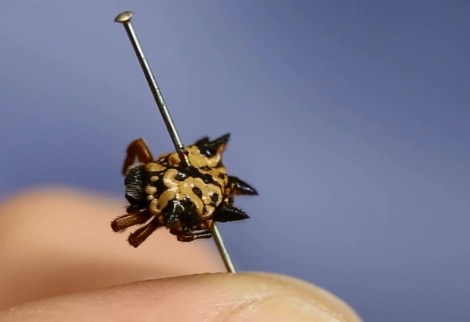
Christmas Island, in the Indian Ocean, is one of the locations where my second Christmas spider, Austracantha minax, can be found. Although not as striking as the metallic green of Gasteracantha scintillans, the layout of the abdominal spines on this spider almost give it the appearance of a star – perfect for the top of a Christmas tree, no?

Austracantha minax: starry, and found, amongst other places, on Christmas Island

The common name of ‘Christmas Spider’ is attributed to this species because in areas of Western Australia it is associated with the arrival of Christmas as the males reach maturity in mid-December and females in January.

Did you know that there is also an Eastern European folk tale of how tinsel came to be included in Christmas tree decorations? The legend tells of how spiders spun cobwebs on a poor family’s undecorated Christmas tree overnight. In the morning the webs turned to gold and silver and the family never lived in poverty again. So when you put the tinsel on the tree this year you could imagine you are a spider spinning a web!

With that spidery festive thought, have a very Merry Christmas from everyone at the Museum!