people: amo spooner

Meet Amo Spooner, Collections Manager for Coleoptera, Hemiptera and Small Orders.  Her job, here at the Museum of Natural History, indulges her love of both insect collections and animals in general.   I met up with Amo to find out what sparked her interest in the natural world, how she began working at the Museum of Natural History and what her current job involves.

How did you first become interested in insects?
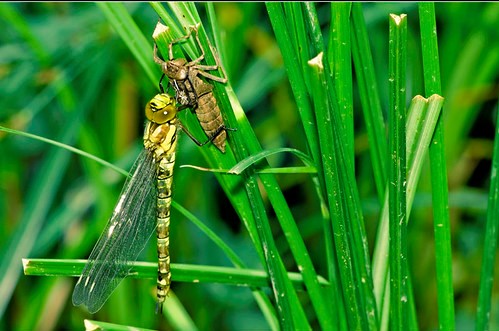
I have always loved the natural world and have a very vivid memory of being woken up in the early morning by my Grandad who wanted to show me some dragonflies emerging from their nymphs in our pond.  We rushed out to the pond where dragonflies were pulling their bodies out of the last of their nymph exoskeletons and emerging as adults. I kept the nymph skins as a souvenir and even have a tattoo of an adult dragonfly emerging from its nymph stage to remind me of that time.

How did you come to work in entomology?

After leaving school, I went to college to do a First Diploma and a BTEC National Diploma in Animal Management.  At college, I learnt how to care for a wide range of animals from guinea pigs to geckos and helped to run the Exotic Unit.  Once I had completed my qualifications, I decided to train as a Veterinary Nurse.  It was during the final year of my degree that I first volunteered at the Museum of Natural History and by the time I finished University, I realised that I really wanted to work at the museum, particularly with the insect collection.  I moved to Oxford, volunteered at the museum during the day and worked at Waitrose in the evenings to fund my time at the museum. 

After volunteering for around 1000 hours, I got my first paid job at the museum! This was working on a collection of entomological specimens that Oxfordshire County Council had donated to the museum.   Much of the collection was damaged, but it was possible to save some specimens and incorporate them into the wider museum collection. 

What is your role here at the Museum?
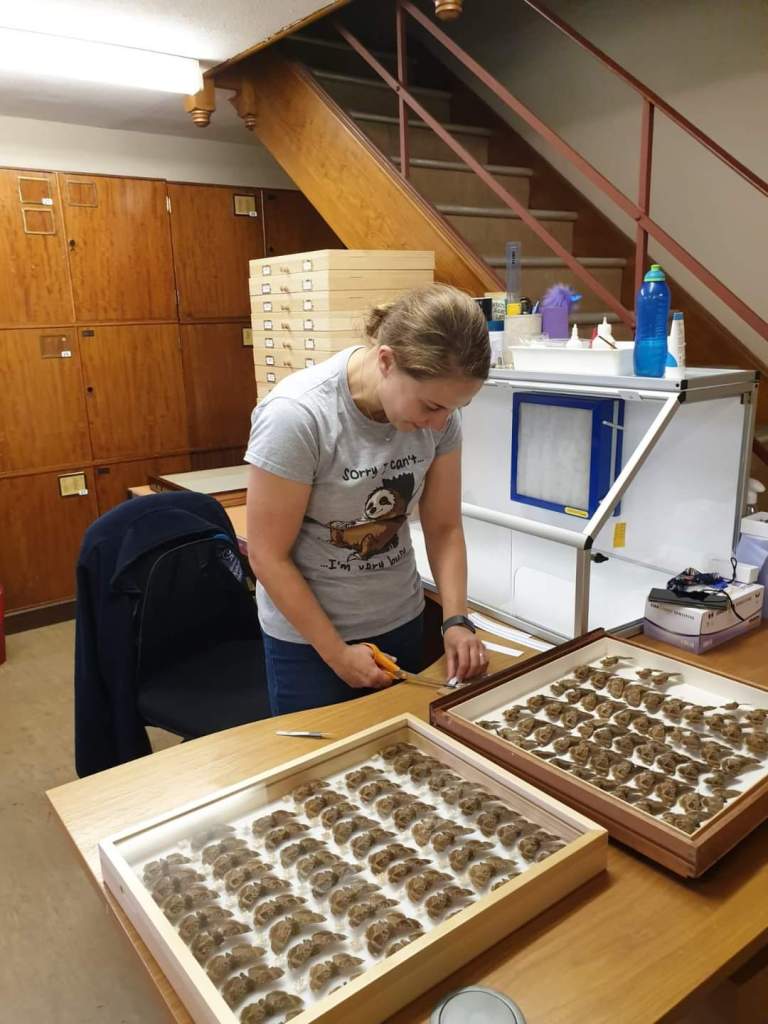
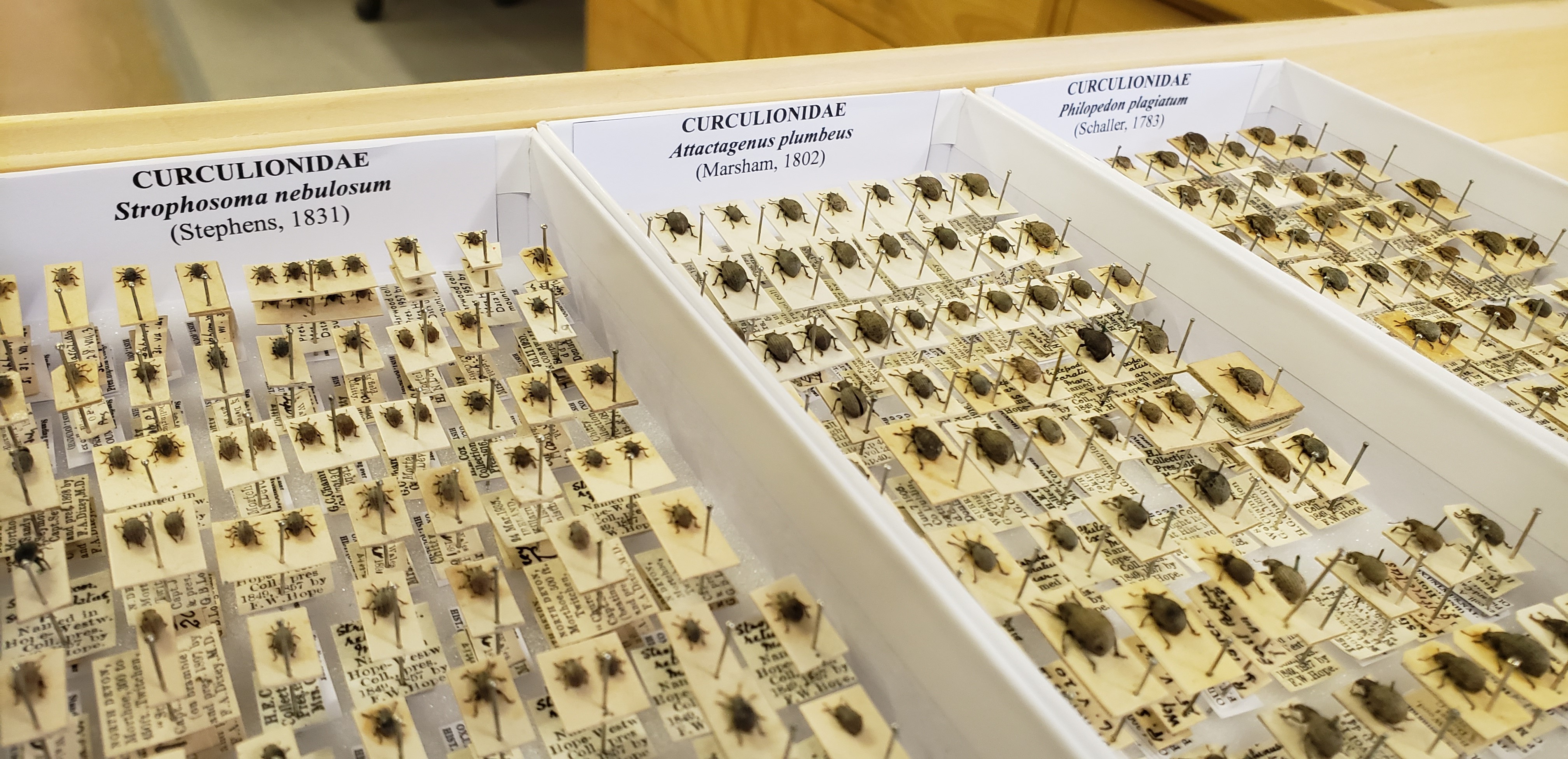
I have now worked at the museum for around 11 years and have had several different roles during that time, including re-curating the World Coleoptera collection housed in the Huxley Room.  Now, I am on secondment from my Collections Manager role for Coleoptera (beetles), Hemiptera (true bugs) and Small Orders (Dragonflies, praying mantis, cockroaches, lacewings, grasshoppers and allies), leading the collections team responsible for re-curating the British insect collection as part of the HOPE for the Future project.

(See our blog post on Tom Greenway to find out more about this re-curation.)

Together with one of my team, I am also responsible for looking after the museum’s collection of live insects and other invertebrates.  These include Madagascan Hissing Cockroaches, Tarantulas, Stick insects and a Peacock Mantis.  I enjoyed designing and working with an expert to build their new tanks a couple of years ago. 
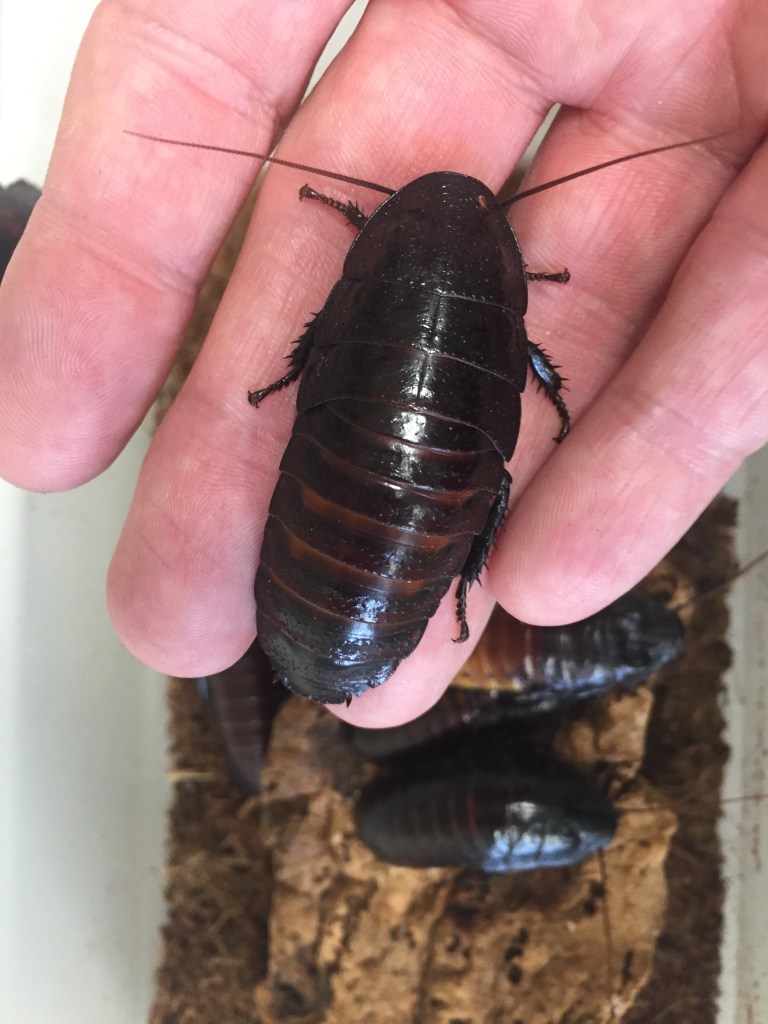
Madagascan Hissing Cockroach

Can you tell us about any particularly challenging aspects of your role?

One of the most challenging aspects of my job is the battle to protect the specimens from insect pests!  When live insects infest specimen drawers they can cause considerable damage and it is part of my job to ensure that drawers are checked on a regular schedule to ensure any infestations do not get out of control.  This has been particularly challenging during the pandemic when the museum has been closed and access to the collections, even for those of us who work here, has been limited.

What do you enjoy most about your job?

I am fascinated by the history of the collections.  For example, my favourite entomology collection in the museum is the Baden-Sommer collection which dates back to the early 1900s.  It is housed in its original furniture, and is really rich in a wide variety of species, including an incredible number of type specimens.  I really enjoy understanding how specimen data labels and pinning techniques have changed over time.  For example, when faced with an undated specimen, the handwriting on labels and how an insect is pinned can give you clues about its age. It’s like being an insect detective!

I take great pride and comfort in the fact that my work helps to keep the collection safe for future generations.  The work that I am currently undertaking on the British Insect collection as part of the HOPE for the Future project is a great example of this, and will result in the collection being accessible to the public online, and available for teaching and research for many years to come. 
Thank you so much, Amo, for some fascinating insights into your role at the museum. Good luck with the Hope for the Future project!

Raising Moths

Ben brought in some Poplar Hawk Moths to show the other participants at our recent summer school. Here he describes how he raised them from eggs he received as a gift from his grandfather.

Last year during lockdown my Grandpa gave me 32 hawk moth eggs: 30 eyed and two privet. Not the most common of presents you might think, but these turned into the most enjoyable gift. I was very excited as I tore open the parcel and found the eggs safely packed in a small tube. It took roughly a week for the leafy-green eggs to turn into the most delightful little caterpillars. I decided to call them all Jim. The first thing they went towards was the fresh willow that lay in a small, water-filled jam-jar.

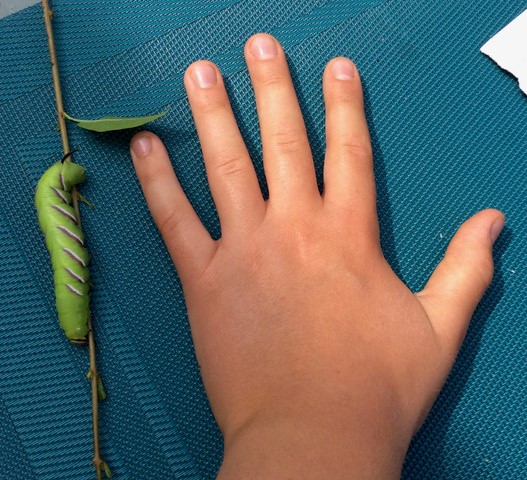
Poplar Hawk moth caterpillar with Ben’s hand for scale. Photo credit: Ben Atwell

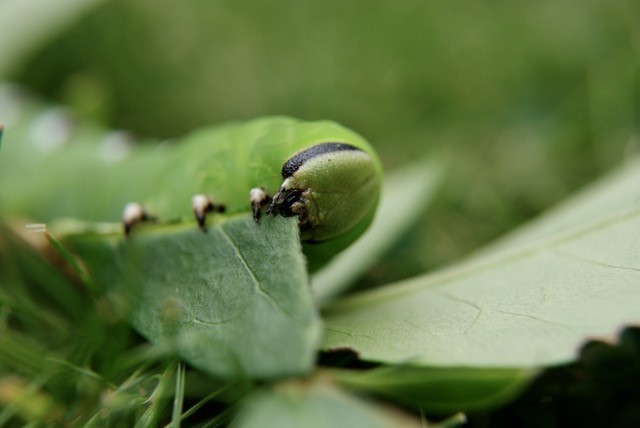
Immediately, they started taking chunks the size of their heads out of the leaves until there were no leaves left inside the tank. I was very surprised by how much they ate in proportion to their size. Every day they grew bigger until, within 4 weeks, they were the length of my index finger! They were bright green with white stripes, pink spots and little pointy tails. To help them grow, they shed their skins every few days. Sadly, one little Jim got stuck in his skin whilst shedding and died. Willow-collecting took a lot of effort as it involved daily trips to the canal, but this was a welcome break from staring at my computer all day during online school.

Poplar Hawk Moth larva feeding. Photo credit: Ben Atwell

One morning we found that a lot of the caterpillars were wandering around, banging their heads on the bottom of the tank. They were also turning a darker green which (after a bit of research) we found out meant they needed to bury and become a chrysalis. We put a deep layer of soil into the tank and within minutes they had disappeared. We tucked them up in the shed for winter and waited.

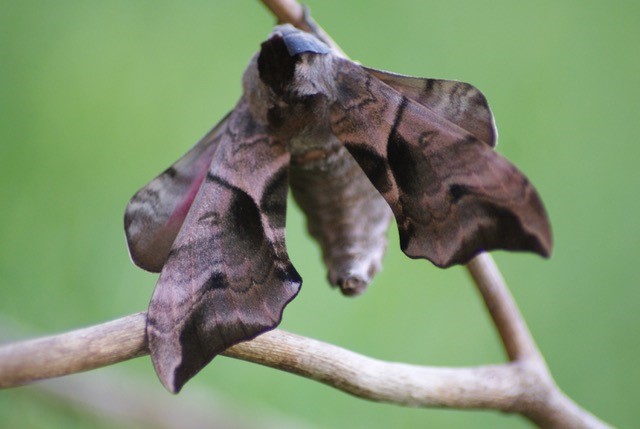
After months of hibernation, they started emerging this spring with crumpled wings, looking very like dead leaves. After stretching out their wings we noticed that we couldn’t see the eyes that the eyed hawk moths are known for, but as we later realised, they only show the eyes as a defence mechanism if they were under attack. Normally it would take a while for the males to seek out the females using their fanned antenna, but because they were in a large tank, it was easy for them to find each other and mate. Within a few days they had laid over 1,000 little green eggs! So, the process of willow collecting began again, but this time, after checking with the county moth recorder, we released the little caterpillars (who this year I called Jeff) into our local wildlife reserve, hoping that they survive and go on to repeat the process in the wild this year.

Poplar hawk Moth adult. Photo credit: Ben Atwell

We are still waiting for the privet chrysalises to hatch, but to keep me busy, my Grandpa sent me 15 poplar hawk moth eggs this spring. These have already been through one cycle of eggs-caterpillars-chrysalis-moth-eggs and I gave some of the eggs to the museum during the Insect Investigators Summer School. I hope the staff have time to collect all that poplar!

The Poplar Hawk Moth, Laothoe populi, is a beautiful insect found thrououghout the UK and is common wherever their foodplants can be found: mainly the poplar trees from which they get their name, aspen and willows. Ben describes the voracious appetite of the larvae well. The adults don’t feed at all and so are short-lived. You can find the adult moth from May to July and the caterpillars from June to October. In Southern England there may be a second generation of adults in the autumn.

Hunt for the Stag beetle

Here is the first contribution from one of our readers. It is a tale from Milo Dawes of his exciting hunt for a stag beetle in Richmond Park, London:

On Sunday 20th June I went to Richmond Park. It was a warm day and I had just been in the car for 45 minutes. When I got there, I saw lots of roe deer, but I had come here to find the biggest beetle in the UK – a greater stag beetle. Here is what you need to know to hunt stag beetles:

  • You should look on and around rotting wood and oak trees, especially where the wood has been chewed away.
  • Look in spiderwebs for dead lesser stag beetles – the greater stag beetles are strong flyers and can fly out of the webs.
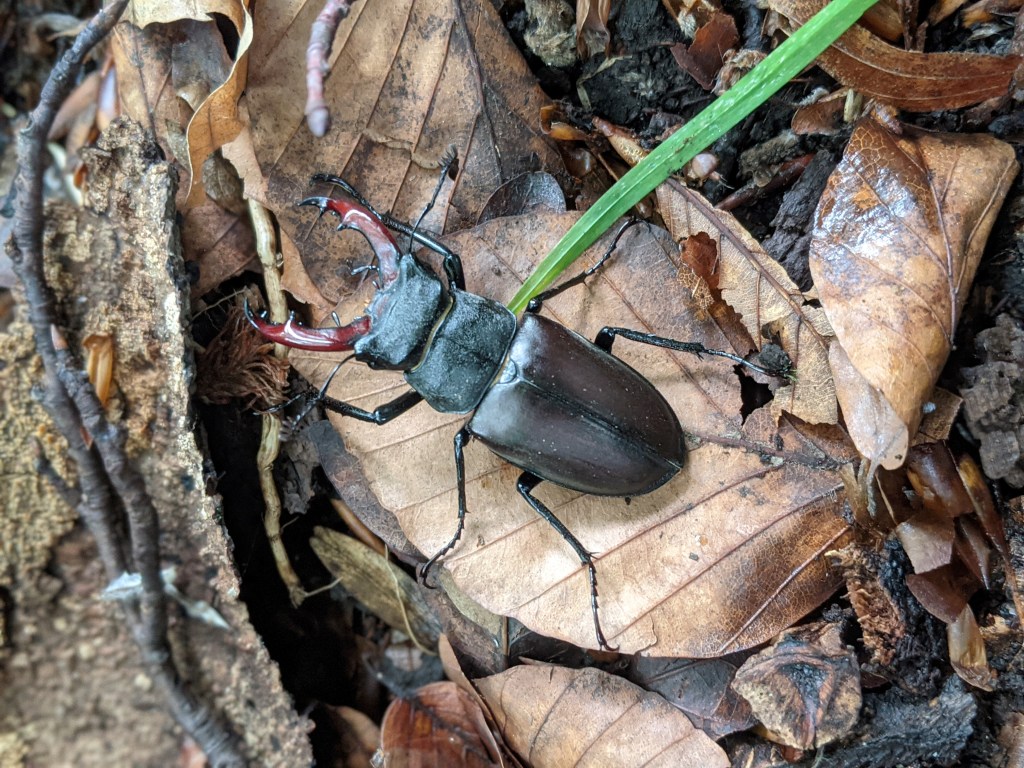
Stag beetle on dead leaves. Image credit: Dawes family.

Next to where I was looking there was a family of grazing deer, chewing away noisily. Slowly and quietly, I walked around some bramble to get to some rotting wood. I lifted it up, but found nothing. Sadly, I walked back, this time the other way around. I spotted something move next to the bramble, out of the corner of my eye. It was a greater stag beetle – the biggest I had ever seen.

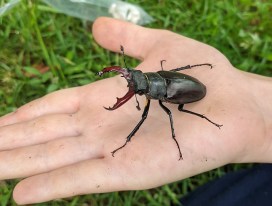
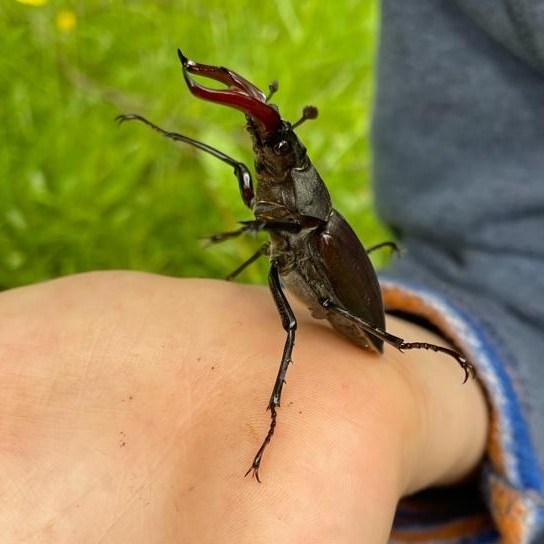
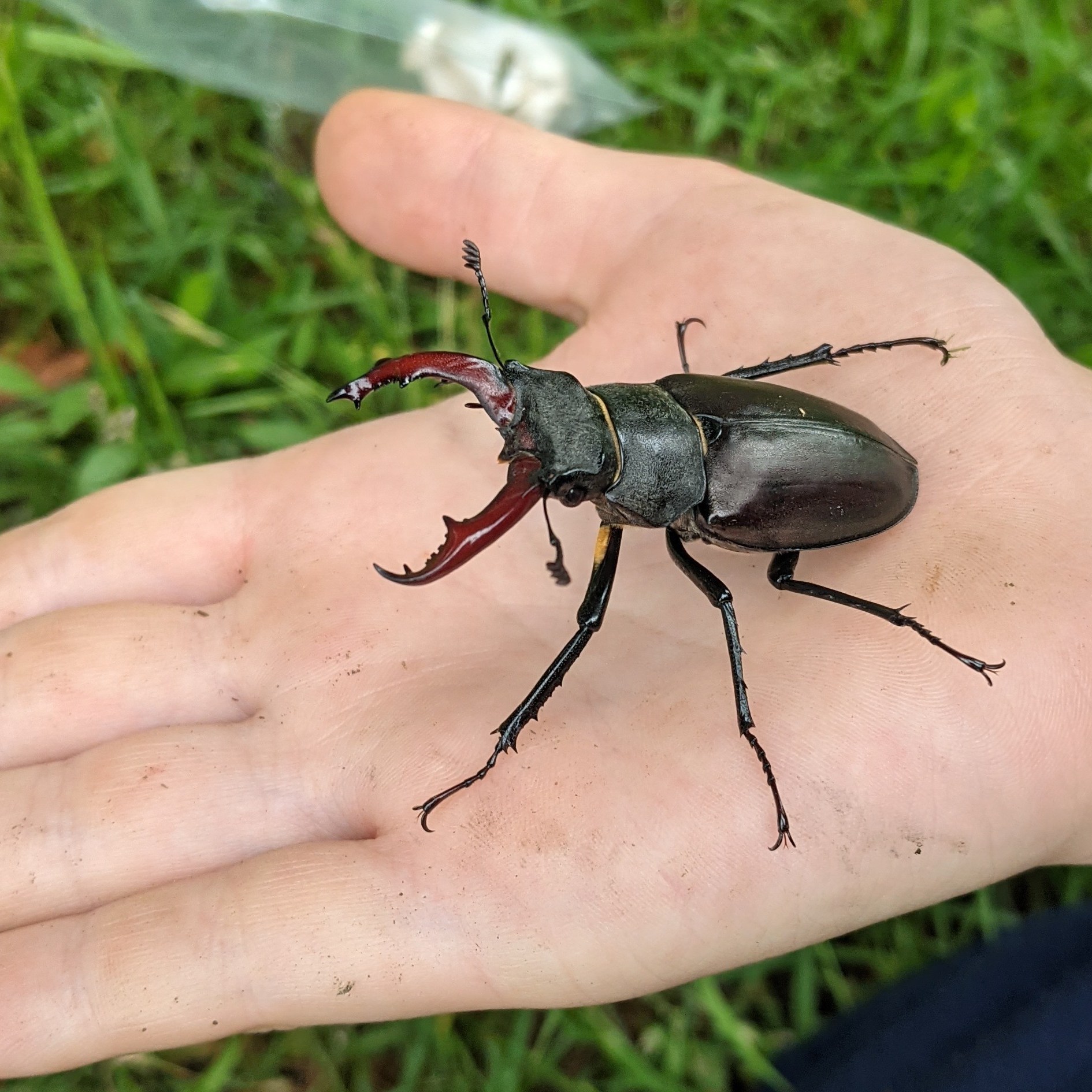
Greater stag beetles are often spotted flying around at dusk, flying with the tip of their jaws facing the sky, like a swordfish jumping out of the water. Males can grow up to 10cm – nearly as big as my hand. Greater stag beetles have a black head and thorax, reddish-brown antlers and a chestnut brown abdomen. They are endangered and rare because humans make life difficult for them. We build on woodland, and rotting wood is often removed from forests. They are being wiped out at an alarming rate. If you spot one, in London, you can help by going to www.wildlondon.org.uk to record your find.

Stag beetle on hand. Image credit: Dawes family

I looked up above me, and there was an ancient oak tree looking very medieval. Then I looked at the stag beetle. It was right next to some rotting wood. I picked it up carefully and ran to a bench. Angrily, the stag beetle waved its antennae at me, and it may have even pointed at me with its claws. The beetle reared up. It was amazing.

Thank you to Milo for this fascinating account. If any of you would also like to write a piece on insects for the blog please contact us or email hopelearning@oum.ox.ac.uk.

Stag beetles are classed as a ‘priority species’, and are protected under the Wildlife and Countryside Act 1981. It is therefore important that you do not remove any from where they are found.

a summer of insect activities

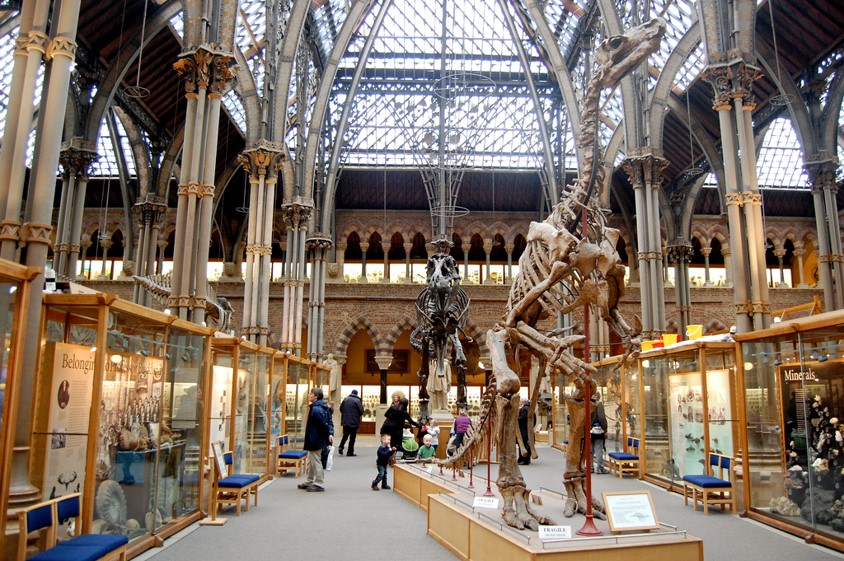
We are open!  After months of being closed due to the pandemic, Oxford’s Museum of Natural History finally reopened in May, and we are absolutely loving the fact that the museum is once again full of life, laughter and learning. 

If you live near Oxford, or are planning a trip to this part of the world, remember to visit us this Summer.  We would love to see you!  We have over 7 million historical and modern specimens, of which around 5 million are insects.  So, if you are interested in insects then this is the place to come!

Visiting the museum is FREE, but please book your tickets here Visit us | Oxford University Museum of Natural History

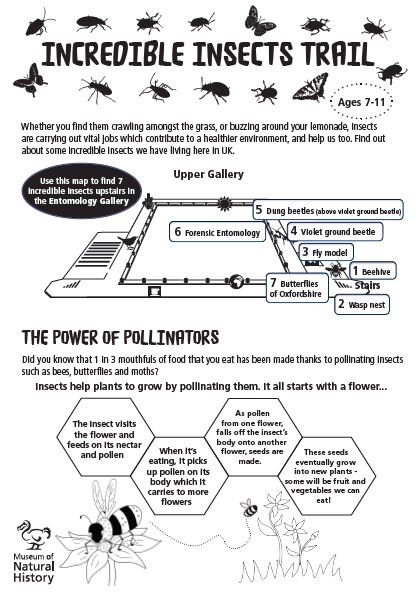
Why not try our Incredible Insects Trail?

Help yourself to a copy of this trail in the main museum court and journey round some of the highlights of our entomology collection. 

Take your completed trail to the front desk, mention that you heard about it here at crunchyontheoutside.com and you will receive a certificate and an Inspired by Insects badge. 

Remember to keep an eye on our website for information about other FREE Summer family activities in the museum. Events | Oxford University Museum of Natural History

Find us out and about in Oxfordshire

This Summer, we will also be out and about at the following events in Oxfordshire:

Out and About with Insects – Tuesday 17th August, 11am – 3pm, Princess Diana Park, Banbury

Finds us at Oxfordshire Play Association’s Play and Activity Day to learn more about insects and have a look at some of our magnificent specimens close up. Out and About with insects – Princess Diana Park, Banbury | Oxford University Museum of Natural History

Wychwood Forest Fair – Saturday 22nd August, 11am – 5pm, Foxburrow Wood, Witney

Come along and visit our stand where you will find a range of insect-related activities, including insect collecting using specialist equipment.  Find out more at: Wychwood Forest Fair | Wychwood Forest Trust

We would love to see you over the Summer, whether in the museum or out and about at an event. Have a fantastic Summer!

People: Karim Vahed

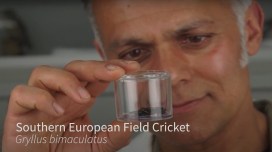
Professor Karim Vahed tells us about how he first became interested in insects and his work with Bush Crickets at the University of Derby. He explains what makes them so fascinating and why the Southern European Bush Cricket, Gryllus bimaculatus, is his favourite insect.

Professor Karim Vahed on why Bush Crickets are his favourite insect.

Do you have a favourite insect? What is it about it that you like? You can let us know using our Contact Us page.

If you enjoyed this video, you might like to take a look at others featuring scientists and other people who work with insects on our ‘People‘ pages.

Make a butterfly feeder

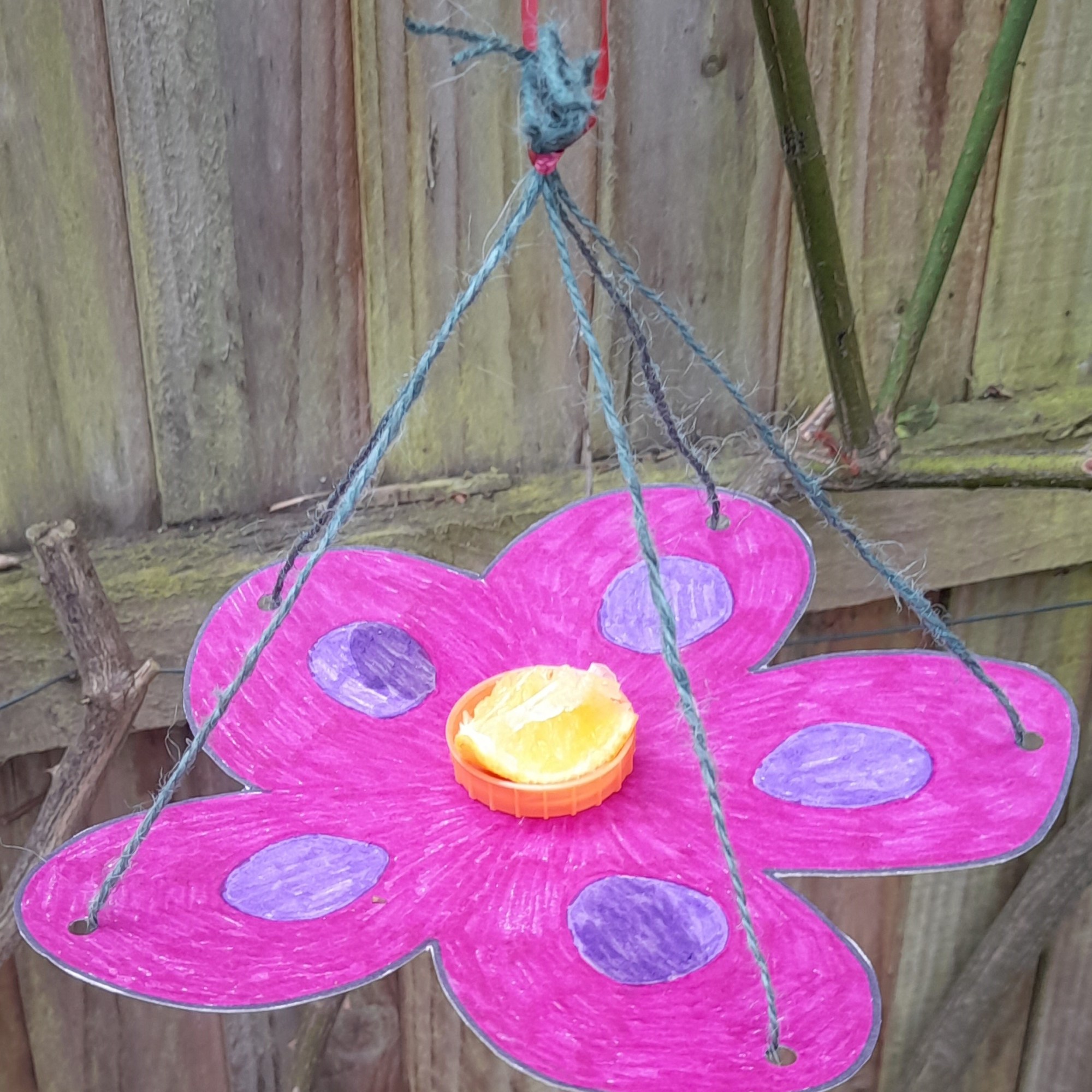
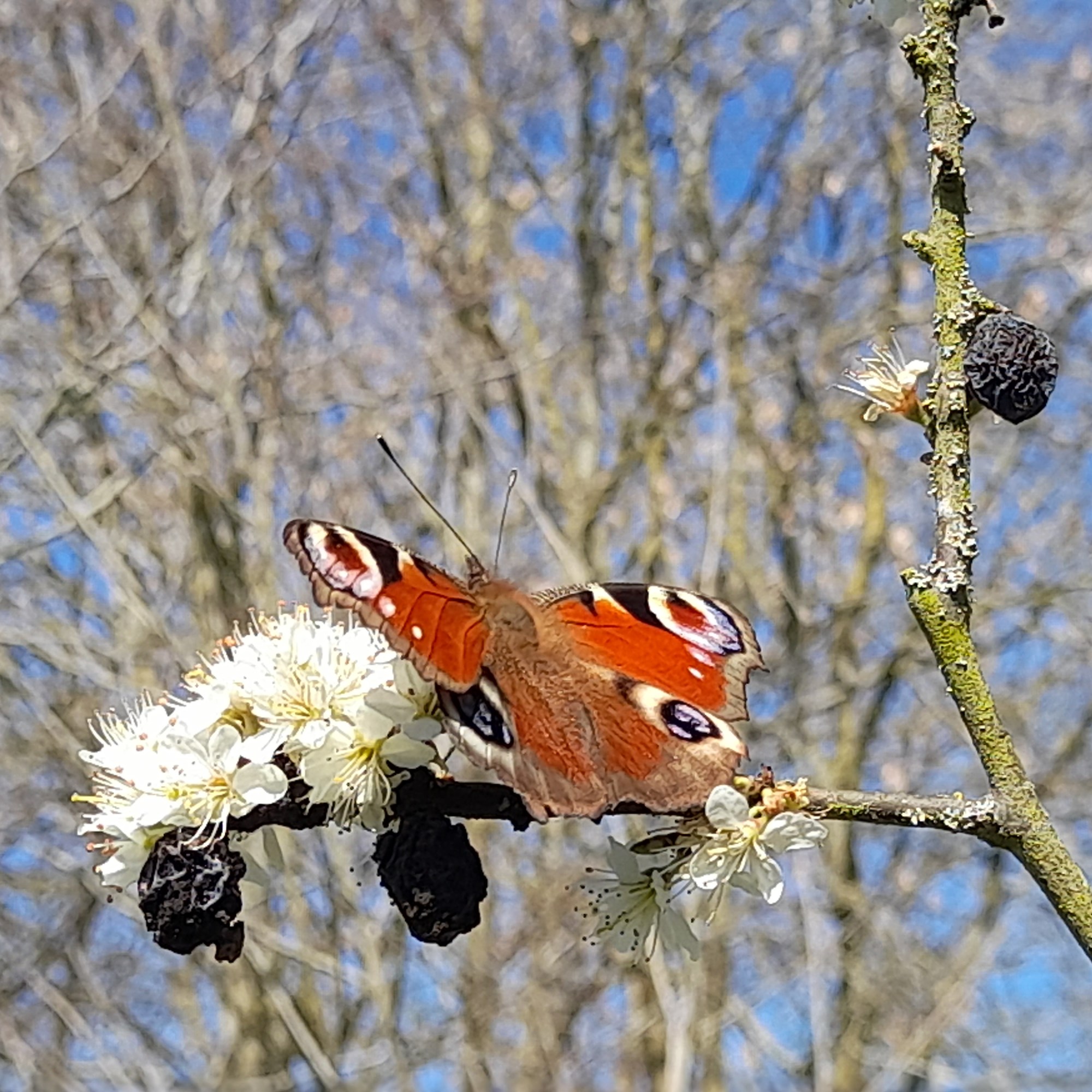
In the last post Kate told us all about her favourite butterfly. In this post I will be showing you how to make your own butterfly feeder, from items you might commonly have at home, to help attract butterflies, and other insects, to your outside space. I had to raid my recycling bin for key materials.

Here are the same instructions on how to make a butterfly feeder, as can be seen in the video:

What you will need:

  • Cardboard
  • Coloured pens or paints
  • String or wool
  • Glue or sticky tape
  • Scissors
  • Bottle top
  • Hole Punch
  1. Take a piece of cardboard and draw a flower with five petals, roughly 20cm wide.
  2. Decorate your flower in any way you wish.
  3. Cut out your flower.
  4. Fix the bottle top to the middle of your flower using glue or sticky tape.
  5. Use a hole punch to make a hole at the edge of each petal of your flower.
  6. Cut five pieces of string or wool, each roughly 40cm long.
  7. Tie the five pieces of string together at one end.
  8. Turn your flower over and thread a piece of string through each hole, and tie the five pieces of string together.
  9. Tie an additional piece of string, or wool, to the knot.
  10. Hang your butterfly feeder in a sunny, but sheltered, spot outside.
  11. Mix together sugar and water, or take a small piece of overripe fruit (e.g. orange or banana), and put it in the bottle lid.

Watch to see any butterflies, or other insects, that visit your feeder. You could investigate which foods different species prefer.

Please tell us about your butterfly feeders and investigations. We would love to see photos of them. Contact us or email at hopelearning@oum.ox.ac.uk.