When working on the dissertation for my MSc in Archaeological Science last year, I explored the medieval craftsmanship of sealing wax. I was interested in the way the medieval wax seals had flaked, as the beeswax dried out. Drawing on my previous education in conservation techniques, I began a close investigation of the prestigious material, beeswax.
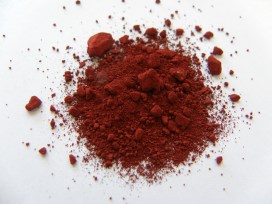
Medieval craftsmen used a range of dangerous materials to make sealing wax. The red pigment cinnabar, a mercury (II) sulphide, and red lead, are now known to be extremely poisonous.
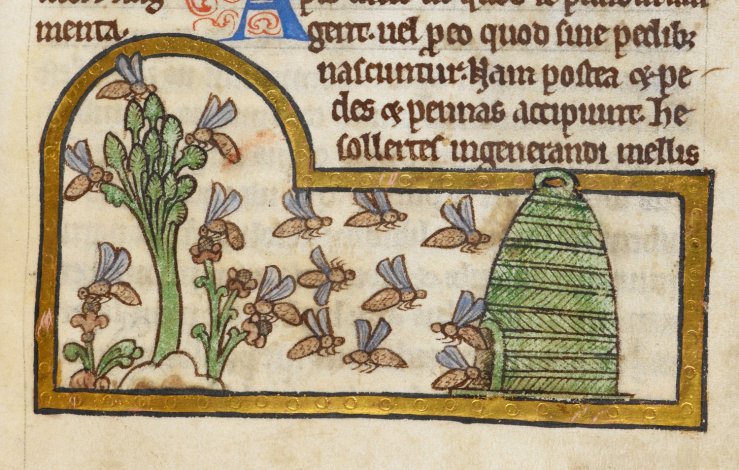
Although some of the ingredients of sealing wax are very hazardous, there is nothing dangerous in beeswax… except the bees! Produced by honey bees, Apismellifera, honey and beeswax were important commodities in the Middle Ages. Beekeeping was a skilful profession, housing colonies in woven hives, known as skeps. Colonies were carefully selected to overwinter for the next season.
Manuscript illuminations provide detailed information on the types and construction of beehives in the Middle Ages.England, 13th century. British Library Royal 12 C XIX f. 45.
Beeswax was also important in the Middle Ages for lighting, and beeswax candles were preferred for their pleasant smell. After the Protestant Reformation in the 16th and 17th centuries, the religious use of candles decreased, so demand for beeswax declined.
Even today, the Catholic and Orthodox Churches still require the candles they use to contain a proportion of beeswax.
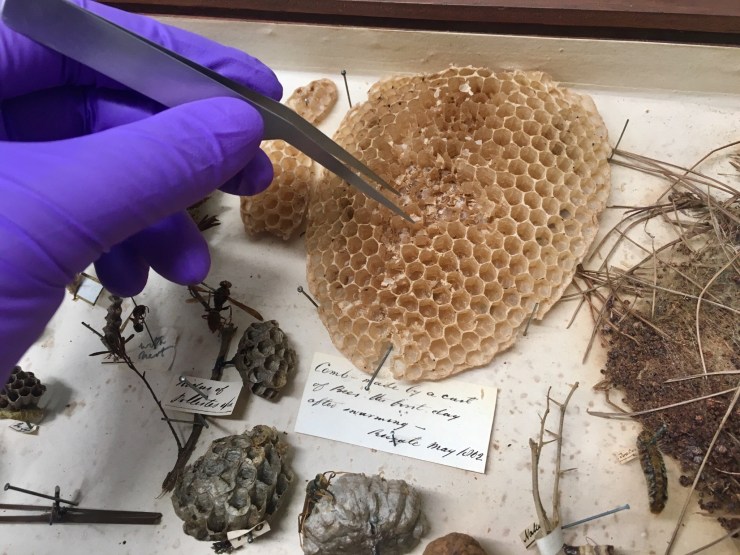
On my quest to understand the degradation of beeswax in sealing wax and write my disseration, I was very lucky to use some samples from the entomological collections from the Oxford University Museum of Natural History. After some early mornings spent amongst the Westwood collection, I found the perfect specimens of natural honeycombs, from the 19th century. The old hand-written labels were also a lovely encounter when exploring the historical collections.
I compared the samples to modern beeswax and medieval seal samples, and learned that the degradation of beeswax is caused by multiple factors, triggered also by storage conditions. The composition of beeswax is very complex, and there are differences caused by the age of the bee in addition to geographical provenance.
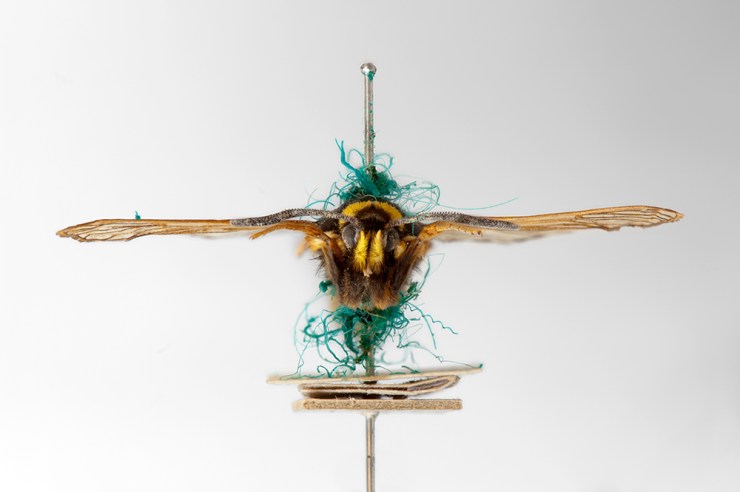
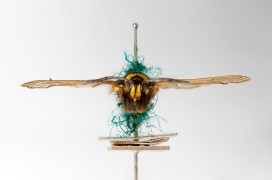
A selection of bee specimens from the Museum’s collection.
The recent catastrophic decline of bee populations has drawn focus to save the bees, and in my PhD research (University of Copenhagen and University of Cambridge) I will explore the recovery of ancient DNA and proteins of bees from beeswax, to cast light on the health of bee populations over time.
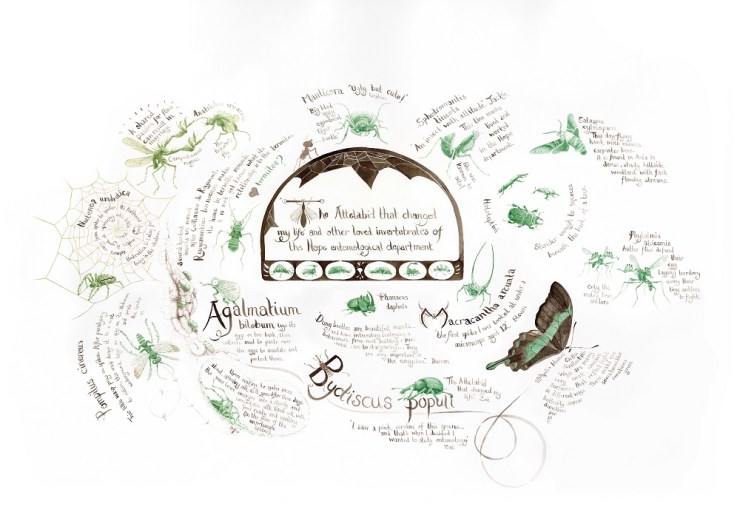
Katherine Child, image technician in the Museum’s Life collections, doesn’t just use photography to capture the beauty of specimens. She is also an artist and has been trying out innovative techniques for her paintings. You may remember her amazing moth illustrations created with deposits of verdigris on pinned insects and she’s now using that technique to explore Museum staff’s favourite insect specimens.
Verdigris is a green corrosion often found on old pins within entomology collections (as well as elsewhere, on things like statues and copper pipes). Last year, after learning that the substance was once used as a pigment, I decided to try and make my own paint.
A clearwing moth before conservation, showing verdigris spreading where metal reacts with insect fats, or lipids.
Verdigris forms when copper or a copper alloy reacts with water, oxygen, carbon dioxide or sulphur. While a beautiful shade of green, the substance is damaging in natural history collections, where it can actually develop inside specimens and if left, split them irreversibly. So as part of the conservation of the Hope Entomological Collections, verdigris is removed.
I started to collect up the substance as it was cleaned from specimens and after about three years (you only get a little bit per pin) I was ready to make my paint! After my first moth project, the only question was, what to paint next…?
Byctiscus populi or ‘The Attelabid that changed my life’, chosen by Zoë (collections manager) who said ‘I saw a pink version of this species in the Natural History Museum in London and that’s when I decided I wanted to study entomology’.
With an estimated 6 million insects and arachnids in the entomology collections, it’s very easy to feel overwhelmed. You can pull open any one of thousands of draws and find astonishing specimens. While I have favourites, my first inclinations as to what to paint still felt a little arbitrary. After mulling over various possibilities, I decided to get help!
Chosen by DPhil student Leonidas, Agalmatium bilobum is a little bug which lays its eggs on tree bark, then covers them with mud to protect them.
I asked my co-workers what their favourite insects were, then opened the question out to regular volunteers and visitors of the Life collections. I loved finding out why people chose the things they did. Answers varied from ‘It was the first spider I ever looked at under a microscope aged 12’ to ‘Because they’re cool’ to ‘Because they have an ingenious way of manipulating spiders!’
One of arachnologist Russell’s favourite spiders: Nuctenea umbratica. Though common in the UK, umbratica is Latin for “living in the shadows”, and it often hides away during the day. The slight transparency of the paint lends itself to a spider’s glittering eyes.
Painting this live African Mantis Sphodromantis lineola (chosen by conservator Jackie) was made slightly more challenging by the fact that the subject thought Katherine’s pencil might be tasty.
Most of the subjects I painted were based on specimens from the Museum’s collections or specimens individuals had brought in from their own collections, but one favourite was a live African Mantis, housed in the department to help with education and outreach. When I began to draw her she was intrigued by the movement of my pencil and came to the front of the tank, to follow every mark I made with her intimidating gaze.
A detail from the final paintingKatherine’s fabulous finished painting, which will be framed and displayed in the Life collections department.
Though time consuming, the painting was loads of fun to research and do. It’s fantastic to be surrounded not only by extremely knowledgeable people, but also by people with a genuine passion for what they do and a love for the insects (and spiders) they study.
Since we posted about ten-year-old Sarah’s amazing beetle discovery, we’ve had lots of queries as to why the insect needed to be caught and pinned. It’s a question we’re often asked, so here’s Darren Mann, Head of Life Collections at the Museum, to explain the value of ‘voucher specimens’.
The Museum’s collection houses over five million insect specimens, amassed over the past 300 years. This collection is, in effect, a biodiversity database, but unlike virtual databases, each data point has an associated ‘voucher specimen’ that was caught, pinned and labelled.
Although technical advances in digital macro-photography do reduce the need for some collecting, it is impossible to dissect an image to confirm an identification. So for many groups, even the best photograph in the world is inadequate for identification purposes.
Shingle CrawlerD18 (Psammoporus insularis Pittino, 2006) one of our few endemic insects.
Unlike plants and birds, many insects can only be identified with the aid of a microscope, to study tiny features that distinguish closely-related species. Some groups even require the dissection of minuscule genitalia to really tell them apart.
Entomologists take voucher specimens to enable this correct identification and these are later deposited in museum collections, making them available for further study in years to come. From an entomologist’s point of view, we believe we need to know what a species is, where it occurs and as much about it as possible, so we can inform biodiversity conservation.
The conservation assessment of UK insects by Natural England in their Species Status Reviews has only been possible with the data provided by entomologists, generated from collecting and identifying voucher specimens.
Entomologists follow a Code of Conduct for responsible collecting, which ensures they don’t remove too many species or damage the environment during their work .
There are numerous examples of the value and use of insect collections in contemporary science, including the discovery of previously unknown species in the UK and population genetics for butterfly conservation. Recently a species believed extinct in the UK was rediscovered. This was only made possible by checking the identification of several thousand museum specimens.
Museum collections also contain numerous examples of species now considered extinct in the UK. Without voucher specimens much of this research would be impossible and our understanding of insect distribution patterns, ecology and conservation would be significantly diminished.
Large Tortoiseshell butterflies, now considered to be extinct in the UK. The voucher specimens act as record in time of its occurrence in the UK.
What is rare? Sarah’s False Darkling Beetle (Anisoxya fuscula) has been described as ‘rare’, but what does that mean in reality? For most invertebrates when we talk about a rare species we are not talking about a tiny number of individuals. This conservation status is based on their known distribution and the level of threat they face. A species can be rare if it is only found at one or two locations, but at those locations there may be many thousands of individuals.
The greatest threats to biodiversity are well known and include habitat loss, fragmentation and degradation and pollution, such as pesticides and light. Taking a small number of voucher specimens to confirm the identification of species has negligible impact on its population. But if we don’t know it’s there because we couldn’t identify it, then a housing development destroys its entire habitat… well you get the picture!
The Museum’s collection of British insects already houses over a million specimens, and now it boasts one more special insect.
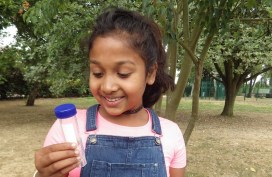
Ten-year-old Sarah Thomas of Abbey Woods Academy in Berinsfield, Oxfordshire discovered a rare beetle in her school grounds while taking part in a Museum outreach session. To Sarah’s excitement, the beetle is so important that it has now become part of the collections here at the Museum – and it is the first beetle of its kind to be added to the historically important British Insect Collection since the 1950s.
Sarah Thomas examines her beetle under the microscope with Darren Mann, entomologist and Head of Life Collections at the Museum
Sarah’s class took part in a HOPE Discovery Day, where they were visited by a professional entomologist, learnt about insect anatomy and how to identify and classify specimens, and went on the hunt for insects in the school grounds. HOPE – Heritage, Outreach and Preservation of Entomology – is reaching out to students in state primary schools across Oxfordshire, using the Museum’s British Insect Collection to spark curiosity and foster a love of natural history. It’s all part of a bigger project at the Museum, supported by the Heritage Lottery Fund, to safeguard this important Collection for the future and engage people with natural heritage.
Sarah brought her family to the Museum to see her beetle in the British Insect Collection.
After some searching, Sarah spotted a 5mm insect lurking under a leaf. To the untrained eye it looked rather like any other tiny shiny beetle, but luckily Darren Mann, Head of the Museum’s Life Collections, was visiting as part of the HOPE team. Darren spotted it as something unusually and took it back to the Museum to get a closer look under the microscope. He was then able to identify it as a False Darkling Beetle.
It’s Anisoxya fuscula, which is rated as Nationally Scarce in Great Britain. We seldom see these outside old forest habitats and this is the first beetle of its kind to be added to the collections for around 70 years.
– Darren Mann, Head of Life Collections
The False Darkling Beetle under the microscope and labelled in the Museum’s British Insect Collection as found by Sarah Thomas
The tiny beetle has been labelled with Sarah’s name and the location of her find, and added to the British Insect Collection. Though she’s very excited to have her specimen in the collections, Sarah admits that she hasn’t always been a big fan of insects:
Before Project Insect I didn’t really like insects, but now I really do.
– Sarah Thomas
Everyone at the Museum is really pleased with Sarah’s fantastic find and we hope it spreads the word to inspire others to become budding young entomologists too.
The beetle Sarah discovered will be stored in this drawer in the British Insect Collection.
This article is taken from European research magazine Horizon as part of our partnership to share natural environment science stories with readers of More than a Dodo.
Unravelling one of the most elaborate forms of non-human communication – the honeybee’s waggle dance – could help researchers better understand insect brains and make farming more environmentally friendly.
It’s part of a field of work looking at insect neurology which is helping to unravel the complexity of their brains.
Bees have evolved a unique, and ingenious, way to communicate with each other – the waggle dance. By shaking their abdomens in a particular way, a bee can tell others in its hive the specific direction and distance of a food source or a new site for a nest.
‘If nectar or pollen is in the direction of the sun, a bee will run a figure of eight that is orientated towards the top of the hive. If pollen is found 90 degrees from the sun they will point that way instead,’ explained Dr Elli Leadbeater, a bee expert from the School of Biological Sciences at the University of London, in the UK.
The longer the bees spend dancing corresponds to the better quality of a food source, while the more time spent on each figure eight represents the distance from the pollen or nectar.
Researchers now believe that decoding this information-packed dance further could reveal a link between bees’ brains and how the surrounding environment affects them. In a project called BeeDanceGap, Dr Leadbeater is working to identify the exact genes in the bee brain that play a role in helping the insects understand this waggle dance.
To do this, researchers must first identify the best dancing bees in a test hive and watch them as they reveal a food source to other worker bees. The newly educated bees are then captured as they leave the hive so their brain tissue can be genetically analysed to determine which genes associated with learning and memory were activated from following the waggle dance.
Only a few individuals are used in this way and the genetic data provides a deep insight into the neurology of a bee’s brain – at a time crucial to their future.
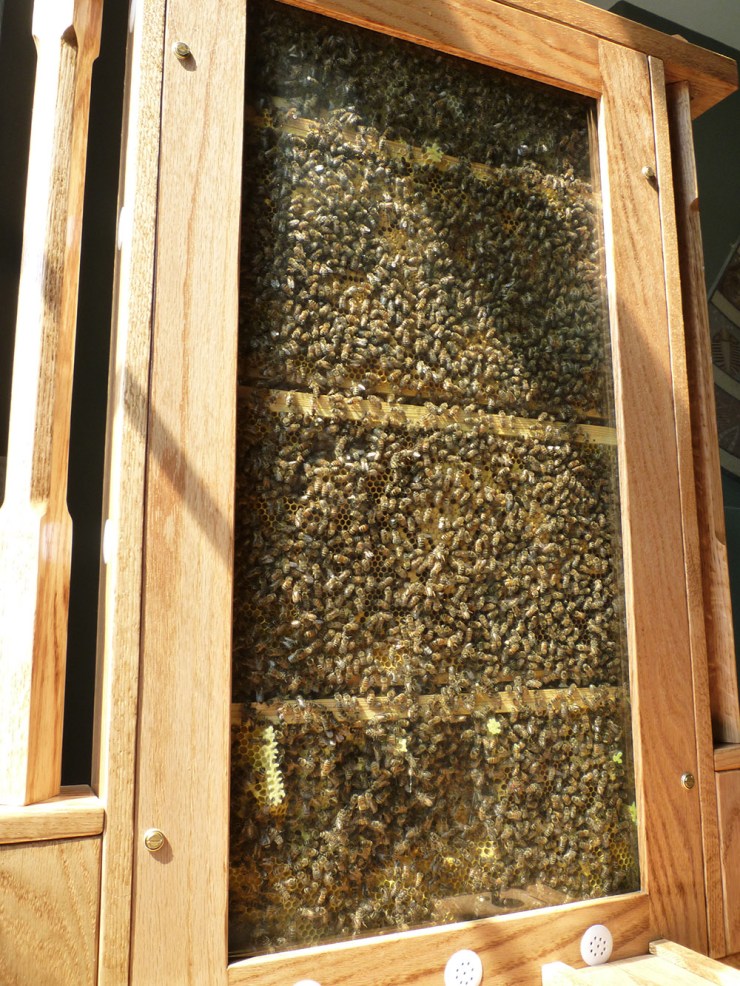
The observation bee hive at the Oxford University Museum of Natural History gives visitors a glimpse into hive life.
Collapse
Beekeepers around the world have reported that many of their bees leave and never come back, causing hives to suddenly collapse. Experts believe there are several factors contributing to this widespread loss of bee colonies, including climate change, parasites and habitat loss. Agrichemicals like pesticides and neonicotinoids, which are used to kill unwanted insects on farms, have also been strongly linked to the problem.
‘The rate pesticides or neonicotinoids are applied to crops don’t necessarily kill bees but they make them worse at foraging,’ said Dr Leadbeater.
If you do damage to just one part of the brain of a lot of individual bees, it can have huge consequences for the whole colony.
Dr Elli Leadbeater, University of London, UK
Neonicotinoid pesticides have been found to bind to parts in the insect brain, disrupting neural transmission. This leads to some brain cells either failing to develop or not functioning properly.
The EU recently banned neonicotinoids, which Dr Leadbeater believes is a huge step forward in protecting bees, but she said governments still need more rigorous ‘long-term environmental safety monitoring’. Without this, there is a risk that other agricultural products used in place of neonicotinoids could impact honeybees in a similar way.
But when the first results of BeeDanceGap are published later this year, they could contribute to building better criteria for testing future agriculture practices or products. Dr Leadbeater believes it will provide a new understanding of a bee’s brain, and so help identify problems sooner.
The impacts of quickly identifying problems go far further than just supporting beekeepers and their insect charges. Protecting honeybees, along with bumblebees and wild bees, is also essential to maintain a healthy and productive environment. These insects pollinate over 80% of crops and wild plants in Europe. According to Professor Martin Giurfa, from the Research Center on Animal Cognition at CNRS in France, ‘preserving little brains is about preserving biodiversity’.
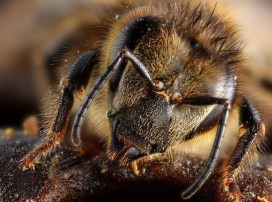
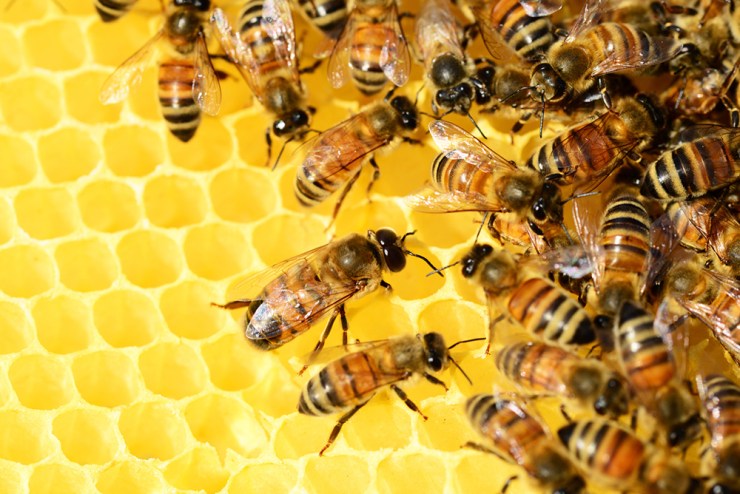
Honey bees working inside a hive
More than machines
Honeybees have a higher social complexity than many other species. Alongside the waggle dance communication, each hive has a division of labour where different workers have responsibility for a variety of tasks – such as foraging for pollen, nursing the young, building hives and even removing the dead.
Prof. Giurfa is co-leading the BrainiAnt project, which looks at how this type of complex social behaviour evolved and how it affected the structure of insect brains. He said that when ‘you understand how bees perceive the world, it is easier to find ways to protect them’.
Through the work of researcher Dr Sara Arganda, the project is investigating a part of the insect brain called the mushroom body, where learning occurs and long-term memories are stored. Researchers analysed bee behaviour and gave them memory tests, such as navigating paths using colour cues, in order to learn more about the structure of insect brains.
The project strengthened the argument that bee brains are more complex than previously thought. ‘Most findings are saying that insects are more than simple machines, which comes from studies in the honeybee,’ said Prof. Giurfa. ‘(But) the entrance region of the mushroom body shows a level of complexity and the studies show that this complexity is not rigid, it is plastic.’
This means its structure is changing all the time, which mirrors how human brains work. ‘(Bee) brains are capable of sophisticated performances such as learning concepts and rules; they are incredible organs and they need to be defended,’ said Prof. Giurfa
To further advance understanding of the mushroom bodies and how they function in different species, the project is being co-led by Professor James Traniello at Boston University in the US, an expert in ant evolutionary neurobiology.
Ants, which are related to honeybees, have brains that may be 100 times smaller, and due to their minute size, provide insights into how insect brains are structured.
‘What happens to neural tissue at an extremely small size?’ asked Prof. Traniello. ‘Are you losing neurons, are neurons becoming more efficient in their actions, how many neurons do you have to string together to form a circuit that enables behaviours as complex as what you would see in ants? How does the collective intelligence of an ant colony impact the structure of the brain?’
If BrainiAnt can answer these questions, it would provide a clearer picture of the evolution and function of ant brains.
‘The next step is trying to understand the genes that are involved in regulating brain size, compartment variability, metabolism and other functions,’ said Prof. Traniello.
He added that a better understanding of neural tissue could also help to guide attempts to genetically engineer bees so their brains are resistant to environmental threats like neonicotinoids. Although far off, it could mean that bees, and the benefits they bring to the environment, will have a more secure future.
The research in this article was funded by the EU.
*
The issue
One in ten pollinating insects is on the verge of extinction, and a third of bee and butterfly species are in decline.
On 1 June, the European Commission launched a proposal to tackle this problem at an EU level. It includes a new monitoring process to collect quality data and identify trends, action plans to protect insect habitats and incentives for businesses such as those in the agrifood sector, to contribute to conservation.
The proposal, known as the EU Pollinators Initiative, has a number of short-term actions to be taken before 2020, at which point the progress will be reviewed.
In the process of researching or conserving old pinned insects, it’s common to find a green deposit clustered around the pin. This is known as verdigris and is a natural patina created when the metal oxidizes over time. Katherine Child is Image Technician in the Museum’s Life collections and takes photos of insects for researchers, students, artists and publications. She is also an artist in her own right, so when she witnessed verdigris being removed during a conservation project, she came up with an inspired idea.
A clearwing moth before conservation, showing verdigris spreading where the metal and the insect fats, or lipids, react.
A few years ago I read a book called Colour: Travels Through the Paintbox, by Victoria Finlay, and was interested to learn that verdigris was once used as a pigment. Verdigris, which I now know translates from French as ‘Green of Greece’, is a word that’s been in my vocabulary since I was small. I loved its rich bright blue-green colour, which is often seen on old copper piping or copper statues.
Verdigris forms when copper or a copper alloy reacts with water, oxygen, carbon dioxide or sulphur.
L: Three years’ worth of verdigris, ground and ready to make into paint. R: A second attempt at mixing the paint, this time using linseed oil.
As early as 5thcentury AD, it was used in paint-making, and until the late 19th century it was the most vibrant green pigment available. But it was unstable – Leonardo da Vinci warned that it ‘vanishes into thin air if not varnished quickly.’ These days synthetic pigments provide a more constant alternative.
Despite its past uses, verdigris is a big problem in pinned insect collections. Nowadays stainless steel pins are used, but pins containing copper still remain in old collections and these react with air and insect fats. The more fatty the insect, the more verdigris tends to form and, if left, it can damage a specimen irreparably.
Comprising around five million or so insects, the Hope Entomological Collections here in the Museum take quite a bit of looking after. A few years ago a project to catalogue and conserve many of its butterfly and moth specimens was undertaken and the removal of verdigris and repining of insects was part of this.
With paint-making in mind, I asked that the beautiful, but problematic, substance be saved. About three years on I finally got around to using the pigment, which I had also been adding to while photographing the collections.
I chose a variety of differently shaped moths to paint (most of the verdigris came from moths, so moths seemed the most apt subject). To narrow my options further I went for green moths. Some of the specimens I chose had verdigris on their pin, so I was able to take pigment and use it to paint the very specimens from which it came!
Katherine tested out the newly made verdigris paint in her sketchbook.
After a first failed attempt to make watercolour paint (during which pigment and water remained stubbornly separate due to the greasy insect fats still present), I tried again, this time using linseed oil to make oil paint – and it worked! Traditionally a flat bottomed tool called a muller was used to press pigment into the water or oil. Not having one of these, I used the flat end of a pestle and a mortar which did the trick.
A Miscellany of Moths, the finished verdigris painting.
The paint went surprisingly far and, following on from the 14 green moths, I plan to use up the remainder to paint beetles.
Katherine’s Miscellany of Moths painting can be seen on display in the Museum’s Community Case until 18th October.









 Since we posted about






 More Than A Dodo