The bully bee

Bee3

Young volunteers Genevieve Kiero Watson and Poppy Stanton tell the tale of the Museum’s resident Wool Carder Bee and their investigative bee work in our Life Collections…

A small guardian patrols its territory among the luscious bed of Lamb’s-ears that grow at the front of the Museum. This feisty critter, the Wool Carder Bee (Anthidium manicatum), is just one of the roughly 270 bee species that buzz around Britain. Having spotted this unusual hovering bee we seized the opportunity to identify, photograph and explore the species a little further.

The male of this solitary bee species is fiercely territorial, fighting off other males as well as any other insects it considers to be intruders. Techniques used in combat vary from skilful aerial hovering to ferocious wrestling. But perhaps its greatest weapon is a series of stout spines found at the tip of the abdomen. These are used to bully an intruder into submission, or even to kill it. In so doing, the male protects the precious supply of pollen for the smaller females which in turn collect it on stiff bristles on the undersides of their abdomens.

Females, being slightly less aggressive, are in charge of constructing the nests, which are built in existing cavities such as beetle holes. Hairs shaved off plants, such as the favoured Lamb’s-ear, are used to create the brood cells for the next generation.
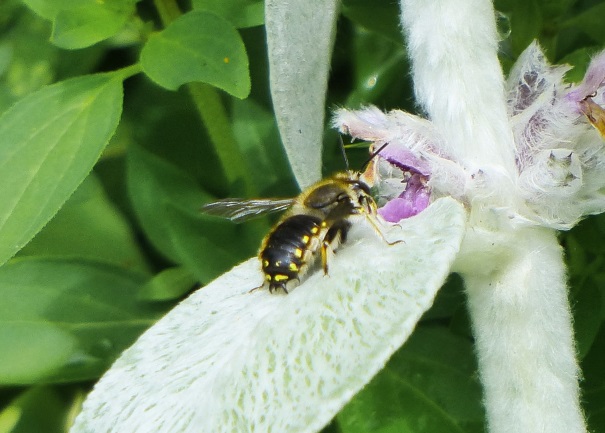
Male Wool Carder Bee on Lamb's ear in the Museum's front garden
Male Wool Carder Bee on Lamb’s ear in the Museum’s front garden

The Museum houses many specimens of the Wool Carder Bee and our job was to pull out the data from each one to help with an ongoing online survey about this species. Although making friends with hundred-year-old bees was enjoyable, trying to comprehend the miniscule handwritten labels accompanying them was altogether more trying.

Every label explains where and when the bee was captured, who collected and identified it, and gives the reference for its current collection. All this on a slip of paper no bigger than half a stamp.

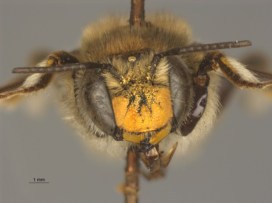
One of the Musuem's Wool Carder Bee specimens, circled, featured in a display of all 270 species of British bee in the Bees (and the odd wasp) in my Bonnet exhibition by artist Kurt Jackson
One of the Museum’s Wool Carder Bee specimens, circled, featured in a display of all 270 species of British bee in the Bees (and the odd wasp) in my Bonnet exhibition by artist Kurt Jackson

After recording data from 120 labels we began to find the grid reference of the location each was originally collected. This too was challenging as many place names have changed in the last hundred years. Ultimately, the information will be used by the Bees, Wasps & Ants Recording Society (BWARS) to improve the distribution map for the Wool Carder Bee.

Why not see if you can spot the Wool Carder Bee in your garden? Characteristics to look out for include small spines on the tip of the abdomen and lateral lines of yellow spots on either side of the abdomen. The bees themselves are about 11-13mm long for females, and 14-17mm for males. Good luck!


Beauty, strangeness and science

This year the Museum is playing host to three poets in residence as part of our Visions of Nature year. The poets, John Barnie, Steven Matthews, and Kelley Swain, have been working alongside staff in our collections and out in the Museum itself to gain inspiration for their writing over the past six months. In the autumn, they will take part in a number of events and activities to present their work, and will be publishing a small anthology at the end of the year.

Here Steven Matthews reveals what has inspired his poems during one of his recent visits to the Museum.

PAL_CL04499_03 (2)
Fossil in the Charles Lyell collection

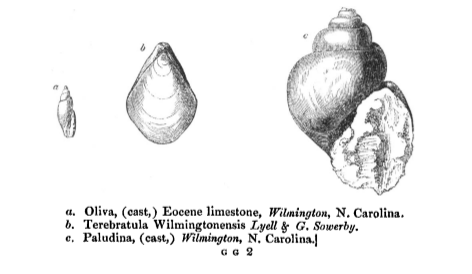
I was struck strongly, during our early visits as poets-in-residence behind the scenes at the Museum, by one particular aspect of the research being undertaken. The history of the Museum collections, their vast reach, is being traced in several instances by the identification of the particular individual specimen which was drawn and lithographed as part of a key scientific paper, in the nineteenth- or twentieth-centuries. Out of the many thousands of specimens held at the Museum, for example, we were shown the exact fossil in the Charles Lyell Collection which had helped, when reproduced in a paper, confirm the geological record of part of the United States.


'Observations on the White Limestone and other Eocene or Older Tertiary Formations of Virginia, South Carolina and Georgia' by Charles Lyell, 1845
‘Observations on the White Limestone and other Eocene or Older Tertiary Formations of Virginia, South Carolina and Georgia’ by Charles Lyell, 1845

The history of the Collections, in other words, is the history not just of their remarkable beauty or strangeness, but of their usefulness in advancing scientific thought; just as it is the history of the individual people who have recognised something new to say from the specimens they were studying. There is a firm analogy between this activity and what the making of poems involves. Concise comparison is, after all, what poetry also seeks to attain, bringing the multifariously divergent elements of the world into intense and new combinations with each other.

In preparing to write poems in response to the Museum building and Collections, I have kept that history in mind, researched it. I have read pamphlets by Henry Acland and John Ruskin, Victorians key to the impulse behind the creation of a Museum here to Science, and to defining what the nature of a building on these principles should look like. I have re-read much Victorian and Pre-Raphaelite poetry in order to steep myself in the kinds of language being used to describe Nature by poets at the time the Museum was becoming active. I have read in the work of scientists working at, or associated with, the Museum in its early days and subsequently.

IMG_9566
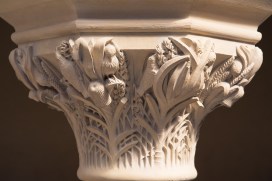
One of the capitals that adorn the Museum court carved by the O’Shea brothers

Out of this reading, but also out of the looking, the many hours spent with the Collections on public display or behind the scenes, have come what is a surprising variety of poems which reflects the wonderful and overwhelming reach of the items at the Museum. I have written about the O’Shea brothers who did much of the amazing carving of column-tops on the Ground Floor; there is a poem on the crystallographer Dorothy Hodgkin, whose lab I was privileged to spend some time alone in.

Dorothy_Hodgkin_Nobel

Nonsense verses have arisen from contemplating the presence of Lewis Carroll here; the astounding collection of multi-coloured marble blocks, the Corsi Collection, has impelled me to create blocks of prose-poetry in their shape. There is a poem ‘voiced’ by an ammonite. The sadness of some specimens, posed in isolation (or in glass jars) far from their original contexts, has moved me; as has the shocked intensified awareness that the history of the Collections is a history of accelerating losses, as more and more of the species gathered in the Museum are extinguished from the world each day.