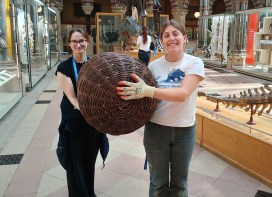
‘Deadly Six’ deinstall

Bethany Milne from the Museum’s Visitor Experience team has spent some time working alongside the Exhibitions team to deinstall a temporary art exhibition. She has reflected on the day – what she enjoyed and what she learnt along the way.

The deinstall of the Museum’s Deadly Six art installation is my first introduction into the world of exhibitions and an exciting one to start with. I have seen the display since it was first installed in September 2024 and I began working at the museum, watching it on my patrols of the court to make sure it stays intact and safe from all the little hands that pass through our doors every day. I didn’t imagine what it would be like to touch them myself until I found out I had the opportunity to join the team in taking them down.
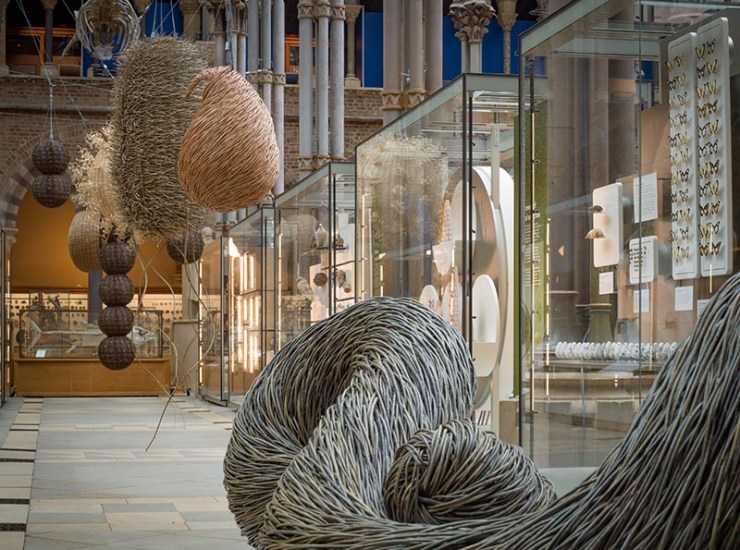
On September 8th I came into the museum at 8:30am to shadow the exhibitions team as a development day. Most of the staff and contractors were already there and so I started by talking to the Head of Exhibitions, Rachel, about what needed to be done. She showed me her schedule of the day, starting at 8am, going through to 5pm, in which we would derig all the sculptures and get them set up safely out of the public areas and into storage. After, I helped set up hoarding to keep the aisle where the work was being done secluded, as the museum would be open to the public as usual around us. This aspect was an interesting learning opportunity for me as I have no earlier experience with the manual labour aspect of the work, but I enjoyed being hands-on.
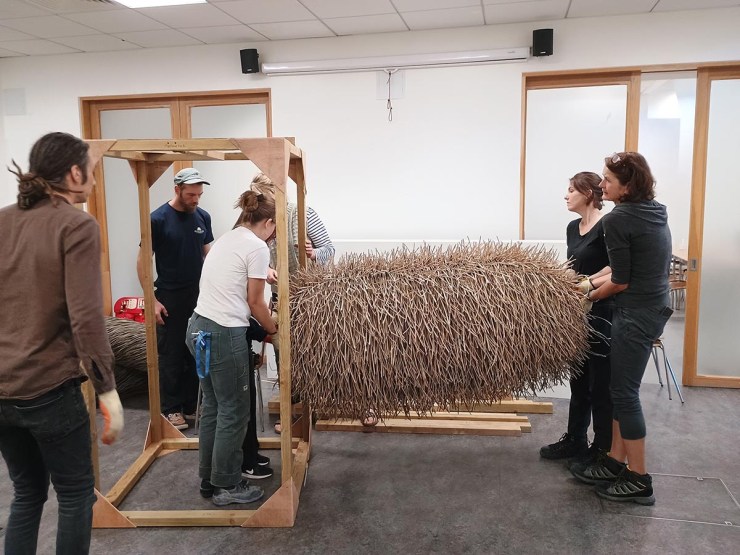
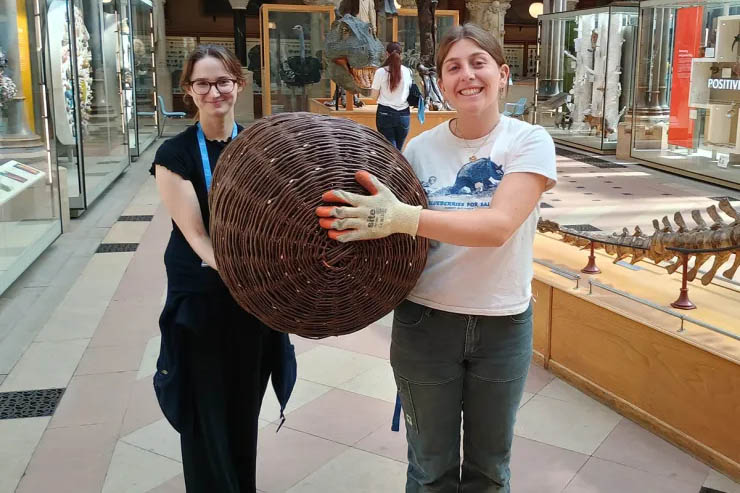
As I was doing this, the team from Outback Rigging worked on carefully lowering the suspended works to the ground and to our surprise; the take down was ahead of schedule. Most of them were removed by the middle of the day and these ones were simple to move. This was interesting to me as they seem so delicate, being large structures made of woven willow, but they proved sturdier than I thought. However, some were more difficult to take down than others, including the COVID sculpture. This was the most difficult to get down to the storage space, due to its intricate structure and its large size. Too wide to take down the stairs we usually use, Rachel organized with the Pitt Rivers to take it through their door, along the road and back into the Museum of Natural History through another door! What made this procedure more complicated was the sculpture itself, as its round construction meant there were no handholds. Luckily, the artist Issy Wilkes created some by looping some zip ties through the metal frame and, learning from the setup of the exhibition, used foam sheets to wrap around these painful to hold ties, to make the journey even easier. I felt it was an extremely rewarding process when we were finally able to put it down, as it required a lot of teamwork and shimmying about corridors to make it – I was very relieved we were able to keep it in one piece.
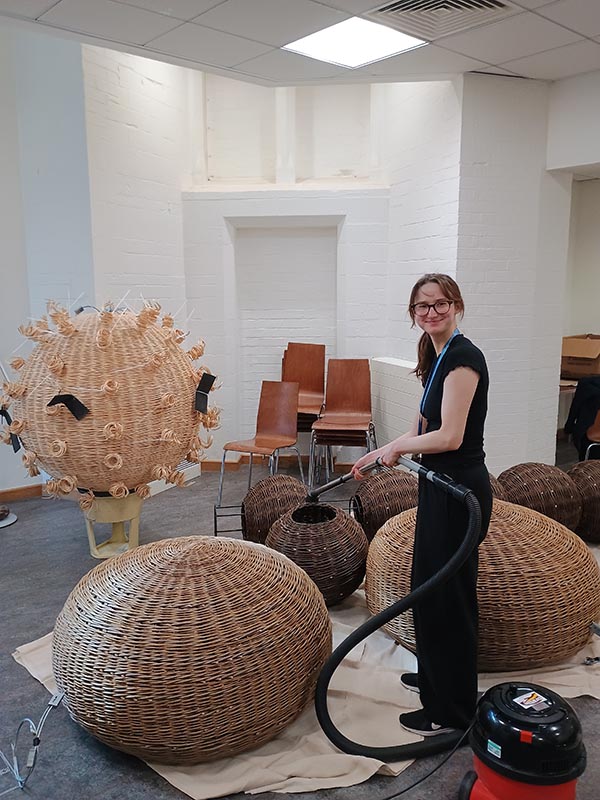
As the day went on and the sculptures were down and put away safely, I began to do smaller, but equally important tasks. The works themselves weren’t the only part of the exhibition, so I aided in removing the signage that was in the aisle that explained the meaning of each part. We also moved these down to the storage room, out of the way of the surrounding visitors and I began the task of removing the labels from inside. Another small step was vacuuming the sculptures. Despite regular conservation cleaning, hanging up in the court for so long had meant they had accumulated a lot of dust, which had to be cleaned out before they moved to their next home. These tasks were ones I wouldn‘t have thought of before the experience, but I realise that the smaller aspects are just as important as the larger ones when it comes to taking care of the exhibitions. It is our job to not only display the works as best we can, honouring their artistic intent and presenting to the audience in a way they understand, but this experience showed me how important the after care is, ensuring that they are well maintained to carry on their purpose and that the museum is returned to its original state.
The Prince and the Plinths

By Hayleigh Jutson, HOPE Community Engagement Officer & GLAM Community Engagement Assistant and Danielle Czerkaszyn, Librarian and Archivist


With the Queen’s Platinum Jubilee in the air, Hayleigh and Danielle reveal the royal connections that are integrated into the very fabric of the Museum, and reveal the surprising story behind our empty plinths.


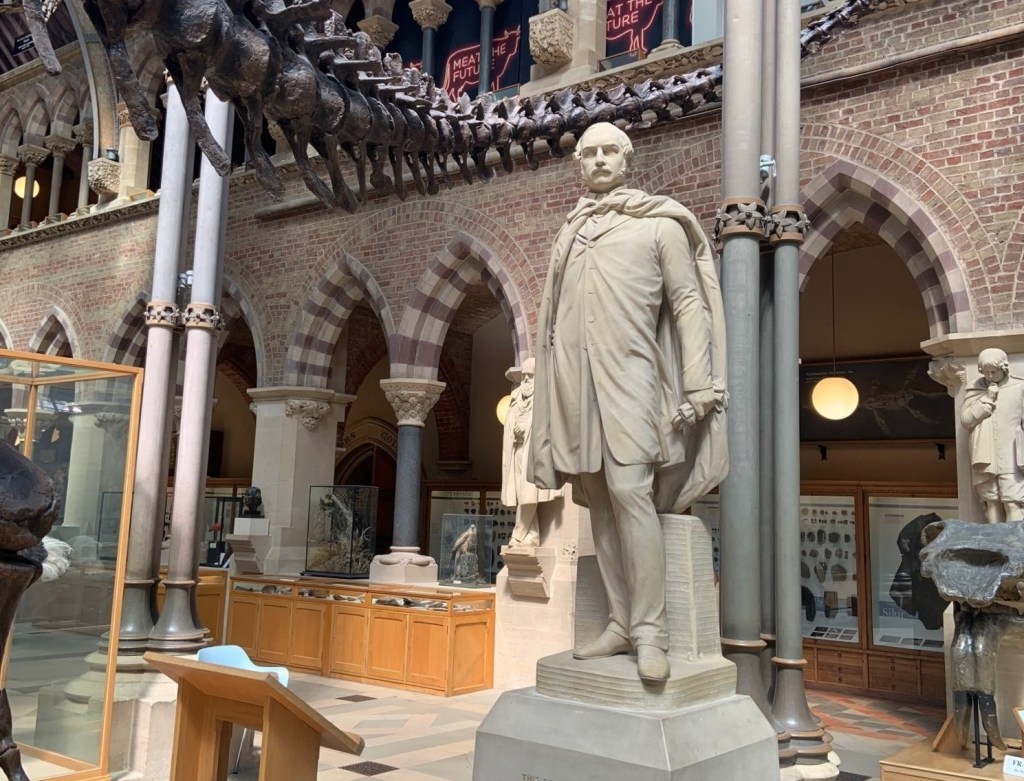
Visitors walking around the Main Court of Oxford University Museum of Natural History will find themselves circled by the stony gazes of 19 life-sized stone statues. These sculptures of eminent scientists, philosophers, and engineers include likenesses of Aristotle, Charles Darwin, Galileo, Linnaeus, and Isaac Newton. Alongside these men of science stands a statue of Prince Albert, husband and consort of Queen Victoria. Although now slightly hidden behind the T-rex, Prince Albert’s statue was given pride of place in the main court, a lasting reminder of the Royal family’s contribution to the establishment of the Museum.

Constructed between 1855-1860, the main structure of the Museum of Natural History was built using funds from Oxford University. However, the University only provided enough money to construct the shell of the building. All additional decorations – the stone carvings, pillars, and statues both outside and in – were to be funded by public donations and private subscriptions. To decorate the new building, Oxford’s scientists, along with the architects Deane and Woodward, invited Pre-Raphaelite artists to come up with designs that would represent nature in the fabric of the building.

A key element of the Museum’s decoration involved the commissioning of a series of portrait statues of ‘the great Founders and Improvers of Natural Knowledge.’ These effigies were meant to represent a range of scientific fields of study, and act as inspiration to researchers, students, and other visitors to the Museum. The University came up with a list of six ancient Greek mathematicians and natural philosophers and eleven modern scientists to be included in the Gallery. Funded by private subscription, donors could provide a statue of one of these ‘Founders and Improvers’ for £70 (equivalent to ~£8000 in today’s money).

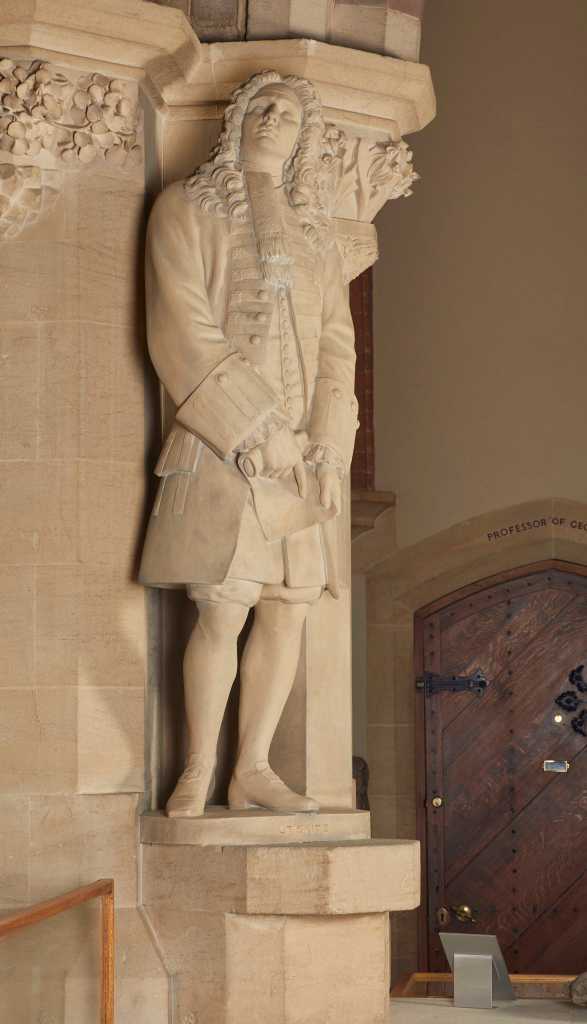
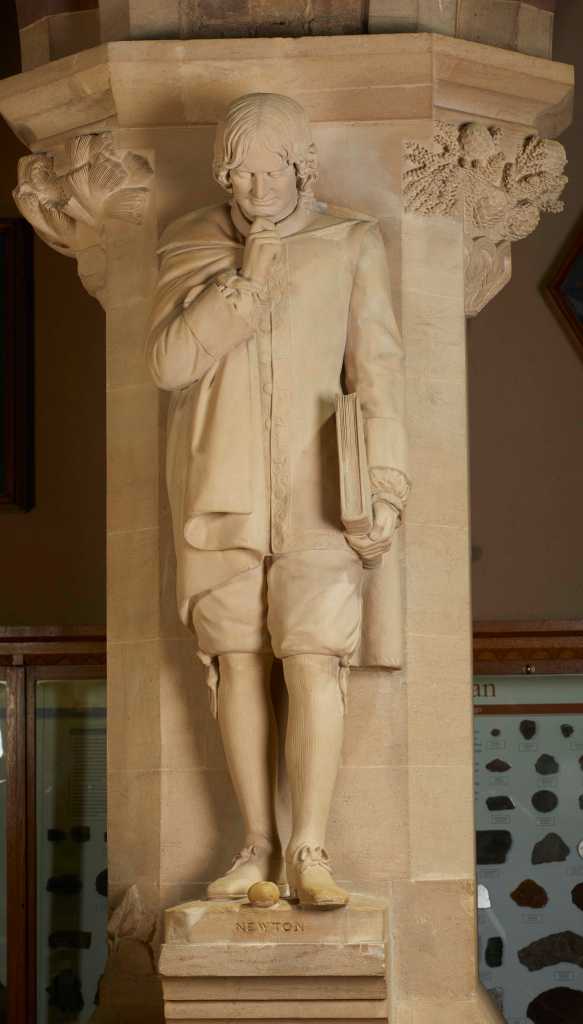
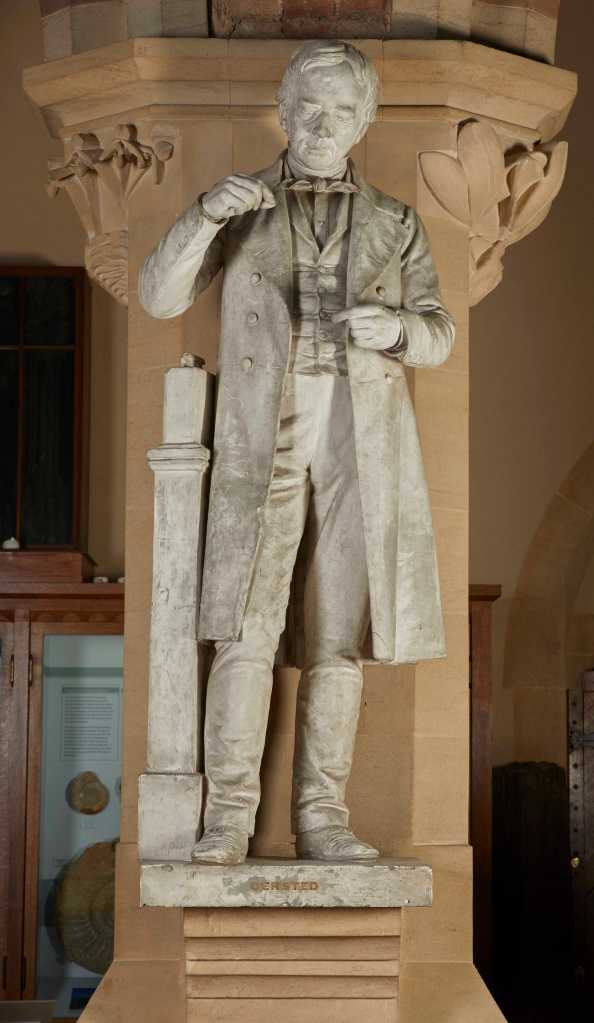
Prince Albert, a great supporter of the arts and sciences, convinced Queen Victoria to fund the first five statues of modern scientists, costing £350 in total. The first statue that Queen Victoria commissioned and paid for was of the philosopher Sir Francis Bacon — remembered as one of the fathers of the ‘scientific method’. His statue was carved by Pre-Raphaelite sculptor Thomas Woolner. The remaining four statues that Queen Victoria paid for – of Galileo, Isaac Newton, Gottfried Liebnitz, and Hans Christian Ørsted – were to be sculpted by Alexander Munro. However, Munro was only able to complete three of these. After the University of Oxford repeatedly failed to fulfil Munro’s request for a likeness of Ørsted, the statue of the Danish physicist went unfinished. Not wanting to waste the money that had been gifted by Queen Victoria, the Museum decided to arrange for a plaster cast to be made of a pre-existing statue of Ørsted, which was sent over from Denmark in 1855.

It was hoped that Queen Victoria’s generous donation would encourage other wealthy individuals to fund the remaining statues. Initially, the plan worked. However, as time went on, donors began to favour British men of science rather than the University’s original list of international candidates. As a result, funding for many of the statues on the University’s list never materialised, and those plinths remain vacant to this day.

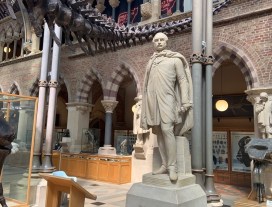
Even if the commissioning of the Museum’s sculptures didn’t go entirely to plan, there is no doubt that Prince Albert made an important contribution to the construction of the Museum. Fittingly, he is also commemorated amongst the Museum’s sculptures. Carved by Thomas Woolner, Albert’s statue sits behind the tail of the T-rex skeleton in the Main Court. It was presented to the Museum by the citizens of Oxford in April 1864, and remains a tribute to a champion of the arts and sciences, and one of the Museum’s earliest and most influential supporters.

Statue of Prince Albert in the Main Court of the Museum