(Reading) Up on the roof

Court

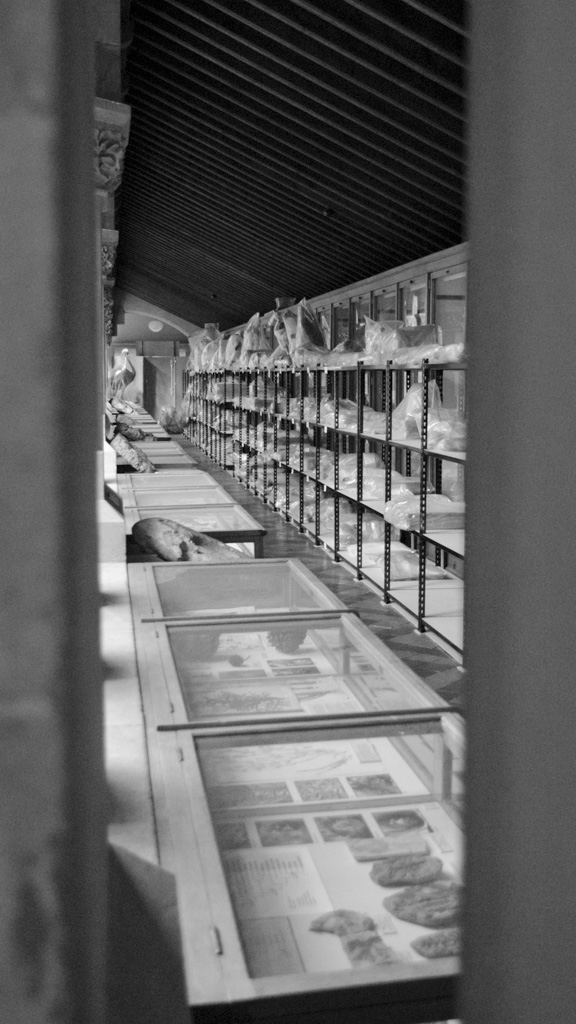
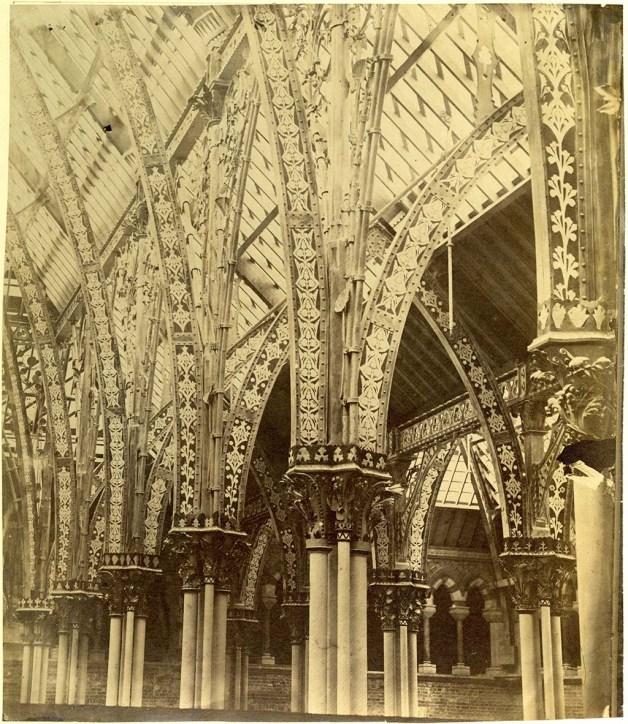
With the view from the gallery looking quite different these days, I was inspired to pull out some historic photographs from the archive of the roof’s original construction. Hoping for a glimpse of what to expect once it’s returned to its original glory, I also discovered some interesting facts about the architectural feats required to raise the roof the first time around.

The Museum was designed by the famous Irish architectural team, Deane and Woodward, which won the contract through a contest held by the Museum Delegates in 1854 (the Museum opened in 1860). One of the few stipulations of the contest was that the design had to feature a glass and iron roof to cover the court, and that the Museum had to be built for less than £30,000.

OUM roof

The design of the roof was quite innovative for the time, but the budget for construction was tight: originally £5,216. However, Skidmore, the iron-worker employed to execute the building of the roof supports, proposed that it could be done for much less if wrought iron, a cheaper and more malleable metal than cast iron, was used instead.
Pillars

In fact, a further £2,000 was needed to complete this magnificent and heavy piece of construction because of this miscalculation on Skidmore’s part: the stronger cast iron was indeed needed to construct the load bearing pillars that held the glass roof safely in place. Wrought iron was still used for some of the work and, being more malleable, it proved the perfect choice for the intricate detailing that was planned for the pillars.

As Skidmore himself stated, it “held out the possibility of uniting artistic iron-work with the present tubular construction, and a prospect of a new feature in the application of iron to Gothic architecture.”

And so it was. More than 150 years later the roof remains visually impressive, even if it is a little leaky around the glass work. The picture below shows the current preparations for repairs that will restore the roof to its original splendour, ready for the Museum’s reopening in 2014.

Current roof work

by Kate Santry, Head of Archival Collections

A date for everyone’s diary


<!–[if !mso]>st1:*{behavior:url(#ieooui) } <![endif]–>
We are pleased to announce that we will be hosting the BENHS for their Member’s Day/AGM on the 23rd of March.

“The Society was founded in 1872 as the South London Entomological and Natural History Society and since its inception has always included amongst its members many of the leading entomologists of the day.

The objectives of the Society are the promotion and advancement of research in entomology with an increasing emphasis now being placed on the conservation of the fauna and flora of the United Kingdom and the protection of wildlife throughout the world”.

The department has in the past, greatly enjoyed hosting the BENHS and other societies for a variety of different events and we hope that this occassion will be as entertaining as the others. We expect it to be a busy day, with staff dividing their time between the lecture theatre, the collections and socialising with members. We will be on hand to try and answer any questions people may have about the collections or entomology in general as well as to make sure that there is plenty of tea and biscuits avaliable to help fuel the thinking.

Details of the meeting, which is open to members and non-members alike, can be found below. 

 ~
BRITISH ENTOMOLOGICAL & NATURAL HISTORY SOCIETY
AGM and Members’ Day Programme Saturday 23rd March 2013
Hosted by the Oxford University Museum of Natural History
Parks Road, Oxford, OX1 3PW
All of the meeting is open to both members and non-members, although only members are allowed to vote on any motions put to the AGM.
Exhibits of live or dead insects, photos, literature, posters etc. will be most welcome. Please display these in the lecture theatre when you arrive. They may then be viewed and discussed during the lunch break.
Within the UK, the Hope Entomological Collections are second in size and importance to the national insect collection at the Natural History Museum, London. The collection houses over 25,000 arthropod types, and comprises over 5 million specimens.  The collection includes many specimens of great historical interest from such sources as the Hope-Westwood and Verrall-Collin collections. 
For those wishing to consult the collection during the day, please contact the department in advance: entomology@oum.ox.ac.uk

.

Programme for the day
10.15   Arrive, coffee/tea, display of exhibits

10.50   Welcoming remarks and introduction to the day

11.00   Galls and their insects. Margaret Redfern (University of Sheffield and British Plant Gall Society)

11.35   21st century insect arrivals in the UK.Sharon Reid (FERA)

12.10   The effects of extreme fluctuating temperatures on aphid life history traits. Christopher Jeffs

            (University of Oxford). Student presentation

12.30   Facing up to Beetles. Michael Darby (BENHS)

12.50   Something different. Glenda Orledge (BENHS) Please bring a pen or pencil for this item

13.00   Lunch and viewing of exhibits (bring your own packed lunch or forage in one of the nearby pubs or

eateries)

14.00   Society notices

14.15   Annual General Meeting with elections, reports and Presidential Address (PTO for AGM notice)

15.00   Extreme Insects. Richard Jones (BENHS). By special invitation of the President

15.45   Conclusion of the AGM and Tea

16.00   Tour of the entomological collections,led by Darren J. Mann

16.45   Close of meeting

Treasures of the Archive

archivetour_1 (2)

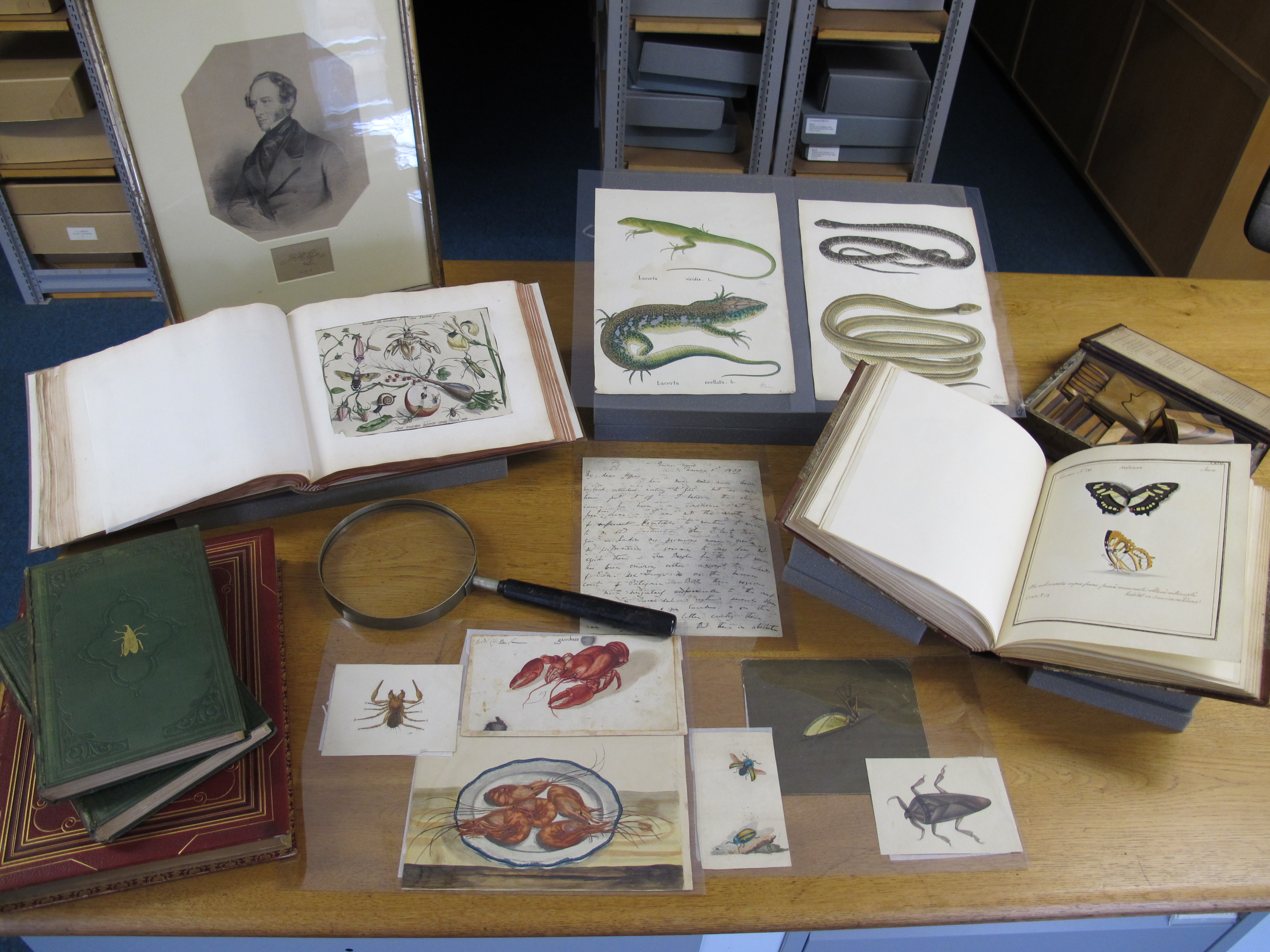
The Behind the Scenes Tours are now in full swing. Hosted here at the Museum on Tuesday afternoons, from 3-5 pm, they offer a unique look at what our collections staff get up to in their day-to-day work, as well as a rare opportunity to see items from our specimen and archive collections that are not normally on exhibit.

The first Treasures of the Archive tour took place last week and offered a beautiful display of some of the oldest and most important items in the archive collection. It included, among others, the original 18th century manuscript known as the Jones’ Icones, which features hundreds of exquisitely detailed butterfly paintings, a letter from Charles Darwin mentioning of his voyage on the Beagle, and William Smith’s personal copies of his Geological County Maps.

There will be two more opportunities to join this great tour, on 2 April and 21 May 2013; but with tours being offered by every department there are sure to be many more that will catch your fancy. There are even tea and biscuits at the end!

Tours can be booked through the University Online Shop and are only £5 per person. Coming up in the next few weeks, we have the first of the Entomology Highlights Tours, behind the scenes in Zoology, and a special themed tour centred around female fossil hunters Mary Anning and Elizabeth Philpot – all sure to be a great afternoon out. To see a complete listing visit our website.

If you have a group that is interested in any of our Behind the Scenes Tours, but you cannot make the advertised times, please contact info@oum.ox.ac.uk to discuss options for private tours.

Kate Santry, Head of Archival Collections

There’s a fly on my nose!

By Mike Ackland
Honorary Associate of the HEC

In September 2011, John Carr of Massachusetts, USA, posted photographs of an anthomyiid fly on the website diptera.info. This site has thousands of photos of flies, sent in by both diptera enthusiasts who are keen photographers, and experts who offer advice and possible identification.

I recognised the anthomyiid as a species of Eutrichota, which has over 50 species in the Nearctic Region. Positive identification to species however generally requires examination of a specimen under a microscope. John, who is a very good photographer and naturalist, later added to his posting some very clear close-ups of various parts of a male specimen he had caught, and offered to send the specimen to me. This proved to be Eutrichota affinis (Stein), a species widespread in America and which is associated with the groundhog Marmota monax L. and may be found in and around their burrows. The larvae are considered to be facultative commensals probably feeding in excrement and debris in the burrows.

A few other species of Eutrichota in North America have been associated with mammals including ground squirrels, Spermophilus tridecemlineatus (Mitchell), chipmunks, Tamias striatus (L.) and various species of gophers (Geomys spp.).

In Europe other species of Eutrichota have been found around the burrows of the Alpine Marmot Marmota marmota L. There are seven species of Eutrichota in Britain, though no life histories are known. See Pont & Ackland, 1995 for more details of the flies found in the Alps (full reference below). I first met Adrian Pont (another Hope Department Honorary Associate) in the mid 1950’s in Leigh Woods near Bristol, where we were both collecting insects. So we have both been studying flies for over 50 years.

Recently John Carr sent me two photographs of specimens of Eutrichota affinis on the head and nose of a groundhog. These were taken in Connecticut on 30th May 2009. The groundhog family was living in a culvert, and John reports that they later ate part of his sister’s garden!
My thanks to John for permission to use these excellent photos.

Diptera, Anthomyiidae, fly, Eutrichota, Eutrichota affinis, Marmot, Marmota monax
There’s a fly on my nose!
Diptera, Anthomyiidae, fly, Eutrichota, Eutrichota affinis, Marmot, Marmota monax
Females of Eutrichota affinis (Stein)(Diptera: Anthomyiidae) on the head of the groundhog Marmota monax L.

Reference
Pont, A.C. & Ackland, D.M. (1995). Fanniidae, Muscidae and Anthomyiidae associated with Burrows of the Alpine Marmot Marmota marmota Linnaeus in the upper Ötz Valley (Tyrol, Austria). Insecta, Diptera. Berichte des naturwissenschaftlich-medizinischen Vereins in Innsbruck, 82: 319-324.

A pdf version of the paper is avaliable HERE.