Presenting… Bruno’s fossil find

Presenting Bruno's fossil find

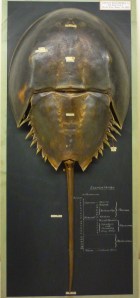
Limulus polyphemisYou’ve read about it in the press (probably), but now you can see Bruno Debattista’s rare trace fossil find for yourself in our Presenting… display, just inside the entrance of the Museum. Although we are closed, this changing exhibit can be seen by visitors coming through the building to the Pitt Rivers Museum.

On display we have Bruno’s shale rock, found in Bude, Cornwall last year, which shows faint tracks left by a pair of horseshoe crabs as they crawled up an ancient, muddy shore more than 300 million years ago. Although the species of horseshoe crab which made these tracks is long extinct, we are displaying two modern specimens for comparison. One is around the size of the animal which left the original trackway; the other is a full size horseshoe crab which lives in the Atlantic Ocean – Limulus polyphemus.

We should also point out that horseshoe crabs aren’t really crabs at all. Crabs are crustaceans, but horseshoe crabs are more closely related to the arachnids, such as spiders and scorpions.Fossil and horseshoe crab

Scott Billings – Communications coordinator
Roof revelation

8588044846_75091db95d_b
Up in the rafters
Credit: Mike Peckett

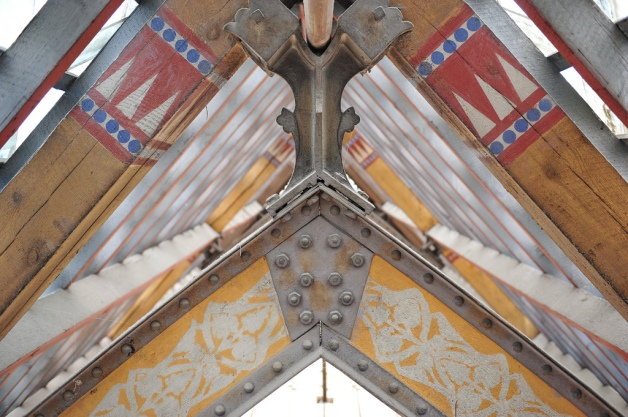
Our beautiful Victorian roof is a masterpiece of wrought and cast iron topped with 8,500 glass tiles. It’s one of the first things our visitors notice when they enter the Museum, and its leaks are the reason we’re closed this year. But what many people don’t notice is that the glass is supported by decorated wooden struts, painted with bright geometric patterns, and contrasting surprisingly with the organic Gothic detail of the rest of the building.

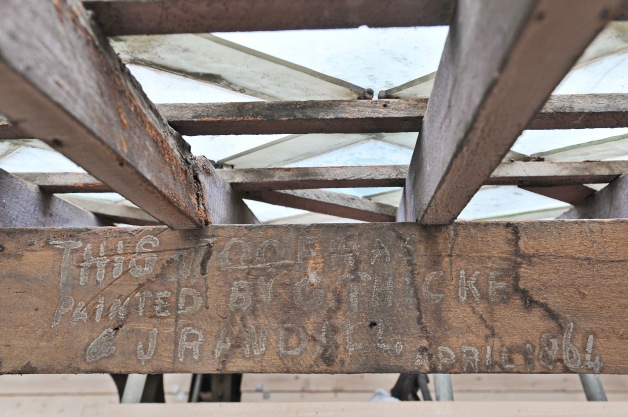
Whilst the construction team from Beard were up in amongst the rafters last week, they spotted a surprising addition to the paint work. Hidden high up, and out of sight of even the most observant of visitors, was a message from the past. The roof decorators had left their names and the date of their work painted onto the woodwork for future generations to discover.

Roof graffiti
Credit: Mike Peckett

The message reads “This roof was painted by G. Thicke and J Randall, April 1864”. In general, we don’t approve of graffiti inside the Museum, but this discovery felt pretty special. Well done Randall and Thicke, you did a great job!

Rachel Parle, Education Officer

What’s on the van? – Heliconius hecale

butterfly3This week’s What’s on the van? comes from Zhengyang Wang, an undergraduate volunteer in our Hope Entomology Collection

Belonging to the genus of Heliconius, this species of butterfly can be seen from Southern Mexico to north-central Bolivia, from dense forests to open savannah. Like many other species of this genus, Heliconius hecale has many different forms of a single species. The picture illustrates the form felix of this species, which is commonly found in Munchai, Rio Beni and Bolivia.

In one of the cabinets of the Hope Entomology Collection here at the Museum, you can find another form of the same species but of slightly different wing pattern, vestustus, usually found in Columbia. Sometimes the visual differences between forms of the same species can be quite stark: the fornarina form of Heliconius hecale from Guatemala, for example, is only black and white.

In fact, morphological differences within species is quite common among butterflies. As well as sexual dimorphism, where male and female body shapes differ, species found at different localities, different climates, and in different seasons can also exhibit variations in morphology.

Speaking of morphology, it also needs to be mentioned that many other species from different sub-families of brush-foot butterflies, such as Danaini and Ithomiini, mimic the morphology of these Heliconius butterflies. Why is that? It’s because many Heliconius butterflies are quite unpalatable to their predators, so a mimicry of them might tell predators “Don’t eat me, I’m poisonous.” This kind of mimicry of other species’ warning signals is called Mullerian mimicry.

Thanks to their choice of plant food, their differing wing patterns and the relative ease with which they can be monitored, the butterflies from the genus of Heliconius have also been widely studied to understand genetic evolution and co-evolution between butterflies and plants.

Zhengyang Wang, visiting student at Hertford College, Oxford and volunteer in the Hope Entomological Collection

What's on the van banner 2

Research links: The Kingdom of Saudi Arabia

Recently, Darren Mann (HEC) and Mike Wilson, Head of Entomology at the National Museum Wales in Cardiff visited Tabuk, Tabuk Province, Saudi Arabia. They were there to meet lecturers and students of Tabuk University and discuss setting up collaborative links to establish an entomology course, a collection of insects and undertake a faunal survey of the area. Below are some pictures from their trip:

Darren, night collecting- sorting dung beetles from camel dung


A hawkmoth (Sphingidae) caterpillar. Note the spine on its rear end.

Anthia duodecimguttata Bonelli, 1813, a species belonging to the coleoptera family Carabidae (Ground beetles) 

Species of the genus Anthia are some of the largest of the Carabidae. All of them are heavily armoured and have strong, sharp mandibles which they use to catch and crush their prey with. The species are usually black with either white or creamy-yellow spots or stripes on them. Many of them also have descriptive species name. With the above species ‘duodecimguttata‘ translates roughly as ’12-spot’.

Mike attempting to make friends with the local camel population

A desert locust, Schistocerca gregaria. Orthoptera: Acrididae.

Darren, camel trekking. Note the slightly uncertain look on his face and the slightly wry one of the face of the camel.

Darren attested to the speediness of this particular camel, something that it seemed particularly proud of and eager to demonstrate at any available opportunity.

Orthoptera: Acrididae, Poekilocerus bufonius (Klug, 1832), a possible new species record for this area of Saudi Arabia.

The grasshopper above can be identified as female by looking at the length of the wings. In this instance the end of the abdomen (tip of its bottom) pokes out by an easily visible amount from under its wings. Male grasshoppers of this species have wings that completely cover the abdomen.

Dermaptera (earwigs) feeding on a flower head of Cynomorium coccineum L. at night

Darren and Mike with , Haitham Badrawy, one of the lecturers at Tabuk University.

Once in a whale

NIKON D700 - 0057
Orca skeleton
Credit: Mike Peckett

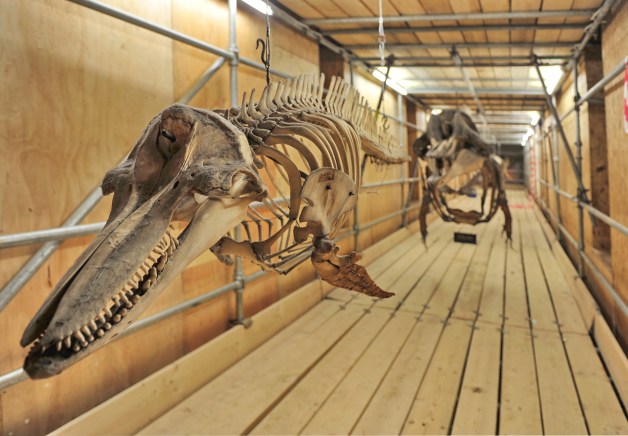
Among the Museum’s large collection of mammal skeletons are five whales (Cetacea), each suspended from the roof in the main gallery. As part of the Museum renovation efforts, it was decided to give these specimens some much needed conservation treatment: 150 years of continuous exposure to light as well as fluctuating temperature and humidity levels has left these skeletons in a poor condition. The types of damage noted include: a big build-up of dust and dirt; cracking of the bone material; secreting of fatty oils; missing sections, such as fingers and ribs; and the corrosion of metal areas, as well as water-stains from the leaking roof!

8374647046_4967936cbc_h
The whales hung from scaffolding ready for conservation
Credit: Mike Peckett
NIKON D700 - 0033
150 years of dust gathered on the skull of a Lesser Fin Whale
Credit: Mike Peckett

Thanks to a successful PRISM grant from the Arts Council England, we have very recently hired an Assistant Conservator to help me complete this huge task. Together we will have six months to complete the treatment which will include in-depth cleaning of the specimens, stabilising loose or cracked areas, and replacing missing segments and corroded wires. We’re aiming to have five beautiful whale skeletons which look clean and scientifically accurate, as well as being stable enough to withstand another 100 years on display.

NIKON D700 - 0101
Credit: Mike Peckett
NIKON D700 - 0047
Credit: Mike Peckett
NIKON D700 - 0211
Credit: Mike Peckett

Although we’re closed for 2013, many visitors are still passing through on their way to the Pitt Rivers Museum. We thought they would like to see what’s going on, so we’ve built a window in the construction boards, enabling the public to see the whales. If you’re visiting, pop by to see our conservators undertaking this exciting and important work.

Bethany Palumbo, Conservator of Life Sciences

What’s on the van? – Harlequin shrimp

_harlequin-shrimpno-29
Credit: Dr Arthur Anker

This week’s What’s on the van? comes from Sammy De Grave, assistant curator of the Museum’s Zoological Collection

Harlequin shrimps are monogamous, living in male-female pairs for life, sharing and actively defending a patch of reef of about 10 square meters. As you can see, they have exquisite colour patterns and a highly unusual morphology.

The main diet for the harlequin shrimp are starfish. Prey is located by either member of the pair, and even though the starfish may often be ten or twenty times larger than the shrimps, the harlequin shrimps flip over the starfish and drag them into their lair.

Once inside the lair, the starfish’s internal organs – tube feet and guts – are devoured, starting from the tips of the arms and working towards the central disk. This keeps the shrimps’ victim alive for as long as possible. It usually takes several days for the process to be completed. On occasion a starfish escapes, minus a leg or two, but usually they succumb.

A large scale program was initiated in the 1980s to attempt to harness this behaviour as a bioweapon against outbreaks of the Crown-of-Thorns starfish in the Pacific. However, due to their antagonistic territorial behaviour this was doomed because each pair of harlequin shrimps would kill all the others in close vicinity.

Sammy De Grave, Assistant Curator, Zoological Collection

What's on the van banner 2