This morning, as I arrived at the MHS, Jewson had just delivered the pre-cut MDF boards that we will use to make various plinths and structures for many of the specimens in the exhibition.
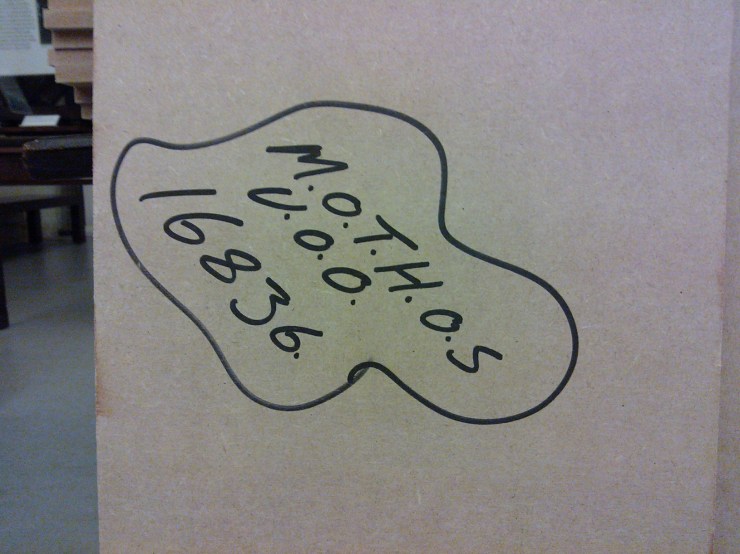
But along with this delivery came a sweet little coincidence; perhaps even a good omen. On one of the Jewson boards the order number had been written in black marker pen and the number, which you can see above, was 16836, tantalisingly close to 1683, the year this building was founded by Elias Ashmole as the original Ashmolean Museum. The ‘6’ is even written just a little bit smaller than the ‘year’.
Given that Natural Histories is partly about a temporary return of Oxford University‘s natural history collections to their original home in the building in Broad Street, this is an unusually apposite order reference.
I don’t know when in 1683 the building opened, but I really hope it was June.
Last week I spent a few days in sunny Italy, visiting my good friends Stefano and Roberta Ziani and timed to coincide with the Italian entomological show ‘EntoModena‘. I had a wonderful few days of dung beetle chitchat and homemade, mouth-watering Italian gnocchi.
My vegan gnocchi as made by Roberta Ziani- it was that good it needed a picture all to itself.
Stefano is a dung beetle researcher, specialising in the fauna of the Middle-East. He has published over 40 papers, mostly on faunistics and taxonomy and systematics, and has described a number of new species to sciences from the genus Onthophagus, including some that are associated with nests of small mammals. During my visit I had the chance to study Stefano’s superb collection of Palaearctic dung beetles, which is better than our Museum’s, and with this collection finally managed to get a grasp of the identification of some difficult species.
EntoModena is similar to the Juvisy and Prague shows, a sort of trade fair with a difference- you can buy live and dead insects, as well as books and various items of equipment. Most people go to meet up with old friends and make new ones.
Pasta picnic at EntoModena 2013
I met for the first time Giovanni Dellacasa, the world’s leading expert on the small dung beetles in the group Aphodiinae, although we have corresponded over many years and even published a paper together (Dellacasa, G., Dellacasa M. & Mann, D.J., 2010. The morphology of the labrum (epipharynx, ikrioma and aboral surface) of adult Aphodiini (Coleoptera: Scarabeaidae: Aphodiinae), and its implications for systematics. Insecta Mundi 0132: 1-21). I also chatted with Giuseppe Carpaneto and other dung beetle researchers, bought a few bits of equipment and admired the selection of insects for sale.
From left to right: Giovanni Dellacasa. Stefano Ziani, Giuseppe Carpaneto and me, Darren Mann.
My only chance to sit down during the day was by meeting up with Magdelana and Marek from Majkowski Woodworking Company who had a table (and chairs) of their wares; this is the company who supply our wonderful collection drawers, postal boxes and wooden cabinets.
Magdelana and Marek from Majkowski Woodworking Company.
This week’s What’s on the van? comes from Monica Price, Assistant Curator of the Museum’s Mineralogical Collections.
This beautiful polished moss agate is about 8 cm across. It is one of 26 moss agate slices collected by John Middlemiss Luff, and given to the Museum in 1909. John Luff was a civil engineer who, as a young man in 1863, took a posting to the public works department in Bengal, India. Some of the finest moss agates come from India, and every one of the samples in John Luff’s collection is of the best quality.
Despite its name, moss agate doesn’t contain any plant material at all. The orange and brown ‘moss’ is made up of crystals of iron minerals, mostly goethite (iron hydroxide). The crystals grew in a translucent white gel composed of silica (silicon dioxide) which solidified to form a mineral called chalcedony. Moss agates are found filling fractures and gas bubbles in volcanic lava. When the lava is eroded away by rivers or the sea, the hard lumps of moss agate survive, to be washed up as pebbles on river banks or beaches.
Moss agates take a beautiful polish and they have been prized as semi-precious gemstones for thousands of years. Brown moss agates are sometimes known as ‘mocha stone’. This has a connection with ‘mocha’ coffee beans, for both are named after the port of Mocha in Yemen, from which they were traditionally exported.
14 May – 29 September at the Museum of the History of Science
One of the things we’ve been working hard on recently (darkened, not dormant remember) is a temporary exhibition we are putting together with the Museum of the History of Science, just up the road in Broad Street. Taking over the MHS’s lovely special exhibition gallery is a neat way of getting some great specimens out and visible to the public while we’re closed. But there’s a bit more to it than that, as it also ties in with some nice history of the museums in Oxford.
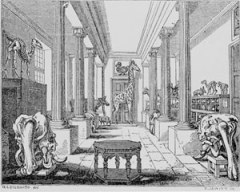
A giraffe in the entrance gallery of the ‘Old Ashmolean’, now the Museum of the History of Science
The first public museum to open in Britain – and quite possibly the world – was the Ashmolean Museum, established in 1683 by Elias Ashmole in the building in Broad Street that is now the Museum of the History of Science. Although the current Ashmolean (in Beaumont Street) focuses on art and archaeology, the ‘Old’ Ashmolean’s collections were of both man-made objects and natural specimens.
They remained there – and grew – until the mid-19th century when our Museum was built in Parks Road. At this point, in 1860, the natural history specimens came here, where many of them remain. So the Natural Histories exhibition at the MHS represents a return of natural history to its original Oxford home in the building on Broad Street. There was even once a giraffe in the entrance gallery as you can see above.
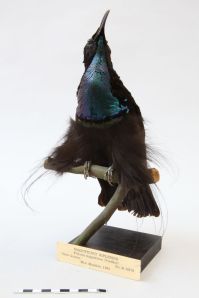
Magnificent Riflebird (Ptiloris magnificus)
But back to the exhibition. Natural Histories takes a look at some of the history of natural history itself. This is a big subject to tackle, so we’ve picked out just a few themes and stories – some important ideas and big name scientists, as well as some lesser-known but nonetheless significant naturalists. The displays will show specimens and ideas from throughout the centuries, right up to the present day.
There will be creatures collected by Charles Darwin and Alfred Russel Wallace, Darwin’s contemporary and co-originator of the theory of evolution through natural selection. We have got some examples of the oldest rocks on Earth; extinct plants and animals; and some of the very latest techniques being used in the Museum to reveal exquisitely preserved fossils.
There’s a lot of material to prepare and we’ve been mocking up shelf layouts and making sure everything is going to fit, as you can see in the picture below.
A particularly busy display: what can you spot…?
And since this is the Museum of Natural History there will of course be some things you can touch. We’re also building in a special thread running throughout the exhibition just for families and children, which I think might well be narrated by our friend the Dodo.
We hope you’ll all come and see the exhibition and let us know what you think, either here or on Twitter. And if you can’t make it, there will also be a dedicated Natural Histories website – more on that and our programme of events and activities to follow.
One way or another, we’ll hopefully see you there…
The Education team had a fantastic sunny day out on Saturday at Oxfordshire Goes Wild. This annual ecology extravaganza sees many of the county’s nature and wildlife groups gather to bring us all a bit closer to the natural world.
In previous years the event has been held at the Museum of Natural History, but as we’re closed at the moment, we stepped out into the countryside… and we couldn’t have picked a better day for it! We arrived at the Earth Trust Centre in Little Wittenham in full sun and were given a beautiful spot to set up our activities, overlooking the Oxfordshire countryside.
Set up and waiting for the crowdsNice and busy later on!
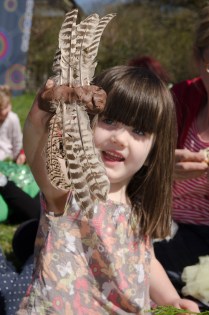
Several hundred children took the opportunity to dissect owl pellets and identify their prey in the sun, or learn about our collections through our Museum Mix-Up activities. Toddlers and grandparents alike were seen picking through the pellets to discover skulls, bones and claws; these owls clearly lived in very rich hunting ground!
We all managed to sneak a short break during the day to investigate the many other things that were going on. There were live animals galore in the shape of bats, reptiles, owls and a bounty of bugs. Also on offer was red kite nest building, pond dipping and crafts a-plenty.
We all left feeling tired but enthused and impressed. Well done to all involved for a fantastic event celebrating our diverse and fascinating wildlife. Even our stuffed owls enjoyed the day out!
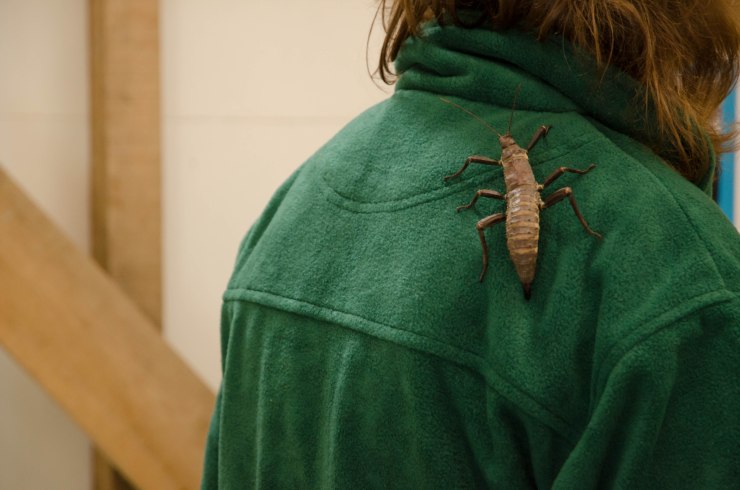
Clay creatures with Going WildDissecting owl pellets with us.Creepy crawlies get everywhere. A stick insect roams at the Amateur Entomologists’ Society stallOur expert navigators confer over the best route to Wittenham.
This week’s What’s on the van? comes from Paul Jeffery, assistant curator of the Museum’s Geological Collections.
The oldest known collection in the Museum is that of Edward Lhuyd (1660-1709), made during the 1680s-1690s. This collection formed the basis for Lhuyd’s ground-breaking monograph, Lithophylacii Britannici ichnographia – a systematic illustrated catalogue of the collection of fossils he was responsible for as Keeper of the Ashmolean Museum, which at that time was still based in its original building, now the Museum of the History of Science in Broad Street.
Lhuyd’s book set the framework for later works by authors such as Carl Linnaeus (1707-1778) and Gustavus Brander (1720-1787) who further systematised the naming and description of animals, plants and fossils, and introduced a Latin-based naming regime still used today.
Lhuyd also advanced thinking on fossils, recognising them as organic in origin, rather than spontaneous mineral concretions or sports of the devil. This was daring and radical for its time – an era when religious orthodoxy still strongly influenced philosophical and academic thought.
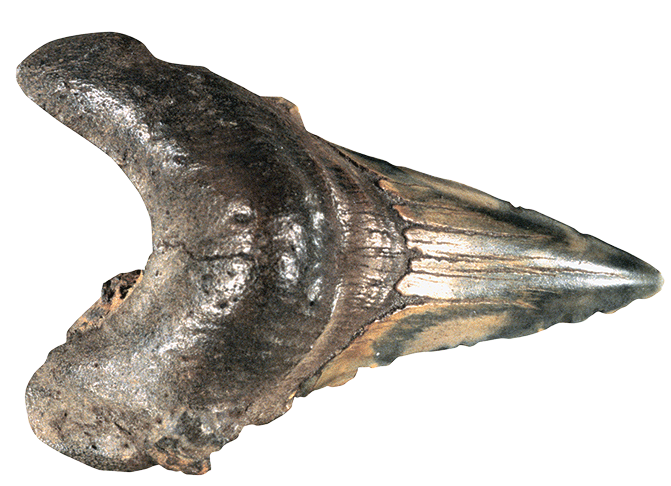
This particular shark’s tooth comes from the extinct species Otodus obliquus. It is from the 50 million year old London Clay (Early Eocene), and was found on the Isle of Sheppey, Kent. Such teeth can still be found on the beaches there today, washed from the crumbling clay cliffs by rain and wave alike.
It is an uncommonly large species of shark – teeth may exceed 75mm in length, and represents one of the earliest steps in an evolutionary “arms race”. During the Palaeogene and Neogene this lineage of lamniform sharks evolved ever larger and more comprehensively serrated teeth, along with proportionately increased body sizes, to keep pace with early whale evolution, as they too increased from modest proportions to the giants of today.
It was a race the whales eventually won in the Early Pleistocene. Otodus’s descendant – the giant Carcharocles megalodon, a 20m long super-predator – disappeared around this time: outgrown by the whales, out-competed by new predatory species and displaced by global climatic cooling.
We will be exhibiting some of Lhuyd’s fossils in Natural Histories, a collaborative exhibition based at the Museum of the History of Science, opening on 14 May. More information about this will follow very shortly.


 Just a quick post to say that things are pressing ahead with our Natural Histories exhibition, which is being hosted and co-curated by the Museum of the History of Science in Broad Street.


![_02-OUMNHMossAgate[1]](https://morethanadodo.com/wp-content/uploads/2013/04/02-oumnhmossagate1.png?w=628&h=526)




 The Education team had a fantastic sunny day out on Saturday at



 More Than A Dodo