It’s all relative

_DSC2241

A while back we featured a great little story about some graffiti, which was discovered high up on the Museum roof. You may remember that it was painted by two of the craftsmen responsible for creating our beautiful Victorian building. The graffiti reads “This roof was painted by G. Thicke and J Randall, April 1864″

Roof graffiti
The graffiti in the rafters of the roof

The story picked up quite a lot of press attention, featuring in the Oxford Mail and BBC Oxford, and that blog post is our most-read so far. But one reader’s attention was particularly attracted by the names of the painters. Oxford resident Debbie Moorwood has been tracing her family history for some time, so when she spotted the familiar name G. Thicke, she decided to do some extra digging.

After consulting the Victorian censuses and tracing back through her family tree, Debbie revealed that painter George Thicke was actually directly related to her husband, Steve Moorwood. Steve is George’s great great great grandson!

_DSC2266
Staff from Beard and Purcell join Steve and Debbie in the roof rafters.

Excited by her discovery, Debbie contacted us directly through this blog and we thought this was a fantastic opportunity for the graffiti artist’s relatives to see his work up close.

So, last week I had the pleasure of meeting Debbie and Steve Moorwood and we joined staff working on the roof project to climb high up into the roof. It was also a good opportunity for Debbie to share her discoveries about her distant relative, George Thicke. He was born in Glastonbury in around 1809, so would have been roughly 55 when he painted the graffiti on our roof. He is first spotted living in Oxford in the 1841 census, when he was a resident of the Cowley Road and, most importantly, listed as a painter! Later he moved around the area, living in St Clements, Headington and finally Shotover, before his death in 1887.

_DSC2231

Debbie said of the experience: “We had an amazing time visiting the Museum roof. We never expected to get a full guided tour of the whole building and Steve loved it, especially the building works. We can’t wait for the roof to be finished and for the Museum to open again, when we’ll be dragging our kids & family in to have a look. I think the museum has become quite a special place for us now.”

We now have a good picture of one of our infamous roof painters, but J Randall remains a bit of a mystery to us. So far, we think he was John James Randall of St Ebbes, Oxford, but we know very little else. Wouldn’t it be wonderful if we could track down one of his relatives next?

Rachel Parle, Education Officer

Flying Icons

Jones' Icones

We are thrilled in the Museum’s Library and Archive to have just been awarded a grant from the Heritage Lottery Fund. It’s for Flying Icons, our project to digitise and make freely available online the beautiful and important 18th-century Jones’ Icones manuscript.

This is the second project to receive financial support in the past year and it’s all part of an exciting initiative to make the library and archive collections more accessible and more useful to wider audiences.

The Flying Icons project was inspired by our collection of archives and specimens belonging to William Jones of Chelsea (1745-1818), a highly regarded, but relatively unknown amateur British naturalist in the late 18th century. A London wine merchant by trade, he became more well-known for his work on butterflies and moths (Lepidoptera).

IconesHis most famous work is his six-volume manuscript, popularly known as the Jones’ Icones. It contains very beautiful and remarkably accurate paintings of over 1,500 butterflies and moths, as well as taxonomic and geographical information of the species depicted. Created from some of the earliest known butterfly collections in Britain, the manuscript is critically important to understanding the history of taxonomy of Lepidoptera, but has never yet been fully published..

As well as digitising the Jones’ archive and specimen collections at the Museum, we will also be using the funding to create a range of workshops for amateur natural history researchers and students. These will launch late this year, allowing individuals and groups who are not associated with universities or research facilities to gain some instruction in how to use and access digital resources for their research.

The online copy of the Jones’ Icones itself is planned for summer 2014 and will include resources on butterfly studies and identification. The launch will be accompanied by an exhibit and lecture given by the foremost William Jones expert, Professor Dick Vane-Wright, Honorary Professor of Taxonomy at the University of Kent.

In the meantime you can see the actual manuscript for yourself in our Natural Histories exhibition at the Museum of the History of Science.

Kate Santry, Head of Archival Collections
HLFNL_2747

Gynandromorphs

Very occasionally we come across some rather special butterfly specimens. These are gynandromorphs, individuals which are part male and part female. In many species of butterfly males and females have different colour patterns. In these species spectacular gynandromorphs can sometimes arise where one half is male and the other female. The genetic cause of these bilateral gynandromorphs is complex but essentially an X chromosome is lost very early in cell division of the embryo.

lepidoptera, gynandromorph, butterfly
The Mocker Swallowtail (Papilio dardanus) showing the female (left), male (right) and gynandromorph (center)
lepidoptera, gynandromorph, butterfly
Three specimens of the Common Yellow Glider (Cymothoe egesta). The gynandromorph (center) is slightly asymmetrical as the female half also includes some male cells with the yellow pattern.
lepidoptera, gynandromorph, butterfly
Example of a British Brimstone (Gonepteryx rhamni) gynandromorph (center) from the Mark Colvin collection.

dermaptera, gynandromorph, earwig
Gynandromorphs also occur in other invertebrates, such as this earwig which has one longer male forcep and a short female one.

What’s on the van? – Paviland Mammoth Ivory Pendant

2234

This week’s What’s on the van? comes from Paul Jeffery, the Museum’s Assistant Curator of Geology.

This curious object lies at the intersection of many different threads of thought and belief.  It was discovered in 1823 by pioneering British geologist and palaeontologist, William Buckland in a cave on the Gower Peninsula, South Wales.

Found along with other ornamental items, it formed part of the grave goods of a slender youth whose body had been painstakingly daubed in red ochre during a burial ceremony.  Buckland took the remains to be those of a Romano-British witch or courtesan, a notion fostered by his religious beliefs, which supposed the World was created by divine forces a few thousand years ago.

Later studies have shown the remains to be male, not female, and have utilised the slow but imperturbable decay of radioactive isotopes naturally present in the environment to prove that the burial dates from the Late Palaeolithic, around 33,000 years ago.  This makes the skeleton the oldest anatomically modern human found in the British Isles, as well as the oldest ceremonial inhumation in western Europe.

Late Palaeolithic art is extremely rare, especially in the British Isles, which lay on the margins of both the culture and often of habitability. Items such as the Paviland pendant illuminate the contemporary society, showing it could support both creativity and belief in a significance to the body after death, suggesting a culturally rich life rather than a mere primitive struggle for survival.

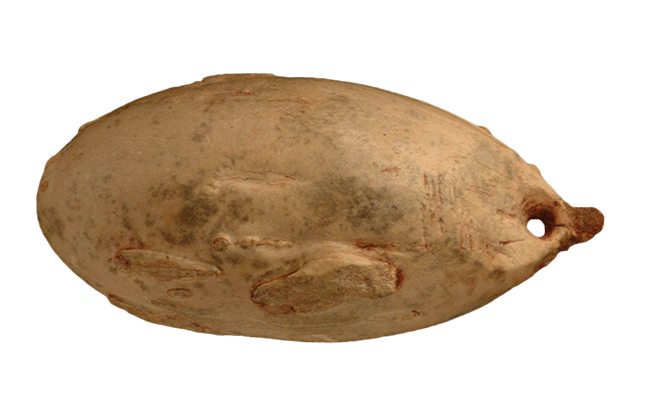
The object itself is exceptionally curious: it is mammoth ivory, its odd shape is largely natural– only the top is carved, providing a hole through which a thread could be passed so the pendant might be worn.

Mammoths are extinct relatives of elephants, and like them it is probable that males would engage in bouts of fighting to establish herd dominance.  During fights, tusks can be broken and if the break is within soft tissue, infection may take-hold.  If it persists, a tumour can form in the pulp from which the tusk grows.  The Paviland pendant is a unique example of such a tumour, as proved by the residue of the dismantled tusk from which it came, later found nearby.

What's on the van?

Cornbury and Cockroaches

Cornbury 5

A year of closure in the Museum is a great excuse to get out and about in our van. A glorious sunny spell is even more of an incentive!

Summertown

What better way to start the bank holiday weekend than standing in a busy street dressed as a cockroach? Here I am (on the right) with Education Trainee Liz, as a butterfly, and Education Officer Chris, in his fantastic dung beetle outfit. This was all in aid of the Oxfordshire Art Weeks event – the Summertown Street Parade. Our live cockroach handling and pinned insect displays fitted perfectly with this year’s minibeast theme and the costumes grabbed plenty of attention. I learnt a lot about life with enormous antennae – it certainly makes getting in and out of a gazebo pretty hard work!

Other attractions at the popular event included felt making, decorating tea towels and a minibeast costume parade, which was judged by our very own dung beetle!

Cornbury 4On Tuesday, we took a few of our most dramatic specimens out to Cornbury Park for a warm up event for the Wilderness Festival. We’re excited to be taking part in the festival this August, so it was great to be able to visit the beautiful site and meet some of the people involved. 

Here our famous cheetah, who usually greets museum visitors with a ‘Please Touch’ sign, is being unpacked for an afternoon in the sunshine. As you can see from the photo below, he looks quite at home in this stately setting!Cornbury 3

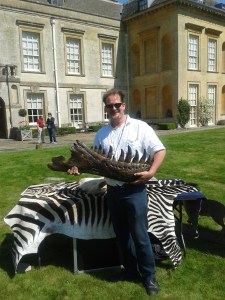
Cornbury 2Other specimens we took with us included this impressive cast of a T rex jaw. Chris is clearly very pleased to have an excuse to show it off!
Look out for us back at Cornbury Park for Wilderness 8th – 11th August. Of course, we’ll have plenty of stunning specimens to handle, along with family crafts to make… and wear!

Rachel Parle, Education Officer

Lightning strikes!

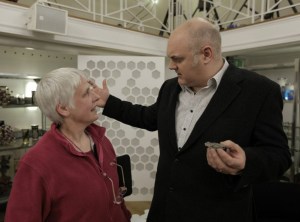
Science Club presenters Mark Miodownik, left, and Dara Ó Briain, right, talk fulgurites with Monica Price, assistant curator of Mineralogy Collections  at the Museum

I’ve just been getting our fulgurites out of their drawer for their second outing to London. ‘What’s that?’ I hear you ask. Well, the clue’s in the name, for ‘fulgur’ is Latin for lightning. Fulgurites form when lightning strikes the ground; and if the ground happens to be made of sand, the intense heat of the lightning melts the grains of sand to form a tube of natural glass. The longest known fulgurite is nearly five metres long, but they are always very fragile things.

A bit of discussion about fulgurites at the end of filming the pilot programme
A bit of discussion about fulgurites at the end of filming the pilot programme. Presenter Dara Ó Briain is holding the Drigg fulgurite. Photo: Alastair Duncan

So why is a fulgurite going to London? We get all sorts of requests to see specimens, from researchers, amateur enthusiasts, students and artists, and even people who are just curious. Our collections are there to be used and enjoyed after all. But in this particular case the producers of the BBC4 programme Science Club were making a pilot for their new series and were looking for a fulgurite to star in the show.

I took two different fulgurites to the recordings, both found in the early 19th century. One is a piece labelled as coming from Drigg in Cumberland. This was a famous discovery; even Charles Darwin knew about them, for he wrote that the fulgurites he discovered in South America were very like those of Drigg in appearance. The second was found in Westphalia, Germany, and it shows a glassy trace of the lightning’s path as it passed through the sand.

Mark was determined to have his photograph taken holding a fulgurite.
Mark was determined to have his photograph taken holding a fulgurite! Photo: Alastair Duncan

For this pilot programme Science Club was investigating natural disasters. Presenter Dara Ó Briain was joined by expert demonstrator Professor Mark Miodownik who had quite a shocking experience with a lightning machine! We were also shown why it is dangerous to stand under a tree during a thunder storm, and we heard about the lucky escapes some people have when struck by lightning.

Fulgurites are rather rare and special, and as the pictures show, both presenters enjoyed a chance to get a close look at these natural curiosities.

The pilot programme was successful, and one of our new Education trainees, Liz Danner, will be taking the fulgurites back for the final filming of Science Club this week. If you would like to see them too, they will feature in our next ‘Presenting…‘ display soon. Follow the blog and we’ll let you know when

Watch out for more Science Club on BBC4 – it’s fascinating and fun.

Monica Price, Assistant curator, Mineral Collections