Every breath you take

IMG_3738

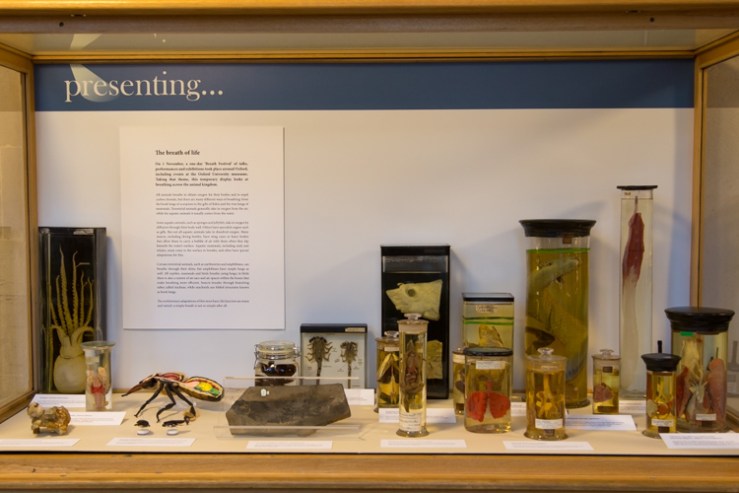
Tomorrow afternoon the Museum will host talks, tours and a dance performance as part of the Breath Festival, a unique series of events coordinated by the Oxford University Hospitals Artlink programme. To coincide with the festival we have put together a special display in our changing Presenting… case, all about breath and breathing across the animal kingdom.

There’s something of the Halloween macabre about the display too, with its pink-coloured lungs and eviscerated bodies suspended in spirit. Here’s a taster of the display, but to see the full selection head down to the Museum either for the Breath Festival tomorrow, Saturday 1 November, or at any time during the rest of the month.
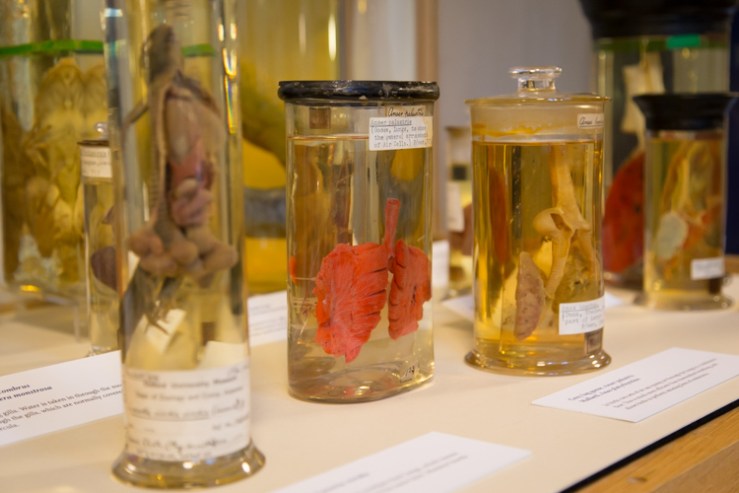
Lungs of a lizard, goose and duck.
Lungs of a lizard, goose and duck

The breath of life
All animals breathe to obtain oxygen for their bodies and to expel carbon dioxide, but there are many different ways of breathing: from the book lungs of scorpions to the gills of fishes and the true lungs of mammals. Terrestrial animals generally take in oxygen from the air, while for aquatic animals it usually comes from the water.

Crocodile and alligator lungs

Some aquatic animals, such as sponges and jellyfish, take in oxygen by diffusion through their body wall. Others have specialist organs such as gills. But not all aquatic animals take in dissolved oxygen. Many insects, including diving beetles, have wing cases or hairy bodies that allow them to carry a bubble of air with them when they dip beneath the water’s surface. Aquatic mammals, including seals and whales, must come to the surface to breathe, and often have special adaptations for this.

Certain terrestrial animals, such as earthworms and amphibians, can breathe through their skins, but amphibians have simple lungs as well. All reptiles, mammals and birds breathe using lungs; in birds there is also a system of air sacs and air spaces within the bones that make breathing more efficient. Insects breathe through branching tubes called tracheae, while arachnids use folded structures known as book lungs.

The evolutionary adaptations of this most basic life function are many and varied: a simple breath is not so simple after all.

Visitors pick out their favourite specimen

Scott Billings – Public engagement officer
Lemur Alert

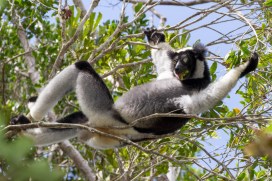
05 indri
Indri by Tom Nicholson-Lailey

According to the International Union for Conservation of Nature (IUCN) Lemurs are the most endangered mammals in the world. This diverse group of primates includes more than 100 species, but can only be found on Madagascar and the neighbouring Comoro Islands. On display here in the Museum we have a variety of lemurs, including the skeletons of extinct giant lemurs – some of which were as large as an adult human,

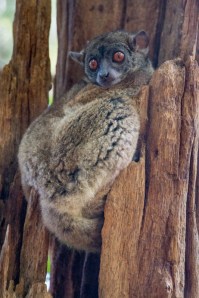
Sportive Lemur
Sportive Lemur

With many species already extinct, the Lemur is in real trouble. This week a World Lemur Festival is being held in Antananarivo, the capital of Madagascar. To spread the word, the Lemur Conservation Foundation have put together a film to celebrate the festival and to highlight how close we are to losing the lemur.

Here in the UK, East Oxford residents and Museum visitors Tom Nicholson-Lailey and Janet McCrae approached us about the Lemur Festival. Janet and her partner Michael set up the McCrae Conservation and Education Fund in 2006 to support local conservation work in Madagascar. In collaboration with the late primatologist Dr Alison Jolly and Durrell Wlldlife, they’ve produced a series of posters, which have been distributed to 200 primary schools, featuring ecosystems under threat. Janet says she is

Mad about helping local children understand the unique habitat and their role in preserving it.

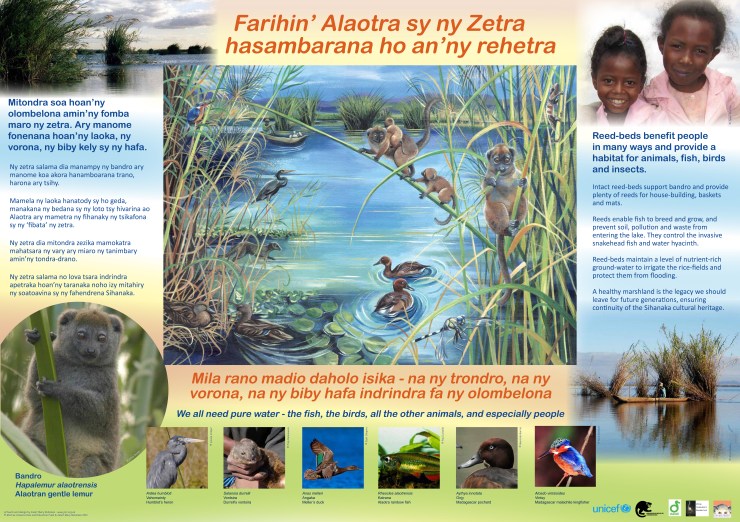
One of the posters designed by  McCrae Conservation and Education Fund
One of the posters designed by Janet Robinson for the McCrae Conservation and Education Fund

Tom has made 3 visits to Madagascar for wildlife-watching holidays, and has contributed the fantastic photographs you can see here. He says

“I hope that by travelling to Madagascar and visiting national parks and reserves, we are supporting local conservation work in Madagascar, and helping to ensure that conservation has a high political profile.”

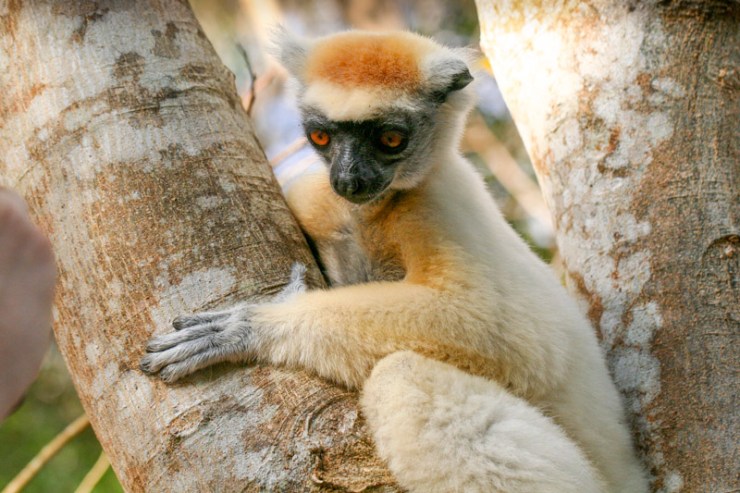
Golden Crowned Lemur
Golden Crowned Sifaka – one of the amazing photos by Tom Nicholson-Lailey

Madagascar, the fourth largest island in the world, is one of nature’s great treasure-houses, described as a ‘biodiversity hotspot’ for its number and variety of species. Some 90% of all the island’s animal and plant species are ‘endemic’ – found nowhere else in the world. The ‘flagship’ species that best represent Madagascar’s extraordinary biodiversity are the lemurs. No less than 103 species and sub-species of these beautiful, harmless, tree-dwelling primates had been identified by 2012, including as many as 39 species identified since the year 2000.

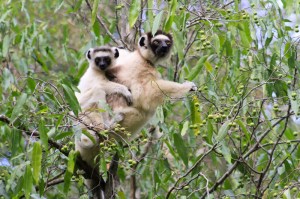
Verreaux Sifaka
Verreaux Sifaka

Most of the island’s original forests have long been destroyed. With a growing population already over 22 million, and extensive rural poverty, the few isolated strips and pockets of forest that comprise the lemurs’ habitats are under increasing threat from slash-and-burn agriculture and from illegal logging of precious hardwood trees.

The current 2012-14 IUCN list of the world’s 25 most endangered primates includes six lemur species:

Blue-eyed Black Lemur (Eulemur flavifrons) – Endangered

Northern Sportive Lemur (Lepilemur septentronalis) – Critically endangered

Silky Sifaka (Propithecus candidus) – Critically endangered

Madame Berthe’s Mouse Lemur (Microcebus berthae)- Endangered

Red Ruffed Lemur (Varecia rubra) – Endangered

Indri (Indri indri) – Endangered

Much needs to be done to strengthen the efforts of local organisations in Madagascar to raise awareness of the unique lemur plight and to help people find alternative means of making a living.

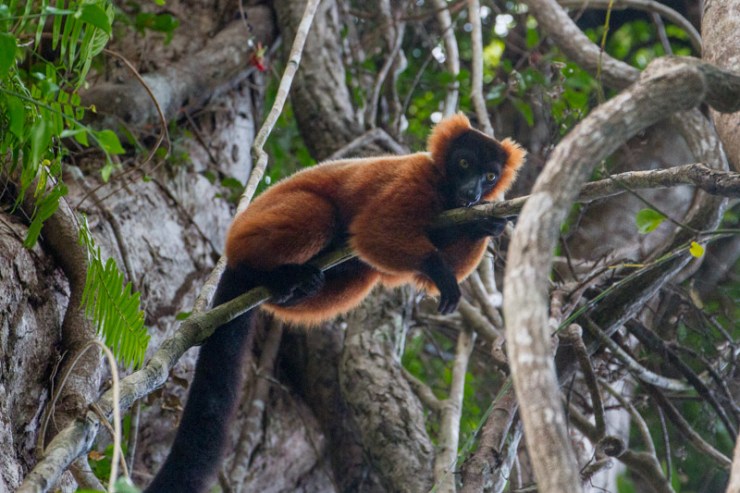
Red Ruffed Lemur
Red Ruffed Lemur

But Janet explains that there is also some good news. Conservation organisations like the Durrell Wildlife Conservation Trust are working with local people in Madagascar to help preserve Lemurs’ habitats, and there are some notable success stories.

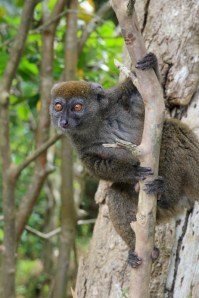
The ‘Bandro’, or Bamboo Lemur

In the Lake Alaotra area villagers have been helping to protect wetland reed-beds from destruction. The ‘Bandro’, or Bamboo Lemur (Hapalemur alaotrensis), which depends on the reed-beds for food and shelter, is no longer on the Critically Endangered list.

Through Durrell’s website, you could adopt your own lemur; choose from ‘Bandro’ the Bamboo Lemur or ‘Stumpy’ the Ring-tailed Lemur. Janet and Tom emphasise that

“They need all the help they can get from friends like you”.

Rachel Parle, Interpretation and Education Officer

Morbid moths

Blog brandingThere are many fascinating displays in the Museum, but there’s something special about meeting an expert and chatting to them about the collections they love. Every Monday to Thursday our Spotlight Specimens series gives you the chance to do exactly that.
Taking place under the T. rex  in the Main Court at 2.30pm each day, staff from across the collections choose favourite specimens to share with the public. These experts will also be writing a series of Spotlight Specimens blog posts for those of you who can’t make it to the Museum to meet them in the flesh. In this, the first in the series, Gina Allnatt kicks us off with a Halloween special…

**

It’s October, month of falling leaves and trick-or-treating, so what better way to get into an autumnal mood than to talk about two moths with marvellously morbid names?

What do the Death’s Head Hawkmoth (Acherontia styx) and Black Witch moth (Ascalapha odorata) have in common? They are both associated with the film and novel Silence of the Lambs. The Death’s Head was used in the film, but the moth in the novel was originally the Black Witch. The moth was changed for the film for two reasons: The producers thought that a moth with a skull on its back would look more sinister, and also because it was almost impossible to get live specimens of the Black Witch moth for filming.

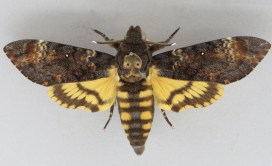
deathshead
Death’s Head Hawkmoth (Acherontia styx)

The author of Silence of the Lambs, Thomas Harris, may have chosen the Black Witch moth because of the many legends and myths that surround it. In Jamaica it is known as the “Duppy Bat.” In Central and South America it’s known as “Mariposa de la Muerte”, which translates as “Butterfly of the Dead” because there is a myth which claims the moth is a harbinger of death. A less sinister version of this myth suggests that if you find one of these moths in your home it means an ancestor or loved one who recently passed away is paying you a visit.

However, the subtlety of these myths would probably not translate so well on film, so Mr. Death’s Head Hawkmoth took centre stage.  The vernacular name of this moth comes from the skull-like markings on its back. There are actually three species of Death’s Head Hawkmoth- A. atropos, A. styx and A. lachesis. Though the moth mentioned in the film is Acherontia styx, Acherontia atropos was actually used instead.

All Acherontia supplement their diet by raiding the hives of bees for honey. The moths achieve this by using their extremely thick cuticle, which makes them impervious to stings. But the moth also uses another tactic: it is able to emit an odour that is chemically identical to the worker bees’ scent. This fools the bees into thinking the moth is one of their own. They also emit squeaking noises while in the hive. Some scientists posit that the squeak is similar to the noise a queen honeybee emits when she wants the workers to freeze. No one has been able to observe this theory, however.

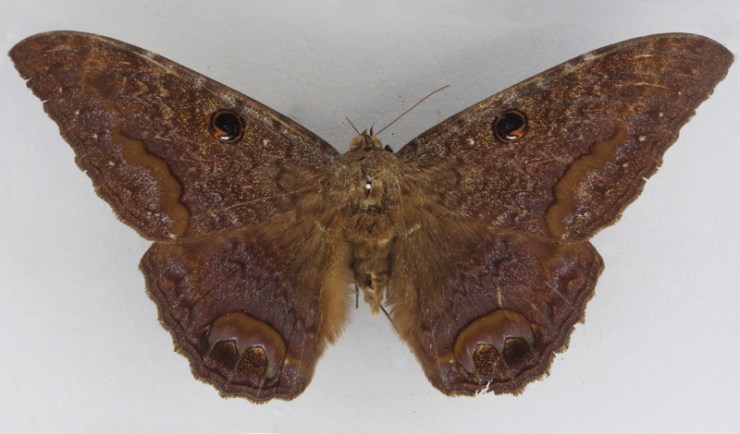
Black Witch moth (Ascalapha odorata)

Despite all the myths and legends surrounding the Death’s Head Hawkmoth and Black Witch moth, both are large and harmless species. It is perhaps the fact that most moths are nocturnal which gives rise to so many legends and misinformation about them. It’s often the case that people will love butterflies but don’t like moths. Moths evolved before butterflies, and it is likely that the butterflies people hold dear evolved from day-flying moths (many day-flying moths exist today and are even more colourful than their butterfly counterparts!).

So remember this when you next see a moth (the original butterfly!) fluttering near a lamp as the sun slowly disappears.

Gina Allnatt, Curatorial assistant (Lepidoptera)

Gina will be talking about the Death’s Head Hawkmoth and Black Witch moth at 2.30pm on 28 and 31 October as part of our Spotlight Specimens series, running Monday to Thursday at 2.30pm.

A glimpse of paradise

Copyright Ben Robinson, Oxford Fashion Week

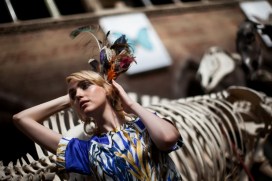
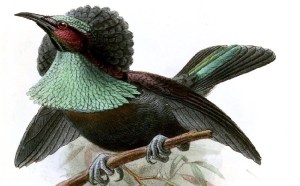
We host hundreds of events a year at the Museum; everything from specialist lectures to family friendly activities. But coming up in November we’ve got a real first – a fashion show right here in the middle of the Museum. Oxford Fashion Week will be hosting their headline event here on Saturday 8 November. Birds of Paradise will be the climax to the week of shows and has been inspired by the spectacular Birds of Paradise in the Museum’s collection.

Hannah Zainnudin
Hannah Zainnudin

Earlier this year, Oxford University student Hannah Zainuddin approached the Oxford Fashion Week team with her exciting proposal. As a Biology student, evolution is at the heart of her studies and she’s particularly interested in the behaviour of Birds of Paradise, as an example of sexual selection at its most flamboyant. But Hannah’s interest isn’t purely biological. She is excited by the overlap between art and science and wants to use fashion as opportunity to blend the creative and academic elements of Oxford.

I hope people will realise that fashion isn’t just superficial.

Hannah is currently a finalist at St Catherine’s College, Oxford and will be juggling her studies with the role of Creative Director for the Birds of Paradise show.

CraspedophoraKeulemans cropShe’s sourced exciting, original looks by cutting edge professional designers. Watch out for explorations of iridescence, dramatic colour combinations and textures that mirror the display techniques used by the flamboyant birds. Changes in the volume of models’ outfits will also reflect the impressive puffed up feathers that male birds use in their dances.
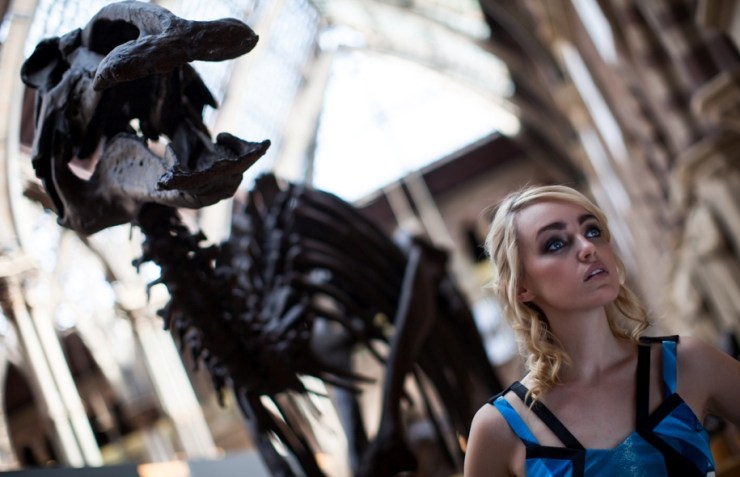
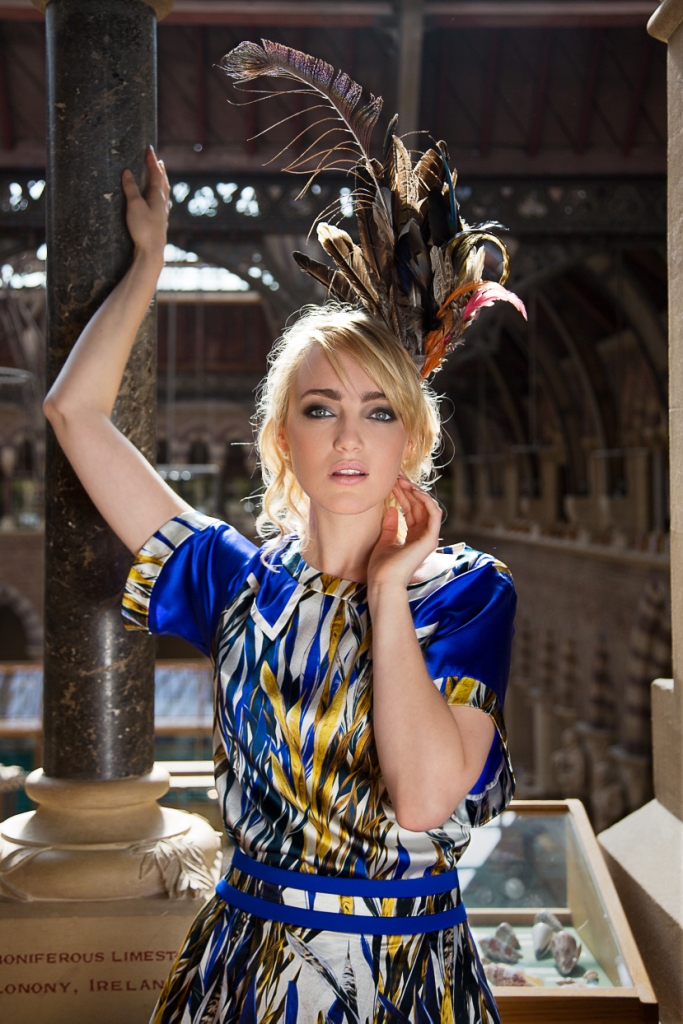
To set the scene and whet the appetite for the show, the Fashion Week team came in to capture some publicity shots. The results give us a glimpse of the dramatic impact we’ll see on the night with striking models, breathtaking outfits and a unique setting.

Copyright Ben Robinson, OFW
Copyright Julia Cleaver, OFW

The model in all these fabulous shots is Tiffany Saunders who, as well as being a professional model, is the Assistant Director of Oxford Fashion Week.

Her enthusiasm for the museum as a set for the shoot and as a venue for the show was obvious as we scouted out the perfect locations in the galleries. Although she’s been modelling since she was four years old and has worked in countless interesting venues, she says that using the Museum as her framework was a very different experience;

I felt in awe of my surroundings in a way that I’m not used to. Every angle, every shot, every corner of the Museum presented an image of wonder and uniqueness. It was an honour to have been amongst such outstanding surroundings.

Tiffany also explained why she and Oxford Fashion Week director Carl Anglim are so excited about the show:

We have wanted to do an event at the museum for a while because it is so unique and iconic. Part of what sets Oxford Fashion Week apart from other fashion weeks is the cultural heritage the city has to offer, so we always like to use venues that display this supreme asset. Headlining at the museum is something the whole team are particularly excited about. It is a world class venue and will be an incredible highlight of Oxford Fashion Week.

Copyright Julia Cleaver, OFW

In another first for the team, they will also be holding a double-bill at the Museum on Friday 7 November. Independent Collections will kick off the evening at 6pm, followed by Couture at 7.30pm. Three brilliant shows in 24 hours.

If you’d like to join us for either of these nights, tickets are available through the Oxford Fashion Week website.

Rachel Parle, Interpretation and Education Officer

A new home for old fossils

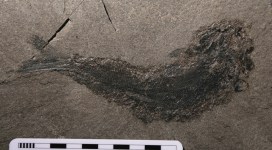
Paleoniscum, a fossil fish from County Durham
Palaeoniscum, a fossil fish from the Upper Permian of County Durham

By Hilary Ketchum, Collections Manager, Earth Collections

A few weeks ago Eliza Howlett (Collections Manager, Earth Collections) and I travelled to Wales to pick up an exciting collection of fossils that had been given to the museum.

The collection was kindly donated by Mr Phil Bennett, who has been finding fossils for over 20 years. In 2004, Phil won the Mary Anning Award for his outstanding contribution to palaeontology by making his collection available for researchers to study. He has an excellent eye for spotting new and interesting things, and thanks to this has a species of trigonotarbid (a spider-like animal) and crustacean named after him.

We had a fantastic day in Wales. After a delicious lunch we looked through the collection, and Phil told us all about the different specimens, pointing out some of his best finds.

One of his favourite specimens is a beautiful fossil fish called Palaeoniscum, from the Upper Permian of County Durham, which is approximately 270-250 million years old.

While Palaeoniscum is instantly recognisable as a fish, some of the older vertebrate fossils in Phil’s collection would look a bit out of place in a modern ecosystem. These fossils, from the Old Red Sandstone in Wales, date from the Lower Devonian period, approximately 410-420 million years ago.

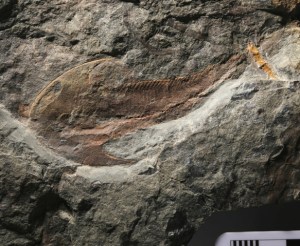
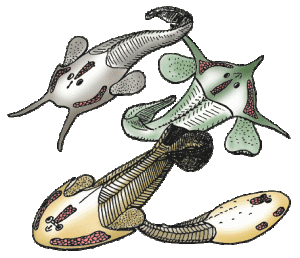
An osteostracan from the Lower Devonian of Wales with a semi-circular head shield (left). The specimen is about 6 cm long from head to tail.

Featuring heavily in Phil’s Old Red Sandstone collection are fossils of strange, fish-like vertebrates (animals with backbones) called osteostracans. Their bodies were covered in large scales and they had massive bony head shields, but they didn’t have jaws or teeth.

The head shields of osteostracans have a mysterious structure called a ‘cephalic field’ (shown in red in the image below). Palaeontologists do not know for sure what the cephalic field was for. Some think that it was a sensory organ that was used to pick up vibrations in the water or changes in electric fields, helping them detect prey or predators.

Image credit: Philippe Janvier

Phil had very carefully packed all the fossils into cardboard boxes before we arrived, so it didn’t take long for us to load the specimens into the back of the car and drive them safely back to their new home. We have now begun the process of incorporating the fossils into the museum’s permanent collections. The specimens will be taken out of their boxes and put into museum trays, ensuring that all of Phil’s labels are kept so that no information is lost. Over the next few months, the specimens will be catalogued on the museum’s electronic collections database. Each specimen will be given a unique museum number so it can always be easily identified.

It’s a fantastic collection, and we are really excited to have it in the museum. They can be used for display and teaching, and will be available for researchers to study for years to come.

An Eye for a Pattern

Dorothy1

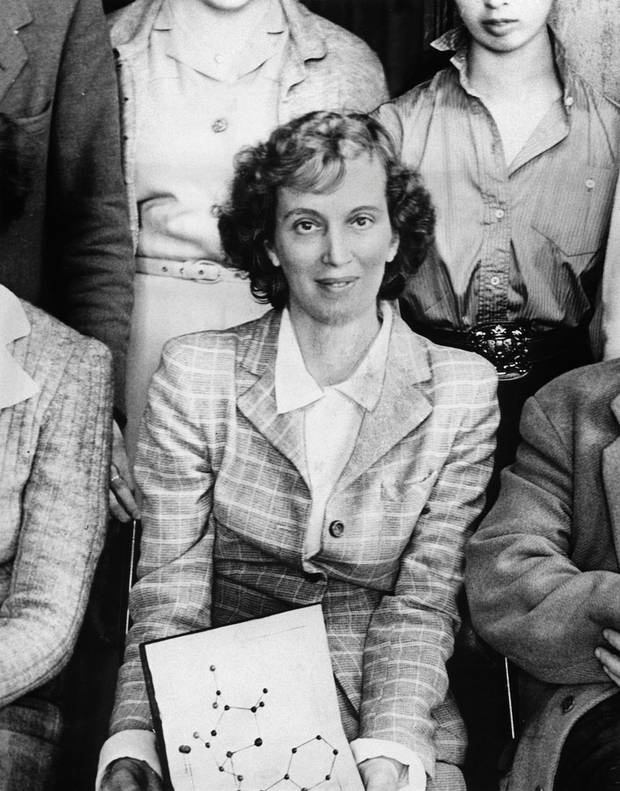
Fifty years ago this month the Royal Swedish Academy announced that Dorothy Crowfoot Hodgkin had won the Nobel Prize for Chemistry. She remains the only British woman scientist ever to win a Nobel Prize.

Hodgkin with fellow Nobel laureate Max Perutz,

The Museum celebrated Hodgkin’s achievement with a bust in the Court – the only female face among all the statues looking down on the dinosaurs. Although the bust is currently off display, undergoing conservation work, she deserves her place more than anyone: she first learned the skills of X-ray crystallography in the Museum, and carried out all of her Nobel Prizewinning work there.

Georgina Ferry, author of Dorothy Hodgkin: A Lifeand a former author in residence at the Museum, reveals more about Dorothy’s work.

*

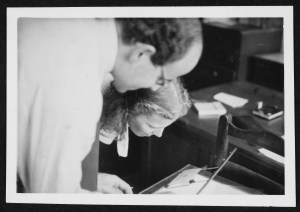
In 1928, when Dorothy Crowfoot (as she then was) arrived in Oxford to study chemistry, the Museum was still the centre of teaching and research in several science subjects including crystallography. The following year the department installed the equipment needed for X-ray work. Dorothy chose to do her Part II research project in X-ray crystallography, the first student to do so. From photographs of the patterns of spots generated by firing beams of X-rays through tiny crystals, she could calculate the positions of the atoms inside the crystal, and so understand how its structure influenced its chemical role.

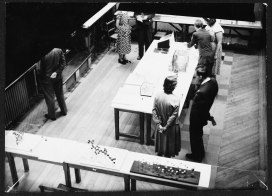
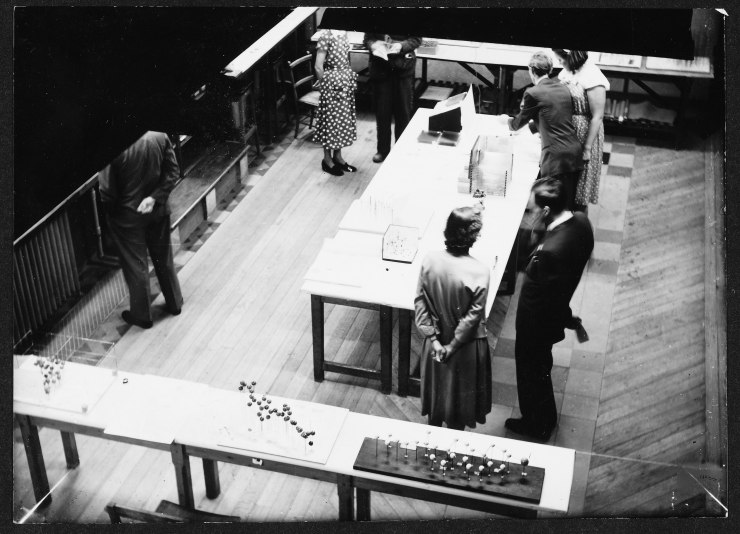
This shot is believed to show Dorothy with an exhibition of her work, in the Museum
This photo is believed to show Dorothy with an exhibition of her work, in the Museum

At the time the whole Mineralogy and Crystallography Department worked and taught in the room under the tower where Samuel Wilberforce and Thomas Huxley conducted their famous debate on human evolution in 1860. There was a darkroom suspended from the ceiling for examining crystals, another curtained-off area for developing photographs, and the X-ray tube, connected to an alarmingly unsafe power supply, sat on a table in the corner.

Dorothy HodgkinAfter getting a first class degree in 1932, Dorothy went to Cambridge to do a PhD with JD Bernal. There she began to study biologically important substances such as cholesterol and pepsin.
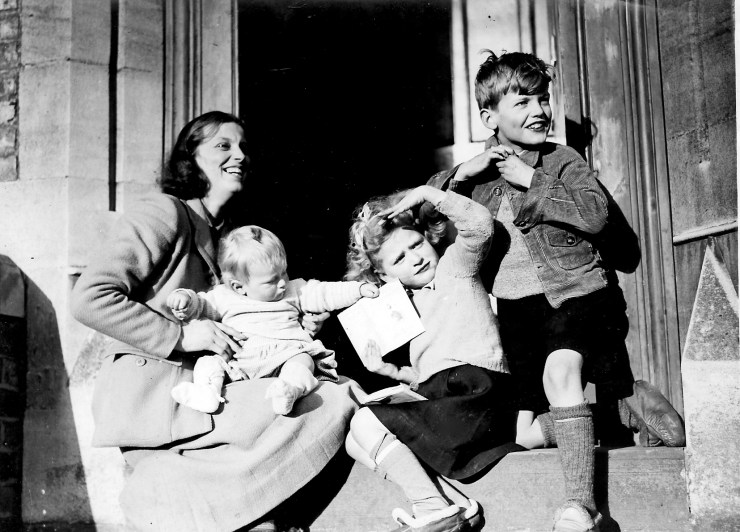
Two years later she was back in Oxford with a fellowship at Somerville. She started her own research in a dingy semi-basement in the northwest corner of the Museum. That remained her lab for more than 20 years. It was there that she solved the three-dimensional arrangement of atoms in crystals of penicillin and Vitamin B12, the achievements that won her the Nobel Prize.

Dorothy with her children, on the day her Fellowship of the Royal Society was announced, 1947

All through this week, as the Nobel Prizes for 2014 are being announced, you can hear Dorothy’s life story told through her letters on BBC Radio 4, in the series An Eye for Pattern (it will be on iPlayer thereafter if you missed it).

With thanks to the Bodleian Library and the Department of Chemistry,University of Oxford for the use of the photographs.