Delving into dung

25

Each summer we host a variety of interns, working both in the collections and with the public. Oxford University student Maria Dance has now come to the end of her placement and reflects on the delights of dung beetles and what they can teach us about ecosystems.

**

Over the past six weeks I have been working in the Hope Entomological collections, home to an estimated 5 million insect specimens. Coming fresh from my second year studying biology at Oxford University, I have been working on a project to sample-sort and identify dung beetles from the SAFE project in Sabah, Malaysian Borneo.

A very short introduction to dung beetles
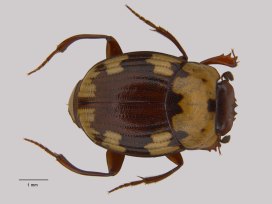
From the order Coleoptera, sub-family Scarabaeinae, most true dung beetles feed exclusively on dung. Some roll dung away from the main pile and bury it for food or as a brood site, some tunnel below the dung  and bury it that way, and others are “dwellers” and simply live in it. All are essential groups for ecosystem functioning and provide indispensable services from which humans benefit; dung beetles recycle nutrients, rework soils, and act as secondary seed dispersers.
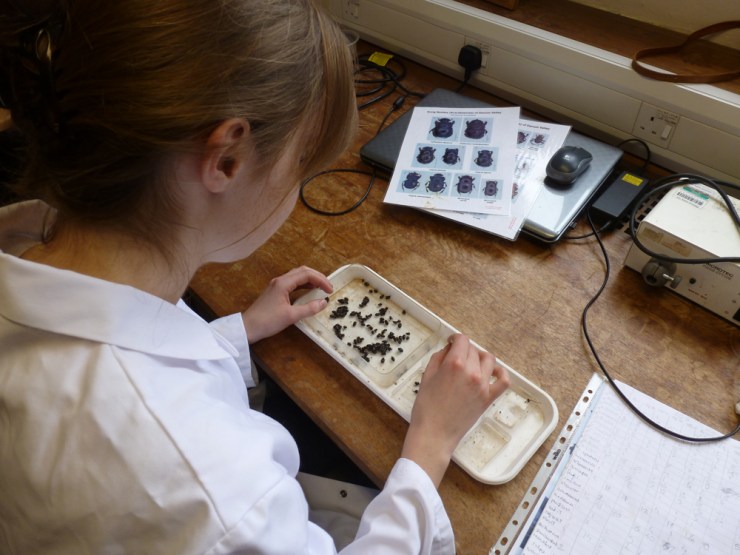
Maria sorting through a dung beetle sample

Dung beetle research at Oxford

Researchers at Oxford are studying the link between dung beetle biodiversity and ecosystem functioning to predict the true environmental consequences of human-driven habitat loss and fragmentation in the tropics. So I have been identifying beetles to calculate diversity, which is then compared across sites with very different human disturbance levels. Dung beetle diversity and community composition are good proxies for ecosystem functions as we know the roles that different groups of dung beetles play.

More than an intern
P1110406
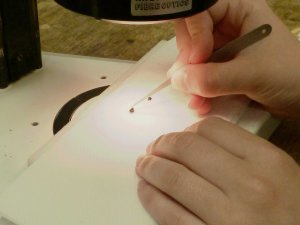
Working on tiny dung beetle specimens

The starting point is for me is material collected from (human) dung-baited pitfall traps, which I search through and extract all dung beetles from; it’s a smelly, tricky job that needs a sharp eye as some beetles can be as small as 2mm in length!

Next comes the hard part: identification. Darren Mann, Head of Life Collections at the Museum and dung beetle taxonomist extraordinaire has guided me through the process. It was particularly difficult to identify the Bornean species due to the lack of good primary literature. A microscope is essential, as many characters used to identify species are not visible with the naked eye.
P1040924
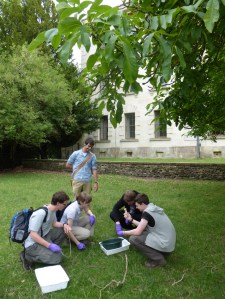
Students sampling for dung beetles at Magdalen College deer park

As my internship draws to a close, I have identified 6851beetle specimens to 56 species. I have also carried out some initial analyses: comparing diversity between habitats, and between data from 2015 and 2011.  I want to find out whether differences over time are more significant than differences between habitats.

In my last week I was fortunate enough help run a “Spotlight Specimens” session about silk worms and their fascinating, human-dependent existence. In the sessions, experts from the Museum collections show intriguing objects and specimens that are not usually on display. Visitors were able to interact with live silk worms and see them cocoon-building, while we answered questions.

In September I travel to Borneo for a field course, where I hope to put my newly-learnt identification skills to practice. Over the past six weeks I have become more enthused by taxonomy, tropical rainforest ecology but, most importantly of all, dung beetles!

Maria Dance, Intern in Life Collections
Striking gold

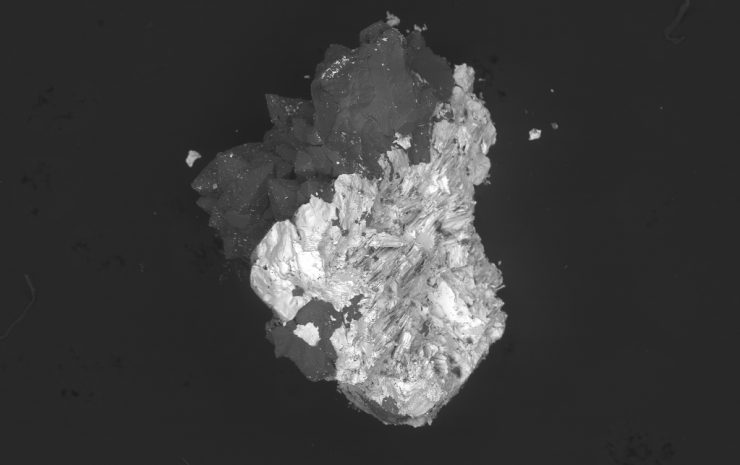
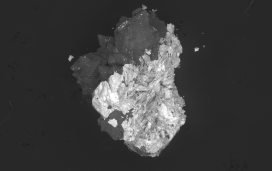
Nagyágite SEM

For the last six weeks, Oxford Earth Sciences undergraduate Charis Horn has been identifying mystery minerals in the Museum’s collections, and she’s struck gold! More precisely, she’s found rare gold-bearing crystals of nagyágite and sylvanite on a specimen which for centuries had been mis-labelled as the common lead mineral galena.

Nagyágite is composed of gold, lead, sulphur, antimony and tellurium and forms metallic grey crystals. Sylvanite is made up of gold and tellurium with a little silver, and is pale, silvery yellow. These minerals and their surrounding rock matrix indicate that the specimen is from the gold mines of Săcărâmb, in Romania, formerly known as Nagyág –  the place where nagyágite was first discovered.

Charis on SEM
Charis using the scanning electron microscope

Charis is one of a number of interns funded by the Higher Education Funding Council (HEFCE) through the University’s Internship Programme to learn more about academic research.

Rocks and minerals have always fascinated me, which is the reason I chose to study Earth Sciences at university. I find it amazing that the history of this planet can be read in the geology beneath our feet.

Many of Charis’s samples were put aside for a bit of extra work many years ago because the minerals on the specimen were potentially more interesting than the labels might suggest. Some can be identified by looking at physical characteristics such as colour and crystal shape, or by testing for properties like hardness and magnetism.

Others are much more challenging, and Charis has been using an analytical scanning electron microscope (SEM) to see close-up images of minute crystals to find out what chemical elements they are made of. There’s an SEM image of the nagyágite crystals, seen in white, at the top of the post.

Another of her discoveries has been a rare lead-bearing silicate mineral called hancockite, which was found on a specimen supposed to be from ‘Glen Coe, Argyllshire’. The orange-red crystals are less than a millimetre long, and hancockite is known from only one place in the world: Franklin mine, in New Jersey, USA.

It seems our specimen comes from Franklin mine too, and is the first sample of hancockite in the Museum’s collections. So both specimens must have had their labels muddled up in past centuries.

I have really enjoyed learning more about mineralogy during my time here at the Museum. Realising that something is far more exciting than it first seemed is definitely a great way to end this internship!

Monica Price – Head of Earth Collections

Bringing dinosaurs to life

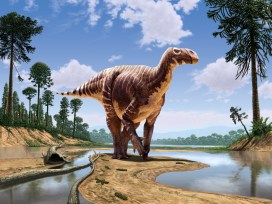
Iguanodon bernissartensis

By Rachel Parle, Education and Interpretation Officer

Dinosaurs were living, breathing, moving animals, but that’s sometimes hard to visualise when standing in front of a skeleton. We may not be able to reincarnate dinosaurs in the style of Jurassic World, but an excellent illustration of the animals in their environment can go a long way to bringing them back to life.

Triceratops horridus

When Earth Collections Manager Hilary Ketchum and I set out to update the labels for our free-standing dinosaur skeletons, we wanted to present current science alongside scientifically accurate illustrations. They should be beautiful and show the dinosaurs as dynamic animals. We found just the person for the job. Julius Csotonyi is a paleoartist, wildlife artist and scientific illustrator who specialises in life-like restorations of prehistoric animals and habitats. He understood exactly what we wanted and set to work researching featured specimens.

Pachycephalosaurus wyomingensis

After several rounds of checks and suggestions from scientists in the Museum and the University, the illustrations are all complete and the new labels are on display in the Museum. So I asked Julius a few questions about his work and how he felt having completed the project.

**

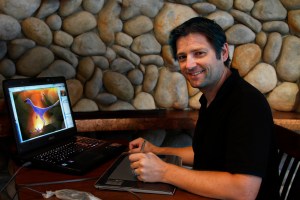
Julius working on a dinosaur reconstruction.
Julius working on a dinosaur reconstruction. Credit: Alexandra Lefort

How do you ensure your representations of dinosaurs are accurate?

Ultimately, all of my reference material comes from palaeontologists’ research. For all reconstructions, I rely heavily on published scientific literature. For reconstructions of newly discovered taxa, of which I am commissioned to do quite a few for press releases and scientific papers, I also have discussions with the palaeontologists who have made the discoveries, since the material is not yet published. This latter process is some of the most exciting, because I am able to participate in the process of scientific discovery, keeping a foot in both camps of science and art.

Struthiomimus sedens

How important do you think the dinosaur’s environment is in the representation?

The environmental context provides the opportunity to tell a more detailed story of the animal’s role in the biological community, its position in the food web, or interesting aspects of its behaviour. Depicting the animal’s environment provides me the opportunity to employ creative and interesting lighting conditions and composition to generate an image that is as aesthetically appealing as possible – this is art, after all, and I feel it’s important to make it as beautiful as I can.

How did you become a paleoartist and what do you enjoy about it?

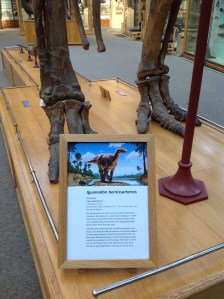
The new Iguanodon on display at the dinosaur's feet
The new Iguanodon label on display at the dinosaur’s feet

I absolutely love my job. It’s wonderful to play a part in piecing together and visualizing worlds that are millions of times older than I am. It was during the completion of my PhD in the microbiology of extreme environments that my work in scientific illustration and paleoart really took off, when I was first contacted to help illustrate a book about dinosaurs by author Dougal Dixon. Ultimately I realized that scientific illustration provided me with a more consistent enjoyment, so I made scientific artwork my full time work as soon as I completed my degree. I know that I am in the right field of work because even when I am juggling projects under the extreme pressure of impending deadlines, I still find great enjoyment in the act of painting.

This up-to-the-minute T. rex has feathers!


How do you feel about your work being on permanent display here?

I feel greatly honoured to have my illustrations incorporated into a permanent display in this renowned and respected institution. It is my hope that my work will help in a small way to interest the public in the intriguing field of palaeontology, and this excites me, for I feel strongly about contributing to scientific outreach. Many thanks to the museum team for allowing me to participate!

**

Next time you call by the Museum, stand in front of a dinosaur, have a good look at its new label and see if it comes to life before your eyes.

Rachel Parle, Interpretation and Education Officer

All images are copyright Oxford University Museum of Natural History and Julius Csotonyi.