Introducing Kelley Swain

Poets in Residence header image

As part of our Visions of Nature programme, we will be joined by three poets in residence: John Barnie, Steven Matthews, and Kelley Swain. They will work alongside staff in our collections and out in the Museum itself to gain inspiration for their writing.

As the poets begin exploring the possibilities of their residency, we’ve asked them each to introduce themselves. Here we meet Kelley Swain, a poet, writer and editor, particularly in art-science crossover genres.

**

My first collection of poetry grew out of spending my final year of university in the zoology and biology laboratories – even though I was completing a degree in English. Darwin’s Microscope was published by Flambard Press in 2009, two years after I graduated, and I was fortunate to take part in many ‘Darwin 200’ celebrations, events and readings.

Kelley2This led me to fashion a niche as a ‘science poet’, and I spent four years volunteering as Poet-in-Residence at Cambridge University’s Whipple Museum of the History of Science, running public engagement events for the Cambridge Festival of Ideas and Cambridge Science Festival each year. Being affiliated with the Whipple also contributed to my first novel, Double the Stars (Cinnamon Press, 2014) about the Georgian astronomer Caroline Herschel.

For my next book, I immersed myself in the science of human anatomy, writing a verse drama, Opera di Cera, about the famous, life-sized anatomical wax Venus in the Florentine Museum of Physics and Natural History. The Museum opened in 1775, and the Venus, along with hundreds of other anatomical waxworks, are still in situ today, used as training tools for medical students, and serving as marvellous examples of artistic sculpture and the history of medicine. Opera di Cera won the Templar Poetry Prize in 2013, and was published in full by Valley Press in 2014. A long-term aim is for it to become a real opera, and I’ve met a marvellous composer who is keen to make this happen.

It was particularly significant to be invited as one of the Poets-in-Residence for Visions of Nature. I feel no more at home than in a Museum of Natural History, and after my time at Cambridge, it felt very special to be invited to get to know Oxford University better. The unique smells of the Museum’s Spirit Stores and specimen cabinets are – perhaps oddly – incredibly comforting and familiar, whispering of care, of travel, and of old knowledge patiently waiting to be unwrapped.

A good natural history museum is a microcosm of the world itself, and like Darwin preparing to set sail on the Beagle, I’m excited about the year ahead – what treasures will I find in the ship of this Museum of Natural History, and who will I meet along the way? I’m especially interested in botany, geology, cetaceans and cephalopods, but open to inspiration from any perspective.  Let’s set sail!

Introducing John Barnie

Poets in Residence header image

As mentioned in a blog post a little while ago, we’ve launched Visions of Nature, a special programme of exhibitions, talks and workshops by artists and writers whose varied work celebrates the natural environment. Things will come and go throughout 2016 but one thread will weave throughout the season – our Poets in Residence.

We welcome three poets, who will work alongside staff in our collections and out in the Museum itself to gain inspiration for their writing: John Barnie, Steven Matthews, and Kelley Swain. In the autumn, they will take part in a number of events and activities to present their work, and will be publishing a small anthology at the end of the year.

But as the poets begin exploring the possibilities of their residency, we’ve asked them each to introduce themselves. First up is John Barnie, poet and essayist from Abergavenny, Monmouthshire.

**

I grew up in a small market town in the Usk valley at the edge of the Black Mountains, a place of rivers and streams, hill farms and upland moors, which shaped me both as a person and as a writer, for though I spent some twenty years living in cities, I was always drawn back to the only world in which I truly felt at home. It eventually became the deepest source for the kind of poetry I write.

John Barnie
John Barnie

I was educated in the Humanities but sometime in the 1980s it dawned on me that my ignorance of science was an appalling gap in my knowledge, and I spent many years reading around in evolutionary theory, palaeontology and especially palaeoanthropology which fascinated me, and continues to do so. Inevitably, this was very much the reading of an amateur, but it opened new ways of thinking for me about the evolution of humans and what that evolution means for our ability to solve the global crises we currently face. Understanding something of the history of life on Earth also gave me new perspectives on religion and its role in human affairs.

Digital reconstruction of a 425 million year old pycnogonid (sea spider), Haliestes dasos, from the Silurian Herefordshire Lagerstätte
A fossil that John saw behind the scenes: Digital reconstruction of a 425 million year old pycnogonid (sea spider), Haliestes dasos.

The opportunity to be a poet in residence at the Museum of Natural History is something I had never anticipated. Judging from my visits to the Museum so far, the experience is likely to lead me in new directions in my writing. It has been extremely interesting to go behind the scenes of the Museum’s public façade to get a sense of the extraordinary array of natural treasures that it holds, and even more so to be introduced by some of the scientists to their research — to follow the patient re-creation of a fossil sea-spider from a lagerstätte, for example, as a three-dimensional image on a computer, revealing the long-dead animal in the finest of detail.

Already my head is buzzing with images, impressions, and ideas, and I know that this is going to be an exciting year which may take me in directions I hadn’t previously thought possible.

Value Added Taxonomy

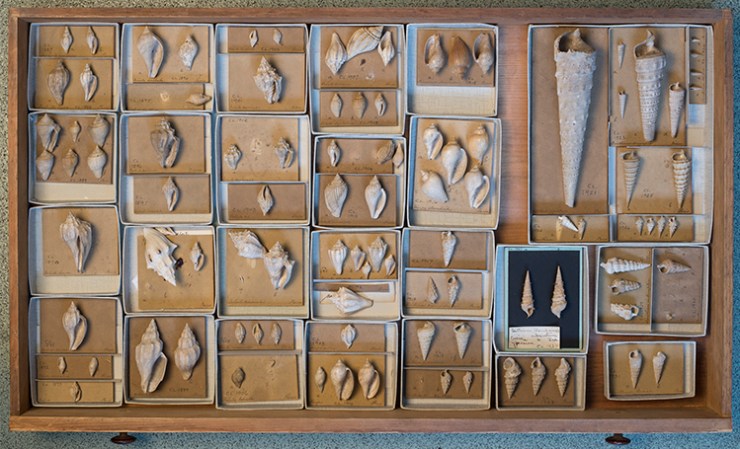
Drawer of Lyell gastropods

Three years ago, one of the Museum’s key strategic aims was to introduce a unified collections management system (CMS) for the scientific collections. Combining data from all the museum collections will allow people to search across all these collections and will also be of enormous benefit in managing activities such as loans, exhibitions, conservation, object entry and exit and movement control, as well as integrating digital imagery.

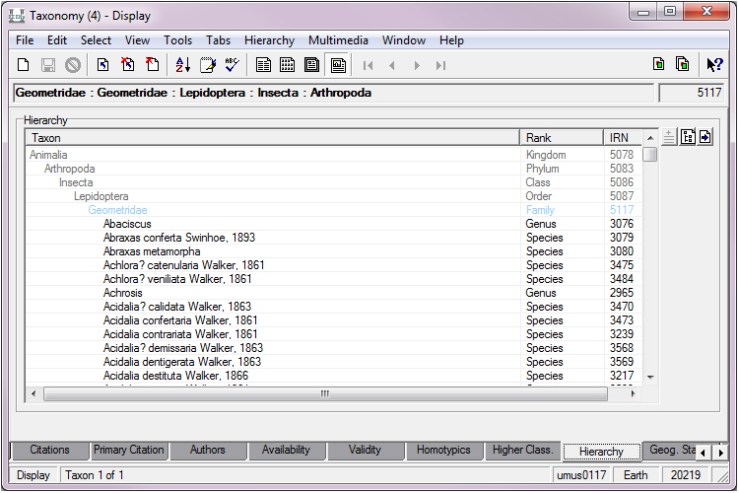
The CMS chosen was KE EMu, which works very well for natural history collections, particularly in the way that it deals with taxonomy (the classification of organisms). Migration of data and original cataloguing is now well underway, with records for minerals, butterflies and moths and archives all in the new system. The Lyell digitisation will act as a pilot project for the migration of palaeontological data.

The biggest challenge with moving all our collections data to a single system will be to standardise data structures and terminology across the collections, for example taxonomy, localities, people and organisations, and bibliographic references. In this blog post we are going to focus on taxonomy, which is key to the understanding of the palaeontology, zoology and entomology collections.

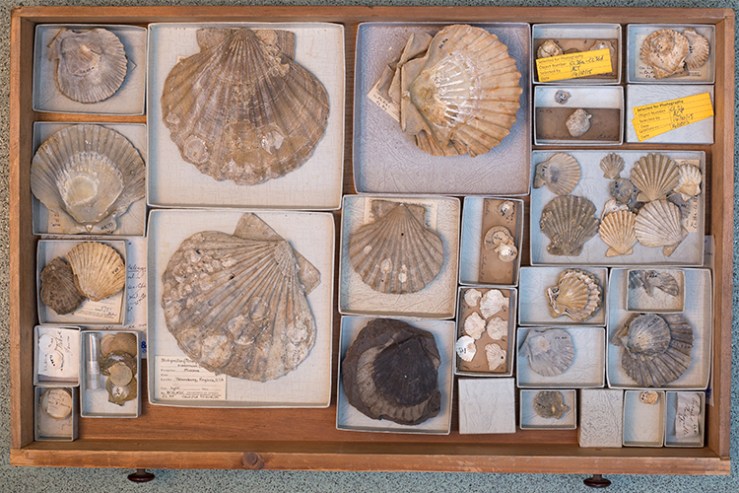
Image of drawer of pecten shells collected by Charles Lyell
Drawer of pecten shells collected by Charles Lyell

All the collections databases record the genus and species where these can be identified. The higher taxonomy, e.g. kingdom, phylum, class, order, family, has been recorded less consistently. At present, the palaeontology collections use an all-purpose field called Taxonomic Group. This is a mixture of phyla, classes, subclasses, orders and a few other groups, chosen because they were regarded as the most useful search terms.

As a consequence, to find all the molluscs in a database you would need 14 separate search terms (Scaphopoda, Amphineura, Monoplacophora, Gastropoda, Nautiloidea, Ammonoidea, Coleoidea, Cephalopoda (other), Bivalvia, Rostroconchia, Tentaculitida, Cornulitida, Hyolitha, and Mollusca (other)). What KE EMu will offer is a structured way of searching taxonomy at multiple levels, for example simply searching for Mollusca, rather than multiple terms.

Our approach to standardising the taxonomic data has been to build a new hierarchy across the collections, starting at phylum level. Most terms for palaeontology and zoology mapped very easily, but the process raised some interesting questions such as how we deal with the fossils that were previously bundled in the ‘Vendazoa’. Our answer will probably be to class these specimens as incertae sedis and reclassify them if and when the question of their affinities is resolved.

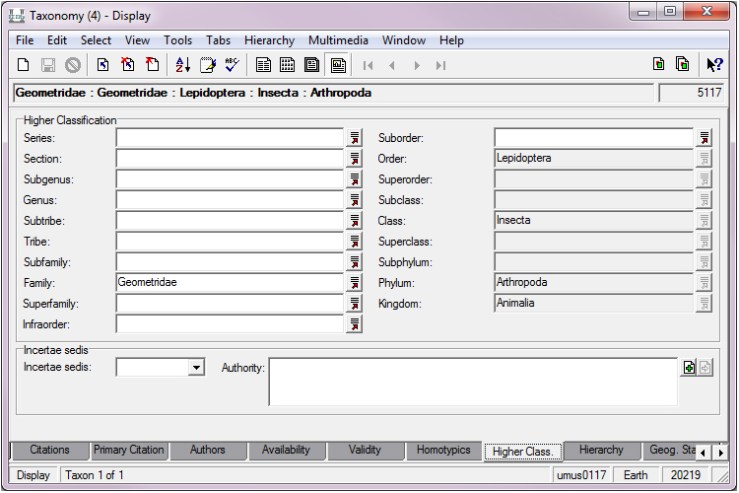
Screenshot of taxonomy fields for entomology in KE EMu CMS
Taxonomy fields in KE EMu CMS
Screenshot of part of taxonomy hierarchy in KE EMu CMS
Part of taxonomy hierarchy in KE EMu CMS

The next step will be to construct the lower levels of the hierarchy down to order level, for example Phylum Mollusca, Class Bivalvia, Order Pectinida. The resources required to determine the family for all our specimens mean that we will need to address this on a project by project basis. For now we are starting to fill in the family and order for all our Lyell material using a combination of the Paleobiology Database and the Treatise on Invertebrate Paleontology. A more specific site that has been particularly useful for Lyell is the Virtual Scientific Collection of French Tertiary Fossils. Gastropods and bivalves make up over 90% of the Lyell Collection, and by the end of the project we hope to have constructed a usable hierarchy down to family level for both these groups. This will involve close work with the Life Collections staff, as we are unlikely to find many reference works that take into account both recent and fossil specimens.

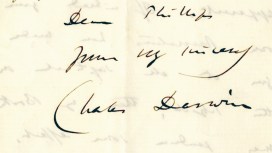
“My dear Phillips…”

Phillips_Darwin9001_signature

Today, across the world, a birthday is celebrated. It’s that of Charles Darwin, perhaps the best-known naturalist to have ever lived, and he would have been 207 years old this year. This Darwin Day, Kate Diston, Head of Archives and Library shares a very special letter from the man himself.

**

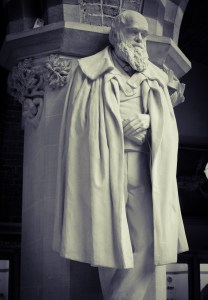
The Museum's statue of Darwin
The Museum’s statue of Darwin

In 1859 Darwin published his best-known book, On the Origin of Species, which presented his theory of evolution for the first time. While his book caused quite a stir, Darwin’s conclusions were the result of years of travel, observation and communication with other scientists in various fields.

One of those scientists was Oxford Professor of Geology, John Phillips. In 1859, Phillips was overseeing the final stages of the construction of this Museum, before taking up the position as its first Keeper.

A record of correspondence between Darwin and Phillips was recently rediscovered in the archive and highlights an interesting relationship between the two iconic men of science. Strikingly, the letter was sent less than two weeks before ‘On the Origin of Species’ was to be released.

I fear that you will be inclined to fulminate awful anathemas against it.

John Phillips
John Phillips, a few years after the book’s publication

Darwin knew that Phillips was not going to like his book. He had corresponded with him over many years about geology, recognizing that Phillips was one of the leading minds on the geological timescale. Phillps’ work had provided him with an understanding of the potential age of the Earth, and the implications this may have had on his theories. Phillips, however, would remain a man of faith.

Yours very sincerely

While Darwin knew that Phillips was not necessarily going to take his work at face value, it is clear from the letter that Darwin respected him immensely. This letter is almost a perfect snapshot of what was happening in science at that precise moment in history. Darwin’s book was about to call into question not just what was commonly understood about the natural world at the time, but also the very core of beliefs for most of society.

It is also a letter that reminds me how remarkable the collection I have the privilege to care for really is.

Kate Diston, Head of Archives and Library

Ferocious, tree-like and beautiful…

Draws in Shelford room

Katherine Child has spent a lot of time photographing the Hope Entomological collections at the Museum; you may remember her beautiful work from the Light Touch exhibition in 2014. But with somewhere between 5 and 6 million insects in the collection, there is still plenty to explore.

Since September she’s been working on a project to photograph African moths and their labels for www.africanmoths.com, which aims to provide as much information as possible for the identification and recording of moths throughout the African continent. The site already displays thousands of images of stunning specimens, some taken in their natural environment and others from collections such as the one here in Oxford.

Katherine reveals some of the challenges and delights of her work:

**

Trying to track down moth specimens is a great excuse to browse some of the beautiful moths in the Lepidoptera collections.

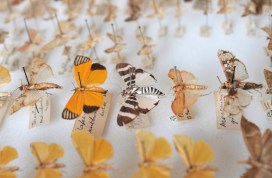
One of the best things about this project for me is probably the fact that it involves exploring the collections to find all the moths that I need to document. The cabinets in the Shelford room, where some of the Lepidoptera are kept, contain drawer after drawer of beautiful and fascinating specimens, and trying to track down a particular moth is a good excuse to browse through the hundreds that are up there.

The photos below show some of my favourite specimens from those I’ve photographed so far.  Some I like just for aesthetic reasons, others have interesting historic labels, are cleverly camouflaged or have appealing names.

Paralacydes arborifera, for instance, is named because of the pattern on its wings; arbori is Latin for tree and fera refers to a beast or creature.  It is easy to see why this moth was named “tree-beast”.

Paralacydes arborifera and its labels: one of several thousand moths which will eventually go on to the African Moths website. Arborifera translates from Latin as tree-beast or tree-creature.
Paralacydes arborifera and its labels: one of several thousand moths which will appear on the African Moths website.

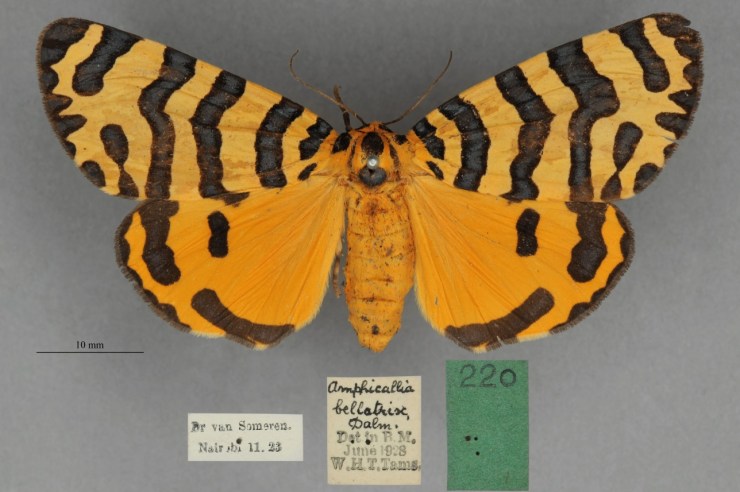
Amphicallia bellatrix was presumably given the name Bellatrix (meaning warrioress, war-like or ferocious) because of its striking warning colours.  As with the stripes on a bee or wasp, yellow and black tends to mean danger in the natural world.

Amphicallia bellatrix displaying the striking warning colours which give it the name bellatrix meaning warlike, ferocious or warrioress.
Eutomis minceus, found in South Africa, displaying beautiful iridescence.

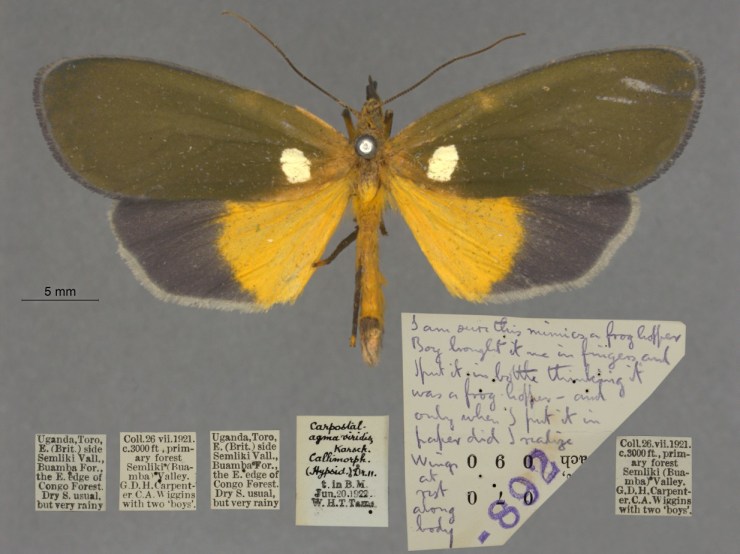
It is always interesting to see a little more information about how the specimens were found or caught. The description on the label below records how the moth was initially mistaken for a froghopper when caught by ‘boy’, and was only later identified to be a moth.

Photo of Carpostalagma viridis and its labels. The large label second from right reads: ‘I am sure this mimics a frog hopper. Boy brought it me in fingers and I put it in bottle thinking it was a frog hopper – and only when I put it in paper did I realise. Wings at rest along body.’

I look forward to photographing many more moths over the months to come!

Katherine Child, Image Technician, Life Collections