Making Microsculpture

Microsculpture

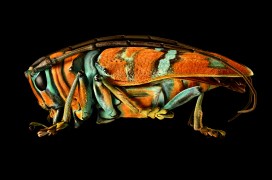
Today we are excited to be opening our new special exhibition, Microsculpture: The Insect Photography of Levon Biss. You may well have already heard about Microsculpture, and have perhaps watched the video showing how Levon Biss made these incredible portraits of insects from the Museum’s collection.

As we open the show in the Museum’s main court we wanted to give a little more insight into the process that Dr James Hogan, an entomologist in our Life Collections, went through to select and describe the specimens for the project. So I put a few questions to James to explain the making of Microsculpture from his point of view.
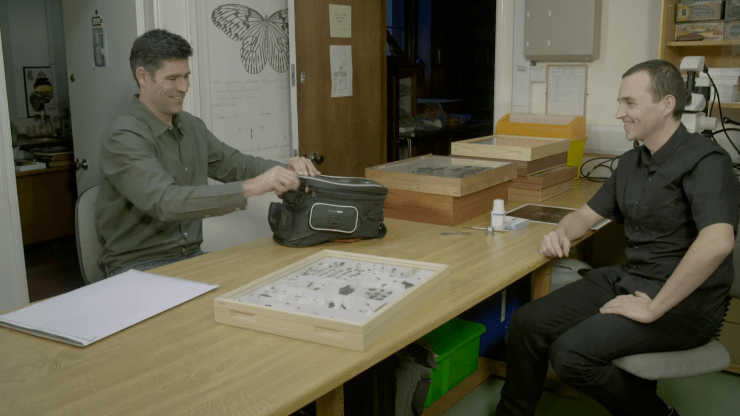
James Hogan (right) selecting specimens with Levon Biss

There are 23 specimens on show in the exhibition: how did you choose these particular ones?
We wanted a wide variety of specimens that would all show some interesting surface detail. Some were also chosen for their spectacular colours, interesting shapes or strange appearance.
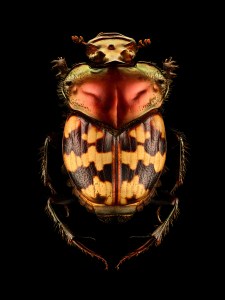
Splendid-necked Dung Beetle (Helictopleurus splendidicollis). From Madagascar. Length: 10 mm
Splendid-necked Dung Beetle (Helictopleurus splendidicollis) from
Madagascar. Length: 10 mm

But perhaps 95 per cent of the specimens we initially considered were rejected because we had some pretty strict criteria; very hairy specimens, which includes most bees, were out as the image processing was too difficult; the specimens had to be intact, so no broken antennae or legs.

Probably the biggest problem was finding specimens which were clean enough. Because Levon’s technique reveals so much detail, any dirt on the specimen is glaringly obvious. And the whole idea was to look at the surface structures, which are obviously very small and easily obscured by any dirt.

How did you prepare them for their close-ups?
All the specimens needed a bit of preparation work before being ready for Levon’s photography. First they needed to be remounted on the end of long pins to allow more clearance space for the lighting setup. Some of the specimens are very small and fragile and this is the stage where damage is most likely to occur.

After remounting, all the insects needed at least some degree of cleaning under the microscope. For this I used a range of fine paintbrushes; we also make our own tools from micro-pins bent into different points and hooks. Again, I had to be careful to not damage the specimens – easily done by over-enthusiastic cleaning!

Where do the specimens come from?
The specimens in the exhibition are from the Museum’s very large insect collection, stored behind the scenes in many different rooms. The insects in the show are from all over the world, from a back garden in England to a remote island near Antarctica. Some were collected over 150 years ago while others were collected very recently by Museum staff.

Of particular historical significance is the Tricolored Jewel Beetle (Belionota sumptuosa) which was collected by the Victorian naturalist and explorer Alfred Russel Wallace, co-publisher of the theory of evolution with Charles Darwin in 1858.

Tricolored Jewel Beetle (Belionota sumptuosa), collected by Alfred Russel Wallace in Seram Island, Indonesia. Length: 25 mm
Tricolored Jewel Beetle (Belionota sumptuosa), collected by Alfred Russel Wallace in Seram Island, Indonesia. Length: 25 mm

How big are the actual specimens in comparison with the photos?
The actual specimens are mostly pretty small, ranging from 6 mm to about 30 mm. Some of the larger printed photographs will be about a thousand times larger than the specimen!

Orchid Cuckoo Bee (Exaerete frontalis) from Brazil. Length: 26 mm
Orchid Cuckoo Bee (Exaerete frontalis) from Brazil. Length: 26 mm

What do you hope people will get out of the pictures in the exhibition?
To me insects are beautiful creatures and Levon has done an outstanding job of revealing this. I hope the photographs will spark people’s interest in insects and inspire more people to study them.

The photographs certainly pose some interesting questions, and reveal that there is so much we don’t know, particularly about the functions of all their strange and varied adaptations.

Is it valuable to showcase specimens from the collections in this way?
One of the most exciting parts of this exhibition for me was the opportunity to show part of the Museum’s collection which visitors don’t normally see.

The collection is used all the time by scientists, artists and educators, but unfortunately most of it is unsuitable for display because the specimens are so small. Levon’s ultra-high resolution photography has in a way solved this problem, allowing us to showcase some of these spectacular, but tiny and fragile creatures in all their beauty.
Looking up

Blue sky

There can be many reasons for a museum’s decision to install a temporary exhibition, but the most powerful is that its visitors have asked for it. While working in the Museum’s shop, Magdalena Molina is often quizzed about the building’s iconic roof, which can be admired as they browse. “What’s it made from? Who designed it? How does it get cleaned?” The most popular question of all is, “Where can I find out more?”.

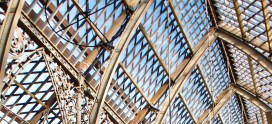
A detail from the roof's rafters
A detail from the roof’s rafters. Credit: Mike Peckett.

Magdalena is an experienced designer, who has worked on various exhibitions, so she approached the Museum with her ideas for a creative, artistic display all about the roof. An exhibition to satisfy the interests of curious visitors.

As a designer I feel inspired by the exquisite design and architecture of the roof of the Museum. Assisting in the shop, I have received a lot of comments from visitors who are fascinated by the building.

Visitor exploring the exhibition

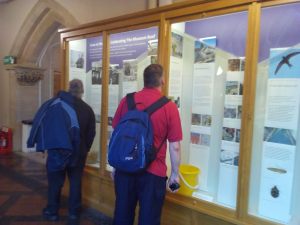
The exhibition, Lives at the Top: celebrating the museum roof, has just opened. It allows visitors to discover the people behind its creation, secrets of its beautiful design and find out how it has been maintained for generations to come.

It begins with the origins of the Museum building, with an architectural competition won by Woodward and Deane, soon followed by the architect’s tragic early death.

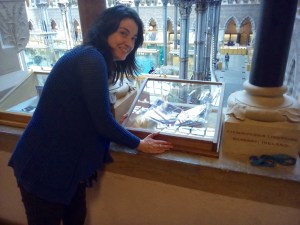
Magdalena with one of the Curiosity Boxes

The story continues with the 2013 roof renovation project and moves on to current museum concerns such as pests living up in the rafters. There are also 6 ‘Curiosity Boxes’ to explore, which use mirrors and magnifiers to look at the roof in a new, imaginative way.

Magdalena hopes that visitors will:

Follow the story which celebrates the people involved in the life of this astonishing roof,  and playfully engage with the interactive designed boxes to help them explore different perspectives of the roof.

Magdalena is encouraging visitors to join the celebration of beautiful roofs, ceilings and architectural details, by sharing their photos with us… and the world! Inspired by the Lives at the Top exhibition, we’ve put together a special board on the Museum’s Pinterest account. If you would like to appear on the board, simply share your photo on Twitter or Instagram and tag with #lookingupMNH.

Lives at the Top is open until 13th November 2016.

A scene from the 2013 renovation. Credit: Mike Peckett

Congratulations Team Dodo!

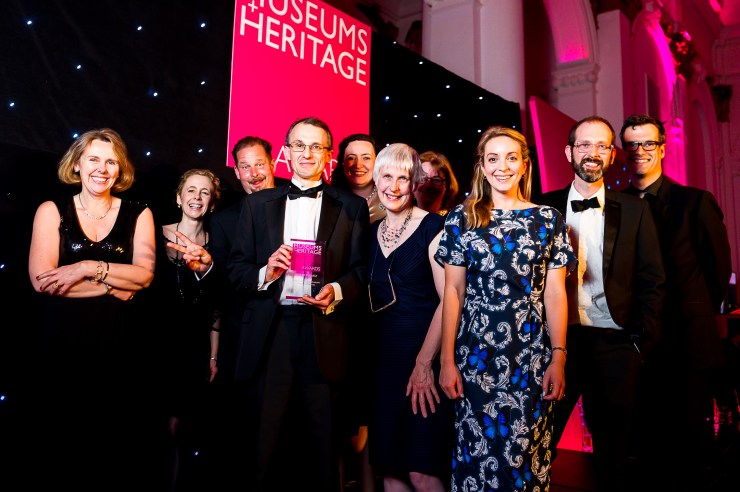
Museum-Heritage-Awards-Northumberland-Ave_SimonCallaghanPhotography227

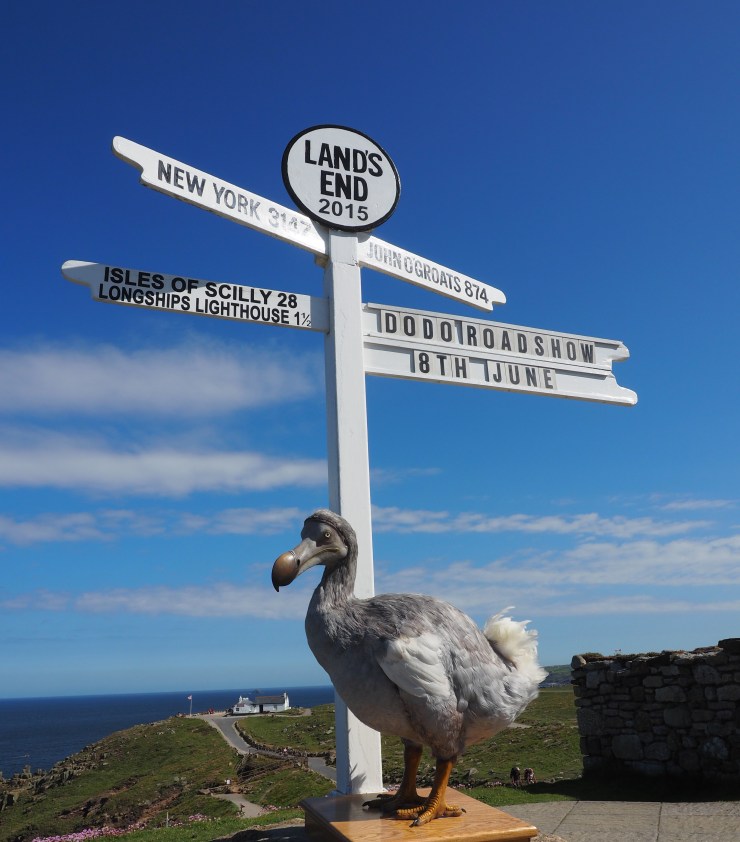
A year ago we came up with a crazy idea. We would take our famous Dodo out on the road, from Land’s End to John O’Groats, calling in at 24 different museums and galleries along the way… and we would get all this up and running just 3 weeks after the initial spark of inspiration. We called it the Dodo Roadshow and an incredible journey across the country began.

The Dodo's journey begins...
The Dodo’s adventure begins…

Last night, team Dodo Roadshow was given a hearty pat on the back at the Museums + Heritage Awards for Excellence 2016, walking away with not one, but two awards! We were delighted to be awarded the prize for ‘Project on a Limited Budget’, but there was an extra surprise at the end of the night when the Museum scooped up the top accolade ‘Best of the Best’!

On awarding the accolade for the Project on a Limited Budget, comedian Marcus Brigstocke described the Roadshow as:

A clever, fun and engaging idea, completed in a very short period of time, which celebrated new conversations and partnerships across the country.

Marcus Brigstocke awards the prize for 'Project on a Limited Budget'.
Marcus Brigstocke awards the prize for ‘Project on a Limited Budget’.

If you missed the adventures last summer, why not explore all of the places, people and museum objects that the Dodo visited along the way.

The museums are migrating!

Night falls in the Museum

by Hannah Allum, Project Assistant

The film ‘Night at the Museum‘ is not as far from the truth as you might think. Museum specimens may not come back to life at night, but they are moving all the time. Whether we’re putting on a new display, loaning a specimen to another museum or using them for teaching sessions, our collections are very active, despite being long dead.

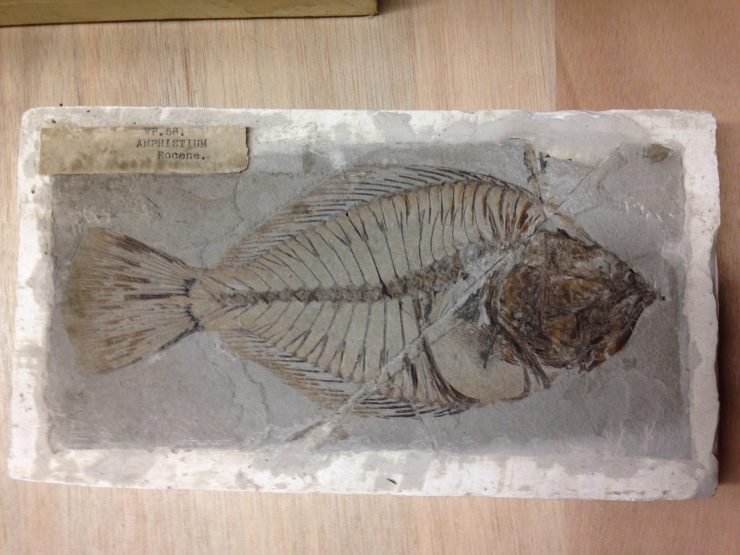
Amphistium fossil fish; an early relative of the flatfish and part of the Earth collection

The Oxford University museum collections are about to begin a huge migration as they move from various off-site stores to a new facility. Generally, museum stores are not open to the public and often house important reference and research specimens, which make up a huge proportion of natural history collections. These valuable stored collections require specific environmental conditions to make sure that they last for generations to come. Taxidermy and articulated skeletons make for eye-catching displays, but tend to be a relatively small part of the collection. In fact, having just 1% of your natural history specimens on public display is the norm.

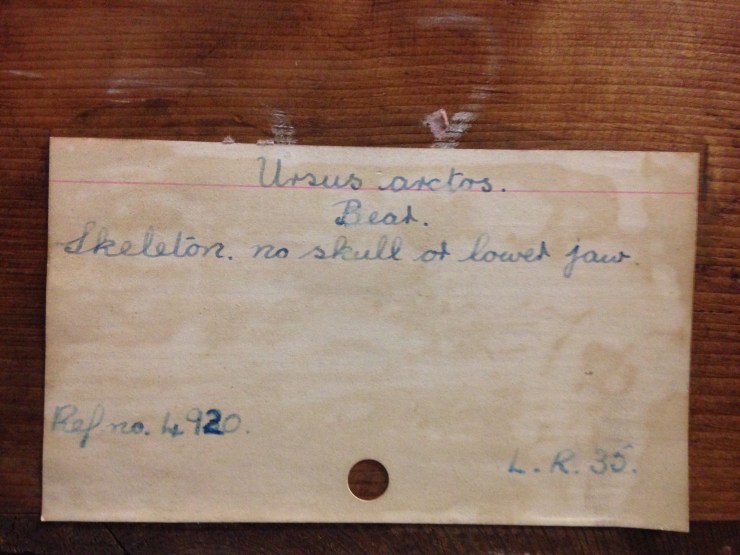
Lured in by Life Collection labels; this headless brown bear will soon have a new home.

As well as improving the storage conditions and ease of access for staff and researchers, this will also be the first time that the Oxford University museums have shared a storage space. It will be a challenging but rewarding project to re-home such a huge variety of artefacts and specimens that have come from all over the world; each with their own unique story.

Hannah profileAs the new Project Assistant working for the Museum of Natural History, I am the lucky person who gets to discover some of these stories. I will be working with specimens from both Earth and Life collections, as well as some material from the Library and Archives. The first stage will be making a detailed list of everything that needs to be moved, then I can go on to prepare the new store and get the supplies I’ll need to document, pack and transport everything safely.
Some enticing titles from the Library

As you can see, I have already come across some fascinating specimens and look forward to getting stuck in to this project.

There will be blog posts throughout the year to update you on our progress and to reveal some exciting stories from the stores.

You can also follow the hashtag #storiesfromthestores on the Museum’s Twitter feed: @morethanadodo

Getting the picture

Photographing museum specimens is an important part of the documentation process. It creates a record of the condition of the object at a particular point in time, and may reduce the need for long descriptions of the specimen and associated material  such as labels. Making pictures available online also provides an exciting new window into the behind-the-scenes collections. There’s recently  been a big drive in the museums sector towards mass digitisation, and our museum is moving towards that model. The important thing for us is to balance speed with  the need to produce photographs that are both useful and appealing to our audiences.

PhotoBlogBridge.JPG
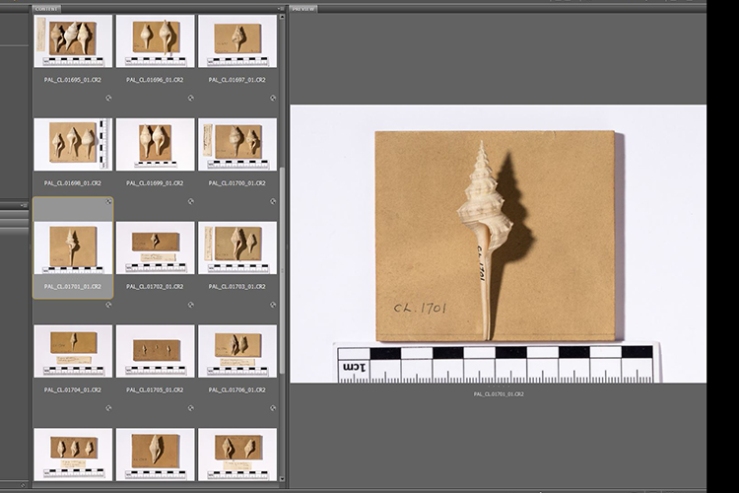
Digitised images in AdobeBridge

I’ve taken many different types of photos over the course of the Lyell Project, trying out different ways of creating the best image to illustrate a blog post, record an entire drawer or capture different types of handwriting. It’s been a useful but time-consuming process. We are now moving on to the mass digitisation part of the project, and I’ve spent  much of the past few weeks experimenting with various ways of doing this.  My aim is to get the entire process of photography, from getting out the specimens to uploading the images, to work more smoothly, making everything faster and more efficient.

The equipment I’m using was already in the museum, purchased during various projects and using different funding sources:

  • Camera: Canon EOS 6D (the specification is probably overkill for these photos)
  • Lens: EF 100mm f/2.8L Macro IS USM
  • Copy stand: Kaiser RS1 copy stand
  • Lights: Kaiser RB30 lights
  • Scale bar
  • Basic laptop
  • Software: DSLR Remote Pro (remote capture application for camera)
  • Cable with USB type A plug to mini-B plug to connect the camera to the laptop
  • Paint brush to dust specimen and clean background
  • White paper for background
  • Stiff white card reflector to reduce shadows
PhotoBlog_20160401_160715
The photography set up

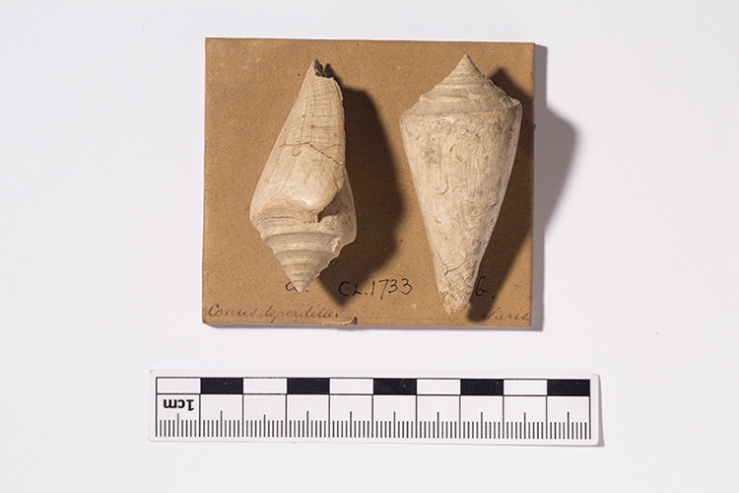
For rapid photography, the big advantage of the Lyell Collection is that around 95% of the specimens are attached to wooden or cardboard tablets, many of which are the same width. We want to capture images of the entire tablet as that provides useful information about the specimen, including the object number, locality, genus and species. As the specimens are already fixed to the tablets, there was no need to go through the time-consuming and fiddly process of orientating every specimen in the same way and keeping it in position using props. The only decision was which way up to photograph the tablet. As you can see from the photos below, there is very little consistency to the orientation of the fossils on the tablets, so we decided to go with standard paleontological orientations e.g. apex up for gastropods or, where there was a mixture of ways up, to go with the orientation of  handwriting.

PhotoBlogIMG_0023
The right way up
PhotoBlog_IMG_0027
Which way should this go?

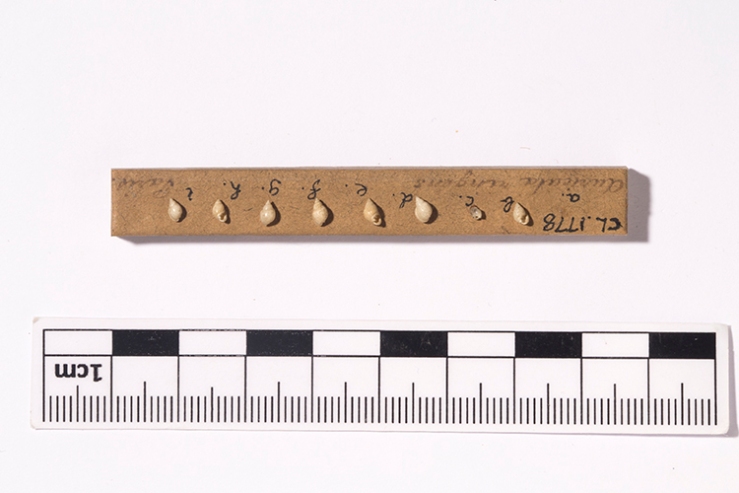
I was surprised how quickly I could take photos of the specimens when I left the camera at a fixed height above the specimens and used autofocus, instead of adjusting the working distance and manually focusing for every specimen. Only the very smallest shells (less than 1cm) looked a bit flat, and there was still enough of the shape recorded to be useful.

PhotoBlog_IMG_0033
Very small shells

I’ve done three drawers about 250 specimens so far and I’ve got down to approximately 2 minutes per specimen. This includes the whole process from getting drawers out of the cabinets, photographing all the specimens, manually renaming the images with the specimen number, doing basic image adjustments to the RAW files, saving as archival tiffs (5472 x 3648 pixels), and jpegs (1000 x 667 pixels) for online use, editing metadata, and uploading to our collections management system and digital archives.  Other demands of the project mean that I won’t be doing this full time, but I’ll probably be be doing a day or two of photography per week for the rest of the project.

This process will slow down considerably as we get to less uniform drawers of specimens and specimens that aren’t on tablets, but it is really useful to know how much we can do with limited equipment. In the future we may look at automating some of these processes. We’ve just been joined by a Museum Studies student who’ll be on placement with us for the next eight weeks. She’ll be working on all aspects of the Lyell project including photography, and simplifying the photography procedure in this way should make the training much easier and allow her to achieve much more in a short period of time.