Our next exhibition – Brain Diaries: Modern Neuroscience in Action – opens on 10 March and in preparation we have indulged in a little bit of brain-washing… This article contains an image of a preserved human brain.
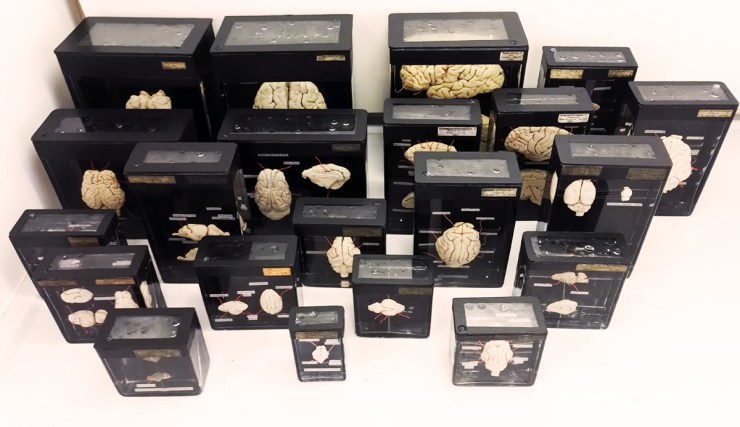
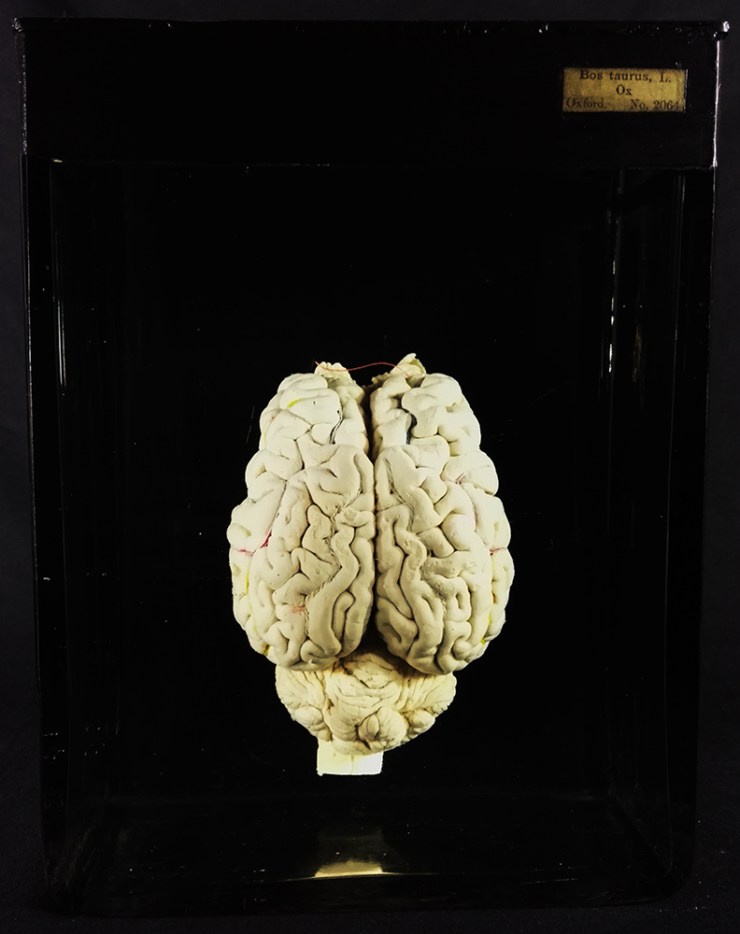
One of the first displays visitors will encounter is a ‘wall’ of 23 fluid-preserved mammal brains – from a Short-nosed Bandicoot to cow. The style of jar, with its black bitumen and paint backing, tells us that these were once used for display so it is exciting to put them in the public galleries again. Museum conservator, Jacqueline Chapman-Gray, runs us through the meticulous process she undertook to ensure these brains will look their best for their return to the limelight.
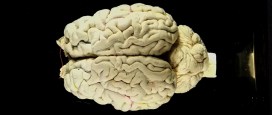
Cow brain before conservation treatmentA number of the brains had become dehydrated over time as the level of fluid – alcohol – had dropped. These needed to go through a rehydration programme to ensure their long-term preservation. This is more complex than simply adding more fluid to the jar. Instead the alcohol level needs to be increased gradually to avoid damaging the tissues.
Brains soaking in alcoholOthers had started to detach from their glass mounts, or anatomy labels that marked each of the different areas or sections of the brain had come loose. These were carefully remounted using specialist conservation-grade materials and a steady hand! Three brains had become completely detached and were repaired using a polyester monofilament thread, otherwise known as fishing line.
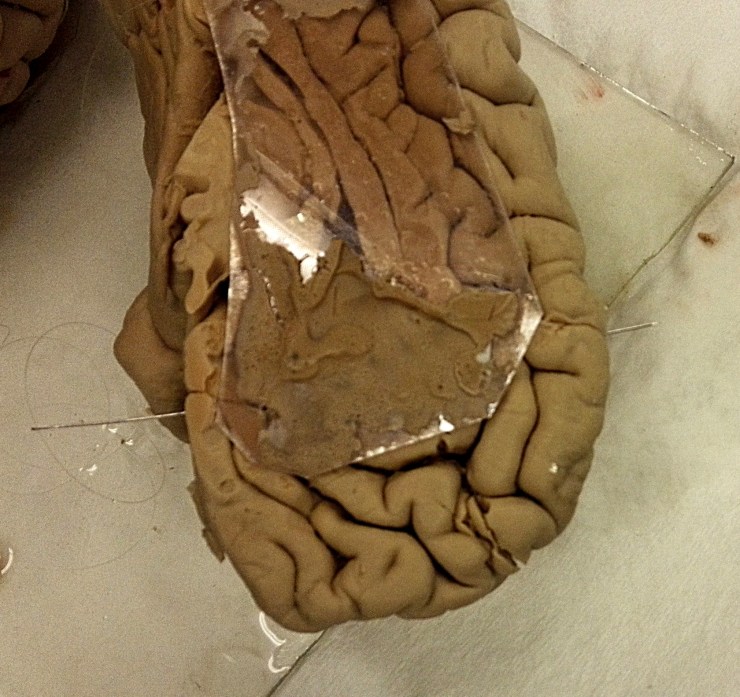
Repairing a human brain with a beading needle Labels found detached at the bottom of the jarFor the smallest of the brains a normal sewing needle was enough to pass through the tissues but for the larger two either a flexible 10cm beading needle or large 25cm mattress needle was needed. The original threading points were reused wherever possible though in one case this proved to be too difficult, as the tissue was soft and susceptible to breaking. With precision and patience I was able to gently stitch them back into place on the backing plate so they look as good as new.
All of the jars were given a thorough clean to ensure that seals were tight fitting and that the contents were shown off to their best. They were then filled with fluid to 4/5ths from the rim and the brains gently placed back inside.
Lids were sealed with clear silicone and each jar was topped up with a syringe through a small hole in the lid that is there for this very purpose – once full, this hole is also sealed.
Lastly, after the seals had dried, for the final finishing flourish black paint was reapplied to the backs and tops of the jars to provide a contrasting backdrop.
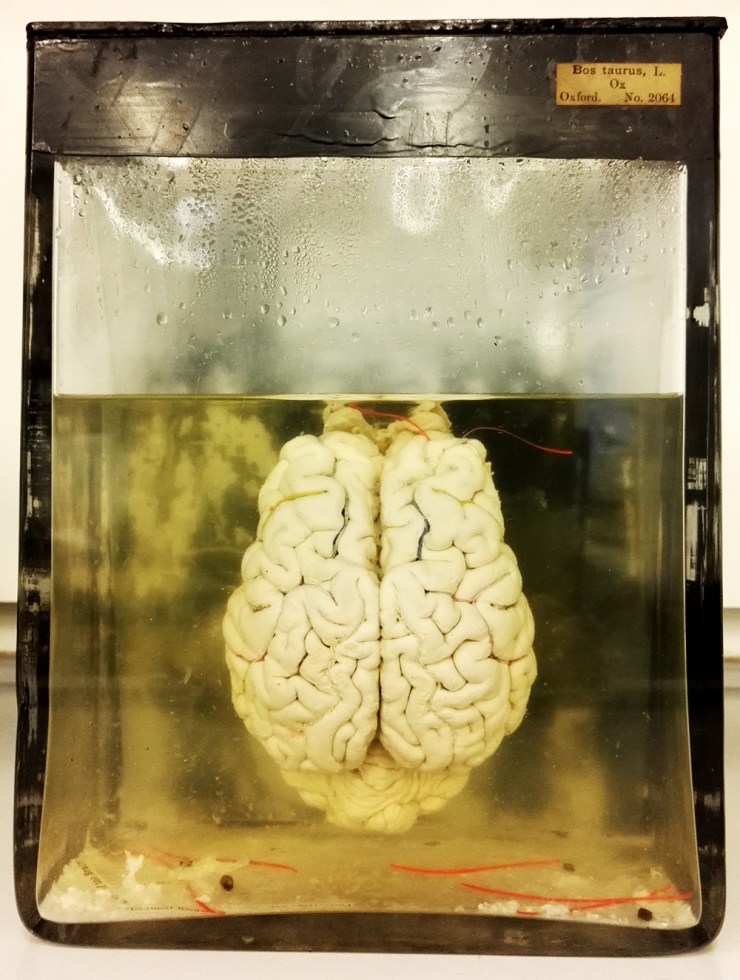
Ta-dah… the cow brain after conservation treatmentBrain Diaries opens on Friday 10 March and runs until Monday 1 January 2018. Take a look at the website to find out more about the exhibition and accompanying programme of events at braindiaries.org
Charles Lyell’s amazing collection of fossils in the OUMNH got me thinking about why he (and others) collected these fossils. Was it for a purely academic purpose or was there something else? In fact, why does anyone collect fossils? Why do you? There are countless reasons that people collect fossils: for research, for fun, because they’re there, for art and crafts (to name a few), but I think the reason at the heart of any collection is for the love of fossils.
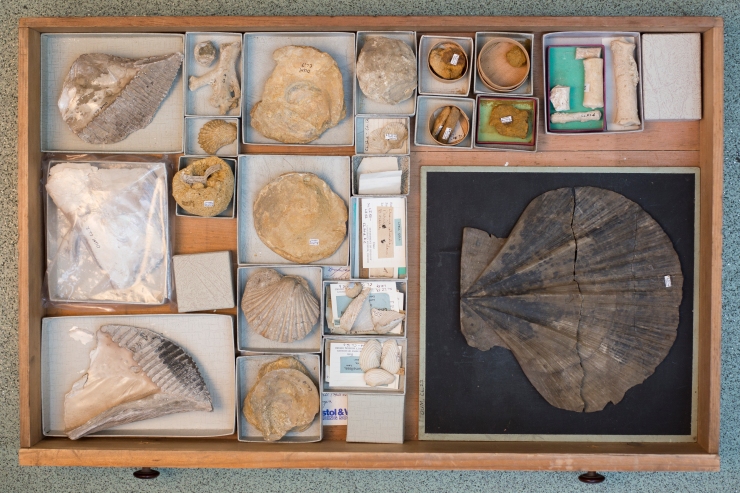
Former Project Officer Sarah Joomun’s favourite drawer. Her reason: “When I first started this is what it looked like and it was the first drawer in the collection. It seems to contain the odds and ends of the Lyell Collection, things that didn’t seem to fit anywhere else. When I used the drawer in a tour for a group of alumni from the Earth Science Department, the enormous broken Pecten shell inspired one of the alumni, a man who was long past his student days, to re-enact his impression of a Pecten swimming from his student days, complete with whooshing backwards and flapping hands. It was very intentionally hilarious“
The Charles Lyell Collection is made up of mainly molluscs (bivalves, gastropods, scaphopods). However it does contain some vertebrate material such as sharks teeth and a partial rhinoceros jaw, as well as giant foraminifera (single-celled planktonic animals with a chalky shell). The collection is from a variety of different localities in Europe and North America. The majority of specimens come from North America, with France a close second.
One of my favourite gastropods. I found this by accident when looking for interesting specimens, I fell in love with it as it is so pretty and spiky.
The molluscs in the collection are often systematically presented on wooden tablets indicating that he collected the fossils for research. However it does raise more questions. Why? What did he use the tablets for? Was it for ease of research or were they being displayed somehow? Why are they in different orientations? Was it to see all the parts or was it how they attached best? What features were highlighted? Were any ignored?
One of the interesting tablets from the collection, also one of Sarah Joomun’s favourites
I think that Charles Lyell was using them as a way to categorise the specimens he had either found in the field or that were given to him by other collectors. I also think the different orientations were to show the features of the specimens he collected, but some are in fairly random orientations. Pencil markings on the tablet reverse give information about where the specimen was collected and, on some, who actually collected it. They also give an identification. Sometimes there are multiple identifications with some given by other people (see Sowerby), and it also can say when Charles and friends think it’s a new species.
One of Earth Collection Manager Eliza Howlett’s favourite specimens because “xenophorids are really cool and I like the fact it has been ambitious enough to cement a whole bivalve to its shell“
This still leaves many questions unanswered, and I am afraid without talking to the man himself we may never find our answers.
I just hope whatever the reason you have for collecting, displaying and researching at first the underlying reason is simply for the love of fossils. I mean Charles Lyell himself even left his law career to pursue his childhood passion of geology.
I am really interested to know what you think: email me at lily.wilks@oum.ox.ac.uk
For the past nine months there has been a lot of moving going on around here. Imagine moving house endlessly for weeks on end, but where your house is full of bones, insects, fossils, rocks, and weird and wonderful taxidermy. And the location of everything has to be precisely recorded. The museum move project was a bit like that.
Project assistant Hannah Allum explains…
The museums are migrating, we declared in May 2016. And so they have. The first major stage of the stores project has been completed. After we had created inventories for the largely unknown collections held in two offsite stores, the next stage was to pack them safely and transport them to a new home nearer the museum, a job which demanded almost 70 individual van trips! We now have over 15,000 specimens sitting in vastly improved storage conditions in a new facility.
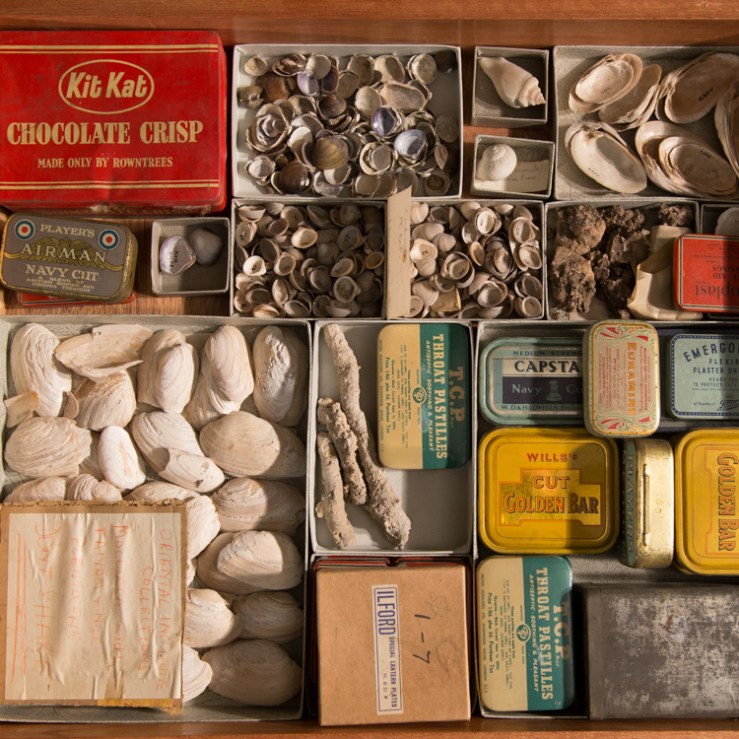
A miscellany of boxes for a collection of shells
Let’s revel in some numbers. All in all there were over 1,000 boxes of archive material, mostly reprints of earth sciences and entomological research papers; over 1,300 specimens of mammal osteology (bones); and more than 1,000 boxes and 650 drawers of petrological and palaeontological material (rocks and fossils).
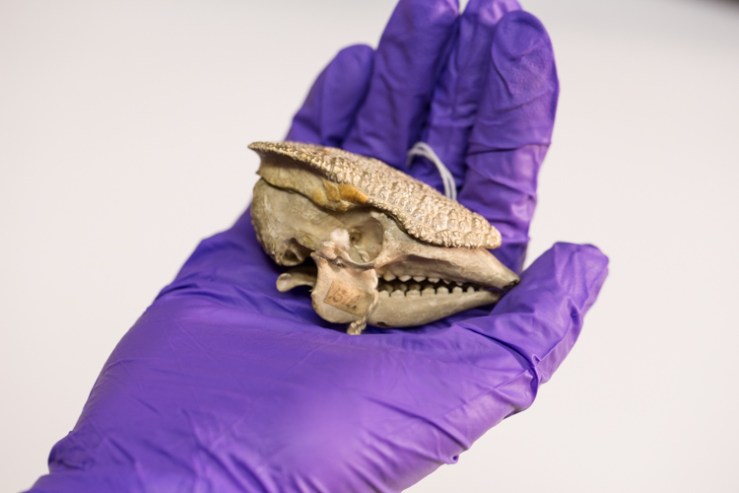
Some of the more memorable specimens include old tobacco tins and chocolate boxes filled with fossils and shells; a beautifully illustrated copy of the ‘Report on the Deep-Sea Keratosa’ from the HMS Challenger by German naturalist Ernst Haeckel; and the skull of a Brazilian Three-banded Armadillo (Tolypeutes tricinctus), complete with armour-plated scute carapace.
The skull and carapace of a Brazilian Three-banded Armadillo (Tolypeutes tricinctus)
There were also a few objects that have moved on to more unusual homes. A 4.5 m long cast of Attenborosaurus conybeari (yep, named after Sir David) was too large to fit in our new store and so made its way to another facility along with a cornucopia of old museum furniture. A set of dinosaur footprint casts, identical to those on the Museum’s lawn, have been gifted to the Botanical Gardens for use at the Harcourt Arboretum in Oxford.
And last but not least, a model of a Utahraptor received a whopping 200 applications from prospective owners in our bid to find it a suitable home. After a difficult shortlisting process it was offered to the John Radcliffe Children’s Hospital and following a quarantine period should soon be on display in their West Wing.
Casts of footprints by made Megalosaurus, queuing for a lift to Harcourt Arboretum. Image: Hannah Allum
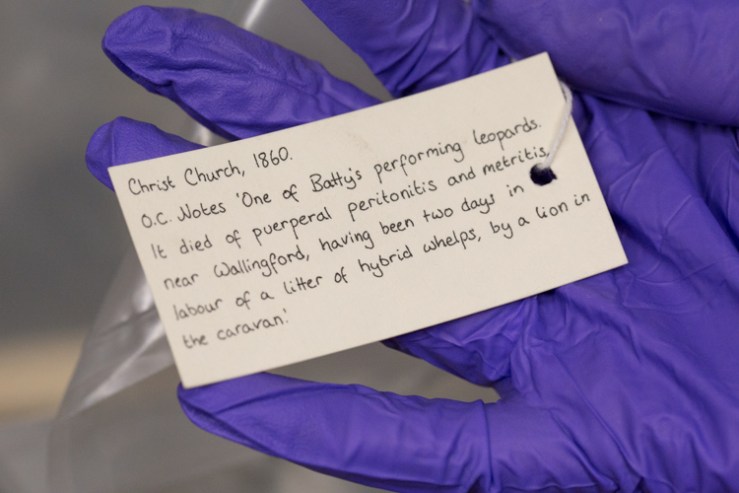
Fittingly, the final specimen I placed on the shelf in the new store was the very same one that had been part of my interview for this job: The skeleton of a female leopard with a sad story. It apparently belonged to William Batty’s circus and died of birthing complications whilst in labour to a litter of lion-leopard hybrids before ending up in the Museum’s collections in 1860.
The sad story of a performing leopard
Though the moving part of this project is now complete there is still plenty of work to do. We are now updating and improving a lot of the documentation held in our databases, and conservation work is ongoing. The new store will also become a shared space – the first joint collections store for the University Museums, complete by April 2018.
The Utahraptor model in the old store awaiting collection by its new owners.
Illustrated plate from the Report on the Deep-Sea Keratosa from the HMS Challenger by Ernst Haeckel
The title page of the Report on the Deep-Sea Keratosa from the HMS Challenger by Ernst Haeckel
On the van, off the van; on the van…
Boxes of Earth collections material stored safely and in sequence in the new store
Boxes, glorious boxes…
Rack ‘n’ Roll: Hannah deftly working the racking
Lily Wilks, an intern assisting with the inventory of bound reprints. Image: Hannah Allum
Hannah Allum working in the old store. Image: Edward Adcock
Life Collections Manager Mark Carnall and Project Assistant Hannah Allum carrying one of the final specimens, a Mirounga leonina (Southern elephant seal) skeleton, into the new store. Image: Edward Adcock
The Attenborosaurus fossil cast, in its unusually shaped case, en route to a new custom built support frame. Image: Hannah Allum
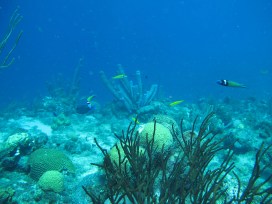
Under the sea, Curaçao, Caribbean. Image: Sancia van der Meij
By Sancia van der Meij, Research Fellow
Biologists often refer to the word “species” when they are talking about the animals or plants that they study, but just what exactly is a species? Defining ‘species’ is actually quite tricky…
A basic definition is based on the work of a German biologist called Ernst Mayr, whose simplified description is “a group of interbreeding populations that are reproductively isolated from other groups”. This is a great starting point, but it is difficult to use when studying animals in the field. Biologists therefore use breeding experiments in laboratories and, increasingly, genetics to help determine what a species is.
How and under which circumstances new species evolve remains an important topic in biology. Quite a lot is known about geographical barriers causing the formation of new and distinct species through evolution – a process known as speciation. Mountains, rivers and ocean currents, for example, can divide populations of single species and in the long run – thousands or millions of years – this isolation can cause different populations to evolve in separate, new species.
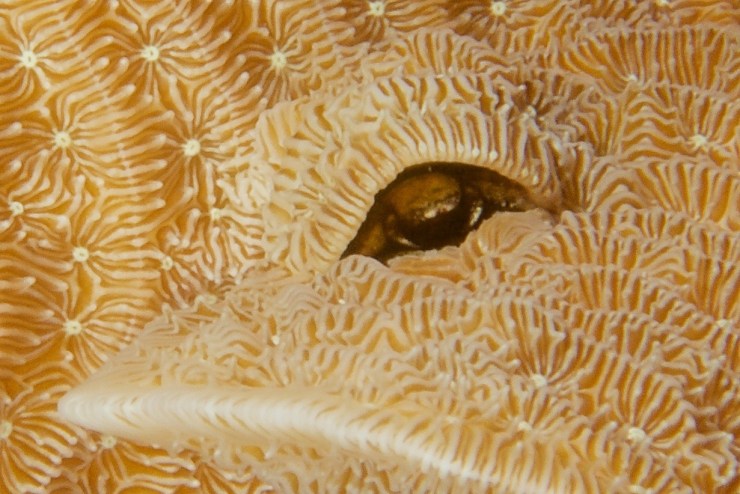
Gall Crab inhabiting a small tunnel in an Agaricia coral. Image: G van Moorsel
But a more difficult concept in speciation is how species can evolve in the same geographical area. Together with a colleague, I studied the genetic composition of Opecarcinus hypostegus, a tiny crab species, around 5 mm in size, that only occurs in the Atlantic Ocean. These Gall Crabs are adapted to living in stony corals and often show a clear preference for inhabiting closely related coral species.
Overhang in a Agaricia coral where a gall crab dwells. Image: Sancia van der Meij
We studied over 200 specimens from five different coral species, all collected from the Caribbean island of Curaçao. The results showed that O. hypostegus should be considered a single, valid species. But to our surprise, when we zoomed into the details of the genetic composition of the crab, we noticed small differences in the DNA of the crabs inhabiting the various coral species. With statistical tests we could prove that the variation in DNA was significantly different between the crabs inhabiting these five different Agaricia corals.
Gall crab dwelling in Agaricia coral. Image: Sancia van der Meij
Despite the fact that all the crabs live around the same small Caribbean island, it does appear that we see the very first signs of future speciation in the crab’s DNA. Unfortunately we will not be around to witness the new species as it will likely take several hundreds of thousands of years before the making of these new crab species has neared completion. But how exciting to witness its new beginnings?












 More Than A Dodo