Diving into deep time

Our current First Animals exhibition is extending its run until 1 September, and to mark the extension our Research Fellow Imran Rahman takes a look at how animal life in the ancient oceans was brought to life in our Cambrian Diver interactive installation.

One of the biggest challenges in developing the First Animals exhibition lay in visualising rare fossil specimens as ‘living’ organisms, transforming them from two-dimensional imprints in the rock into three-dimensional animated computer models.

Many of the specimens on display in First Animals were collected from sites of exceptionally well-preserved fossils called Lagerstätten. These deposits preserve the remains of soft-bodied organisms that are almost never seen in the fossil record; things such as comb jellies and worms, as well as soft tissues such as eyes, gills and muscles. Even so, most of these fossils are flattened and two-dimensional, which makes it very difficult to reconstruct what they looked like in life.

Vetulicola cuneata from the Chengjiang fossil site had a large body with triangular openings on either side and a segmented tail. Its three-dimensional shape is uncertain.

To help exhibition visitors visualise the animals in a living environment we worked closely with Martin Lisec and his team at Mighty Fossils to create a set of detailed computer models of a key set of animals. We have worked with Martin before on the video of a Jurassic sea inhabited by plesiosaurs and other marine animals for our Out of the Deep display. That was very successful, but our idea for First Animals was even more ambitious: to create a unique interactive installation called the Cambrian Diver.

The material focused on the Chengjiang animals from the Cambrian of Yunnan province, China, which provides the most complete record of an early Cambrian marine community, from approximately 518 million years ago. Using fossil evidence of the organisms thought to have lived at the time we selected 12 species that were representative of the diversity of the Chengjiang biota.

The first phase was collecting as many materials as possible to be able to create 3D models. As usual, we started with rough models, where we set basic dimensions, shapes and proportions of body parts. Once approved, we moved to very detailed models for the animations, artworks and textures for less detailed models to be used within the interactive application. – Martin Lisec, Mighty Fossils

Images showing a preliminary 3-D model of the lobopodian Onychodictyon ferox in multiple views, with annotations in yellow highlighting changes suggested by Museum researchers.

To provide two-dimensional templates for Mighty Fossils to work from we scoured the scientific literature for the most recent accurate reconstructions available for each of the species.

The predatory arthropod Amplectobelua symbrachiata is a good example. We drew heavily upon a 2017 paper by Dr Peiyun Cong and colleagues, which included a very detailed reconstruction of the head region. This reconstruction shows that the underside of the head of Amplectobelua consisted of a rod-shaped plate, a mouth made up of two rows of plates, and three pairs of flaps with spiny appendages, all details that are included in our 3D model.
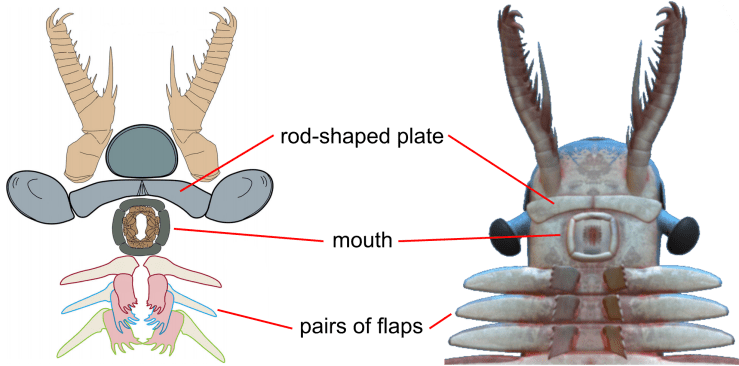
Scientific reconstruction (left) and our 3D model (right) of the arthropod Amplectobelua symbrachiata. Left-hand image modified from Cong et al. (2017).

Colour and texture were another consideration. To inform these we looked at living species that are thought to have similar modes of life today. For Amplectobelua, a free-swimming predator, we examined the colouration of modern marine predators such as sharks. Many sharks have countershading, with a darker upper side of the body and a lighter underside, which acts as camouflage, hiding them from potential prey.

We reconstructed our Amplectobelua model with similar countershading camouflage, with blue and red colouration inspired by the peacock mantis shrimp, a brightly coloured predatory arthropod that lives in the Indian and Pacific oceans.

3-D model of Amplectobelua in angled upper (top) and lower (bottom) views, showing countershading.

The next vital step was establishing how the animals moved and interacted with one another. This is a major challenge because in many cases there are no modern equivalents for these extinct early animals. For Amplectobelua we inferred that the flaps on the sides of the body were used for swimming, with the tail fan helping to stabilize the animal as it moved through the water. This agrees with previous interpretations of swimming in closely related animals such as Anomalocaris.

The models were built and textured by Mighty Fossils using the 3D gaming engine Unity. The video below is an accelerated sequence showing how the elements of the model are layered together.

The finished, animated and annotated Amplectobelua model is shown below, and can be zoomed and rotated. All the models generated by Mighty Fossils for the First Animals exhibition are gathered in a collection on our Sketchfab page.

Once animated models of all 12 species were created we placed them in a realistic marine environment. Study of the rocks preserving the Chengjiang fossils suggests these animals lived in a relatively shallow, well-lit sea, perhaps 50 metres deep and characterised by a flat, muddy seafloor. A continuous shower of organic particles is thought to have filled the water column, as in modern oceans.

Reconstruction of the Cambrian seafloor with ‘marine snow’

Based on present-day marine ecosystems, we infer that the number of immobile suspension feeders would have been much greater than the number of predators. As a result, we included multiple individuals of the suspension feeders Cotyledion, Saetaspongia and Xianguangia, which were tightly grouped together, but only a small number of the active predators Amplectobelua and Onychodictyon.

This scene is now populated with animals, including two predators: Amplectobelua (swimming) and Onychodictyon (centre)

The final step involved setting up a camera and user interface to allow visitors to discover the various animals in our interactive environment. For this we worked with creative digital consultancy Fish in a Bottle to identify eight locations, each focused on a different animal.

As the video above shows, users can navigate between locations by touching an icon on the screen, and when the Cambrian Diver sub arrives at a location information about the animal, its mode of life and its closest living relatives is presented on-screen. A physical joystick allows users a 360-degree rotation to look around the scene, and explore the ancient watery world.

This project was significantly bigger than the Out of the Deep work we had done previously with the Museum, mainly because of the complicated approval procedure needed for 20 individual 3D models. Along with three large illustrations, two animations and the interactive application this was a big workload! Fortunately, we managed to finish the whole project on time for the opening of the exhibition. – Martin Lisec

That’s Amore

By Laura Ashby and Megan MacLean, events managers

From cockroaches hissing alluringly to their mate, to smooth newts wafting intoxicating pheromones, and butterflies with eyes in their genitalia, the amorous pursuits of the natural world are enough to make St Valentine blush.

Valentine’s Day may conjure images of Cupid and his arrows, and indeed the romantic cherub of mythology has a brutal counterpart in nature. When the hermaphrodite Garden Snail (Helix aspersa) snuggles up to mate, both partners try to stab each other with love-darts in a mating duel. These darts are coated in chemicals that increase the chances of the dart-receiver’s eggs being fertilised. Love is a dangerous game: sometimes a dart misfires and hits a vital organ – a dart to the heart.

The hermaphrodite Garden Snail (Helix aspersa) fires love-darts as part of its mating ritual

Traditionally given as wedding presents in Japan, the lacy white deep-ocean glass sponge Euplectella, known as Venus’ flower basket, offers an interesting take on “…’til death do us part”. When a young shrimp pair enters the sponge to mate, they become trapped inside as they grow too large to escape. The couple then spend the rest of their lives together, caged in the sponge, whilst their offspring are small enough to leave through the small gaps and seek sponge-mates of their own.

The glass sponge Euplectella spp., also known as Venus’ flower basket

And if you forgot all about Valentine’s Day you will no doubt be panic-buying a bunch of overpriced roses on the way home, but be heartened that humans are not the only creatures that try to attract mates by presenting each other with gifts. The male Bowerbird builds a bower to attract females, decorating it with brightly coloured embellishments including flowers, leaves, stones, and even bits of plastic.

Objects from a Spotter Bowerbird bower, showing an interesting preference for white and green material

Meanwhile, male Empids (dance flies) offer a high-protein ‘nuptial gift’ – a gloopy sac called a spermatophore – for the female to eat during copulation. One theory is that females use the size of the gift as a way of choosing their mates…

Moving on from the natural world to natural historians, in 1835, Frederick William Hope married the wealthy heiress Ellen Meredith. He donated one of the founding collections to the Museum that they subsequently worked on together, the inspiration behind our current HOPE for the Future project. Meredith had recently rejected a marriage proposal from the future Prime Minister Benjamin Disraeli, stating that:

a life as the wife of a politician would have been a very dull one indeed

We at the Museum completely understand that weekends rootling around in dung for beetles with her entomologist husband seemed more appealing than stiff diplomatic receptions at Number 10.

Ellen Meredith and Frederick William Hope married in 1835

Fast forward to the modern day, and romance is in the air at the Museum, as many couples celebrate their marriages here each year. Every wedding has a different flavour, depending on the interests of the bride and groom, but natural history puns are guaranteed during the speeches, and dancing amongst the dinosaurs is a must!

A wedding in the Museum is surely the best start to a marriage

It may seem like a strange idea to tie the knot in a Museum, but perhaps 60-odd years of marriage seems comfortingly short in the context of 4.5 billion years of geological time?

If you are interested in talking with our events team about celebrating your wedding at the Museum of Natural History, contact Laura and Megan at venue@oum.ox.ac.uk / 01865 282780.

HOPE for the Future is supported by the National Lottery Heritage Fund. Find out more and get involved: https://www.oumnh.ox.ac.uk/hope-future

Top image: Gold-fronted Bowerbird, once thought to be extinct, but rediscovered in the Foja Mountains of Indonesia, painted by activist artist Jane Mutiny for the Conservation Optimism film festival at the Museum in 2019.


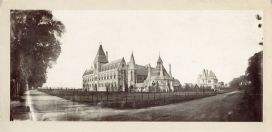
Oxford University Museum 1860

An ever-evolving museum

Oxford University Museum 1860

As we embark on our Life, As We Know It redisplay project – the first substantial changes to the permanent exhibits in more than 20 years – our Senior Archives and Library Assistant Danielle Czerkaszyn takes a look back at 160 years of an ever-evolving museum, in the first of a series of posts around the redisplay.

On 15 June 1860, Henry W. Acland, Regius Professor of Medicine at the University of Oxford, wrote:

The Oxford Museum slowly approaches completion. The building will shortly sink into insignificance when compared to the contents it will display, and the minds it will mould.

The University Museum at Oxford, as the Museum was originally known, was established to bring together scientific teaching and collections from across the University under one roof. The doors opened in June 1860, and soon after several departments moved into the building – Geometry, Experimental Physics, Mineralogy, Geology, Zoology, Chemistry, Astronomy, Human Anatomy, Physiology, and Medicine.

Ground floor plan 1866
Ground floor plan of the University Museum in 1866

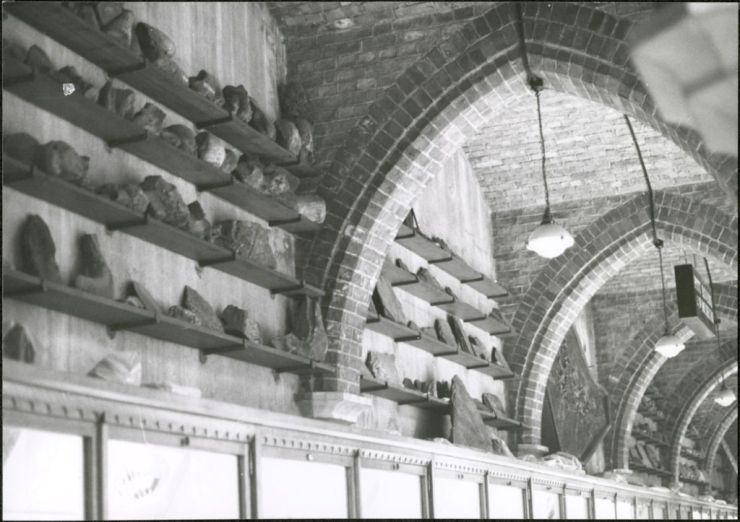
When the University Museum opened, it was not simply a museum; each department got a lecture room, offices, work rooms and laboratories, as well as use of the library and display areas. According to Acland, a key figure in the Museum’s foundation, in 1860 the outer south aisle of the main court featured mineralogical specimens and chemical substances, while the inner aisle exhibited Oxfordshire dinosaurs.

Acland’s detailed descriptions of the central aisle highlighted zoological specimens with twelve parallel cases of taxidermy birds, four side cases of taxidermy animals, including animals on top of the cases, and six table cases down the centre showing shells, crabs, insects, corals and sponges, starfish and urchins. The inner north aisle presented reptiles and fish, while the outer aisle introduced the Ashmolean‘s zoology specimens, as well as anatomical and physiological collections.

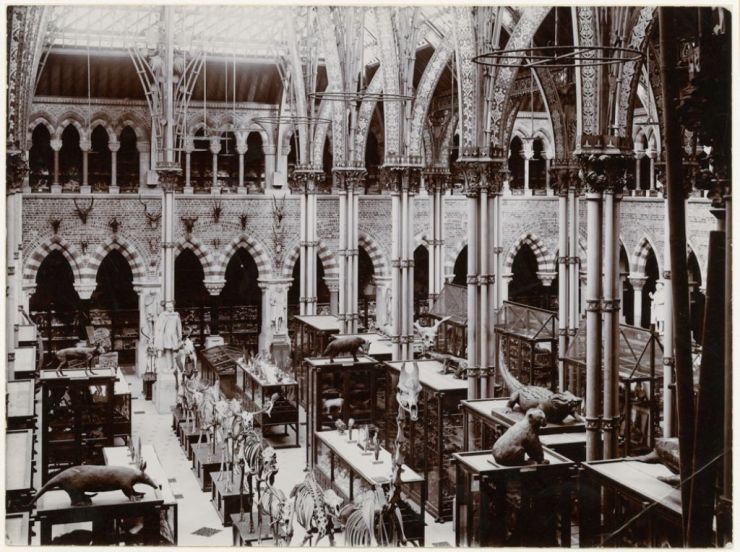
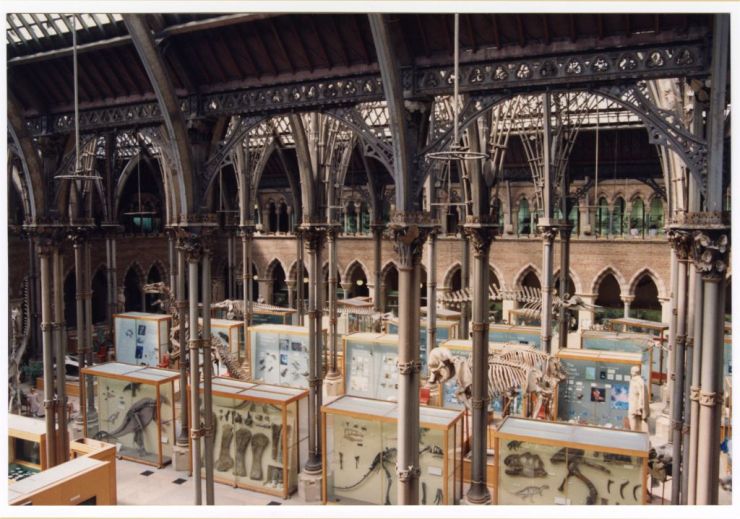
The Museum in 1890
The Museum court in 1890

Although members of the public were welcome in the Museum from the start, the departments which inhabited the building were more concerned with teaching space, research facilities and the storage of their specimens than the needs of visitors. As a result, most of the early displays and cases were arranged in a systematic manner that focused on space-saving practicalities and communicating scientific knowledge, rather than aesthetics.

Geology specimens on the walls
Geology specimens displayed on shelves on the walls
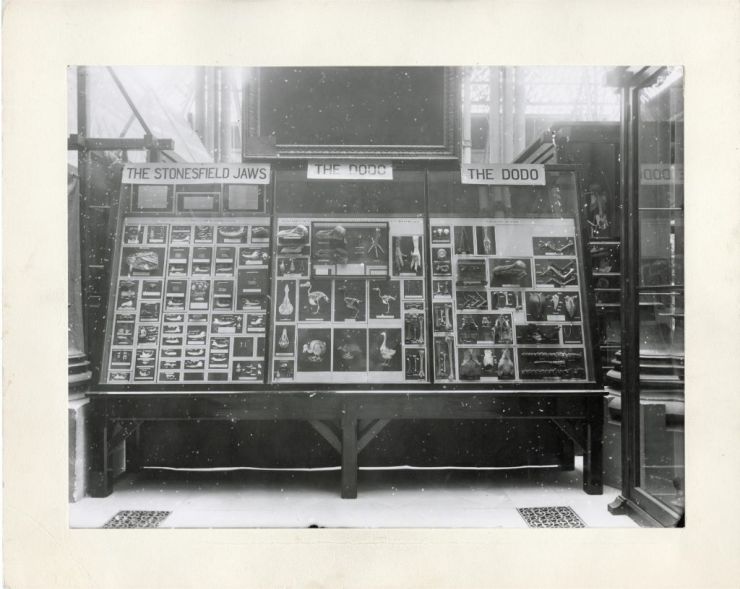
Early Dodo display case
An early display focused around the Museum’s famous dodo specimen

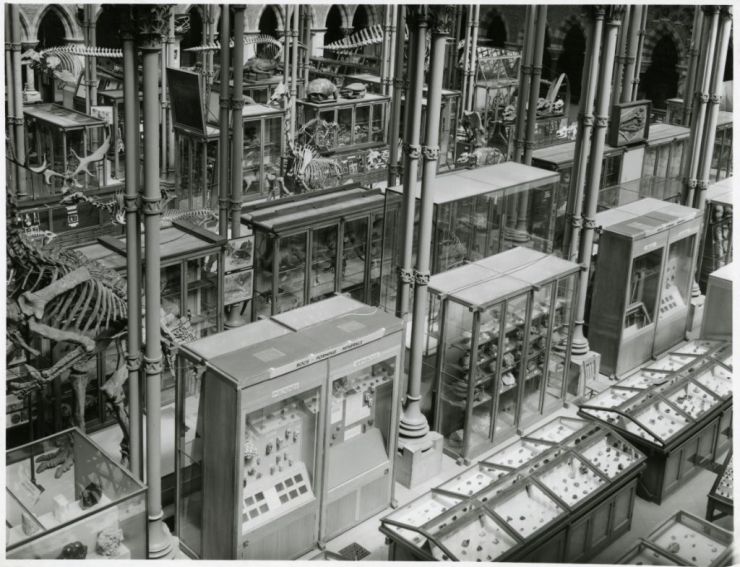
Tracing through old annual reports it is clear that cases in the main court have been almost constantly refreshed and updated, with displays highlighting new specimens and changes to scientific understanding, or through practical improvements to lighting, electricity points and environmental monitoring. Nonetheless, the overall layout of the cases remained the same until the early 1980s.

The Museum court, unknown date

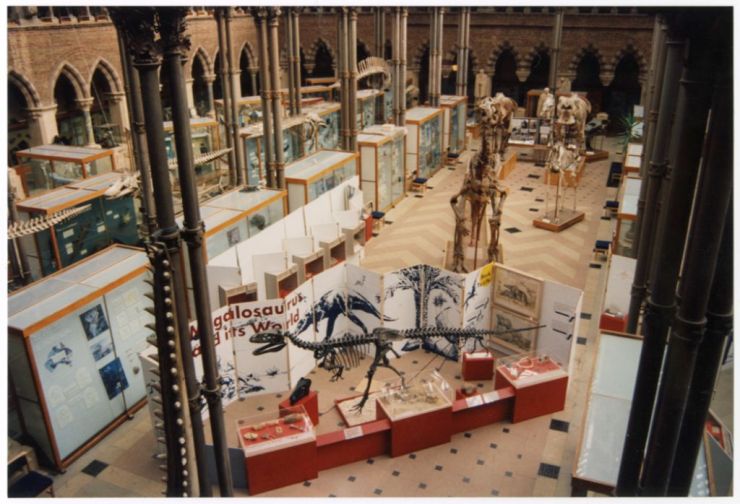
From the early 1990s a focus on public engagement began to increase. Longer opening hours were introduced and displays were redesigned to link to both undergraduate teaching as well as the National Curriculum. Temporary exhibitions also regularly featured in the main court to increase the variety of specimens on display.

The Museum court in 1994
Megalosaurus temporary exhibition
A temporary exhibition about the Megalosaurus dinosaur in the 1990s

The turn of the millennium marked the start of a major project to update the main court displays. The central cases were reconfigured and a new set of introductory cases installed, including many themes familiar to visitors in recent years, such as exhibits on the Oxfordshire dinosaurs, Alice in Wonderland, and the Oxford Dodo.

T. rex makes its presence known

These showcases were complemented by the addition of an imposing cast of ‘Stan’ the Tyrannosaurus rex in the centre aisle, positioned behind the historic Iguanodon cast. The changes were well received and attendance in the month of July 2000 was the highest ever recorded. The Museum also introduced live insects for the first time in 2000, with Upper Gallery tanks containing Madagascan Hissing Cockroaches, South American Burrowing Cockroaches, a variety of stick insects, and some large tarantulas.

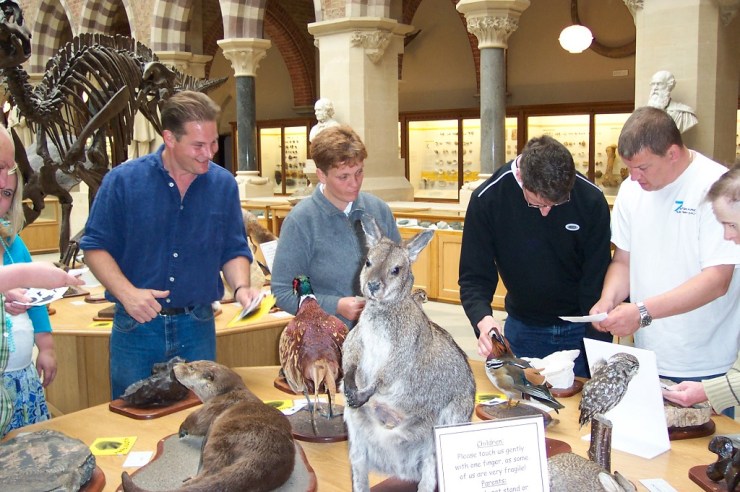
The project completed in late 2005 when the displays on Evolution, the History of Life, and Invertebrate Biodiversity were installed. Touchable specimens were also given their own permanent display area, allowing visitors the opportunity to physically interact with natural history material. These and other public engagement activities were recognised when the Museum won The Guardian newspaper’s Family Friendly Museum of the Year Award for 2005.

People around a table of touchable taxidermy specimens
New tables of touchable specimens were introduced for visitors in the 2000s.

The last substantial update to the fabric of the building took place in 2013, when the Museum closed for a year to fix the leaks in the glass roof. Taking advantage of the closure, a major piece of conservation work was undertaken on the seven whale specimens suspended from the roof. Having been on display for over 100 years, the whales were in need of considerable TLC.

A conservation team worked on the whale skeletons during the Museum’s closure for roof repairs in 2013.

Today, new and exciting changes are afoot as we embark on the first major changes to our permanent displays in almost 20 years. New high-end showcases will present displays under the concept of Life, As We Know It – beautiful presentations of the diversity of life, and the importance and fragility of biodiversity and human impact on the environment. The new exhibits will look at how the biological processes of evolution combine with the geological processes of our dynamic Earth to give rise to the immense, interconnected variety of the natural world.

Looking back across the decades we can see that the Museum is never static, but instead constantly changing and adapting, shifting from its foundation as a Victorian centre of academia to the accessible and engaging space we know and love today.

The Life, As We Know It redisplay project is supported by a generous gift from FCC Communities Environment.

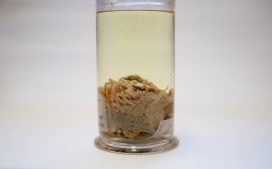
Close up of OUMNH-ZC-7483 Section of blue whale intestine with mysterious acanthocephalan parasites

Worms of Discovery

By Mark Carnall, Life Collections manager

The Museum’s zoology collections contain a dizzying diversity of animal specimens. It is a collection that would take multiple lifetimes to become familiar with, let alone expert in. So we benefit hugely from the expertise of visiting researchers – scientists, artists, geographers, historians – to name just a few of the types of people who can add valuable context and expand our knowledge about the specimens in our care.

Earlier this year, Dr Andrew McCarthy of Canterbury College (East Kent College Group) got in touch to ask about our material of Acanthocephala, an under-studied group of parasitic animals sometimes called the spiny-headed worms.

Although there are around 1,400 species of acanthocephalans, they are typically under-represented in museum collections. Dr McCarthy combed through the fluid-preserved and microscope slide collections here, examining acanthocephalan specimens for undescribed species, rare representatives and unknown parasitic associations.

Close up of OUMNH-ZC-7483 Section of blue whale intestine with mysterious acanthocephalan parasites

One such specimen, catchily referenced OUMNH.ZC.7483, was of particular interest. It is a section of blue whale intestine packed with acanthocephalan adults, labelled ‘Echinorhynchus sp. “Discovery Investigations”’, and dated 13 March 1927. Drawing on his expert knowledge, Dr McCarthy spotted an unusual association here because the genus Echinorhynchus was not known to infect Blue Whales, meaning the specimen could represent a species to new science.

However, identifying different species of acanthocephalans cannot be done by eye alone, so Dr McCarthy requested to remove one of the mystery worms from the intestine and mount it on a slide to examine its detailed anatomy. When we receive a destructive sampling request like this it triggers an investigation of the specimens in question: we need to weigh up their condition, history, and significance against the proposed outcome of the research before we decide whether the permanent alteration of the specimen justifies the outcome.

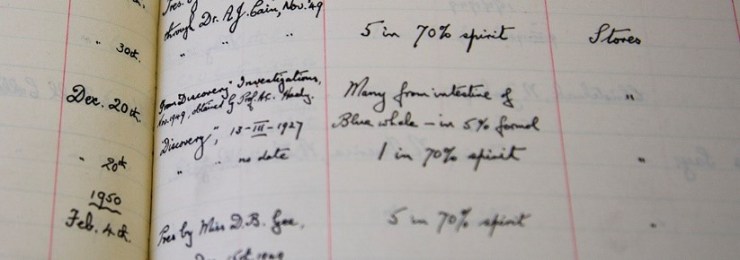
Image of Oxford University Museum of Natural History zoology collections accession register entry for this specimen showing the donation of the specimen and collector information.

This particular investigation began to yield a much richer story than the Museum’s label suggested. It turned out that the specimen was collected by Sir Alister C. Hardy who was serving as zoologist on RRS Discovery’s scientific voyage to the Antarctic. Fortunately, Discovery’s scientific findings were meticulously documented and published by many libraries of the world, including the fantastic Biodiversity Heritage Library where it was easy to find the report mentioning acanthocephalans collected during the voyage.

Alongside descriptions of acanthocephalans from seals, dolphins and icefish there is no mention of Echinorhynchus sp. from Blue Whales, though there are a few references to another genus, Bolbosoma, collected from Blue Whales on seven occasions: a single individual of Bolbosoma hamiltoni, so obviously not this specimen, and six occurrences of Bolbosoma brevicolle from the intestines of Blue Whales from South Africa and South Georgia.

These specimens and others reported in the Discovery reports. Image from Biodiversity Heritage Library

Piecing together the evidence, the association with Hardy, the dates, and the descriptions of RRS Discovery’s acanthocephalans, it seems likely that our specimen is one of the six samples of Bolbosoma brevicolle and not Echinorhynchus at all. So in this instance we decided not to grant destructive sampling as the likelihood of identifying a new species seemed much lower when all the information was brought together.

Although sampling wasn’t granted, Dr McCarthy was delighted that his initial research request had prompted the discovery of some important historical connections to the humble specimen, and the new identification seemed to fit.

We still weren’t sure when or why this specimen was mislabelled some time between the Discovery reports and its donation to the Museum in 1949, so Dr McCarthy conducted some further investigations. He found out that Echinorhynchus was the original name combination for Bolbosoma brevicolle, and that H. A. Baylis, a parasitologist and author of Discovery reports, had links with the University of Oxford.

This story is just one example of how visiting researchers enrich knowledge and information about our collections, and it illustrates nicely why our work with broader research communities is so important.