Reconstructing the Cretaceous with Bones and Amber

A double window into the past

Post by Dr Ricardo Pérez-de la Fuente, Deputy Head of Research

Nature is wonderfully imperfect, and the data that we can gather from it is even further from perfection. Fossil localities, even those providing exceptionally well-preserved fossils, are inaccurate records of the past. Fossils can form from a variety of matter including organisms, their remains, or even traces of their activity. Yet not all of the material that can get fossilised at a particular site actually will. Among other factors, biases in the fossil record result from the nature of the materials responsible for fossilisation – usually sediments which are in the process of turning into rocks. In most cases, fossil localities offer us only a single ‘window of preservation’ – a skewed geological record of the ancient ecosystem that once existed there.


In 2012, a rich vertebrate bone bed was documented at the Ariño site in Teruel, Spain. Since then, researchers have unearthed more than 10,000 individual fossil bones, from which they have discovered new species of dinosaurs, crocodiles, and turtles. Plant fossils were also found, including pollen grains and amber, which is fossilised resin. Although amber was known to occur in this locality, this sort of material had remained unstudied… until recently.

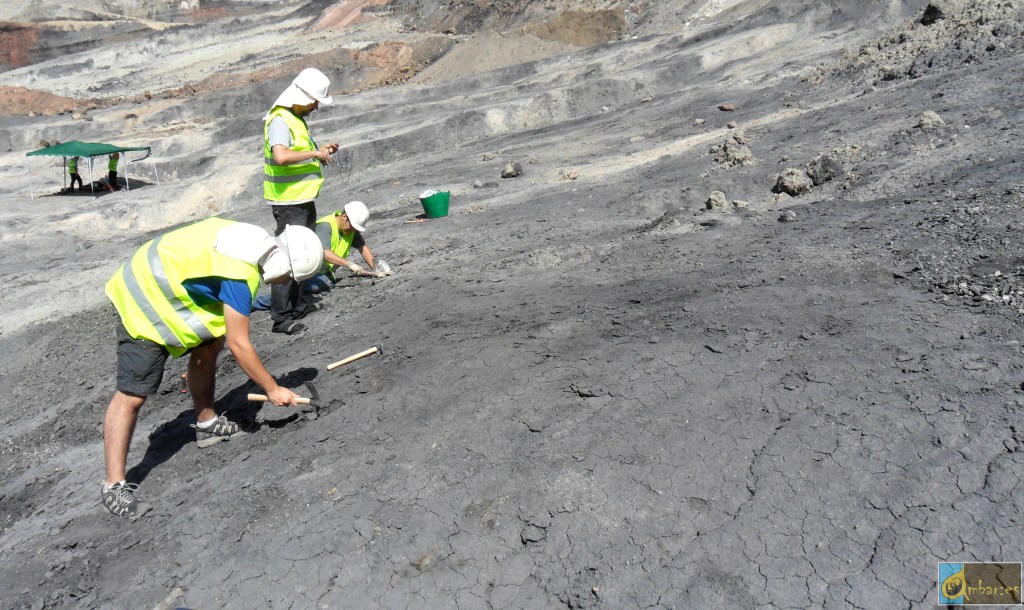
Over the summer of 2019, I joined my colleagues to carry out amber excavations in the Ariño site – an open-pit coal mine that has an almost lunar appearance due to the dark carbonate-rich mudstone rocks and the total lack of vegetation. The scorching heat during a very hot summer was a bit maddening, but I did try to enjoy my yearly dose of sun before returning to the UK!
Resin pieces can be transported significant distances by runoff water before depositing on their final burial location, where they slowly transform into amber. However, we found amber pieces that had not moved from their original place of production. These large, round-shaped pieces preserved delicate surface patterns that would have been polished away even by the slightest transport. The resin that produced these amber pieces was formed by the roots of the resin-producing trees, and resembles sub-fossil resin my colleagues found in modern forests from New Zealand.
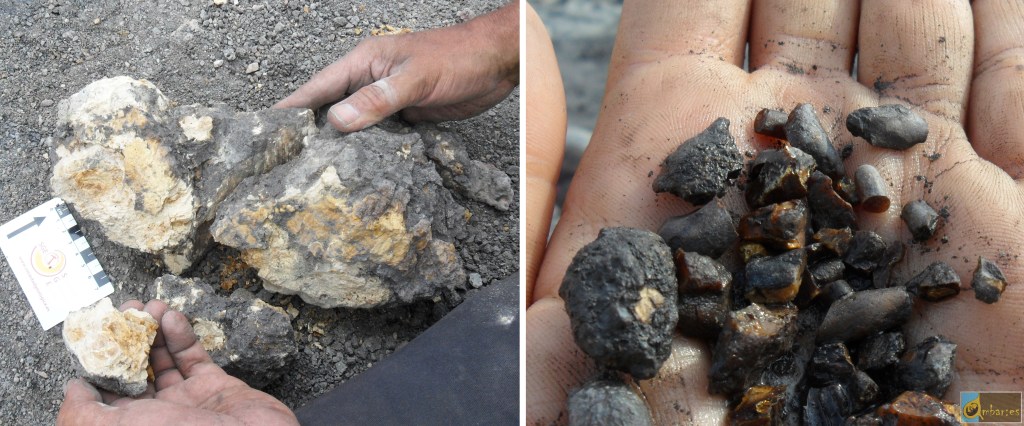
Large amber piece produced by roots (left) and assemblage of smaller amber pieces (right) from Ariño (Teurel, Spain).

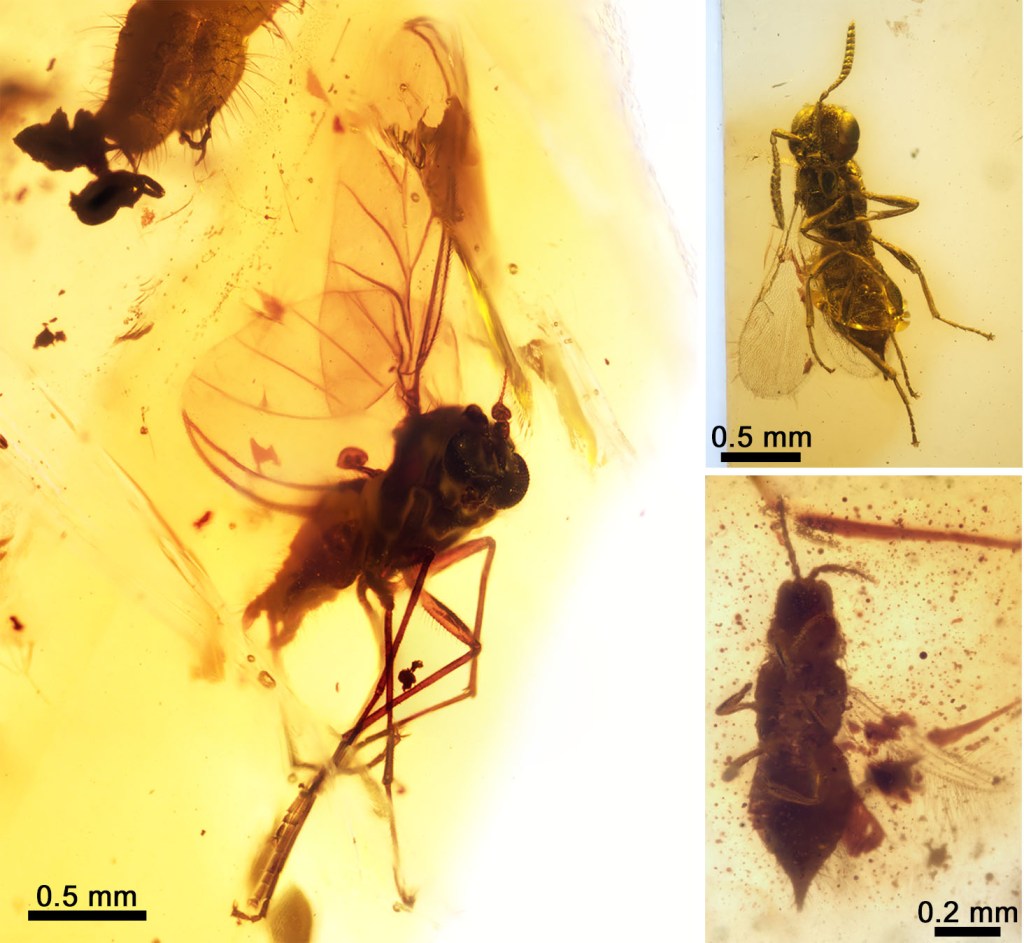
The small amber pieces from Ariño contain an unusual abundance of fossils. These pieces come from resin produced by the branches and trunk of the resin-producing trees. From the almost one kilogram of amber we excavated, we identified a total of 166 fossils. These include diverse insects such as lacewings, beetles, or wasps, and arachnids such as spiders and mites. Even a mammal hair strand was found!1


We now know that the Ariño site provides two complementary windows of preservation — a bone bed preserving a rich variety of vertebrate animals, and amber with abundant inclusions. Aside from Ariño, only three localities that preserve both dinosaur bone beds and fossiliferous amber have been reported in Western France, Western Canada, and North Central United States. However, in these cases, either the bone bed or the amber have offered a much more modest abundance and diversity of fossils. Some of the fossils from these localities also show signs of significant transport, which means that the organisms could have inhabited different, distant areas even though they fossilised together. This makes Ariño unique because it offers two valuable ‘windows of preservation’ from the same ecosystem.

Thanks to all this evidence and other data, we have been able to reconstruct an ancient terrestrial ecosystem – a 110-million-year-old coastal swamp – with unprecedented detail and accuracy.2 The inherent incompleteness of the fossil record will always remain a headache for palaeontologists… but localities like Ariño make the data that we can recover from the past a bit more complete.

Reconstruction of the coastal swamp forest of Ariño, in the Iberian Peninsula, from 110 million years ago. Author: José Antonio Peñas. Source: Álvarez-Parra et al. 2021.

If you want to learn more about amber excavations, check out this post on Excavating Amber.


1Álvarez-Parra, Sergio, Ricardo Pérez-de la Fuente, Enrique Peñalver, Eduardo Barrón, Luis Alcalá, Jordi Pérez-Cano, Carles Martín-Closas et al. “Dinosaur bonebed amber from an original swamp forest soil.” Elife 10 (2021): e72477.

2Álvarez-Parra, Sergio, Xavier Delclòs, Mónica M. Solórzano-Kraemer, Luis Alcalá, and Enrique Peñalver. “Cretaceous amniote integuments recorded through a taphonomic process unique to resins.” Scientific reports 10, no. 1 (2020): 1-12.
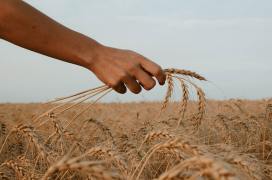
The Roundup on The Great Debate – Do We Need a New Agricultural Revolution?

Post by Dr Caroline Wood


How can we meet the challenge of feeding 10 billion people by 2050 whilst simultaneously addressing climate change, impoverished soils, mass extinctions and unsustainable pollution?

On 20th October, Oxford University Museum of Natural History hosted The Great Debate – an anniversary celebration of the Museum’s Great Debate in 1860, on Darwin’s Theory of Evolution. During this special event, the panel and audience (both in-person and live-streamed) discussed issues, opportunities and tensions relating to the future of food production. By the end of the evening, it was clear that we won’t be able to rely on ‘quick fixes’. Instead, we will need a whole-scale revolution at multiple levels: in our fields, on our plates, and in our attitudes. 


Panel Speakers

Lord John Krebs (Chair) – Former chairman of the Natural Environment Research Committee and Adaptation to Climate Change Committee

Helen Browning – Chief Executive of the Soil Association

Professor Sir Charles Godfray – Director of the Oxford Martin School

Stuart Roberts – Deputy President of the National Farmers Union (NFU)


In our fields

With global food demand estimated to increase by 35% to 56% between 2010 and 2050, it is unquestionable that we will need to keep producing more food. Although the prospect seems daunting, Helen Browning outlined the potential of new technologies to boost yields, including hydroponics and vertical farming; robots that can perform crop care and harvesting; and genetic technologies such as gene editing. However, she warned that the UK is currently ‘way off the pace’, and would remain so until there is more investment in farmer-led research, innovation and knowledge-sharing opportunities. 

As Stuart Roberts pointed out, there are also significant opportunities to boost production simply by addressing inefficiencies and yield gaps. For instance, according to the NFU, if all the 270 million+ dairy animals worldwide were as efficient as UK dairy cows, we would only need 76 million to produce the same amount of milk. New market models, such as direct-to-consumer and digital technologies (e.g. blockchain), could also help reduce the 15% of food that the WWF estimate is wasted even before it leaves the farm

But will increased production come at the expense of damaging natural ecosystems? The new UK Agricultural Act aims to avoid this by providing farmers with a financial incentive to preserve ‘public goods’ including air quality, biodiversity, soil health, and flood mitigation. Sir Charles foresaw that the Agricultural Act will result in a ‘patchwork’ of different farming systems across the UK, each tailored to their locality, with some being highly productive and others more dedicated to public services. 

Debate Panel (Left to Right) – Lord John Krebs, Helen Browning, Stuart Roberts, Prof Sir Charles Godfrey

On our plates

Extensive research indicates that achieving net-zero carbon emissions will require a global reduction in meat consumption and a shift towards plant-based diets. But as Stuart noted, presenting consumers with only the extremes of a carnivorous diet and a vegan lifestyle is not helping this transition. Instead of focusing on binary choices, we should be more concerned with improving the meat we do eat. As consumers, we need to stop seeing food as a cheap, mass-produced commodity, and be prepared to pay a price that will compensate for the development of production systems that are more in harmony with nature. Helen agreed that only by paying more for food can we allow farmers to escape the stranglehold of contracts that pressure them to produce as much as possible, regardless of the environmental cost. However, as Stuart pointed out, to avoid higher prices leading to food poverty, it will be necessary to tackle income poverty first. To this end, he cited Food Foundation research which reveals that the poorest 10% of households would have to spend 76% of their disposable income to meet current diet recommendations.

In our minds

Farmers are critical actors in the global response to climate change, but all too often they are portrayed as villains. Stereotypes regularly cast farmers as chemical lovers who rip up hedgerows and mistreat animals. Instead, we need to recognise and celebrate the farmers who are trying to be part of the solution, including those embracing regenerative farming methods such as pasture cropping, agroforestry, no-till farming and undersowing. Overall, if we want more farmers to become innovators, we need to support them – and as consumers, we can make that choice every time we shop.


The Huxley Room at the Oxford Natural History Museum where the original Great Debate took place in 1860.

Dr Caroline Wood works as a Communications Officer for Oxford Population Health, a department at Oxford University that specialises in global health studies. She is also a freelance science writer, focusing on sustainability, food science and packaging issues. When she is not writing, she enjoys visiting museums (including OUMNH obviously!), hillwalking and painting (badly).