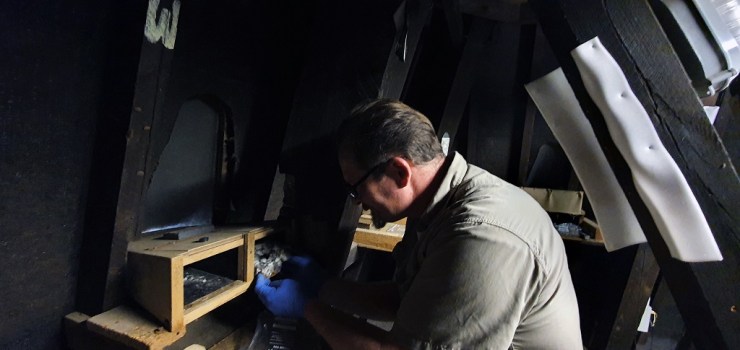
Chris Jarvis cleaning the nest box in the Museum Tower Room

A swift return

Chris Jarvis cleaning the nest box in the Museum Tower Room

by Chris Jarvis, Education Officer

‘Look! They’re back! Look!’
This line from Ted Hughes’ excellent poem Swifts shares the excitement generated every year by the arrival of one of the most iconic summer visitors to Britain…. and I’m pleased to announce that they’re here!

Each year at the Museum we eagerly look forward to the swifts returning from their epic migration to southern Africa and back to our tower. Here they will land for the first time in a year, to nest after a 14,000 mile journey on the wing.

Necks of Museum staff are strained as each of us develops a twitcher’s twitch, heads snapping upwards at every bird flying overhead. We all hope to be the first to see a swift returning to the buzz the tower, scoping out the possible nesting opportunities, some no doubt remembering past sites from summers gone by.

Video courtesy Oxford Swift City

With the Museum currently closed due to the global pandemic, this year most staff will be craning their necks to the sky at home, perhaps wondering if any swifts they spot are ‘our’ Museum swifts, or some of the many others that colonise the roof spaces and nest boxes of Oxford and its surrounding towns each year.
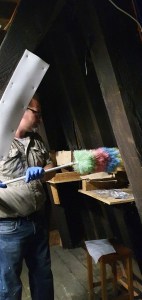
Chris cleaning the swifts’ nest boxes with a feather duster

The swifts at the Museum are part of what is probably the longest-running continuous study of any bird colony in the world, started by David Lack in 1948. Because so little is known about these protected and declining populations of birds, every bit of data matters.

Although the Museum’s Swift Warden, George Candelin, is currently unable to reach the Museum during the lockdown, we agreed that it was an essential part of our role as a conservation and research institution to continue the study that has helped us to understand what little we do know about these enigmatic visitors.

Even before the swifts arrive there is a lot to do. With George’s expert guidance, in the last week of April we climbed the winding stone staircase and then the ladders to the very top of the tower to prepare for the swifts’ arrival.

Each of the nest boxes is thoroughly cleaned and their entrance holes dusted to make sure they are free of cobwebs or other obstructions. We then replace the shallow nests used to entice nesting activity. Swifts cannot land to collect nesting material and so have to collect suitable airborne material while on the wing. Their nests are often scanty, basic affairs made of a few stray feathers and other random bits of material they have found blowing about in the wind, so they seem to appreciate a helping hand.
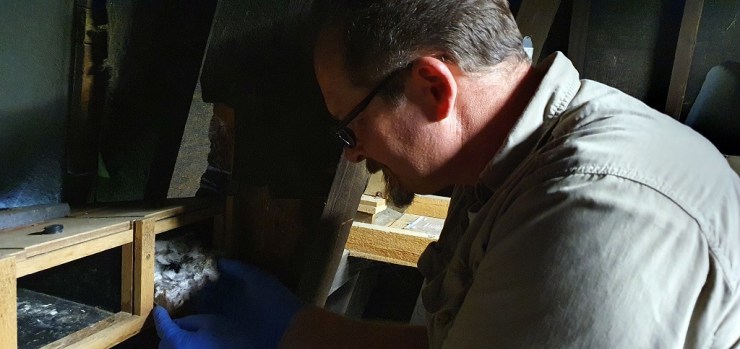
Each of the 80 nest boxes has to be carefully cleaned before the swifts return from Africa

Each of the man-made nests comprises a shallow ring of soft feathers. This is removed from the nest box at the end of each breeding season, frozen to kill off any resident feather lice or other pests, then thawed and gently replaced.

Finally the Swift Cams are put in position and checked, ready to beam intimate shots of life in the tower directly into your home. Now you can follow the breeding season of these fascinating but hard to observe birds from the comfort of your sofa!

All this was completed just in time as, on leaving the Museum, one lucky staff member glanced upwards to see the first swift of the season glide across the sky above the tower. Perhaps a visitor travelling further north to breed, just passing through, or perhaps an early arrival feeding up and replenishing itself before starting its nesting, checking its old nest site is still there and reminding us, as Ted Hughes continued in his poem, that…

They’ve made it again,

Which means the globe’s still working, the Creation’s

Still waking refreshed, our summer’s

Still all to come —
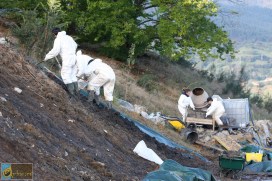
Excavating amber

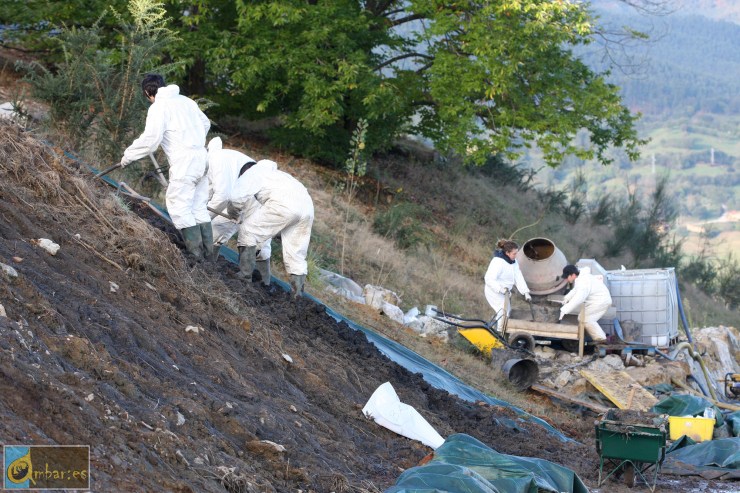
First amber excavation in the El Soplao outcrop, Cantabria, N Spain in 2008. Credit IGME-UB.

By Dr Ricardo Perez-De-La Fuente, Research Fellow

Amber, or fossilised plant resin, is a unique material to learn about the history of life on Earth. Its incredible preservation and ability to capture life “in action” are well known thanks to the Jurassic Park saga, but fewer people know where amber is found, what it looks like in the field, and how it is gathered.

Cretaceous amber, about 130 to 70 million years old, is the oldest amber that provides abundant fossils, specifically insects and spiders. Ecosystems drastically changed during this period due to global greenhouse conditions and the diversification of flowering plants, among other factors. Amber from that time has been discovered in Lebanon, Spain, France, Myanmar, eastern United States, Canada, and northern Russia.

My research team and I carry out regular amber excavations in northern Spain, working in teams of six to ten people. The outcrops that we excavate are often located next to roads and highways because amber is typically uncovered during roadworks. Excavations take place during the summer or fall to try and minimise the risk of rain, and we usually embark on one field trip each year.

The goal is to recover as much amber as possible – usually a few kilograms – from the muddy and sandy sediments. These materials were transported downstream tens of million of years ago by heavy rain and river swellings from the forests where the resin was produced, before being finally deposited in near-shore areas.

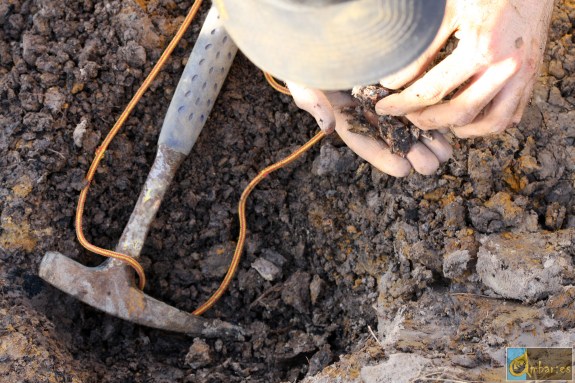
Manual extraction of amber. Credit IGME-UB
Manual extraction of amber in the El Soplao outcrop, Cantabria, northern Spain in 2008. Credit: IGME/UB.

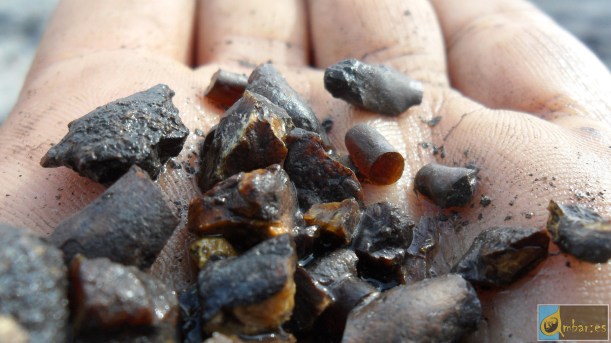
I find amber excavations quite romantic. In the field, amber has a dull appearance that makes it difficult to distinguish from rocks or woody remains. This is due to an opaque crust resulting from oxidation in the sediments and other processes.

This outer layer makes detecting potential fossils inside the amber highly unlikely while the excavation is ongoing. So, in the field we just gather as many amber pieces as possible, and hope for the best.

Only when amber is polished – or shows broken surfaces – does its distinct yellowish to reddish shine emerge, and any possible fossils within become evident. Some ambers are highly fossiliferous, while others are very poor in fossils.

Amber can be gathered by hand using regular tools such as hammers. However, the most efficient method to extract amber from soft sediments is with concrete mixers! This rather unsophisticated piece of equipment provides the best way to recover medium quantities of amber in the field.

We charge water and amber-bearing sediments into the mixer, and after stirring for a while amber floats to the top because it is less dense than muddy water. Then, the surface of the water containing the amber is poured into sieves, which separates even the tiniest pieces.

Amber pieces recovered in a sieve after washing
Amber pieces recovered in a sieve after having been “washed” from their sediment. First amber excavation in the La Manjoya outcrop, Asturias, northern Spain in 2017.

After fieldwork, many hours will be spent looking for fossils within the amber and preparing them. Gathering raw amber is just the first part of a process in unearthing the secrets held within – fragments of encapsulated time.

Top image: First amber excavation in the El Soplao outcrop, Cantabria, N Spain in 2008. Credit: IGME/UB.

Through the looking glass

With our Life, As We Know It redisplay project now underway, our Senior Archives and Library Assistant Danielle Czerkaszyn takes a behind-the-scenes look at how we captured the contents of the current displays for the Museum’s archive.

The archive here holds a unique collection of natural history books, journals and documents covering a wide range of subjects related to the Museum’s collections and research. It also contains papers and objects on the history of the building, providing an institutional memory of Oxford’s ‘University Museum’ since its foundation in 1860.

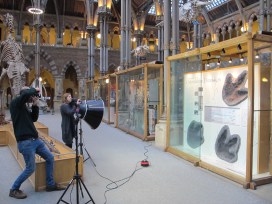
From an archive perspective it was really important to document the current layout of the cases, their specimens and text before they were removed from the court to make way for the new showcases in the first phase of our redisplay work.

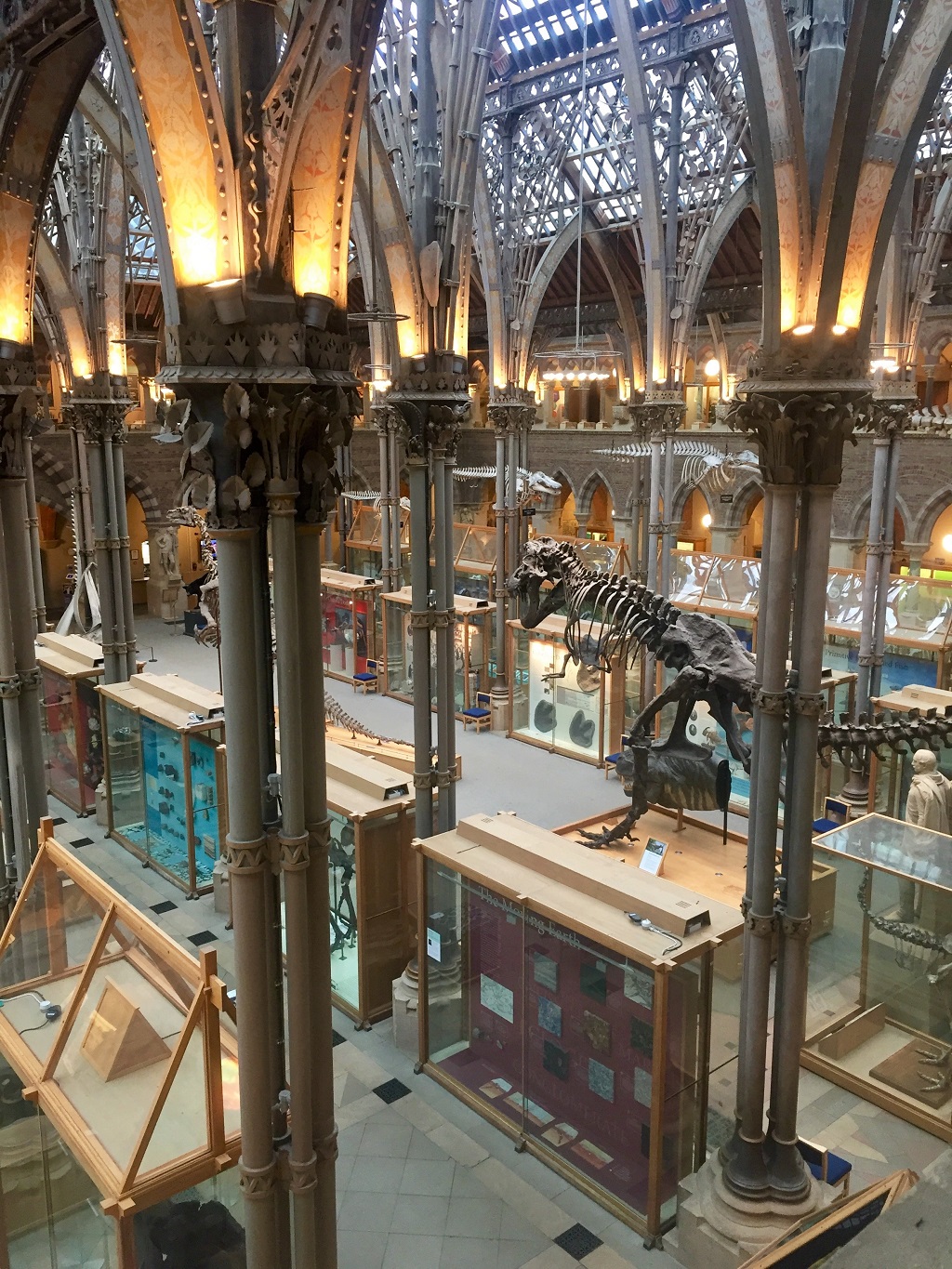
The museum in late 2019

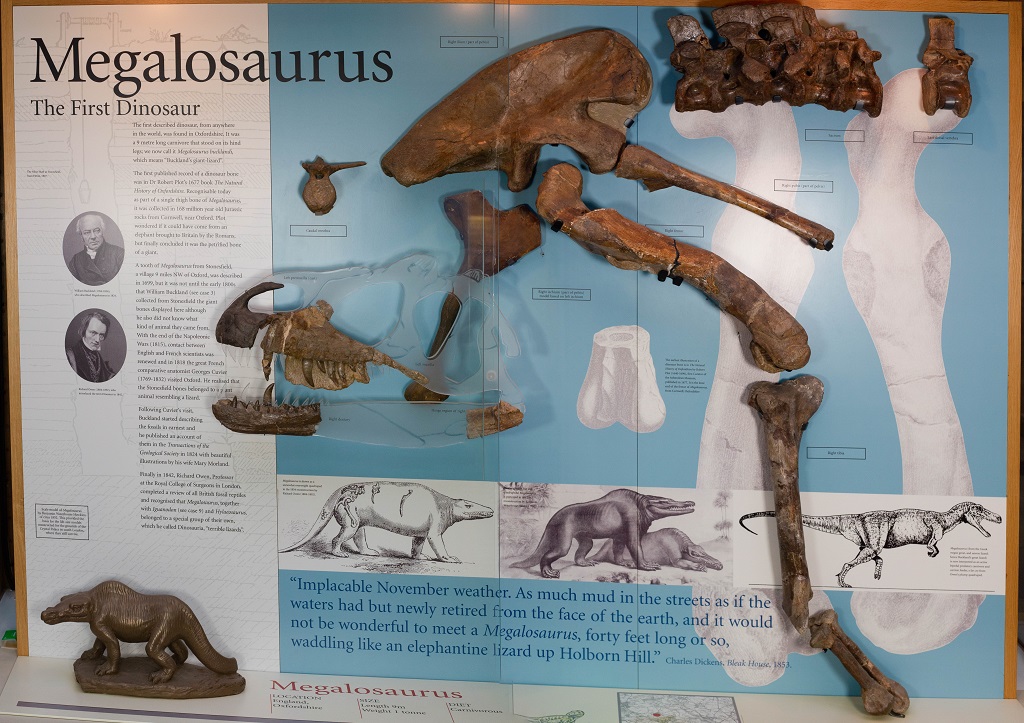
The displays as we know them – with exhibitions on the Oxfordshire dinosaurs, Alice in Wonderland, the Oxford Dodo, and more – were last changed in 2000. For the last 20 years visitors to the Museum would remember their first time being wowed by the Megalosaurus jaw – the world’s first scientifically-described dinosaur – or charmed by the Dodo made famous in Lewis Carroll’s Alice Adventures in Wonderland.

Although after 20 years it is time for a change, the stories and information in the displays are too good to be forgotten. So before anything was removed we began to build the archive for the future.

A display of the fossilised remains of Megalosaurus
The previous display on Megalosaurus: The First Dinosaur

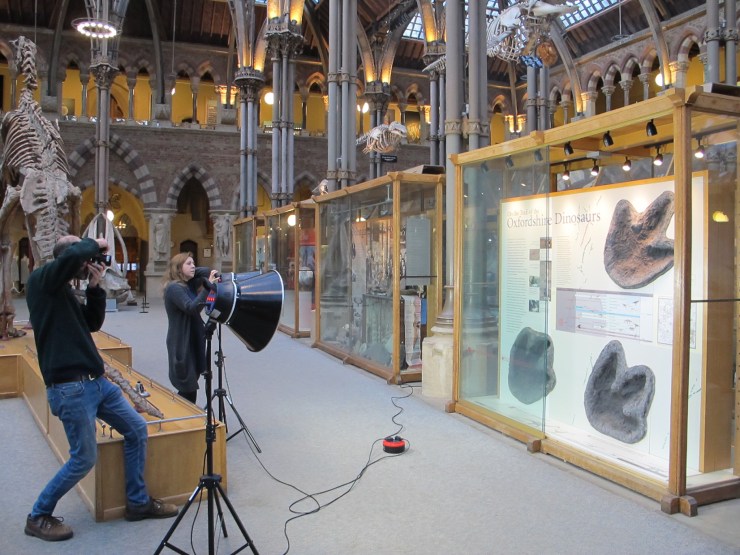
The best way to capture all the information of the displays was through high resolution photography, but this was not as straightforward as we hoped.

The first two obstacles to good photographs are pretty obvious to anyone looking at the cases: glass causes huge amounts of glare; and each case has a big dividing line down the centre where the two sliding glass doors meet, cutting what should be a lovely seamless image into two halves.

To avoid glare and the solve the problem of the dividing line, our photographer Scott opened each individual side of the case, photographed two or three images of the display, and then stitched the separate photos together using Photoshop.

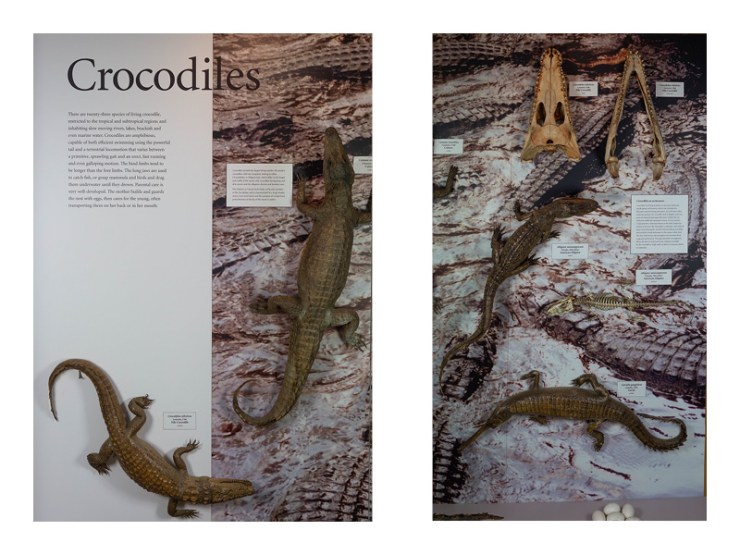
Each case was photographed in two or three segments
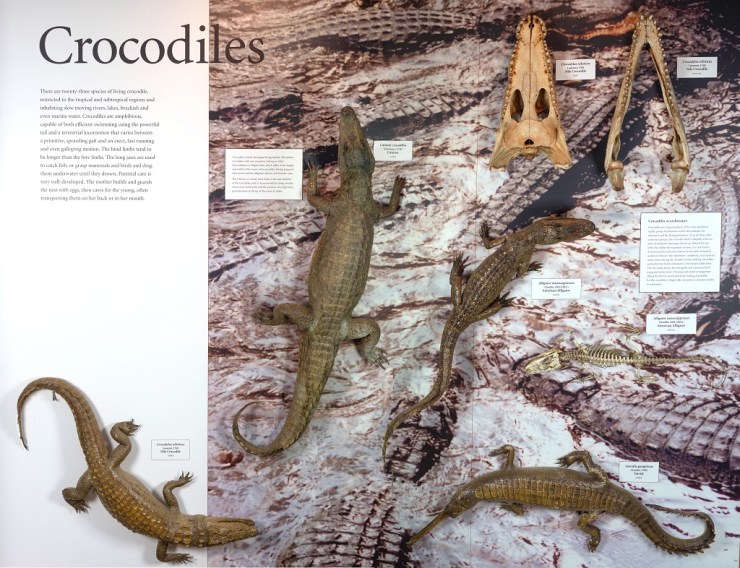
The segments were then stitched back together and adjusted for exposure and colour balance to create the final image

Another obstacle to taking good photographs of the displays came from the Museum itself. Some of our larger display furniture, such as the glass case for the Atlantic Bluefin Tuna or the huge T. rex plinth – got in the way of a nice straight shot. Because these items are so large and heavy they were impossible to move, so we had to improvise and do our best.

Capturing the displays before the current cases were removed allowed us to keep an archival record of their contents

Thankfully, we managed to get shots of all 24 displays before they were removed and so a record of each case now rests with the Museum’s archive. If anyone wants to know what the display cases in the court looked like from 2000 to 2020, they will now be able to look back at the images in the archive and recall the magic of the Oxford Dodo exhibit that perhaps first made them fall in love with the Museum.

Our new displays are now in development, and will include some beautiful presentations of the diversity of life, looking at the importance and fragility of biodiversity and human impact on the environment. These new exhibits will show how the biological processes of evolution combine with the geological processes of our dynamic Earth to give rise to the immense, interconnected variety of the natural world.

We look forward to telling you more about that here as the project progresses.

The Life, As We Know It redisplay project is supported by a generous grant from FCC Communities Foundation.

Uncovering ancient threads

By Dr. Frankie Dunn, Research Fellow

Some of the very oldest complex, macroscopic communities on Earth appear in the fossil record about 570 million years ago and record the presence of a group of organisms – the rangeomorphs – with an unfamiliar body plan that, at their ultimate extinction, was lost from life’s repertoire.

Rangeomorphs are characterised by a strange frondose branching anatomy, where large primary branches host smaller branches which themselves host smaller branches again. This arrangement appears to maximise the surface-area to volume ratio of the organism, rather like a lung or a gill would today.

The smallest known rangeomorphs are less than a centimetre in length, but they grew huge and the largest records indicate they could stand more than two metres tall. There is no evidence to suggest that rangeomorphs were able to move around, rather, they lived stuck to the sea floor in the deep ocean, far below the reach of light.

Despite this strange set of characters, there is growing consensus that rangeomorphs likely represent very ancient records of animal life. However, they lived at such a remote time in Earth’s history that they do not possess any direct living descendants. Given all this, it may not be a surprise to hear that we know relatively little about how these organisms made their living and came to dominate the ancient seafloors.

Fig A
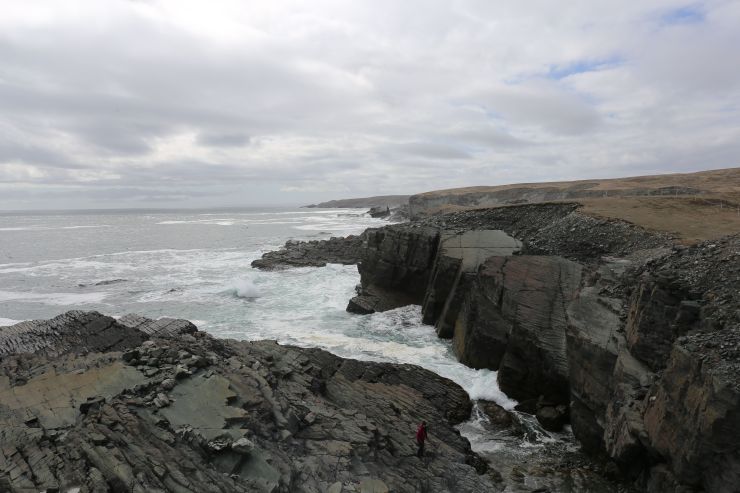
The UNESCO world heritage site Mistaken Point in Newfoundland, Canada, is one of the sites on which we find exceptionally preserved rangeomorph fossils. Photo: Alex Liu.

In order to better understand them, my co-author Alex Liu and I travelled to Newfoundland, Canada to explore the rocks which host these remarkable fossils and over the past few years we have made an unexpected discovery. We found that fine filamentous threads connect rangeomorph fronds of the same species, in some cases over many meters, though they are typically between two and 40 centimetres long.

N3
An undescribed rangeomorph fossil with filamentous connections at the base of the frond. We find that this species of rangeomorph can be connected to each other over meters! Photo: Alex Liu. 

It is possible that these filaments were involved in clonal reproduction, like strawberry plants today, but they may have had additional functions such as sharing nutrients or providing stability in strong ocean currents.

The discovery of the filaments means that we have to reconsider how we define an individual rangeomorph, and may help us understand how rangeomorphs (seemingly) rapidly colonised deep-sea environments. Either way, some reassessment of the palaeobiology of these unique organisms is certainly required!

More information:

  • Read the full research paper here.


Top image: Beothukis plumosa, a rangeomorph from Newfoundland showing the intricate branching anatomy of rangeomorphs. Photo: Alex Liu.

Diving into deep time

Our current First Animals exhibition is extending its run until 1 September, and to mark the extension our Research Fellow Imran Rahman takes a look at how animal life in the ancient oceans was brought to life in our Cambrian Diver interactive installation.

One of the biggest challenges in developing the First Animals exhibition lay in visualising rare fossil specimens as ‘living’ organisms, transforming them from two-dimensional imprints in the rock into three-dimensional animated computer models.

Many of the specimens on display in First Animals were collected from sites of exceptionally well-preserved fossils called Lagerstätten. These deposits preserve the remains of soft-bodied organisms that are almost never seen in the fossil record; things such as comb jellies and worms, as well as soft tissues such as eyes, gills and muscles. Even so, most of these fossils are flattened and two-dimensional, which makes it very difficult to reconstruct what they looked like in life.

Vetulicola cuneata from the Chengjiang fossil site had a large body with triangular openings on either side and a segmented tail. Its three-dimensional shape is uncertain.

To help exhibition visitors visualise the animals in a living environment we worked closely with Martin Lisec and his team at Mighty Fossils to create a set of detailed computer models of a key set of animals. We have worked with Martin before on the video of a Jurassic sea inhabited by plesiosaurs and other marine animals for our Out of the Deep display. That was very successful, but our idea for First Animals was even more ambitious: to create a unique interactive installation called the Cambrian Diver.

The material focused on the Chengjiang animals from the Cambrian of Yunnan province, China, which provides the most complete record of an early Cambrian marine community, from approximately 518 million years ago. Using fossil evidence of the organisms thought to have lived at the time we selected 12 species that were representative of the diversity of the Chengjiang biota.

The first phase was collecting as many materials as possible to be able to create 3D models. As usual, we started with rough models, where we set basic dimensions, shapes and proportions of body parts. Once approved, we moved to very detailed models for the animations, artworks and textures for less detailed models to be used within the interactive application. – Martin Lisec, Mighty Fossils

Images showing a preliminary 3-D model of the lobopodian Onychodictyon ferox in multiple views, with annotations in yellow highlighting changes suggested by Museum researchers.

To provide two-dimensional templates for Mighty Fossils to work from we scoured the scientific literature for the most recent accurate reconstructions available for each of the species.

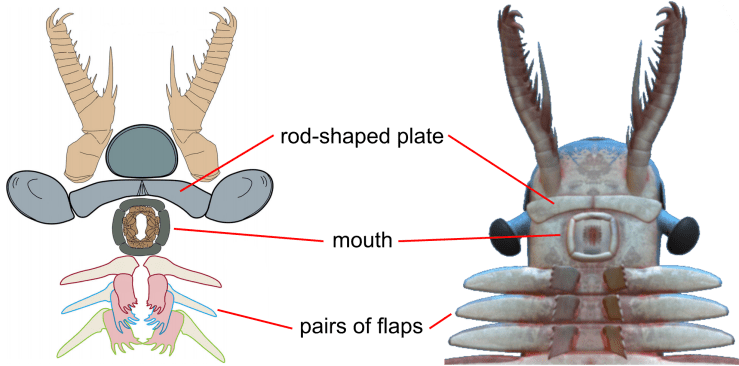
The predatory arthropod Amplectobelua symbrachiata is a good example. We drew heavily upon a 2017 paper by Dr Peiyun Cong and colleagues, which included a very detailed reconstruction of the head region. This reconstruction shows that the underside of the head of Amplectobelua consisted of a rod-shaped plate, a mouth made up of two rows of plates, and three pairs of flaps with spiny appendages, all details that are included in our 3D model.

Scientific reconstruction (left) and our 3D model (right) of the arthropod Amplectobelua symbrachiata. Left-hand image modified from Cong et al. (2017).

Colour and texture were another consideration. To inform these we looked at living species that are thought to have similar modes of life today. For Amplectobelua, a free-swimming predator, we examined the colouration of modern marine predators such as sharks. Many sharks have countershading, with a darker upper side of the body and a lighter underside, which acts as camouflage, hiding them from potential prey.

We reconstructed our Amplectobelua model with similar countershading camouflage, with blue and red colouration inspired by the peacock mantis shrimp, a brightly coloured predatory arthropod that lives in the Indian and Pacific oceans.

3-D model of Amplectobelua in angled upper (top) and lower (bottom) views, showing countershading.

The next vital step was establishing how the animals moved and interacted with one another. This is a major challenge because in many cases there are no modern equivalents for these extinct early animals. For Amplectobelua we inferred that the flaps on the sides of the body were used for swimming, with the tail fan helping to stabilize the animal as it moved through the water. This agrees with previous interpretations of swimming in closely related animals such as Anomalocaris.

The models were built and textured by Mighty Fossils using the 3D gaming engine Unity. The video below is an accelerated sequence showing how the elements of the model are layered together.

The finished, animated and annotated Amplectobelua model is shown below, and can be zoomed and rotated. All the models generated by Mighty Fossils for the First Animals exhibition are gathered in a collection on our Sketchfab page.

Once animated models of all 12 species were created we placed them in a realistic marine environment. Study of the rocks preserving the Chengjiang fossils suggests these animals lived in a relatively shallow, well-lit sea, perhaps 50 metres deep and characterised by a flat, muddy seafloor. A continuous shower of organic particles is thought to have filled the water column, as in modern oceans.

Reconstruction of the Cambrian seafloor with ‘marine snow’

Based on present-day marine ecosystems, we infer that the number of immobile suspension feeders would have been much greater than the number of predators. As a result, we included multiple individuals of the suspension feeders Cotyledion, Saetaspongia and Xianguangia, which were tightly grouped together, but only a small number of the active predators Amplectobelua and Onychodictyon.

This scene is now populated with animals, including two predators: Amplectobelua (swimming) and Onychodictyon (centre)

The final step involved setting up a camera and user interface to allow visitors to discover the various animals in our interactive environment. For this we worked with creative digital consultancy Fish in a Bottle to identify eight locations, each focused on a different animal.

As the video above shows, users can navigate between locations by touching an icon on the screen, and when the Cambrian Diver sub arrives at a location information about the animal, its mode of life and its closest living relatives is presented on-screen. A physical joystick allows users a 360-degree rotation to look around the scene, and explore the ancient watery world.

This project was significantly bigger than the Out of the Deep work we had done previously with the Museum, mainly because of the complicated approval procedure needed for 20 individual 3D models. Along with three large illustrations, two animations and the interactive application this was a big workload! Fortunately, we managed to finish the whole project on time for the opening of the exhibition. – Martin Lisec

That’s Amore

By Laura Ashby and Megan MacLean, events managers

From cockroaches hissing alluringly to their mate, to smooth newts wafting intoxicating pheromones, and butterflies with eyes in their genitalia, the amorous pursuits of the natural world are enough to make St Valentine blush.

Valentine’s Day may conjure images of Cupid and his arrows, and indeed the romantic cherub of mythology has a brutal counterpart in nature. When the hermaphrodite Garden Snail (Helix aspersa) snuggles up to mate, both partners try to stab each other with love-darts in a mating duel. These darts are coated in chemicals that increase the chances of the dart-receiver’s eggs being fertilised. Love is a dangerous game: sometimes a dart misfires and hits a vital organ – a dart to the heart.

The hermaphrodite Garden Snail (Helix aspersa) fires love-darts as part of its mating ritual

Traditionally given as wedding presents in Japan, the lacy white deep-ocean glass sponge Euplectella, known as Venus’ flower basket, offers an interesting take on “…’til death do us part”. When a young shrimp pair enters the sponge to mate, they become trapped inside as they grow too large to escape. The couple then spend the rest of their lives together, caged in the sponge, whilst their offspring are small enough to leave through the small gaps and seek sponge-mates of their own.

The glass sponge Euplectella spp., also known as Venus’ flower basket

And if you forgot all about Valentine’s Day you will no doubt be panic-buying a bunch of overpriced roses on the way home, but be heartened that humans are not the only creatures that try to attract mates by presenting each other with gifts. The male Bowerbird builds a bower to attract females, decorating it with brightly coloured embellishments including flowers, leaves, stones, and even bits of plastic.

Objects from a Spotter Bowerbird bower, showing an interesting preference for white and green material

Meanwhile, male Empids (dance flies) offer a high-protein ‘nuptial gift’ – a gloopy sac called a spermatophore – for the female to eat during copulation. One theory is that females use the size of the gift as a way of choosing their mates…

Moving on from the natural world to natural historians, in 1835, Frederick William Hope married the wealthy heiress Ellen Meredith. He donated one of the founding collections to the Museum that they subsequently worked on together, the inspiration behind our current HOPE for the Future project. Meredith had recently rejected a marriage proposal from the future Prime Minister Benjamin Disraeli, stating that:

a life as the wife of a politician would have been a very dull one indeed

We at the Museum completely understand that weekends rootling around in dung for beetles with her entomologist husband seemed more appealing than stiff diplomatic receptions at Number 10.

Ellen Meredith and Frederick William Hope married in 1835

Fast forward to the modern day, and romance is in the air at the Museum, as many couples celebrate their marriages here each year. Every wedding has a different flavour, depending on the interests of the bride and groom, but natural history puns are guaranteed during the speeches, and dancing amongst the dinosaurs is a must!

A wedding in the Museum is surely the best start to a marriage

It may seem like a strange idea to tie the knot in a Museum, but perhaps 60-odd years of marriage seems comfortingly short in the context of 4.5 billion years of geological time?

If you are interested in talking with our events team about celebrating your wedding at the Museum of Natural History, contact Laura and Megan at venue@oum.ox.ac.uk / 01865 282780.

HOPE for the Future is supported by the National Lottery Heritage Fund. Find out more and get involved: https://www.oumnh.ox.ac.uk/hope-future

Top image: Gold-fronted Bowerbird, once thought to be extinct, but rediscovered in the Foja Mountains of Indonesia, painted by activist artist Jane Mutiny for the Conservation Optimism film festival at the Museum in 2019.