Happy New Year! We hope 2022 is full of exciting times and awesome insect discoveries. We are SO excited because this year, we are inviting you to join us for FREE Crunchy on the Outside events here at the museum. Come and take part in some fabulous activities specially designed for young people, aged 10 – 14, interested in natural history and insects in particular. Keep an eye on this blog for news of forthcoming events.
Read on to find out more about the first event happening in February half term and how to book!
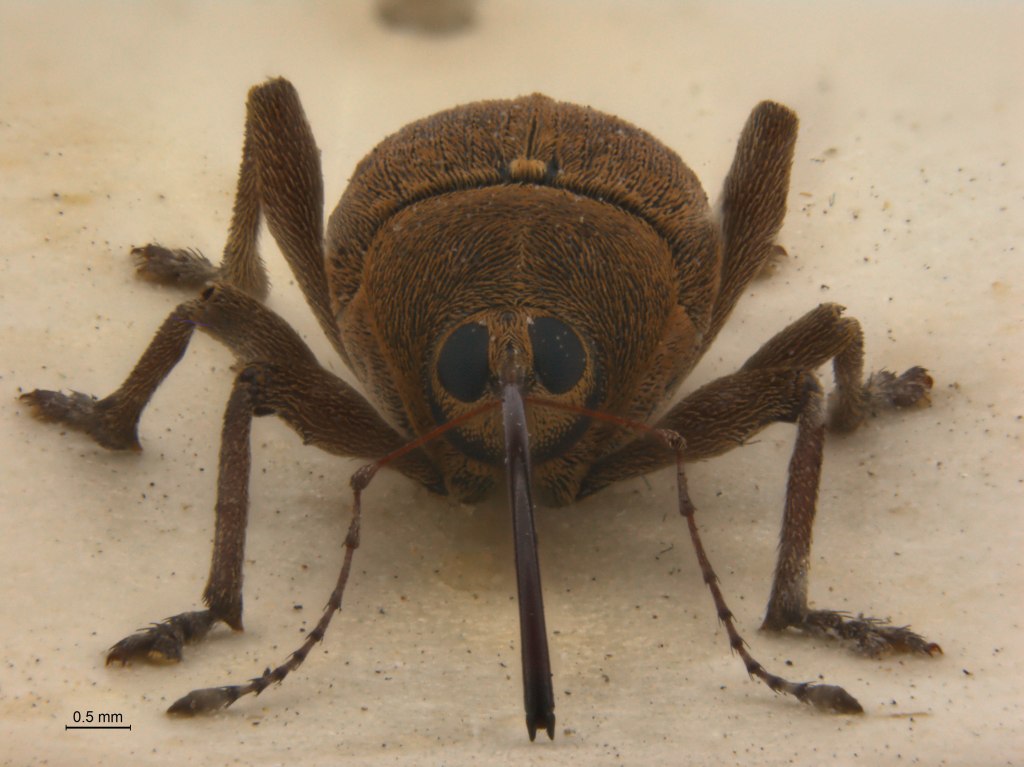
Acorn Weevil – Curculio glandium
Insects under the Lens – Wednesday 23rd February 2022, 1 – 3pm
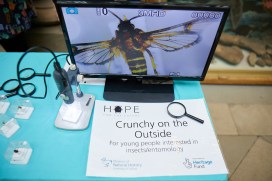
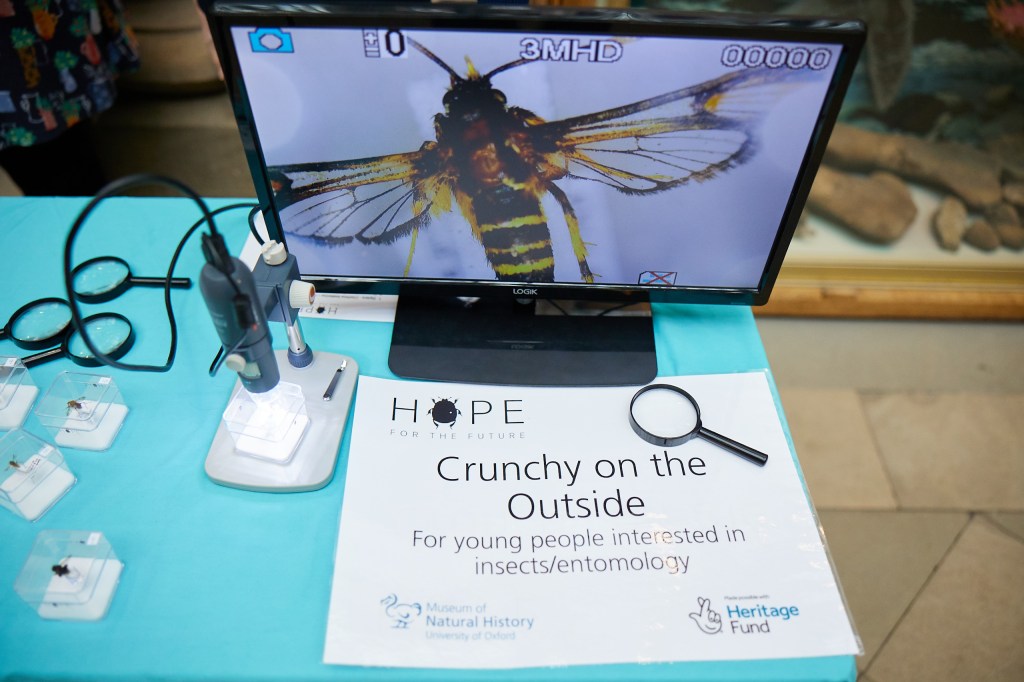
Intrigued by insects? Join us to take a closer look at some of the museum’s 5 million insect specimens under a variety of different lenses. We will be using microscopes and digital photography to reveal beautiful details of insect anatomy not visible to the naked eye. This workshop promises to unlock some of the secrets of the insect world and develop your powers of observation!
Six-belted Clearwing Moth under the microscope
FREE workshop – Insects under the Lens
Wednesday 23rd February 2022 , 1pm to 3pm
Museum of Natural History, Parks Road, Oxford, OX1 3PW
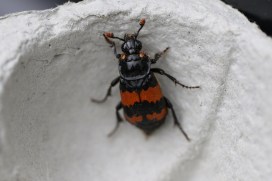
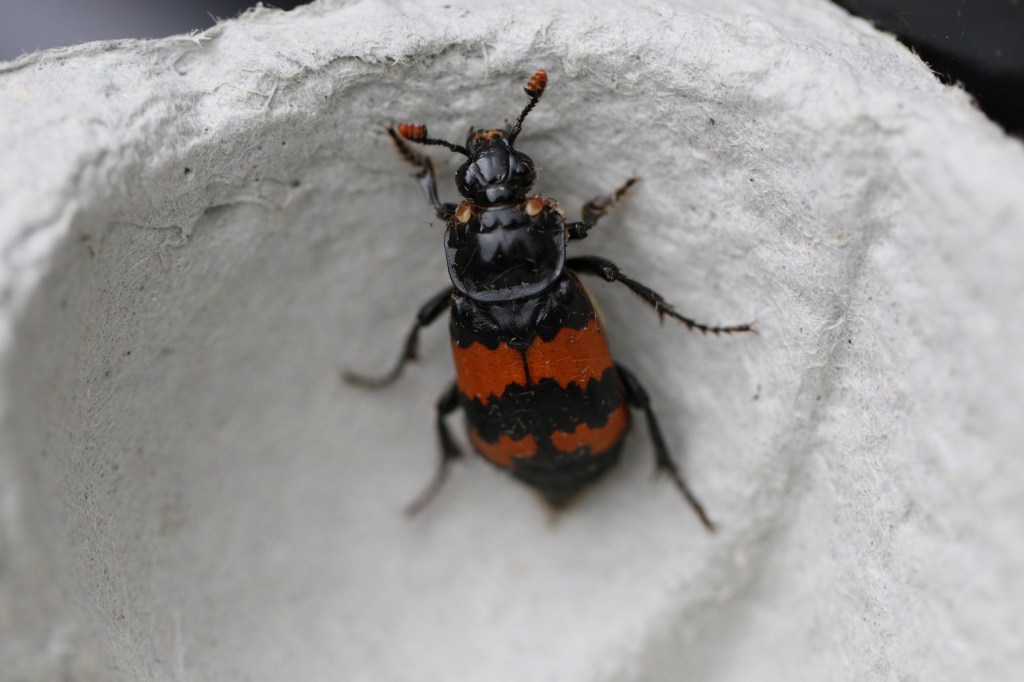
Carrion beetles are a family of beetles, Silphidae, that feed on decaying organic matter, such as dead animals. This makes them important natural recyclers.
They are also Ashleigh Whiffin’s favourite group of insects. She tells us a bit about them in this video:
Ashleigh Whiffin, Assistant Curator of Entomology for National Museums Scotland, telling us about her favourite group of insects.
Do you know of any other insects that act as decomposers and natural recyclers? Tell us about them in the comments below or in the Contact us section of the blog.
To round off an eventful year here at Crunchy on the Outside, we have put together a quiz for you combining our two favourite things: Insects and Christmas!
There are ten questions in the video. Each of the answers is formed by smashing together the two clues. One clue is about insects, the other about Christmas. We’ve included a couple of examples at the start to help you get the hang of it. Don’t worry if a question seems tricky, it’s just for fun and we’ve included some clues below.
Clues
The scientific name of this insect is Colletes hederae.
Nature is wonderfully imperfect, and the data that we can gather from it is even further from perfection. Fossil localities, even those providing exceptionally well-preserved fossils, are inaccurate records of the past. Fossils can form from a variety of matter including organisms, their remains, or even traces of their activity. Yet not all of the material that can get fossilised at a particular site actually will. Among other factors, biases in the fossil record result from the nature of the materials responsible for fossilisation – usually sediments which are in the process of turning into rocks. In most cases, fossil localities offer us only a single ‘window of preservation’ – a skewed geological record of the ancient ecosystem that once existed there.
In 2012, a rich vertebrate bone bed was documented at the Ariño site in Teruel, Spain. Since then, researchers have unearthed more than 10,000 individual fossil bones, from which they have discovered new species of dinosaurs, crocodiles, and turtles. Plant fossils were also found, including pollen grains and amber, which is fossilised resin. Although amber was known to occur in this locality, this sort of material had remained unstudied… until recently.
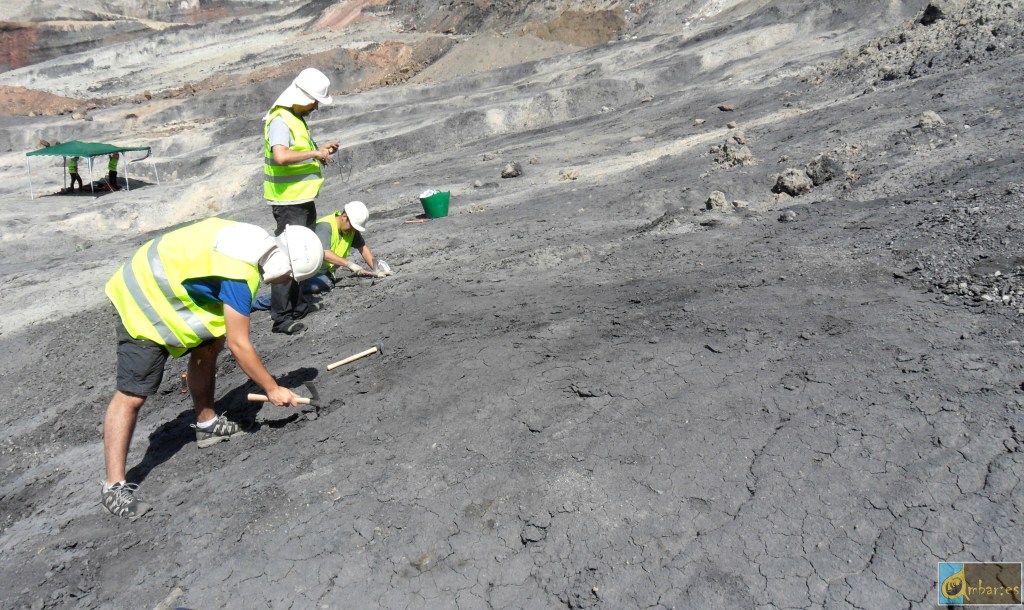
Over the summer of 2019, I joined my colleagues to carry out amber excavations in the Ariño site – an open-pit coal mine that has an almost lunar appearance due to the dark carbonate-rich mudstone rocks and the total lack of vegetation. The scorching heat during a very hot summer was a bit maddening, but I did try to enjoy my yearly dose of sun before returning to the UK!
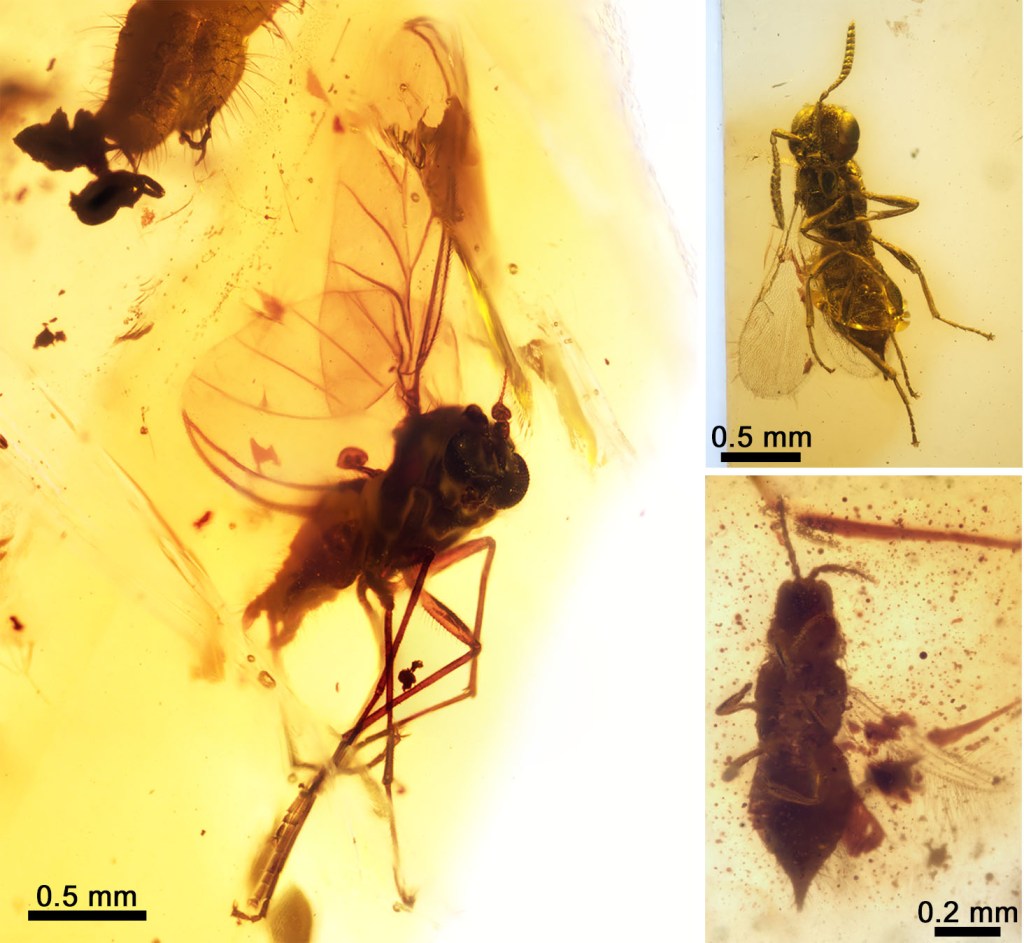
(Left) Manual extraction of amber from Ariño during the 2019 summer campaign. (Right) A selection of fossil insects found in Ariño amber: a true fly belonging to an extinct family (left); a platygastroid parasitoid wasp (top right); and a thrips (bottom right). Modified from Álvarez-Parra et al. 2021.
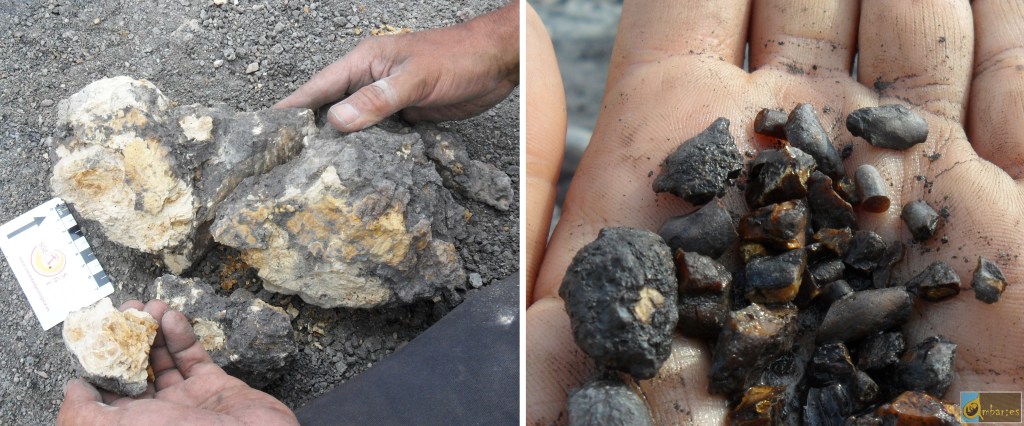
Resin pieces can be transported significant distances by runoff water before depositing on their final burial location, where they slowly transform into amber. However, we found amber pieces that had not moved from their original place of production. These large, round-shaped pieces preserved delicate surface patterns that would have been polished away even by the slightest transport. The resin that produced these amber pieces was formed by the roots of the resin-producing trees, and resembles sub-fossil resin my colleagues found in modern forests from New Zealand.
Large amber piece produced by roots (left) and assemblage of smaller amber pieces (right) from Ariño (Teurel, Spain).
The small amber pieces from Ariño contain an unusual abundance of fossils. These pieces come from resin produced by the branches and trunk of the resin-producing trees. From the almost one kilogram of amber we excavated, we identified a total of 166 fossils. These include diverse insects such as lacewings, beetles, or wasps, and arachnids such as spiders and mites. Even a mammal hair strand was found!1
We now know that the Ariño site provides two complementary windows of preservation — a bone bed preserving a rich variety of vertebrate animals, and amber with abundant inclusions. Aside from Ariño, only three localities that preserve both dinosaur bone beds and fossiliferous amber have been reported in Western France, Western Canada, and North Central United States. However, in these cases, either the bone bed or the amber have offered a much more modest abundance and diversity of fossils. Some of the fossils from these localities also show signs of significant transport, which means that the organisms could have inhabited different, distant areas even though they fossilised together. This makes Ariño unique because it offers two valuable ‘windows of preservation’ from the same ecosystem.
Thanks to all this evidence and other data, we have been able to reconstruct an ancient terrestrial ecosystem – a 110-million-year-old coastal swamp – with unprecedented detail and accuracy.2 The inherent incompleteness of the fossil record will always remain a headache for palaeontologists… but localities like Ariño make the data that we can recover from the past a bit more complete.
Reconstruction of the coastal swamp forest of Ariño, in the Iberian Peninsula, from 110 million years ago. Author: José Antonio Peñas. Source: Álvarez-Parra et al. 2021.
1Álvarez-Parra, Sergio, Ricardo Pérez-de la Fuente, Enrique Peñalver, Eduardo Barrón, Luis Alcalá, Jordi Pérez-Cano, Carles Martín-Closas et al. “Dinosaur bonebed amber from an original swamp forest soil.” Elife 10 (2021): e72477.
2Álvarez-Parra, Sergio, Xavier Delclòs, Mónica M. Solórzano-Kraemer, Luis Alcalá, and Enrique Peñalver. “Cretaceous amniote integuments recorded through a taphonomic process unique to resins.” Scientific reports 10, no. 1 (2020): 1-12.
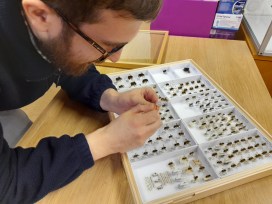
Louis is a Collections Assistant, for the HOPE for the Future Project, at Oxford University’s Museum of Natural History. Here he is telling us about his role and how he first became interested in insects.
Louis mentions that through his job he gets to see rare and extinct insects that you normally might not get the chance to see. Can you tell us about any rare or extinct insects that you know about? Let us know in the comments below, or through the contact us page.