The stars our destination?

john-barnie

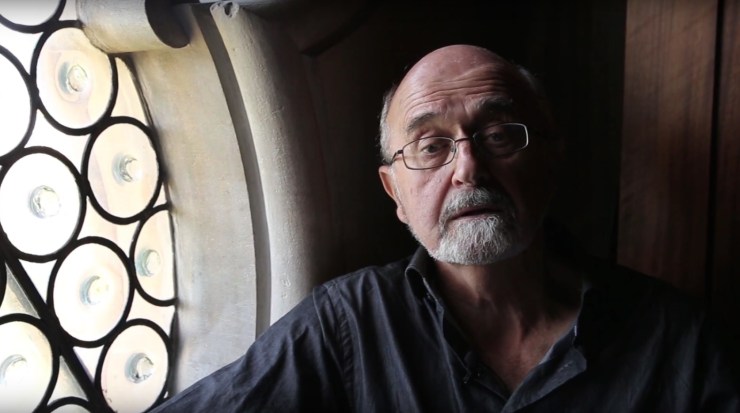
John Barnie, one of our three Poets in Residence, reflects on claims that the future of life from Earth lies deep in the Solar System…

In a recent article in The New York Review of Books, physicist Freeman Dyson speculates that in three or four hundred years it may be possible to seed promising planets and moons in the solar system with organisms genetically engineered to withstand their harsh conditions, eventually transforming them into environments which could support humans – fleeing, perhaps, from an irreparably damaged Earth.

297191main_enceladus_full
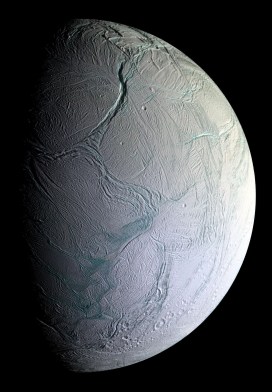
Does Saturn’s moon, Enceladus, offer a viable site for the seeding of life? Image: NASA/JPL/Space Science Institute

Saturn’s moon Enceladus is one example he gives; geysers pierce its hostile icy surface, and Dyson hypothesises a warm sea hidden below. The process would be achieved by landing ‘pods’ of self-sustaining life forms – ‘Noah’s Arks’ he calls them. The rocket technology is well on its way, he argues, and will be perfected by small cost-effective space companies rather than lumbering giants like NASA. Biotechnology, too, will develop by leaps and bounds to produce, for example, ‘warm-blooded plants’ that would absorb energy – on Saturn’s moon Enceladus, say – concentrated from starlight and the distant rays of the Sun.

In the increasingly stressed and chaotic twenty-first century, it is impossible to predict what will happen in two or three years, let alone two or three hundred. In the meantime, while Professor Dyson elaborates his techno-fantasies, we are here, on the only Ark we have, and the only one, I’d say, we are ever likely to have.
asfas
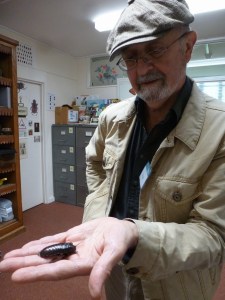
John Barnie meets some of our live residents, the Madagascar Hissing Cockroaches, during his residency at the Museum

My year at the Museum has been a fascinating and unforgettable reminder of this, the Museum itself forming an ark within an ark, celebrating the extraordinary diversity of multicellular life as it evolved over 650 million years. Many of its specimens, of course, represent extinct species, and they, too, are a reminder – of how life on Earth is fragile but also robust, endlessly reacting and adapting to changing circumstances. Life has survived at least five mass extinctions in the geological record, and will survive the largely human-induced one many biologists and naturalists, from Niles Eldredge to David Attenborough, think we are entering now – though our species may not be around to see what gets through the inevitable extinction bottleneck.

For techno-utopians like Freeman Dyson, the future is out there in space, not here where we evolved, where we have the grounding of our being. The new biotechnology, he argues, will have to be perfected on Earth first, filling ‘empty ecological niches’. They may, he suggests, ‘make Antarctica green before they take root on Mars’. There are so many things wrong with this it is difficult to know where to start. Luckily for us, the Museum of Natural History represents a very different vision of the Earth, its creatures, and our place among them.
Nature’s medals

By Sarah Joomun, Documentation officer

In the 1820s a young geologist named Charles Lyell travelled around France studying the landscape and rock formations to try and work out the processes that created them.

In between these field-trips, he met the people who had been studying the geology of France and from these discussions and his observations he created The Principles of Geology, one of the first significant popular science books on the subject and a foundation for the methods of modern geology.

pal_cl01718_01

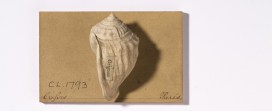
Lyell collected many samples from the rocks he studied, amassing thousands of fossils during his lifetime. The Museum has a collection of some 16,000 of them, around 90 per cent of which are shells, mostly gastropods (snails) and bivalves (clams), many collected during his travels in France.

The reason for this prodigious collection of fossil shells, or testacea as they were then known, was that Lyell believed them to be the most useful clue to understanding the Earth’s history.

The testacea are by far the most important of all classes of organic beings which have left their spoils in the subaqueous deposits : they are the medals which nature has chiefly selected to record the history of the former changes of the globe.

– Lyell’s Principles of Geology, Vol III, 1833.

Fossil shells can show how the animal that lived inside the shell behaved, and whether it lived on the land, in freshwater or in the sea. Species of shelled animals have a wide geographical range and individual species survive for a long time, so they can be compared across time and space.

pal_cl01742_02

This allowed Lyell and his colleagues to determine the relative ages of the rock layers that the fossil shells came from. He looked at the proportion of shells that belonged to living species and determined that the rock layers with the lowest proportion of living species were likely to be older than rocks with higher proportions of living species.

And so three main groups of rock layers were found: the Eocene, containing fewer than 4% living species; the Miocene, with fewer than 18% living species; and the Pliocene, with more than a third of living species.

Although what is now known as the Eocene (from 56 to 34 million years ago), Miocene (23 to 5.3 million years ago) and the Pliocene (from 5.3 to 2.6 million years ago) don’t denote exactly the same periods as Lyell described, we still use these terms for some of the youngest geological epochs today.

Tales from the Jurassic Coast

marybuckland_philpot_2

Britain’s Jurassic Coast is a famous location for fossil hunters. Dorset’s Lyme Regis in particular was a collecting ground for two very important Victorian palaeontologists – Elizabeth Philpot (1780-1857) and Mary Anning (1799-1847) – and the site yielded some of the earliest specimens of Ichthyosaurs and Plesiosaurs.

Last weekend Channel 4’s Walking Through Time series focused on the Jurassic Coast and featured two members of staff from the Museum, Eliza Howlett and Hilary Ketchum from our Earth Collections. To coincide with the programme, Eliza here delves into the Museum’s Philpot archive to paint a picture of the relationship between Elizabeth Philpot, Mary Anning, and Oxford University’s first Reader in Geology, William Buckland.

*

Elizabeth Philpot moved to Lyme Regis around 1805 with two of her three sisters, Mary and Margaret, where they soon became involved in fossil collecting and where they remained for life. At this time Lyme-born Mary Anning was still a young girl, but so began an affectionate relationship with the Philpot sisters which transcended any barriers of age, social origins or educational background.

Caption
A letter from Elizabeth Philpot to Mary Buckland dated 9 December 1833.

As the Philpots’ fossil collection grew it became known in the geological community. One familiar visitor was William Buckland, whose earliest published reference to the ‘Miss Philpots’ is in his 1829 paper on the pterosaur found at Lyme by Mary Anning.

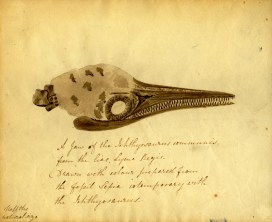
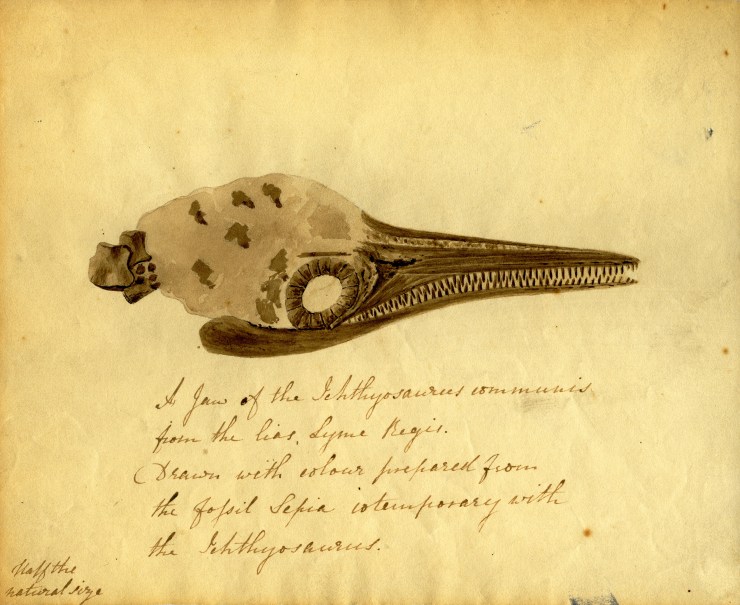
In one letter to Buckland’s wife, Mary, dated 9 December 1833, Elizabeth Philpot enclosed a sketch of an ichthyosaur head that she had painted using ink from a fossil squid of the same age as the ichthyosaur, 200 million years old; this is pictured at the top of the article. The letter also contained a colourful description of Mary Anning’s escapades:

Yesterday [Mary Anning] had one of her miraculous escapes in going to the beach before sun rise and was nearly killed in passing over the bridge by the wheel of a cart which threw her down and crushed her against the wall. Fortunately the cart was stopped in time to allow of her being extricated from her most perilous situation and happily she is not prevented from pursuing her daily employment.

Next, it sends a reminder to William Buckland, a man well-known for forgetting things:

May I beg you to remind Dr. Buckland that he has borrowed from me some Plesiosaurus vertebre. As it is some time since I will mention that it is a section of a vertebre, one with the process, ten others, and a chain set in a box.

These letters from Elizabeth Philpot are now held by the Museum, along with the Philpot collection of around 400 fossils. Mostly from Lyme Regis, this collection includes more than 40 type specimens, the reference specimen for a new species, which is a remarkable total for any collector. A brief list of people known to have examined the collection is practically a roll call of the key figures in 19th-century palaeontology: William Buckland, William Conybeare, John Lindley and William Hutton, Richard Owen, James Sowerby, and (from Switzerland) Louis Agassiz.

But the collection was also made available to the ordinary people of Lyme, and the handwritten labels by Elizabeth Philpot sometimes included detailed explanations of what these extinct animals would have looked like. Both the letters and the specimens remain deeply evocative today, conjuring up visions of what it must have been like to call on these three remarkable sisters.

Because of the risk of light damage the material is not normally on display, but it can be viewed by appointment. Email library@oum.ox.ac.uk or earth@oum.ox.ac.uk for more information.

“Yet With Time’s Cycles Forests Swell”

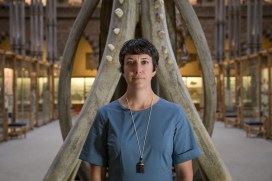
As part of the Museum’s Visions of Nature year in 2016, we have had the pleasure of hosting three poets in residence: John Barnie, Steven Matthews, and Kelley Swain. During the year the poets worked alongside staff in the collections and out in the Museum itself to gain inspiration for their writing. A small anthology of the resulting poetry is published at the end of 2016.

In this video Steven Matthews reads his poem “Yet With Time’s Cycles Forests Swell”. The title is taken from a line in a poem called Emblems by one the founding members of the Pre-Raphaelites, Thomas Woolner.

To The Palaeontologists

As part of the Museum’s Visions of Nature year in 2016, we have had the pleasure of hosting three poets in residence: John Barnie, Steven Matthews, and Kelley Swain. During the year the poets worked alongside staff in the collections and out in the Museum itself to gain inspiration for their writing. A small anthology of the resulting poetry is published at the end of 2016.

In this video Kelley Swain reads two of her poems To The Palaeontologists and Rorqual. Kelley is a poet, writer and editor.

You can meet Kelley at the Museum for National Poetry Day on Thursday 6 October 2016.

In The Grand Concourse

As part of the Museum’s Visions of Nature year in 2016, we have had the pleasure of hosting three poets in residence: John Barnie, Steven Matthews, and Kelley Swain. During the year the poets worked alongside staff in the collections and out in the Museum itself to gain inspiration for their writing. A small anthology of the resulting poetry is published at the end of 2016.

In this video John Barnie reads his poem The Grand Concourse, inspired by the Museum’s main space. Listen out for other references to the Museum in the poem. John is a poet and essayist from Abergavenny, Monmouthshire.

You can meet John on National Poetry Day on Thursday 6 October 2016, when he will be at the our special event during the morning.