The world’s first fussy eaters?

OUMNH_Blog_Post_Rahman_Figure1

by Dr Imran Rahman, Research Fellow

I have just returned from visiting colleagues at Vanderbilt University in Nashville, Tennessee. Nashville is the home of country music, hot chicken and, most importantly for my work, a brand new CT scanner. Together with Drs Simon Darroch, Marc Laflamme and Rachel Racicot, I used the CT scanner to create 3-D models of 560-million-year-old fossils which will be used to learn more about how such ancient organisms lived and fed.

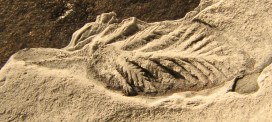
These fossils are some of the strangest ever described. They come from the ‘Ediacara biota’, which is approximately 542 to 600 million years old. These include the first large organisms on Earth, some of which might be early animals, but placing these fossils in their correct place in the tree of life is extremely controversial. In fact, despite extensive study by palaeontologists for many years, we know very little about what these organisms were like when they were alive.

In order to better understand these enigmatic fossils, we used Simon’s CT scanner to study them. The scanner works by using X-rays to create cross-sectional images through the specimen, which can be then used to digitally reconstruct it in 3D. We scanned a range of different fossils and were able to describe their morphology in exceptional detail, as shown in the image below.

OUMNH_Blog_Post_Rahman_Figure2
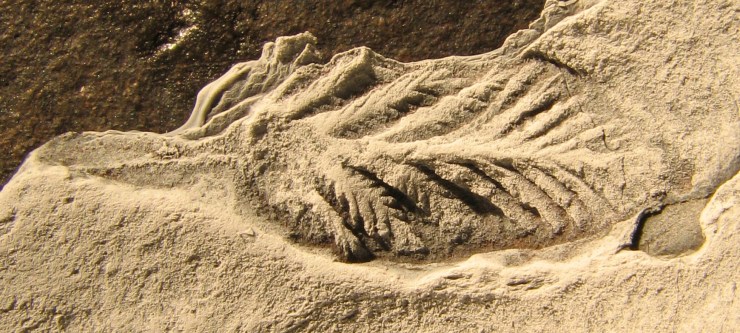
3D reconstruction of the fossil shown at the top of the article: a 560-million-year-old organism from Spaniard’s Bay, Newfoundland (width of fossil = c. 8 mm). Source: Marc Laflamme.

These 3D reconstructions will serve as a basis for computer simulations of water flow around the fossils, which will allow us to evaluate ideas about how these organisms might have fed. Research we carried out last year suggested that some Ediacaran organisms may have fed in a more complex way than previously thought, and we would like to test if this applies to other species from the same time period.

Simon, an Assistant Professor in Vanderbilt’s Department of Earth and Environmental Sciences, brought us together to carry out this research. We will also be working closely with Simon’s Grad Student, Brandt Gibson, who is creating 3D models of fossils using computer graphics software. Ultimately, we hope to gain a better understanding of Ediacaran ecosystems, which will provide important new insights into the early evolution of complex life.
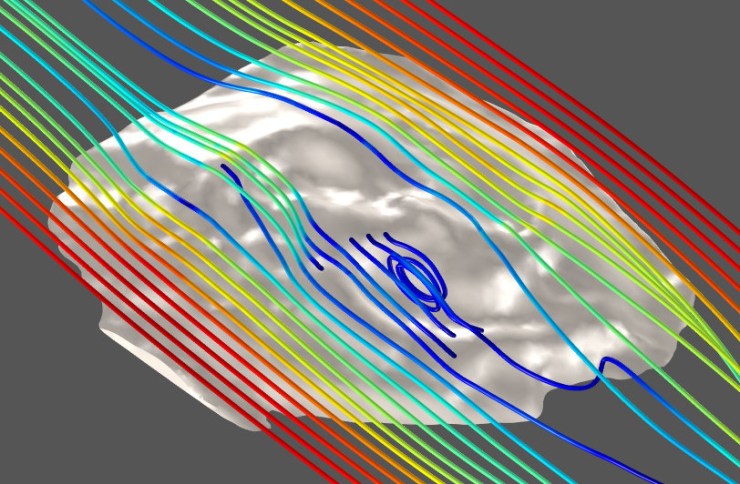
Computer simulation of water flow around a 3-D reconstruction of a 555-million-year-old fossil organism from Flinders Ranges, Australia (width of image = c. 30 mm). Source: Imran Rahman.

The value of collections

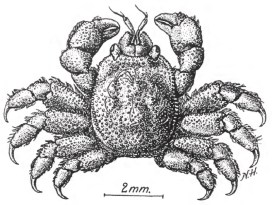
Gall crab illustration
Figure after Kropp and Manning (1987: Fig. 4)

by Sancia van der Meij, Research Fellow

Scientists often use DNA to study the position of a species in the tree of life. By sequencing DNA from different species we can begin to see how closely they are related, but sometimes it can be difficult to obtain specimens to carry out this type of research. This is where museum collections become invaluable.

I have been investigating a tiny coral-dwelling crab, Detocarcinus balssi, which is less than 1cm in size and lives in the Atlantic ocean. In a paper just published in the Journal of Zoological Systematics and Evolutionary Research, my co-writer and I show how we have resolved where this crab is placed, taxonomically-speaking.

To establish this we needed DNA, but unfortunately the crab has only been collected on a few occasions since the discovery of the species in 1956. Luckily, the Smithsonian Institution in Washington D.C. houses several specimens of D. balssi that were collected in the 1980s.

Gall crab females carry many, many eggs, so with permission of the curator at the Smithsonian a special DNA protocol for old and degenerated material was used to extract small fragments of DNA from the eggs of a D. balssi specimen collected in 1984.

Gall crab
Hapalocarcinus marsupialis, a gall crab similar to Detocarcinus ballsi, with big bundle of eggs

The DNA sequence that was obtained offered a surprise: the Atlantic species D. balssi is more closely related to an Indo-Pacific species Utinomiella dimorpha than any other Atlantic species. This may seem odd at first, but gall crabs probably originated before the Panama Isthmus – the landmass connecting North and South America – was fully closed. At the time, species could freely pass between what we now know as the Pacific Ocean and the Atlantic Ocean.

With this little part of the puzzle solved, the relationship between Atlantic and Indo-Pacific gall crab species can be studied in more detail.

Without the scientific collections held in museums this research could not have been completed. Researchers increasingly use museum collections, including the famous Dodo in this Museum, to answer important questions about where to fit a species in the taxonomic scheme of things – on the grand tree of life.

Value Added Taxonomy

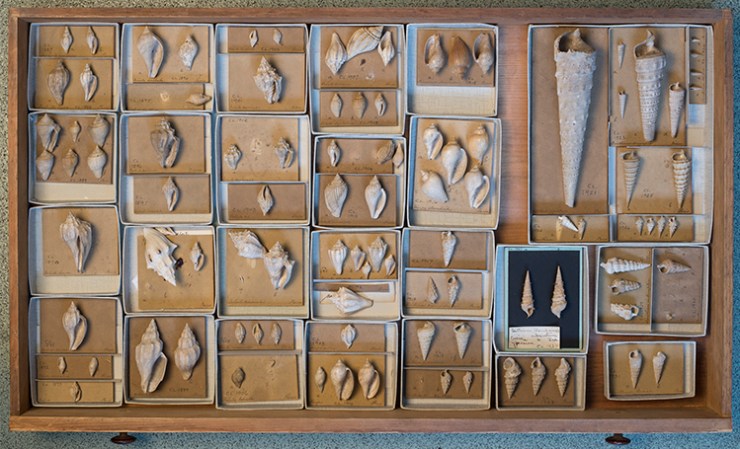
Drawer of Lyell gastropods

Three years ago, one of the Museum’s key strategic aims was to introduce a unified collections management system (CMS) for the scientific collections. Combining data from all the museum collections will allow people to search across all these collections and will also be of enormous benefit in managing activities such as loans, exhibitions, conservation, object entry and exit and movement control, as well as integrating digital imagery.

The CMS chosen was KE EMu, which works very well for natural history collections, particularly in the way that it deals with taxonomy (the classification of organisms). Migration of data and original cataloguing is now well underway, with records for minerals, butterflies and moths and archives all in the new system. The Lyell digitisation will act as a pilot project for the migration of palaeontological data.

The biggest challenge with moving all our collections data to a single system will be to standardise data structures and terminology across the collections, for example taxonomy, localities, people and organisations, and bibliographic references. In this blog post we are going to focus on taxonomy, which is key to the understanding of the palaeontology, zoology and entomology collections.

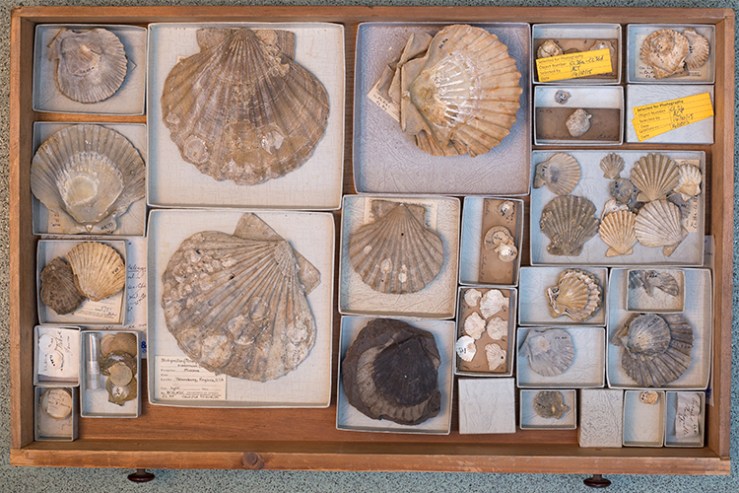
Image of drawer of pecten shells collected by Charles Lyell
Drawer of pecten shells collected by Charles Lyell

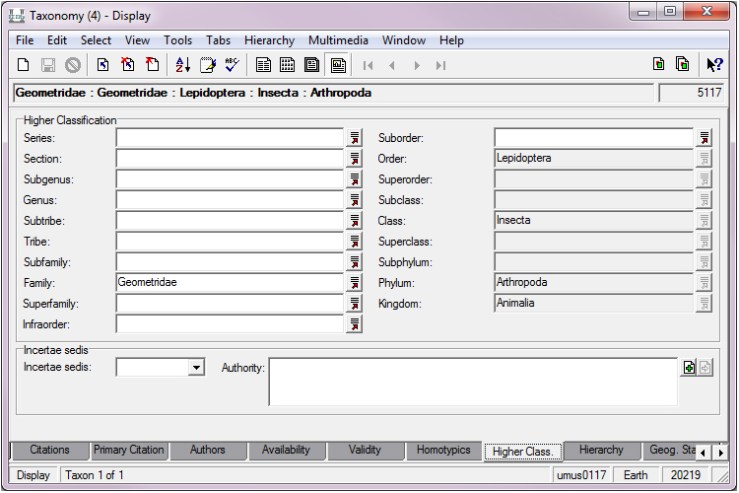
All the collections databases record the genus and species where these can be identified. The higher taxonomy, e.g. kingdom, phylum, class, order, family, has been recorded less consistently. At present, the palaeontology collections use an all-purpose field called Taxonomic Group. This is a mixture of phyla, classes, subclasses, orders and a few other groups, chosen because they were regarded as the most useful search terms.

As a consequence, to find all the molluscs in a database you would need 14 separate search terms (Scaphopoda, Amphineura, Monoplacophora, Gastropoda, Nautiloidea, Ammonoidea, Coleoidea, Cephalopoda (other), Bivalvia, Rostroconchia, Tentaculitida, Cornulitida, Hyolitha, and Mollusca (other)). What KE EMu will offer is a structured way of searching taxonomy at multiple levels, for example simply searching for Mollusca, rather than multiple terms.

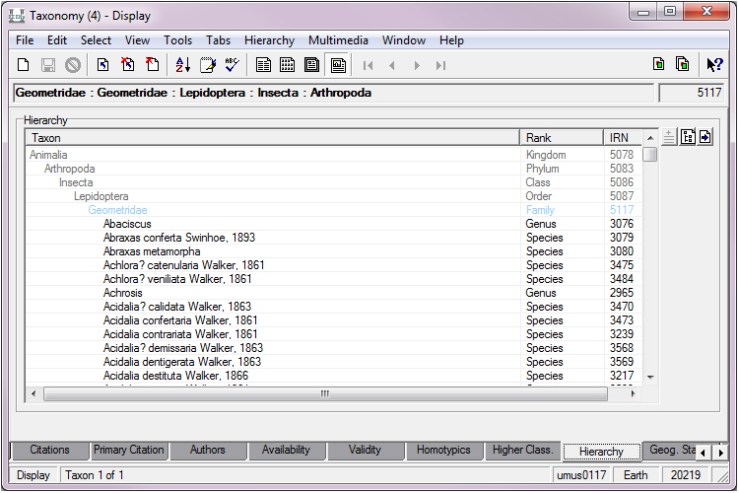
Our approach to standardising the taxonomic data has been to build a new hierarchy across the collections, starting at phylum level. Most terms for palaeontology and zoology mapped very easily, but the process raised some interesting questions such as how we deal with the fossils that were previously bundled in the ‘Vendazoa’. Our answer will probably be to class these specimens as incertae sedis and reclassify them if and when the question of their affinities is resolved.

Screenshot of taxonomy fields for entomology in KE EMu CMS
Taxonomy fields in KE EMu CMS
Screenshot of part of taxonomy hierarchy in KE EMu CMS
Part of taxonomy hierarchy in KE EMu CMS

The next step will be to construct the lower levels of the hierarchy down to order level, for example Phylum Mollusca, Class Bivalvia, Order Pectinida. The resources required to determine the family for all our specimens mean that we will need to address this on a project by project basis. For now we are starting to fill in the family and order for all our Lyell material using a combination of the Paleobiology Database and the Treatise on Invertebrate Paleontology. A more specific site that has been particularly useful for Lyell is the Virtual Scientific Collection of French Tertiary Fossils. Gastropods and bivalves make up over 90% of the Lyell Collection, and by the end of the project we hope to have constructed a usable hierarchy down to family level for both these groups. This will involve close work with the Life Collections staff, as we are unlikely to find many reference works that take into account both recent and fossil specimens.

Plesiosaur puzzle

IMG_7075

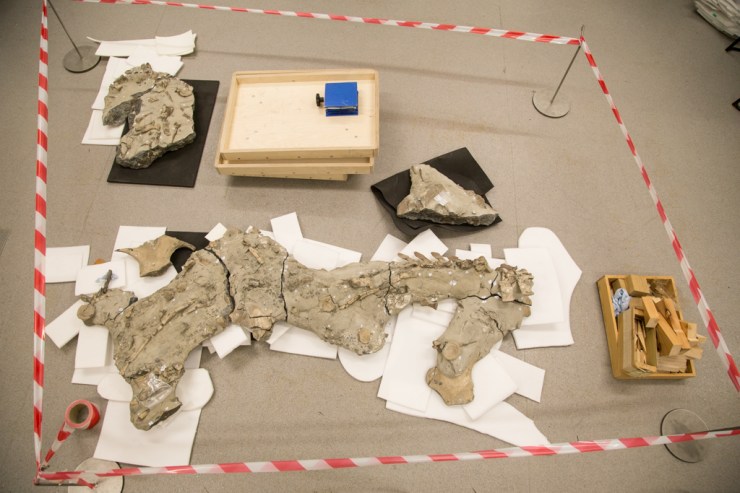
An exciting new resident arrived at the Museum recently, having lain in the Cambridgeshire earth for around 165 million years. Discovered in a quarry near Peterborough, the skeleton of a 5.5 metre plesiosaur has been donated to the Museum and is now awaiting reconstruction and further study in our labs.

Plesiosaurs were long-necked sea creatures that lived during the time of the dinosaurs, but died out 66 million years ago.

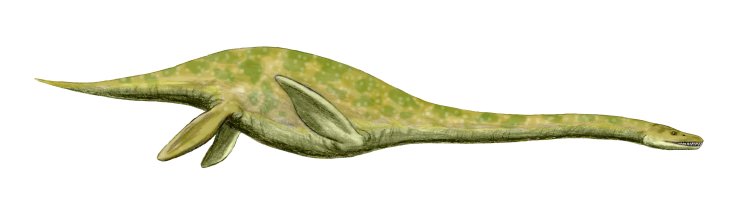
Muraenosaurus
Artist’s impression of Muraenosaurus leedsii, a similar plesiosaur from the Middle Jurassic of Europe. Image by Nobumichi Tamura.

The fossilized remains of the marine reptile were discovered at a site owned by building product manufacturer Forterra, which has kindly allowed the material to be added to the Museum’s collections.

The creature was first spotted by Oxford Clay Working Group member Carl Harrington who noticed a tiny fragment of bone sticking out of the clay. Over the course of four days, Carl and eight others dug up more than 600 pieces of fossilised bone. Carl then spent over 400 hours cleaning and repairing the specimen.

I’d never seen so much bone in one spot in a quarry. As I was digging amongst the wet clay, the snout of a plesiosaur started to appear in front of me. It was one of those absolute ‘wow’ moments – I was the first human to come face to face with this reptile.

IMG_7059
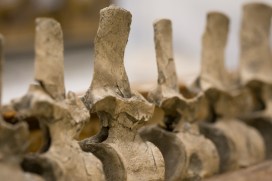
The plesiosaur’s neck vertebrae

The plesiosaur had a 2.5 metre long neck, a barrel-shaped body, four flippers and a short tail. Its skull is still preserved inside a block of clay, and the painstaking task of removing it will now be undertaken here.

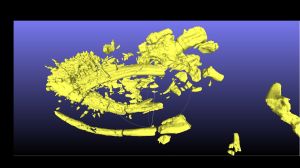
A CT scan of the plesiosaur's skull, which is still inside a clay block
A CT scan of the plesiosaur’s skull, which is still inside a clay block

DrJames Neenan, one of our research fellows, and Professor John Hutchinson from the Royal Veterinary College have already CT-scanned the block to reveal the location of the bones inside. This will help in removing it from the clay.

Next week pupils from a visiting secondary school will get the chance to see the plesiosaur find for themselves and to ask our Earth Collections manager Dr Hilary Ketchum all about it. Hilary says:

We are so excited that the plesiosaur has come to the Museum where it will be used for research, education and display.

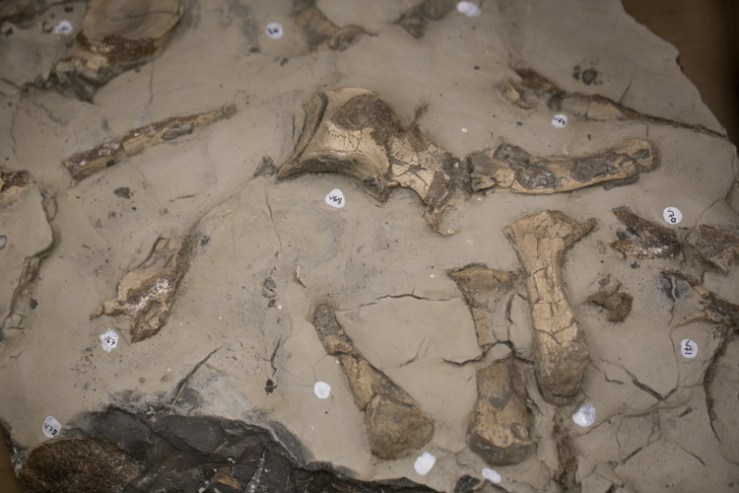
The plesiosaur’s ribs and vertebrae still inside the rock

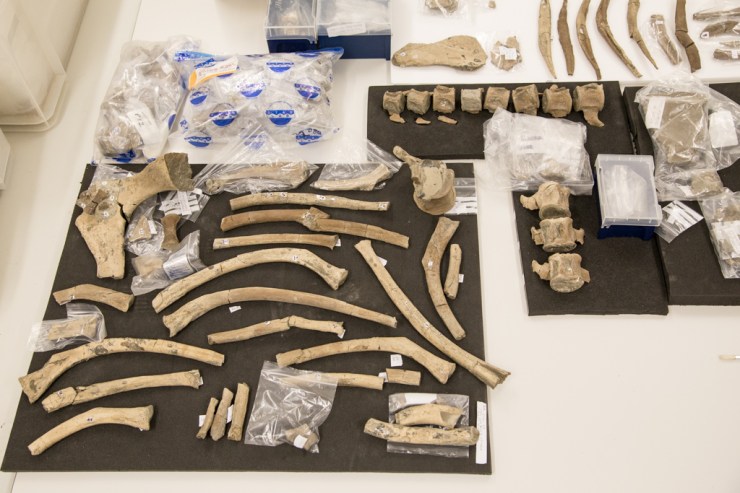
Hilary will now begin the task of reconstructing the plesiosaur from the remains you can see in the photos here – a combination of individual separate bones and those still contained in clay nodules. Ultimately, we hope to articulate and suspend the specimen for public display.

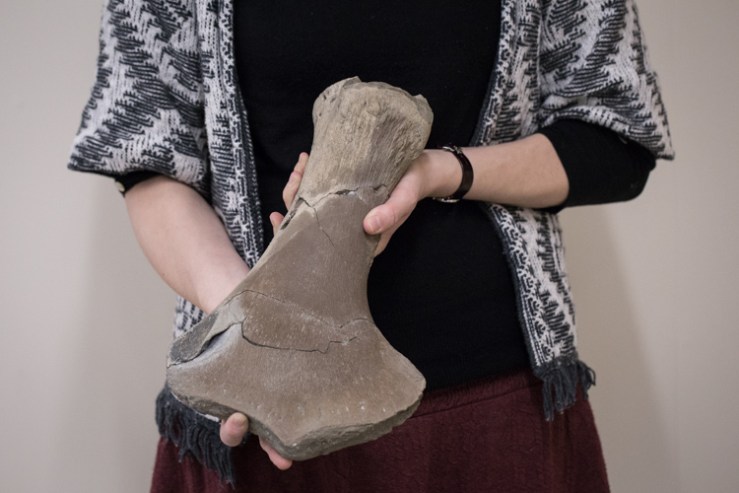
Hilary holds out the plesiosaur’s arm bone (humerus)

Part of the study will be to determine whether this is a known or new species of plesiosaur. Early indications suggest that it might be a species new to science, but more investigation is needed before we will know for sure.

Watch this space…

IMG_7078

Different Hands

IMG_0018
Five specimens of the bivalve Cardita rudista Lamarck, 1919 from Touraine, France

Most of Lyell’s specimens are mounted on wooden tablets like the one pictured above. The glue used for mounting the specimens has failed in some cases so the fossils are loose. This means we have to be very careful moving them, for example if we want to see what’s written on the back.

IMG_0022
The glue used to mount these bivalves has failed.
back of a Charles Lyell tablet with the loose fossils detached
The back of a Charles Lyell tablet with the loose fossils detached.

The faded ink writing on the front of the tablet gives the identification “Cardita rudis” and the locality “Touraine”, a historical province in the north east of France. We think that this writing and the pencil on the back may belong to Charles Lyell based on comparison with some of his letters, but we aren’t sure. We do know that the black ink numbers were added to the tablets by Paul Clasby, the Honorary Associate who catalogued the collection in the 1980s and 1990s.

Although it gives the same information, the writing in ink on the back of the tablet seems completely different to Lyell’s, and the slope of the letters suggests that the writer may have been left handed. The layout suggests that the ink writing came first and the pencil was added later, which means Lyell may not have been the person to originally identify the specimen.

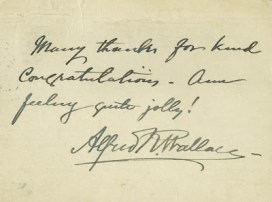
We’ve come across a few cases where people working with Lyell helped label fossils (for example the fossil bryozoans annotated by Lonsdale on this page from the Natural History Museum). There is also some indication that one of Lyell’s sisters labelled some specimens held at the University of Dundee.

Some of our unmounted Lyell fossils have distinctive labels from previous owners, but the fact that these Cardita specimens are mounted on the standard Lyell tablet suggests that the ink writing on the back is not that of an original collector. As we continue to work through the collection we hope to work out the identities of some of the other people associated with it and the role they played.

Temporarily misplaced

Scouring the archives, and receiving an unexpected package, help our documentation officer Sarah Joomun in her investigations into the Museum’s Lyell collection of fossil material.

Read more on the latest post from Past to Present…

Sarah Joomun's avatarPast to Present

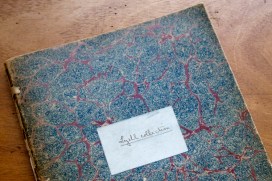
When I started work on the Lyell project in July of this year, I was very keen to know more about the history of the collection, both before and after it arrived at the museum. Collections often arrive at the Museum with associated material such as catalogues, letters or notebooks and after they arrive any activity related to the collection should be documented.

The first step in investigating the history of the collection was to find out what was in the Museum’s records. I began by looking at the donors database; this recorded the date that the Lyell collection arrived (1903) and the donor, Sir Leonard Lyell, Charles Lyell’s nephew. There was a little more information in the donors card index, which mentioned the fact that the collection came in two parts, the bulk of the collection in 1903 and then additional Italian specimens in 1907. The Collections Manager, Eliza…

View original post 674 more words