It is with much happiness (and a lot of satisfaction) we can announce that the ‘Once in a Whale’ project has been shortlisted for a Museums and Heritage Award for Excellence 2014, in the ‘Restoration or Conservation’ category. The glitzy ceremony is to be held at 8 Northumberland Avenue in London on May 14th 2014. We will be competing with some other amazing projects, including the Staffordshire Hoard Conservation Outreach Programme and the Mary Rose Trust. We are extremely grateful for the opportunity and feel that even to be shortlisted is a huge accomplishment for our little project. With thanks to the Museums and Heritage show, details of which can be found here: http://www.museumsandheritage.com/
Project Conservators: Nicola Crompton, Gemma Aboe and Bethany Palumbo
We’d also like to thank the Arts Council England for the Preservation of Industrial and Scientific Material…
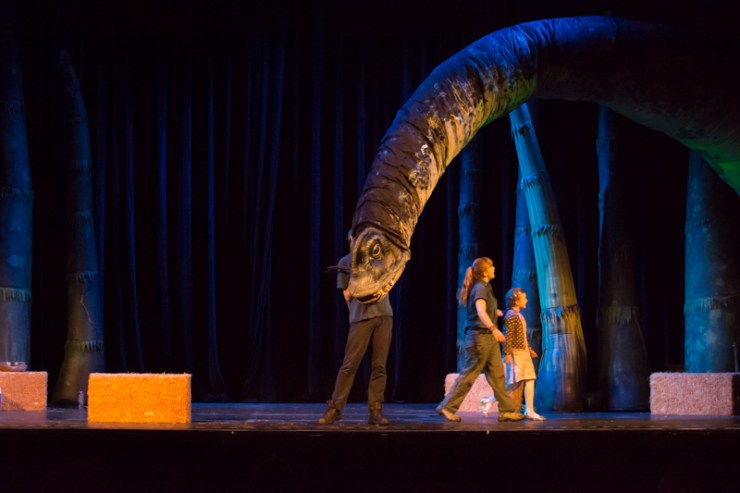
Last weekend the dinosaurs rumbled into town; a whole menagerie of them. Indeed, it was a veritable Dinosaur Zoo. They’d come a long way too – all the way from Australia – and so their names were not so familiar to us: the Australovenator, the Titanosuar (above),the Dryosaur, and the cutely-named Leaellynasaura, so-called after the discoverer’s daughter Leaellyn (Leaellyn’s lizard, see?).
If you didn’t catch it, these creatures were all part of a show at Oxford’s New Theatre. There was a sneak preview of this in the Museum earlier in the year. Produced by Australian company Erth Visual and Physical, the Dinosaur Zoo Live production mixes the thrill of brilliant puppetry with facts and explanations about the adaptations, environments and possible behaviours of these long-lost Australian lizards.
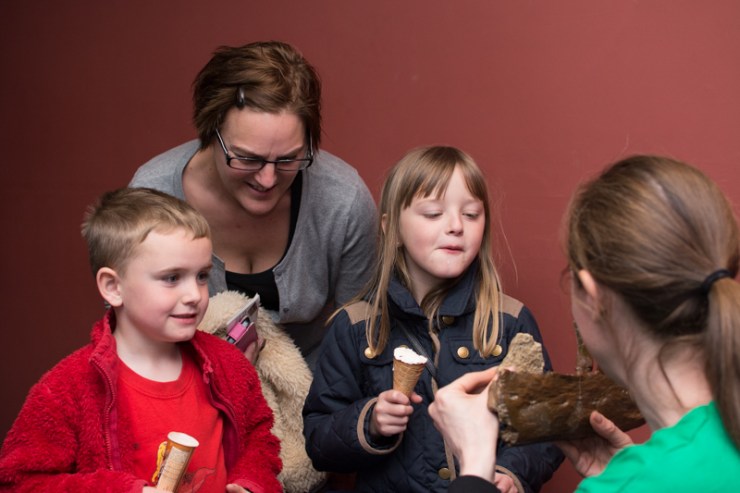
This wasn’t an opportunity to be missed, so we teamed up with the New Theatre and the show’s production team to bring some of our own fossil specimens to the event. With a handling table set up in the theatre’s bar area, families spent up to an hour before the show examining our selection of theropod and sauropod material, getting up close to teeth, eggs, jaws, and more.
We had the lower jaw and fossilised tooth from Oxfordshire’s very own Megalosaurus, famous for being the first dinosaur to be scientifically described, by William Buckland in 1824 (actually the term Dinosauria came later, coined by Richard Owen in 1842). As it was Easter we had some ancient eggs too, including the fossil of an egg laid, probably, by a sauropod dinosaur, cracks in the shell still clearly visible.
A family enjoy pre-show ice creams while learning about the Megalosaurus
To represent the the Cretaceous period, which is when the Australian beasts in the show were around, we brought the teeth and a hefty vertebra of an Iguanodon. Unlike the still-serrated Megalosaurus tooth fossil, the flat Iguanodon teeth show that this dinosaur was a herbivore. There’s a nice story, possibly apocryphal, that these teeth were actually spotted not by Gideon Mantell, the geologist who described Iguanodon in 1825, but by his wife Mary Ann as she waited in their carriage for her husband to visit a patient in Sussex.
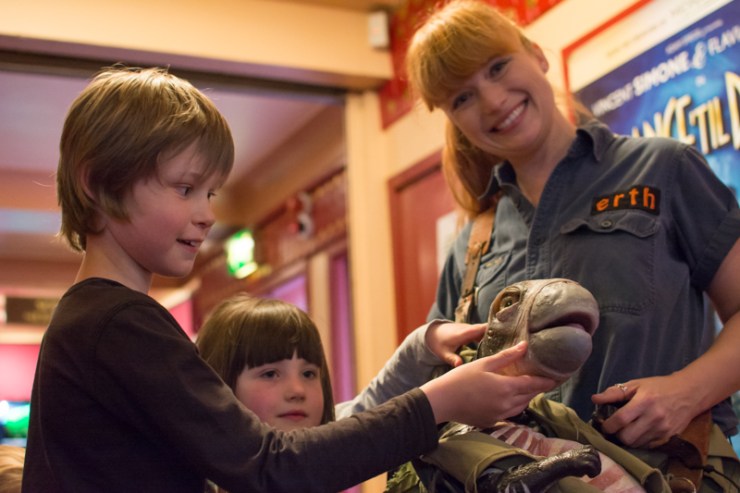
Meeting the stars after the show with brilliant host and zoo-keeper Lindsey Chaplin
We threw in a couple of tricksy things too. On the handling table there were two non-dinosaur specimens – could people work out which they were? In many cases, yes they could: if there’s one thing we learnt it’s that young kids know a heck of a lot about dinosaurs. The two red herrings were an ichthyosaur skull, because ichthyosaurs were marine reptiles rather than dinosaurs; and the fossil imprint of a leathery egg, probably laid by a prehistoric crocodile or turtle.
All in all, everyone had a great big dinosaur overdose. Still, better that than chocolate eggs.
Each year our Education team hosts two students from Oxford Brookes University’s PGCE course in Primary Education. The students are in the third and final year of their degree and get the chance to spend a week here to learn about the techniques and strengths of museum education and to plan their own class session using the collections.
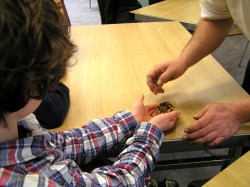
Handling a Chilean rose tarantula
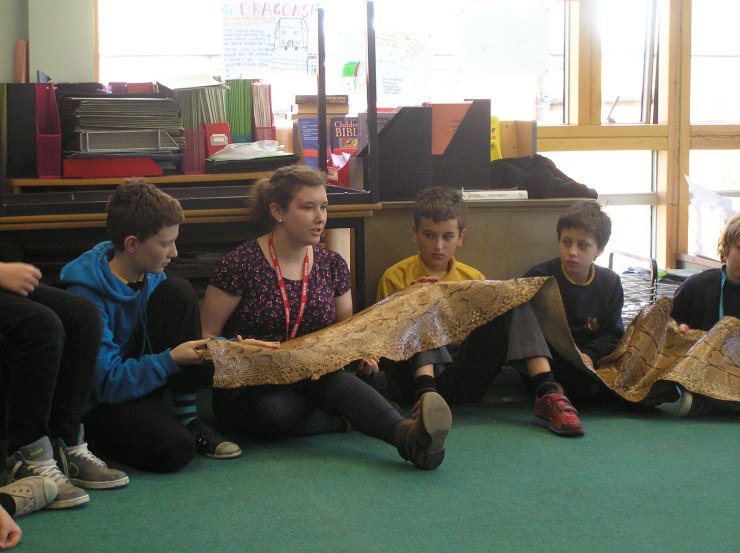
This year’s students were Hannah Fry and Ryan Bratley, who have been working with St. Aloysius School in Oxford. After a week observing and developing ideas with our education officer Chris Jarvis, Hannah and Ryan delivered a session for their class in the Museum looking at adaptations and food chains. They also brought Chris and a rock python skin in to the school to help facilitate a Philosophy for Children discussion about whether it is acceptable to kill animals for science.
“School trips are active and multi-sensory with new smells, sights, sounds and sensations, and mind and body work together to promote active learning and recall,” says Chris. “At school you might see a picture of a polar bear and read about its adaptations but only in a museum can you run your fingers through its coarse fur, hold your hand next to its immense claws for comparison, or smell the oily, fishy odour of its skin.
“For teachers this type of learning may highlight different relationships and behaviour between children, different knowledge and understanding or thought processes and learning styles that children may not necessarily exhibit in the classroom and so school trips can also be extremely beneficial in understanding individual pupils by seeing them in a different light.”
The primary pupils got the chance to hold live insects – a Madagascar hissing cockroach and a Chilean rose tarantula – as well as handle many other specimens. They learnt how to predict what animals eat by examining their teeth and discovered the many other ways that animals have adapted to their environments.
“Ryan and Hannah did a fantastic job, preparing the children beforehand by asking for predictions about what they’d see, with homework topics to research based on those predictions and linking the trip to their literacy book Journey to the River Sea. They then delivered a fantastic session in the Museum and, most importantly, really capitalised on the children’s excitement by building what they’d learned and seen into their teaching back at school,” says Chris.
We also asked Hannah and Ryan for some of their thoughts on the experience of planning and delivering sessions in the Museum. Here’s what Hannah had to say:
Just being in the Museum for a week was brilliant. We spent lots of our time getting distracted by all of the incredible things so it was no wonder that visiting children had a similar reaction.
Observing Chris and working with visiting schools gave us the confidence to teach our own class in the Museum and this in turn really enriched our work with them back in the classroom. The children loved their time in the Museum and they really impressed us with their background knowledge, behaviour and bravery when holding the creepy-crawlies.
Pupils use a rock python skin from the Museum to help stimulate a Philosophy for Children session discussing whether it is acceptable to kill animals for science.
Ryan was already keen on science before his week at the Museum, but still found it very rewarding:
At one point, I was coming home each day with so much new information and so many new ideas buzzing around my head that I was having trouble sleeping!
I didn’t come to the Museum looking to learn about biology or geology; I came to see what experiences I could give the children in my class which would make them love the subject as much as I do. I came away with a whole new outlook on the complexities of taking children to a museum and, most importantly, the things that could be gained from such a visit.
Needless to say we’re very pleased to hear such enthusiasm from the next generation of teachers and, who knows, maybe some of the pupils in Hannah and Ryan’s group will now nurture their own lifelong interest in natural history.
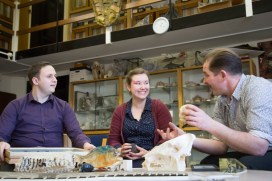
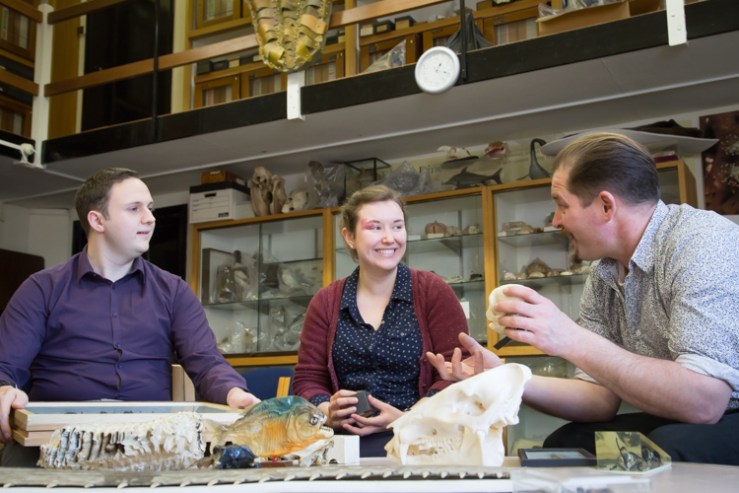
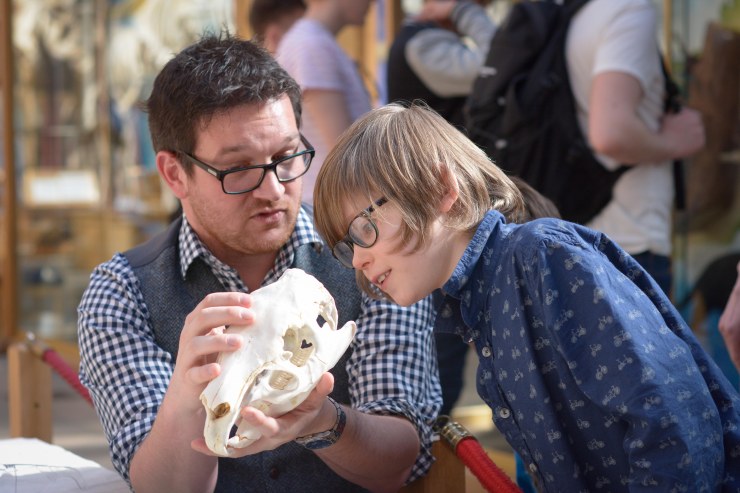
Here’s a little taster of the Capybara Construction event that we held in the Museum last Sunday. Evolutionary biologist and presenter of BBC4’s Secrets of Bones, Ben Garrod, joined our Life Collections conservator Bethany Palumbo and conservation intern Nicola Crompton to attempt the live reconstruction of a capybara skeleton.
This event was part of the week-long Reactions festival – an exploration of science and the arts at the University of Oxford Museums.
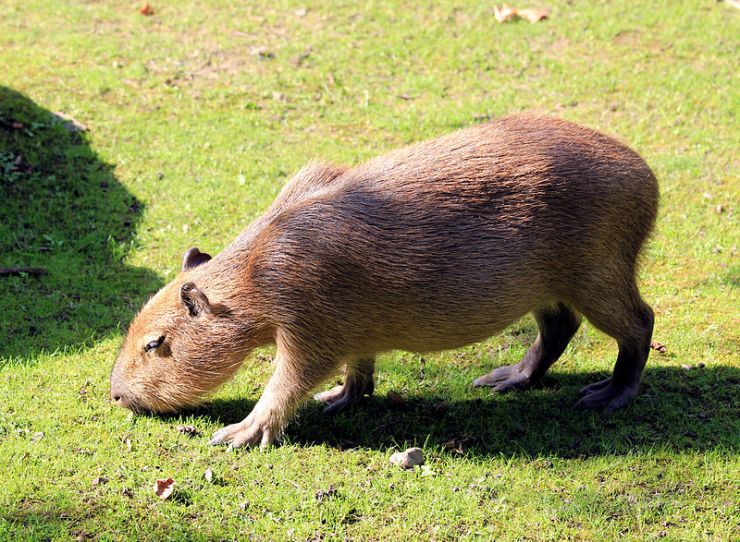
Just in case you don’t know what a capybara is – here’s one. It’s the world’s largest rodent and lives in South America.
We should confess that Ben and Beth did not manage to completely recreate the skeleton, but they had plenty of interesting conversations with visitors about bones, anatomy, capybaras and conservation, so a very successful day nonetheless. Thanks again to Ben for coming along.
Examining the skull and explaining the capybara jaw movements.
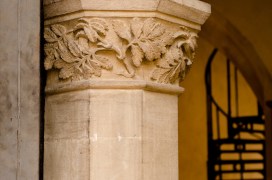
Even the most fleeting visit to the Museum here will reveal the intricate marriage of science and art that the building embodies. Designed by Irish architects Deane & Woodward, the Museum was also influenced by the Victorian art critic and intellectual John Ruskin, whose ideas – and those of the Pre-Raphaelites – promoted art as a form of investigation, a serious study on scientific lines.
As you look around the building its intricate carvings and the careful selection of materials confirm that the design really was a serious investigation of the natural world, resulting in a beautiful piece of architecture.
Although science and the arts are often seen as the pursuits of opposing camps – one a strict process, the other a free creative expression – the truth of course is that they are intertwined. Science and technology influence and prompt artistic practice, and some of the greatest scientific work is the result of a piece of creative and imaginative flair. Rather than two separate cultures, science and art instead sit on a spectrum of different ways of investigating, and reacting to, the world around us.
Marcus du Sautoy’s talk, The Secret Mathematicians, at the Museum of Natural History on Monday 17 March
Taking this idea, we decided to present a set of events and activities that would explore science and the arts during National Science and Engineering Week and the Oxfordshire Science Festival. It’s called Reactions and is being hosted across all four Oxford University Museums – here, at the Ashmolean Museum, the Museum of the History of Science, and the Pitt Rivers Museum.
Siobhan Davies Dance presents a talk and children’s workshop at the Ashmolean
Running over a whole week, from 15-23 March, the fourteen events in the Reactions programme all address or reflect the connections, opportunities or perceived tensions between science and the arts, some directly, others gently. There’s something for everyone across the week, from a lecture on mathematics and art by Professor Marcus du Sautoy, to a science of pollination dance workshop for children by Siobhan Davies Dance at the Ashmolean, to the live reconstruction of a capybara skeleton by evolutionary biologist and broadcaster Ben Garrod at the Museum of Natural History.
Nathaniel Mann, composer in residence at the Pitt Rivers Museum, presents a performance on Thursday 20 March.
The Pitt Rivers Museum is presenting a performance by its composer in residence, Nathaniel Mann, exploring the science of voice disguisers; and sound artist Ray Lee talks about his fascination with the hidden world of electromagnetic radiation and sound waves, demonstrating the science and philosophy behind his unique installations and strange instruments at the Museum of the History of Science.
Award-winning science filmmaker Sally Le Page offers a workshop for A level and BTEC students at the Museum of Natural History. Contact education@oum.ox.ac.uk to book.
There are family events too – the Wow! How? science fair here and at the Pitt Rivers, and Crystals Day at the Museum of the History of Science.
The full programme lists everything else that is going on and gives links to booking pages for any bookable events. Hopefully you’ll find a few interesting and perhaps thought-provoking things to see and do during the week, all hosted in buildings and collections that themselves reveal many different reactions to the world, both natural and man-made.
Regular readers of our closure blog, Darkened not Dormant, will know all about our Goes to Town project, where twelve plucky specimens escaped from the Museum for an eight month holiday in venues all around Oxford city centre. Like any good treasure hunt, the Goes to Town trail presented a competition which promised a valuable prize…
The framed fragment of roof tile, presented to the Goes to Town competition winners
Each of the twelve specimens carried two ratings, one for Danger and one for Rarity. To enter the competition, trail hunters needed to find all the displays and then tell us which specimen was rated most dangerous and which most rare. The most dangerous was the Snowy Owl, the sharpest living predator on the trail; and the rarest were the animals from Alice’s Adventures in Wonderland which are, of course, completely fictional. If you entered without checking all the specimens and guessed that the Dodo would be the rarest then we caught you out – sorry!
Which is best – piece of glass, or cuddly dino?
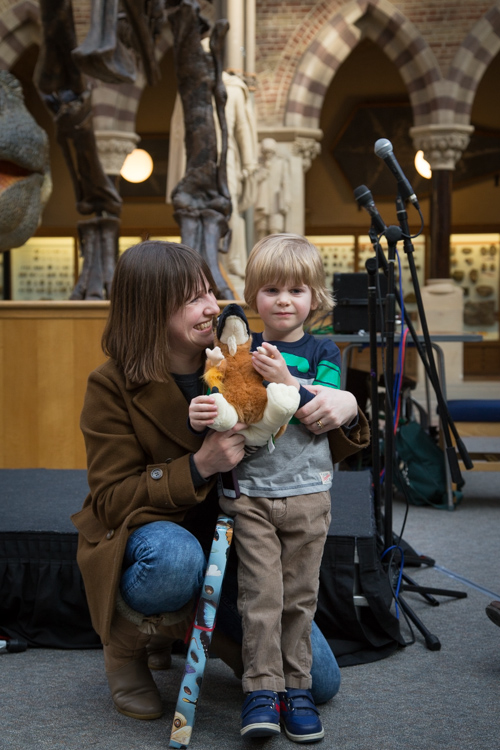
Around 80 people entered the competition and three winners were chosen at random. We held a little award ceremony on our reopening day on Saturday 15 February, where all three winners attended to receive their prizes. And the prizes were quite special. One was a cuddly dinosaur toy (always special, right?) and the other was a small framed, cut fragment of one of the glass tiles from the Museum’s roof.
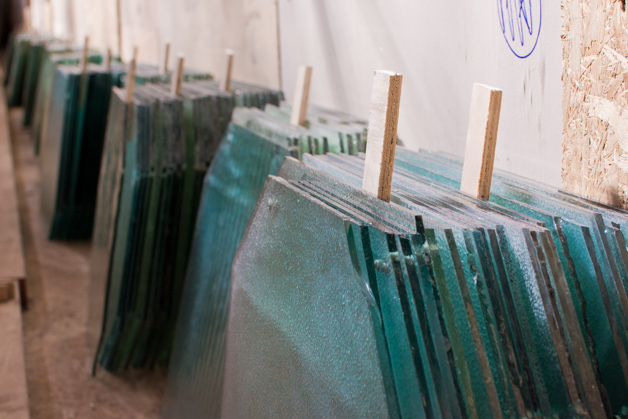
The whole reason for our closure last year was to have the original Victorian roof repaired, so we felt that it was a fitting prize to present a little piece of the fabric of the roof – a little piece of history – to the winners. Congratulations again to the three winners and we hope those small fragments of the Museum are now hanging proudly on three walls somewhere in Oxford.
Adults get the cuddly dino too, of course.Museum director Professor Paul Smith presents the prizes.



 The whale aisle once more open to the public
  Project Conservators: Nicola Crompton, Gemma Aboe and Bethany Palumbo