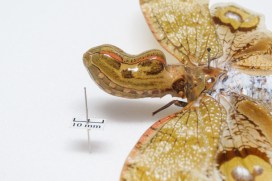
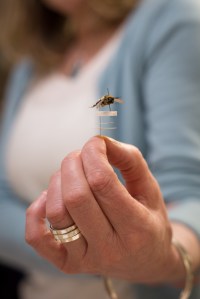
It’s National Insect Week this week, and insects are creatures close to the hearts of many people in the Museum. So to celebrate here’s a Peanut-Head Bug, chosen as a favourite specimen from Hope Entomology Collections by Gina Allnatt in our Life Collections department. Gina explains why:
This species – Fulgora laternaria – is also referred to as the “Alligator Bug” because of the grin-like markings on the head process when viewed from the side. This is probably the biggest specimen of this species I have ever seen in any collection. It was obtained from the Amazon by Rev. A. Miles Moss who presented them to Edward Bagnall Poulton, the second Hope Professor of Zoology at the University of Oxford. The specimen was exhibited at the Royal Entomological Society in 1932.
It’s pretty big.
The strange looking head is hollow, and its purpose may be to afford the insect some protection through mimicry. The insect sits on the side of a tree trunk, with its head pointing upwards. When viewed from the side it looks like a lizard. And if this doesn’t deter a predator it will then open its wings to reveal “eye” spots, complete with white markings that mimic light reflection.
Despite its fearsome appearance, the insect is completely harmless, and is a stunning example of adaptation in the insect world.
Taxidermy has enjoyed a bit of a surge in popularity in the last few years, as surveyed by Alexis Turner in his 2013 book Taxidermy. In the Museum, the touchable taxidermy animals are always popular, especially Mandy the much-stroked pony, the removal of which we fear might cause a public outcry.
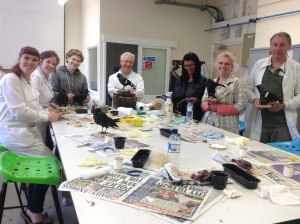
Derek Frampton, centre, leads the workshop
Of course it’s all very well stroking cute, furry taxidermy animals, but have you got the, well, guts to have a go at it yourself? We suspected that plenty of people not only have the guts but also the desire so we set up a workshop with professional taxidermist Derek Frampton, whose work is regularly on display in the Museum. It’s the first time we have offered a taxidermy workshop, but despite the £175 cost for the specimen, materials and tuition, the day was easily oversubscribed.
And what a great session it was. Five excited and enthusiastic members of the public (and one equally excited education officer) were given expert tuition in a step by step guide to create their very own taxidermy jackdaw.
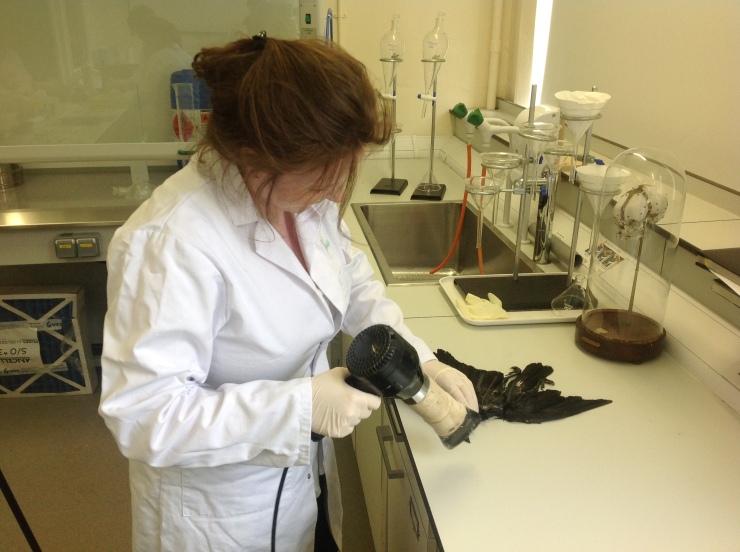
Blow dry in the lab
It wasn’t for the squeamish either because the birds were not pre-skinned, so there was some down and dirty hands-on work to be done before the pretty stuff could begin. The whole process took from 10am until 6.30pm with barely a break. Nonetheless, one participant said that the time flew by (no pun intended, we assume) and another said:
I don’t believe it, I thought we were just going to get a pre-prepared skin, not do the whole thing in a day! That was excellent!
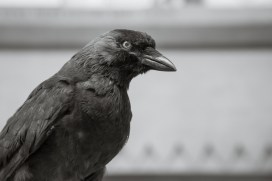
The bird you can see at the top of the post is the creation of the over-excited education officer, Chris Jarvis. He’s named it Scratch because it was made entirely from – yep – scratch. Being a remarkably clever corvid, he (she?) now perches loftily above the rest of the Education team, squawking edicts from time to time.
Given the success of the workshop we may well run another in the future, so keep your eye on our quarterly programme for that. And if you’d like to join our mailing list, email communications@oum.ox.ac.uk and I’ll add your address.
Who created the theory of evolution? Why, Mr Darwin of course! Ah, if only the history of science were so neat.
Charles Darwin’s 1859 work, On the Origin of Species, is considered the stake in the ground for intellectual ownership of the theory of evolution by natural selection. But as a play making its UK premiere this week shows, the picture is not so clear-cut.
Joe Kenneway as Charles Darwin, beside Charles Darwin
Darwin is evolution’s most famous proponent, but when pressed on the subject some people may also name Alfred Russel Wallace, Darwin’s contemporary and a co-conceiver of the theory of natural selection. Others claim the idea had earlier antecedents.
And so the muddle of priority – and its effects on those involved – is played out in Trumpery, a play by American playwright and West Wing script writer Peter Parnell.
Trumpery is produced by Oxford’s Eleven One Theatre and directed by Helen Taylor, who is keen to note that the script is a dramatisation of events, not a historical record.
The central story of the play is Darwin’s decision to publish the Origin after sitting on it for so many years, when he hears that Wallace has come up with the theory independently. The play is a fascinating exploration of Darwin’s feelings of guilt – not just about Wallace and the issue of priority, but about the impact of his discoveries on religious belief.
As well as holding many specimens collected by Darwin and Wallace in the collections, the Museum was also the site of the famous Great Debate in 1860 between Thomas Henry Huxley, championing Darwin’s ideas, and Samuel Wilberforce, Bishop of Oxford, who defended the biblical account of creation.
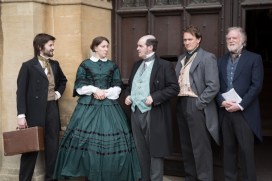
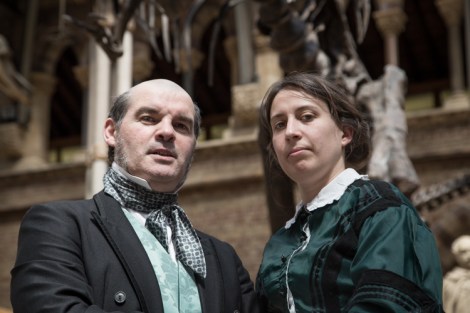
So it was a treat to have the cast in full costume parading around the Museum yesterday, regarding the statue of Darwin in the main court (and lamenting the absence of Wallace), checking out the specimens and doing a bit of promo at the same time.
Trumpery opens at the Simpkins Lee Theatre at Lady Margaret Hall in Oxford on Tuesday 10 June with evening performances each day, plus a matinée on Saturday 14 June. It is part of a science season created by Eleven One Theatre in conjunction with the University of Oxford’s Mathematical Institute. Tickets are available via the Eleven One Theatre website.
The first of the three plays in the season was Émilie: La Marquise du Châtelet Defends Her Life Tonight, which ran in February. After Trumpery, the group will stage Copenhagen, Michael Frayn’s tightly-constructed play about atomic scientists Niels Bohr and Werner Heisenberg. Of the season Helen says:
As a non-scientist, my ‘way in’ to these plays is through the human stories: there is so much drama to be found in the lives of people who struggled to break new ground, to push themselves to their intellectual limits, to deal with the constraints placed on them by the beliefs and politics of the times, and with the impact of their work on their personal lives.
Emma Darwin (Ida Persson) and Alfred Russel Wallace (Nathan Grassi)
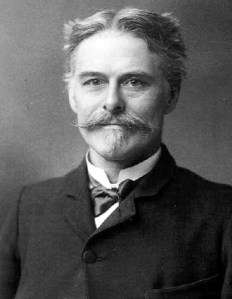
Ever heard of the Bone Wars? Probably not, but this was the name given to a period of intense academic rivalry between American anatomist and palaeontologist Edward Drinker Cope and his erstwhile academic partner Othniel Charles Marsh. This 20-year fued at the end of the 19th century saw each man trying to out-compete the other by naming as many new Paleocene vertebrate species from North America as possible. And it was during this intense period of fossil collecting that Cope noticed something remarkable…
Edward Drinker Cope (1840-1897)
Observing many specimens and publishing an astonishing number of academic papers (over 1,300 in his lifetime, still the highest number by a single individual), Cope uncovered what appeared to be a tendency towards larger body size in a population’s lineage over evolutionary time. This was, he suggested, because new groups are commonly founded at smaller sizes, but it was generally advantageous to be larger. This became known as Cope’s rule.
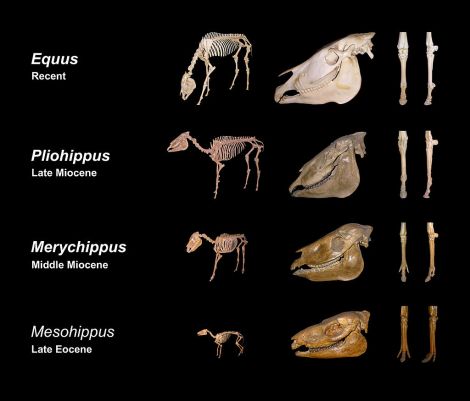
A classic example of a group of organisms that conforms to the rule is that of horses, or the Equidae lineage. Early ancestors of modern horses were no bigger than dogs during the Eocene period (56-37 million years ago), as illustrated below.
Late Eocene: 37-33.7 million years ago; Middle Miocene: 16 – 11.5 million years ago; Late Miocene: 11.5 – 5.3 million years ago. Image: H. Zell
Cope’s rule now has an extensive history of research, with some studies supporting a trend of size increase and others countering it. The notable palaeontologist Stephen J. Gould proposed that the best way to test Cope’s rule would be to study all lines of ancestry within large groups with excellent data over substantial geological time. Not so easy – much of the fossil record is just too poor to support this approach.
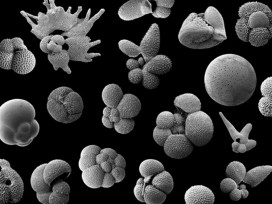
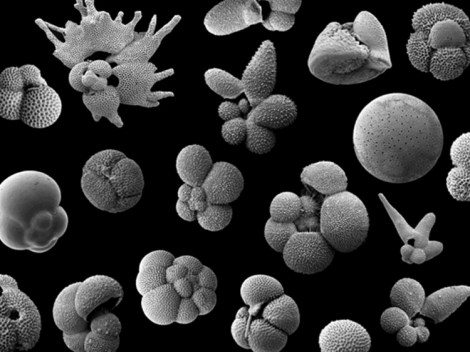
That’s where the little fellas you can see in the picture at the top of the post come in. At the Museum I am investigating the validity of Cope’s rule by using the fossil record of something called planktonic foraminifera. These are single-celled organisms that make a hard shell no bigger than a grain of sand. But when viewed under a microscope these shells display a wide variety of shapes, as you can see in the photograph, making it possible to identify different species.
They live in our modern oceans, but have existed for over 100 million years and can be found from the poles to the equator. Crucially, they have the best-documented species-level fossil record of any group for the last 65 million years and a well-constrained family tree (phylogeny).
This means we can drill deep-sea cores and collect countless planktonic foraminifera specimens from all the world’s oceans. These specimens can then be sorted into different species and measured. And that’s what I am doing. With over 30,000 specimens measured, the project I’m running at the Museum will be the largest and most robust test for Cope’s rule anyone has ever attempted. Hopefully it will shed some light on this fascinating phenomenon.
One of the tasks of a University museum – and indeed all museums – is to communicate often complex and detailed academic knowledge to a non-specialist audience. There are lots of creative ways for us to go about this, from capturing children’s interest in nature and natural history through well-structured schools and family sessions, to the careful interpretation of specimens and subjects in exhibition displays. Another route is to collaborate with artists who can respond to and present the collections in a different manner.
We’ve been running a collaboration like this in our Life Collections since 2011, working with local artist Jane King. Jane has more recently teamed up with another Oxford-based artist, Neil Mabbs, and together they have formed Pale Blue Dot, a not-for-profit arts-science partnership that aims to raise public awareness about environmental and social concerns through exhibitions, publications and events.
Jane picks out a great yellow bumblebee (Bombus distinguendus)
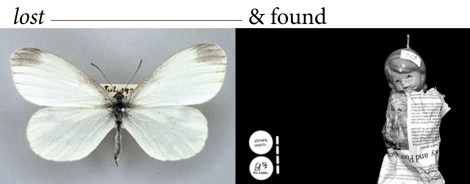
The first of these events is a multimedia installation called Lost & Found, running at the North Wall Arts Centre in Oxford from 28 May – 13 June. For this project Jane and Neil have worked with head of Life Collections Darren Mann and Amoret Spooner in the Museum, along with Professor Dave Goulson at the University of Sussex.
The Lost & Found exhibition asks whether consumerism is causing the extinction of millions of the planet’s species and the ecosystem services they provide. It uses a variety of material, including mixed media prints, photography, film and projection, 3D display, live planting, textiles, and artists’ books.
Artwork is supported by ‘Evidence Tables’ containing specimens from the Museum’s collections, as well as the results of the latest scientific research in the area. It is part of an effort by Pale Blue Dot to communicate complex scientific messages to a wider public audience.
Amoret explains the idea behind the project:
It focuses on the pollinators and decomposers that provide humans with some of the most tangible benefits in terms of ecosystem services.
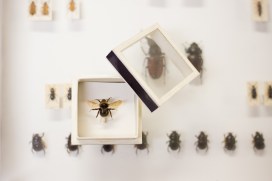
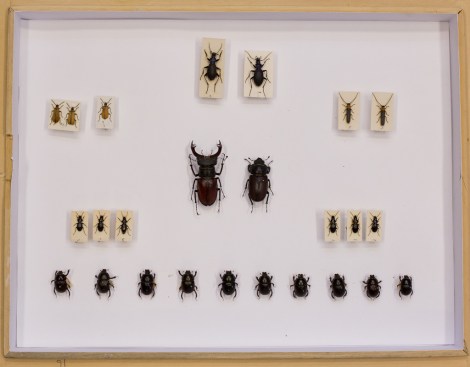
The pollinators are a group of almost 500 species of UK bees, hoverflies, butterflies and moths. Specimens from the collection are being displayed in cases to represent many of the species, as well as being utilised as source material for the artwork.
Pale Blue Dot’s Lost & Found aims to raise awareness of some of the research carried out by scientists here at the Museum that visitors wouldn’t normally hear about.
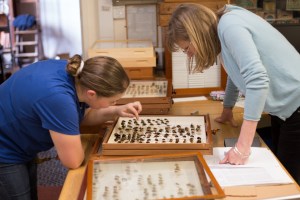
Jane and Amoret researching bee specimens
Darren’s photographs of dung beetles and his research papers on the role of dung beetles in the environment are featured. Dung beetles’ daily task of dung recycling helps increase crop yields by speeding up the release of nutrients into the soil, as well as reducing the spread of farm animal parasites and infections caused by biting insects. One of the pieces made by Jane is an artist’s book – Beetle Book – which highlights this vital ecosystem service that beetles provide to humans.
Many of our beetle, bee, moth and butterfly specimens will be on display in the Lost & Found exhibition at the North Wall, so head over there from 28 May to check it all out.
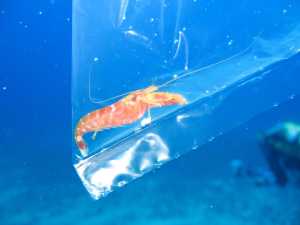
Over the last few months, a number of parcels containing marine decapod crustaceans – yep, ten-footed sea beasts – have arrived at the Museum from the small island of Saint Helena in the South-central Atlantic. Saint Helena is perhaps best known as the place of exile and death of Napoleon Bonaparte, but far less well known are the marine fauna of the island, especially the decapod crustaceans.
The specimens that have been arriving for our Invertebrate Collections were collected by Dr Judith Brown of the Environment and Natural Resources Directorate in Saint Helena and Professor Peter Wirtz of Universidade do Algarve, Portugal. Until now only 36 species were known from the island, and the majority of these were collected between 1958 and 1964; only a single additional species has been recorded since, a specimen collected in 1977, but only reported on in 2007!
The present collection is being studied in collaboration with Dr Paul Clark at the Natural History Museum in London and has so far yielded upwards of ten additional species found on the island, as well as four completely new species.
Alpheus cedrici – a snapping shrimp
The snapping shrimp Alpheus cedrici, pictured right, is one of the new records for the island. The species was previously only known from two specimens collected in 2008 from Ascension Island, 1,300 km further north, during this Museum’s Ascension expedition; it was formally described in 2012.
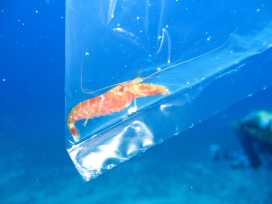
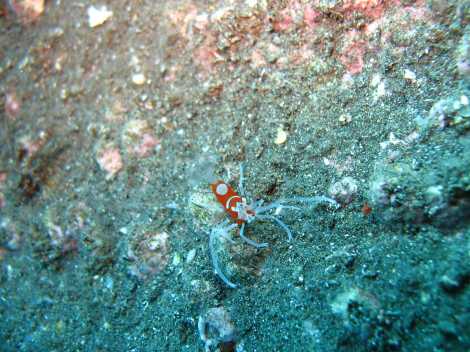
Gnathophylleptum tellei, pictured at the top of the post, is not a new record for St Helena but it is a very rare species of shrimp, currently only known from three specimens in museum collections worldwide (and now one of them is here!). The species was only sighted for the first time in 2001 in Gran Canaria and is otherwise only known from Saint Helena.
The four new species will now be described in the scientific literature, after which a new check-list of the decapod fauna of Saint Helena will be produced. It’s also clear that there’s plenty more to learn about the decapod crustaceans of the island so plans for a more focused collecting trip are now underway.