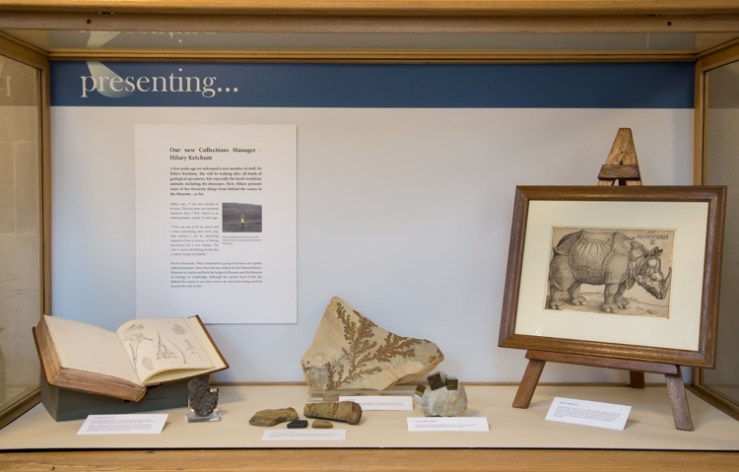
A few weeks ago we welcomed Dr Hilary Ketchum as our new collections manager for the geological collections. Hilary will be looking after all kinds of specimens, but especially the fossil vertebrate animals, including the dinosaurs. To welcome her, and to announce her arrival to the public, we have handed over our regularly-changing Presenting… display so that Hilary can exhibit some of her favourite things (so far) from behind the scenes in the Museum.
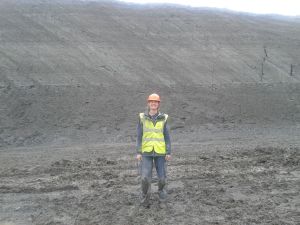
Hilary looking for plesiosaurs in the Oxford Clay on a rainy day. She’s never found one.
For her doctorate, Hilary researched a group of Jurassic sea-reptiles called plesiosaurs. Since then she has worked for the Natural History Museum in London and both the Sedgwick Museum and the Museum of Zoology in Cambridge. Although she spends most of the day behind the scenes in our store rooms she also loves being involved in activities and events.
I am very excited to be here. This has been my favourite museum since I first visited as an undergraduate, nearly 15 years ago. I love my job as it’s so varied and I learn something new every day. One minute I can be answering enquiries from scientists, or finding specimens for a new display. The next I can be identifying fossils that a visitor found on holiday.
A few of Hilary’s selection of specimens are include here. To see the full display, look for the Presenting… case just to the right of the Welcome Desk near the entrance to the Museum. An online archive of the Presenting… series is also available on our website.
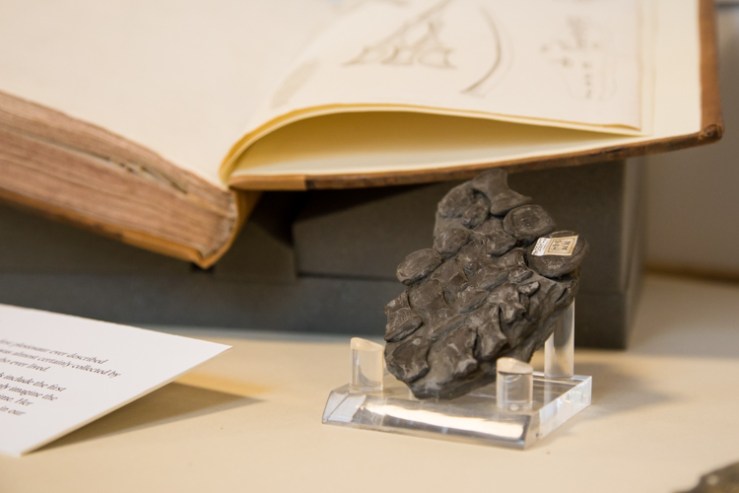
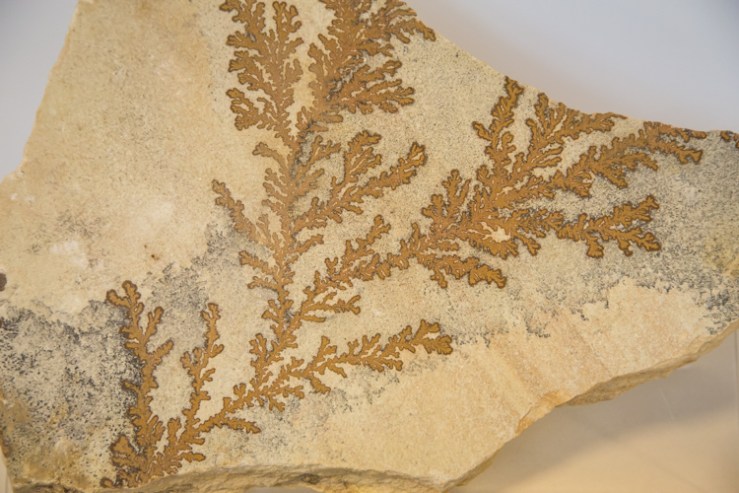
The first plesiosaur – Part of a flipper from the first plesiosaur ever described scientifically. It was almost certainly collected by Mary Anning, one of the greatest fossil-hunters who ever lived.Dendrites – This may look like a fossil plant but it is actually a form of mineral growth called a dendrite. This type of crystal growth can also be found in snowflakes.Cubic pyrite crystals – This specimen of “Fool’s Gold” is from Spain. “I find it amazing that something so straight and orderly can arise in nature,” says Hilary.
Over the past few days the ranks of the Museum have been swelled by the arrival of a host of summer interns from the University of Oxford Internship Programme and the EPA Cephalosporin Fund scheme. Overall, twelve internships are being run at the Museum, and the new faces have been squirreled away into the various departments and collections throughout the building.
We’ve got people working on a wide variety of activities, from audience research for Oxford ASPIRE, to the curation of longhorn beetles (Cerambycidae) in the Life Collections, to work on the archive of 19th-century entomologist James Charles Dale.
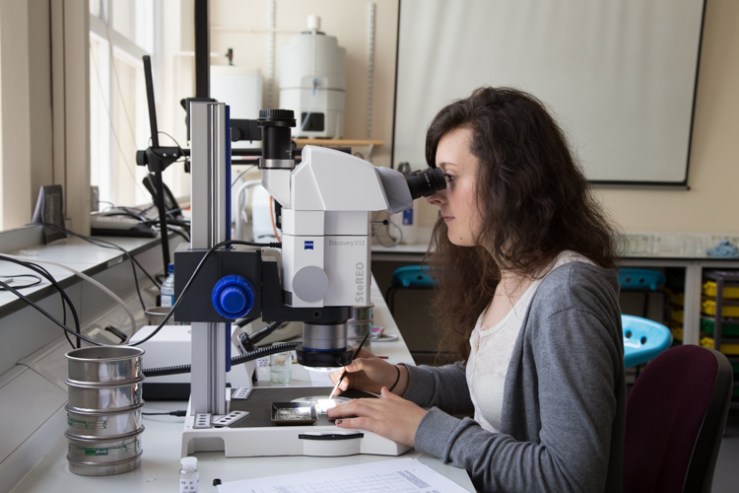
One of the interns, Grace Manley, is pictured above peering into a microscope. Grace is working with Dr Tracy Aze, a research fellow at the Museum who is studying planktonic foraminifera – fossils of single-celled organisms found in deep-sea sediments – to investigate marine extinctions. Tracy explains how Grace is contributing to the work during her internship:
Grace is helping me to test some methodological practices that will feed into how I conduct my future research. She has been involved in all the stages of micropalaeontological processing, from washing down core sediments and microfossil identification, through to imaging specimens on the scanning electron microscope.
The project gives her the opportunity to learn many of the common practices that micropalaeontologists use in a lab today and is excellent experience should she decide to continue to work in this field, or other areas of palaeontology.
Grace Manley working on the planktonic foraminifera as part of her internship with Research Fellow Dr Tracy Aze
For Grace, the internship provides ‘a practical experience of scientific research in the field of environmental change and extinction’. At the same time, she is enjoying ‘the chance to learn about the hugely diverse range of collections in the Museum and how they are actively used for scientific research today.’
We hope that all the interns across the Museum are finding a similarly rich and rewarding experience and we’ll feature some of the highlights of their work on this blog over the coming weeks.
In the meantime, a big welcome to Naomi Saunders, Stephanie Faulkner, Grace Manley, Emily Giles, and Samuel Peacock on the University of Oxford programme; and to Branwen Snelling, Keyron Hickman-Lewis, Ellen Foley-Williams, Max Brown, James Evry, Cecilia Karlsson, and Emily Tibly on the EPA Cephalosporin Fund scheme.
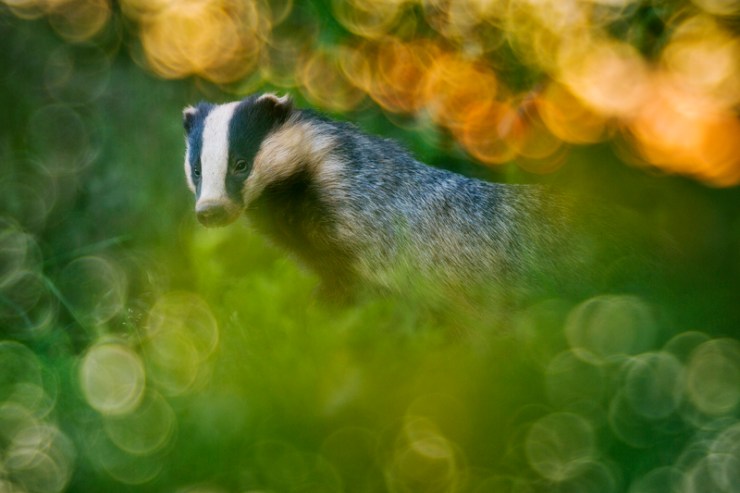
Wildlife Photographer of the Year – 16 July-22 September We’re excited to announce that the prestigious Wildlife Photographer of the Year exhibition is returning to the Museum this summer for the first time in over a decade. It will be on show, for free, in the Main Court from 16 July to 22 September, so make sure you get down here to see it.
This global showcase of the very best nature photography has inspired us to launch a little wildlife photography competition of our own…
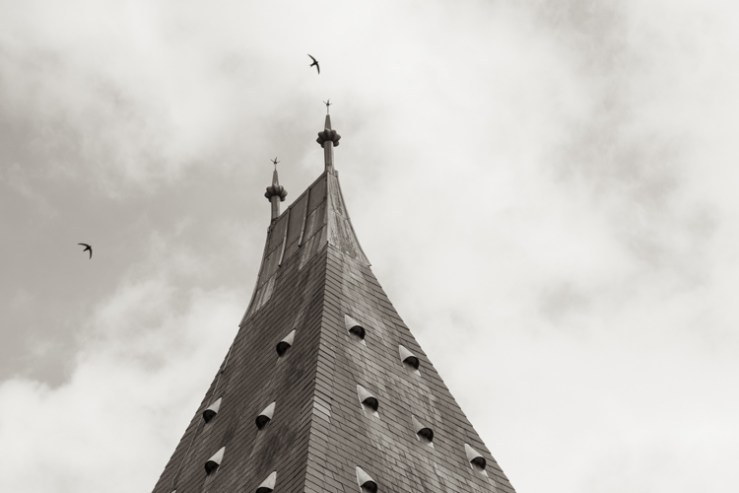
In celebration of the swifts that return to nest in the Museum’s tower each spring, we are running the Summer Swifts photo competition. Send us your best photograph of this summer’s swifts on the wing, either around the Museum’s tower or near you, and the winning image will be put on display alongside Wildlife Photographer of the Year in the Museum from mid-August. Not bad eh?
The picture below is not from Wildlife Photographer of the Year, but is my hastily-grabbed effort to capture the swifts. I imagine many of you can do better. Email your entries to communications@oum.ox.ac.uk by 15 August and we’ll let you know who’s won shortly after. Needless to say the images must be your own and not break anyone’s copyright, and you grant us permission to print and display them in the Museum until 22 September. Good luck!
Swifts swoop around the Museum tower
Wait, there’s more… To coincide with Wildlife Photographer of the Year here we’re also offering a unique adult Day School titled Imaging Techniques in Modern Natural History – a Hands-On Guide. This takes place on Saturday 20 September and costs just £60.
It’s a practical course in digital imaging that will give you access to the Museum’s imaging equipment and specimens to learn about electron microscopy, 3D laser scanning, multiplane microscopy and macrophotography, as well as a poke around behind the scenes. Places are limited so for more info and to book email education@oum.ox.ac.uk pronto.
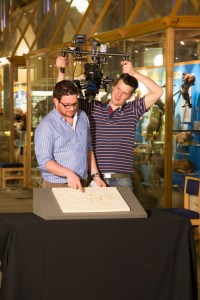
Earlier this year we had the pleasure of hosting the BBC iWonder team and evolutionary biologist and presenter Ben Garrod for a filming session all about the evolution of birds. BBC iWonder is a growing series of short but rich guides to subjects as wide-ranging as salt in your diet, the World Cup, and the holocaust, each designed to pique people’s interest and curiosity.
Ben Garrod filming with the Archaeopteryx cast
Ben’s guide is titled ‘Do Dinosaurs Still Live Among Us?’. This is a good question indeed and the answer is (sort of) ‘yes’. You can find out a lot more in the guide itself, which has just been launched here and features some lovely footage of the Museum and our cast of the famous Archaeopteryx fossil, the first found to show the traces of feathers on a dinosaur.
Needless to say we were very pleased when the iWonder team contacted us about their idea to look at the evolution of birds from dinosaurs using specimens in the Museum. The guide’s producer and director Ben Aviss explains how it came about:
We brainstorm ideas for new content for the guides and one of those was to look at dinosaurs, but what question might we ask? The idea of dinosaurs and birds sharing a common ancestry is something that not everyone may know about so we decided to look at that.
Ben Aviss had already seen the Museum on Ben Garrod’s BBC4 series Secrets of Bones and thought it looked great. “The more we chatted about the things we might want access to, the more we realised you offered everything we needed,” he adds.
Ben Garrod tracks along the Iguanodon tail
It was a third return to the Museum for Ben Garrod who, as well as filming sequences for Secrets of Bones, had also run our Capybara Construction special event earlier in the year. He explains the appeal of returning for the iWonder guide:
This iWonder guide represents a new and fun way to retell a key moment in evolutionary history – the transition from dinosaurs into modern birds and I’m pleased with the final result. It’s informative and interesting but more than that, it looks good and that is in no small part down to the setting in which we filmed.
I keep coming back again and again because I genuinely love the Museum. The collection is laid out in a way that gives the visitor lots of time and space to explore and the specimens themselves are great – I’m still finding new things every time I visit.
There are plans for further iWonder guides that go richer and deeper, with greater interactivity and content. Let’s hope the collections – and Ben’s enthusiasm – brings the team back to tell another story here soon.
As we head towards the end of National Insect Week this year it seems like a very good time to introduce you to one of the hardest-working people in bugworld – Sally-Ann Spence of Minibeast Mayhem. If you’ve ever visited the Museum on one of our bug-handling days you may well have met Sally already, quite probably holding a stick insect.
Through Minibeast Mayhem, Sally does a lot of work to support the budding entomologists of tomorrow, running invertebrate-based educational workshops for schools and public outreach events around Oxfordshire. Sally is also a committee member of the Amateur Entomologists Society’s Bug Club, an entomological club for children.
We asked Sally to tell us a bit more about her work and her desire to encourage bug-loving kids. Here’s what she has to say:
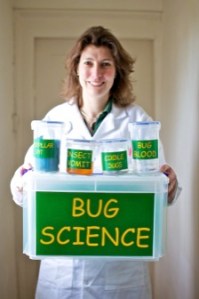
Sally-Ann Spence and her Minibeast Mayhem Bug Science kit
“When I meet a child with a passion for bugs I always suggest to their family that they should join a society such as the AES Bug Club where they can take part in many events and their interest can be nurtured. Sometimes it becomes apparent that a child has more than just a passing interest in bugs; in fact they have a true passion that could extend well beyond childhood. Unfortunately the UK has no BSc in Entomology so the subject is often missed in our schools careers advice. This can leave some children and their families at a loss for how to pursue their interest.
So I decided to set up a voluntary mentoring scheme – the Ento Kids – not only for enthusiastic children but also to support their families. The scheme has been successful, thanks to the incredible support I have received from expert individuals, landowners, universities, entomology-related companies and museums and their staff.
The aim of the Ento Kids is to support children through a CREST Award and a two week work experience placement. We offer advice on GCSE and A level choices and suitable university courses, as well as provide access to sites for research projects (and potential future employers).
Ento Kids hard at work in the Museum
Ento Kids take part in active fieldwork on research experiments to learn practical skills and are introduced to a network of professional entomologists who share their expertise from previous experience.
Theory is also fundamentally important and this is where museums such as the Museum of Natural History in Oxford are vital. Darren Mann, Head of Life Collections, and his team in the Entomology Department encourage the Ento Kids unreservedly. The children are taught about fieldwork in various habitats around the world and about the processes involved for collected specimens. They are taught about active scientific research, the importance of the collections and how to conserve them. Best of all, they learn all of this in a hands-on way with the staff in the Museum itself.
We need our entomologists, both from the past and today, and National Insect Week is a celebration of insects that everyone can take part in.”
It’s National Insect Week this week, and insects are creatures close to the hearts of many people in the Museum. So to celebrate here’s a Peanut-Head Bug, chosen as a favourite specimen from Hope Entomology Collections by Gina Allnatt in our Life Collections department. Gina explains why:
This species – Fulgora laternaria – is also referred to as the “Alligator Bug” because of the grin-like markings on the head process when viewed from the side. This is probably the biggest specimen of this species I have ever seen in any collection. It was obtained from the Amazon by Rev. A. Miles Moss who presented them to Edward Bagnall Poulton, the second Hope Professor of Zoology at the University of Oxford. The specimen was exhibited at the Royal Entomological Society in 1932.
It’s pretty big.
The strange looking head is hollow, and its purpose may be to afford the insect some protection through mimicry. The insect sits on the side of a tree trunk, with its head pointing upwards. When viewed from the side it looks like a lizard. And if this doesn’t deter a predator it will then open its wings to reveal “eye” spots, complete with white markings that mimic light reflection.
Despite its fearsome appearance, the insect is completely harmless, and is a stunning example of adaptation in the insect world.