Once in a whale

NIKON D700 - 0057
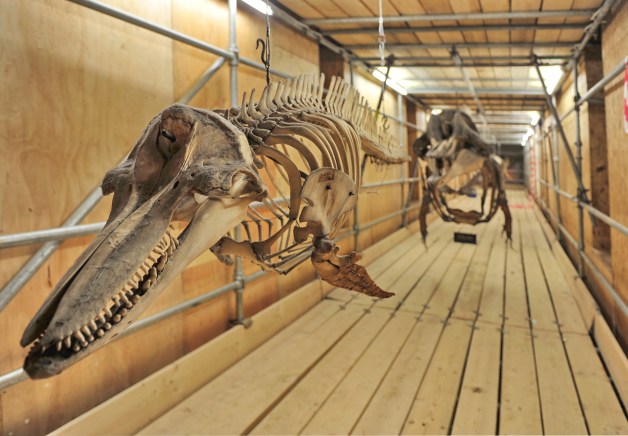
Orca skeleton
Credit: Mike Peckett

Among the Museum’s large collection of mammal skeletons are five whales (Cetacea), each suspended from the roof in the main gallery. As part of the Museum renovation efforts, it was decided to give these specimens some much needed conservation treatment: 150 years of continuous exposure to light as well as fluctuating temperature and humidity levels has left these skeletons in a poor condition. The types of damage noted include: a big build-up of dust and dirt; cracking of the bone material; secreting of fatty oils; missing sections, such as fingers and ribs; and the corrosion of metal areas, as well as water-stains from the leaking roof!

8374647046_4967936cbc_h
The whales hung from scaffolding ready for conservation
Credit: Mike Peckett
NIKON D700 - 0033
150 years of dust gathered on the skull of a Lesser Fin Whale
Credit: Mike Peckett

Thanks to a successful PRISM grant from the Arts Council England, we have very recently hired an Assistant Conservator to help me complete this huge task. Together we will have six months to complete the treatment which will include in-depth cleaning of the specimens, stabilising loose or cracked areas, and replacing missing segments and corroded wires. We’re aiming to have five beautiful whale skeletons which look clean and scientifically accurate, as well as being stable enough to withstand another 100 years on display.

NIKON D700 - 0101
Credit: Mike Peckett
NIKON D700 - 0047
Credit: Mike Peckett
NIKON D700 - 0211
Credit: Mike Peckett

Although we’re closed for 2013, many visitors are still passing through on their way to the Pitt Rivers Museum. We thought they would like to see what’s going on, so we’ve built a window in the construction boards, enabling the public to see the whales. If you’re visiting, pop by to see our conservators undertaking this exciting and important work.

Bethany Palumbo, Conservator of Life Sciences

What’s on the van? – Harlequin shrimp

_harlequin-shrimpno-29
Credit: Dr Arthur Anker

This week’s What’s on the van? comes from Sammy De Grave, assistant curator of the Museum’s Zoological Collection

Harlequin shrimps are monogamous, living in male-female pairs for life, sharing and actively defending a patch of reef of about 10 square meters. As you can see, they have exquisite colour patterns and a highly unusual morphology.

The main diet for the harlequin shrimp are starfish. Prey is located by either member of the pair, and even though the starfish may often be ten or twenty times larger than the shrimps, the harlequin shrimps flip over the starfish and drag them into their lair.

Once inside the lair, the starfish’s internal organs – tube feet and guts – are devoured, starting from the tips of the arms and working towards the central disk. This keeps the shrimps’ victim alive for as long as possible. It usually takes several days for the process to be completed. On occasion a starfish escapes, minus a leg or two, but usually they succumb.

A large scale program was initiated in the 1980s to attempt to harness this behaviour as a bioweapon against outbreaks of the Crown-of-Thorns starfish in the Pacific. However, due to their antagonistic territorial behaviour this was doomed because each pair of harlequin shrimps would kill all the others in close vicinity.

Sammy De Grave, Assistant Curator, Zoological Collection

What's on the van banner 2

Egg-cellent!

The Easter weekend has now been and gone but for some inexplicable reason we have all come in to work with eggs on the brain (figuratively speaking that is). We don’t often get to see eggs-amples of eggs in the department as they are not often collected, so whilst we have thousands of specimens of adult insects and even a few jeuvenille ones, we don’t have many eggs.
Which is a bit sad in our opinion, as the eggs themselves tend to be egg-ceedingly interesting and beautiful, often have complex sculpturation or construction and can allow you to egg-stract information regarding species behaviours and habitat use.

So here we present some very egg-citing photographs of some eggs-traordinary insect eggs that we did manage to find in the collections. Eggs-amine them closely and see if you can figure out what sort of insect they belong to- answers will be at the bottom of the post.

insect eggs, photograph, OUMNH, ootheca, mantid
Picture 1: Technically an egg sac or cluster, this weird shape houses a number of individual eggs belonging to what kind of insect?

insect eggs, photograph, OUMNH, ootheca, cockroach, blattodea
Picture 2: Another one containing multiple eggs. Here you can see the individual eggs that are paired up along a central spine. Which kind of insect makes eggs like these?

insect eggs, photograph, OUMNH, butterfly, lepidoptera, hairstreak
Picture 3: Only just visible to the naked eye, this tiny egg proves to be beautifully micro-sculptured once you get close up. This photograph had to be taken using a microscoped with camera attachment just so we could show it off. What kind of insect lays an egg like this though?

insect eggs, photograph, OUMNH, ootheca, cockroach, blattodea
Picture 4: Okay, so we are repeating ourselves now but this egg ‘sac’ was just too egg-sciting not to photograph! The delicate little wave-formation along one edge demonstrates which kind of insects aesthetic tastes?
insect eggs, photograph, OUMNH, hemiptera, belostomatidae
Picture 5: Each of these is an individual egg which has been laid in a neat little cluster by which kind of insect?

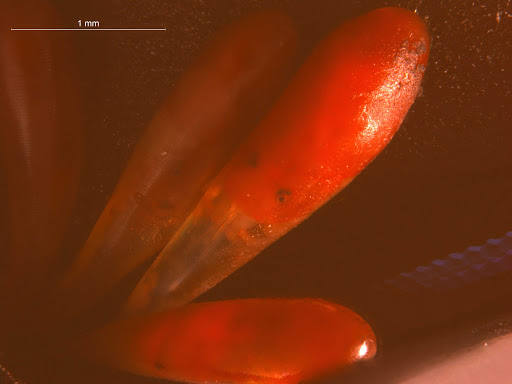
Whilst you are musing on your answers for the above five questions here are some even more egg-citing photographs for you to study. These are pictures of some mystery eggs. We know that they probably belong to some kind of decapod. They were found attached to a water beetle that was collected in Mozambique. If anyone reading this has any idea about what the egss might be then we would love to know.

insect eggs, photograph, OUMNH, decapod eggs
Mystery eggs 1: Here you can see that there are small clusters of eggs attached to the underside of the beetle next to it’s coxae.

insect eggs, photograph, OUMNH, decapod eggs
Mystery eggs 2: We had to take the specimen out of alcohol and dry it off to take the pictures so the eggs look very shiny. If you look really closely you can make out little pairs of eyes in each of the eggs.

insect eggs, photograph, OUMNH, decapod eggs
Mystery eggs 3: Here’s a real close-up shot. Are those tiny legs and antennae that we can see?

Egg-shausted by eggs yet? Over egg-cited maybe? Ready to egg-splode from all the egg-stravagent egg puns?

Here are the answers to the above quiz questions:

  1. Mantid ootheca
  2. Cockroach ootheca, in this case belonging to a species of madagascan hissing cockroach
  3. Butterfly egg: Order Lepidoptera, Family Lycaenidae.
  4. Another cockroach ootheca (we warned you it was a repeat)
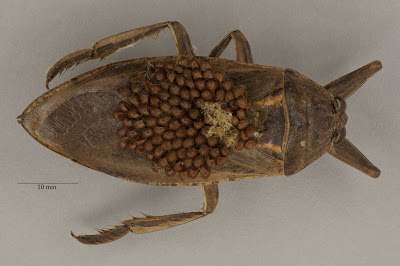
  5. True bug eggs: Order Hemiptera, Family Belostomatidae. Interesting fact- the males of this family carry the eggs on their backs (the females stick them on there with a water resistent glue) until they hatch.
insect eggs, photograph, OUMNH, hemiptera, Belostomatidae
Egg cluster on the back of a male Belostomatid
That’s all yolks!
No more egg puns until next year- we promise.

Life and Death in Herculaneum

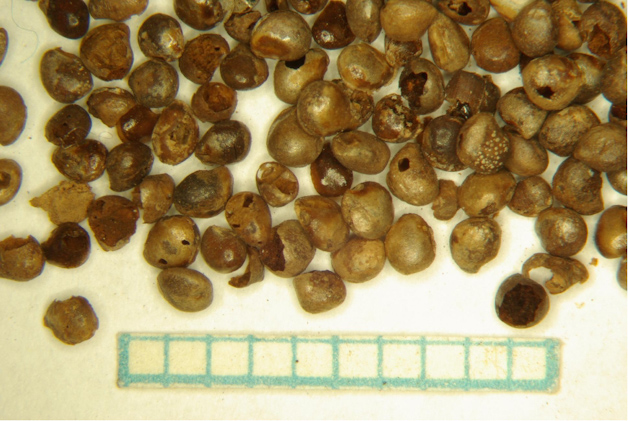
Fig seeds

At 9pm today BBC2 is broadcasting The Other Pompeii: Life and Death in Herculaneum, a documentary following The Herculaneum Conservation Project, which aims to find out what life was like in the small Roman town of Herculaneum, moments before it was destroyed by the famous eruption of Mount Vesuvius in 79 AD. This project involves work both in the field and in the Museum by our Environmental Archaeology Unit, led by Mark Robinson.

The sewer in Herculaneum

One of the problems faced by the conservators at Herculaneum is that they need to remove rainwater from the site. To this end, a Roman sewer was to be excavated so that it could act as a conduit for new plastic drain pipes. The Museum’s Environmental Archaeology Unit was brought in to investigate the contents of this sewer for evidence of Roman diet. Biological remains from Herculaneum were transferred to the Museum for detailed analysis by Mark and Erica Rowan, a doctoral student in the Environmental Archaeology Unit.

The numerous fish bones, sea urchin fragments and so on suggested that the occupants of the town enjoyed a varied marine diet. There was also evidence of the plant component of their diet, including a major consumption of figs and the use of food flavourings such as coriander and even black pepper, which would have been imported from India. Remains of fly pupae suggest unhygienic conditions.

Sorting in the field at Herculaneum

Look out for more on this research, including footage filmed in the Museum, in the BBC 2 documentary tonight. The programme is being broadcast to coincide with the opening of the Life and Death: Pompeii and Herculaneum exhibition at the British Museum.

Mark Robinson, Head of the Environmental Archaeology Unit

What’s on the van? – Darwin’s dung beetle

_Beetle-wpin

This week’s What’s on the van? comes from Darren Mann, assistant curator of the Museum’s Hope Entomological Collection

On the 27 December 1831 a young naturalist by the name of Charles Darwin (1809-1882), on a ship by the name of the HMS Beagle, began a five year journey around the world. During this voyage he collected many specimens of plants and animals, which he later dispersed to some of the most eminent scientists of the day.

Of all the insects in this small collection, the beetle Onthophagus australis (Guérin, 1830) is by far my favourite, simply because it’s a dung beetle, which are my favourite insects. I think dung beetles are both beautiful in form and ecologically are extremely interesting.

This very specimen was collected by Darwin during 1836 at Hobart town, Tasmania. At the time, Reverend Frederick William Hope (1797-1862), the British entomologist who founded the Museum’s Hope Entomological Collection, thought the beetle was a new species to science; it had in fact already been described from Port Jackson, Australia by French entomologist Félix Guérin-Méneville (1799-1874). This is a widespread species found in Tasmania and south-western Australia, where it feeds on all sorts of dung.

During Darwin’s early life, Hope was a friend and mentor, and as such Darwin sent some of the Australian insects he collected to Hope for study. Sadly, Hope took ill and retired to Italy, never completing his work on Darwin’s insects.

To date we have found over 130 Darwin specimens in our collections. Some of these have even travelled back to Australia to form part of the temporary exhibition at the National Museum, which celebrates Darwin in Australia.

Darren Mann, Assistant Curator, Hope Entomological Collection

What's on the van?

Gené dor left open


Carlo Giuseppe Gené (1800-1847) was an Italian naturalist, who became the Professor of Zoology and director of the Royal Zoological Museum at Turin (1830). Between 1833 and 1838 Gené made four trips to Sardinia to collect insects. These trips resulted in two primary publications, in which he described many new species to science:
Gené, C. G. 1836: De quibusdam Insectis Sardiniae novis aut minus cognitis. [Fasciculus I.]. Memorie della Reale Accademia delle Scienze di Torino, Torino 39: 161-199, [1] Taf. (Fig.1-29).
Gené, C. G. 1839: De quibusdam Insectis Sardiniae novis aut minus cognitis. [Fasciculus II.]. Memorie della Reale Accademia delle Scienze di Torino, Classe die Scienze Fisiche, Matematiche e Naturali, 2. Ser., Torino 1: 43-84, Taf. I-II.
Most of Gené’s insect collection is in Museo Regionale di Scienze Naturali di Torino, with duplicates being deposited in the Museo Civico di Storia Naturale de Milan and in Museo storia naturale di Pisa.  However, some of his insect specimens are believed to be lost or destroyed.
For example, in the recent revisions of the genus Chelotrupes (a dor beetle) by Dellacasa and Dellacasa (2008) the authors were unable to find the original specimen(s) Gené used to describe Chelotrupes hiostius and so designated a neotype (a new type to replace one that is lost or destroyed). Hillert et. al. (2012) followed this in their review of the genus Chelotrupes.
The department provided the type specimen of Chelotrupes momus (Fabricius, 1792) for the Hillert et. al. (2012) work on the genus, and when the paper was recently sent to us along with the returned loan of our specimen, we noted the ‘lost’ Gené specimen cited. We knew we had some of Gené’s specimens in Oxford, but the value and extent of this collection had not been realised. 
Gené corresponded with our founder Frederick W. Hope (1797-1862) and in our archive collection there are letters to Hope dated 7th March 1835, 25th February and 24th October 1837 and June 1844. The most interesting archive (dated 1837) was a list of ninety-six Insects from Sardinia that Gené sent to Hope. In which, several of the new species, identified in the list by having ‘nob’ after their scientific name, which is shorthand Latin for nobis– which translates as ‘belonging to me’, and was used by authors to designate their new species. In this list was Geotrupes hiostius (as Gené called it).
archive, letter, species list, coleoptera, OUMNH, library
List of specimens that Gené sent to Hope
After the discovery of this archive we searched the collections and found the ‘lost’ type of Chelotrupes hiostius (Gené) in our dor beetle collection.
Coleoptera, type, Chelotrupes hiostius, OUMNH, Gené, Sardinia
The type specimen of Chelotrupes hiostius
An amazing discovery for us, as this specimen’s scientific importance had not been recognised for over 170 years! We have looked for a further two specimens from this list, and have found both, one Oil Beetle and a Stag Beetle. We hope to spend some time over the summer to see how many more from this list we can find!
References:

Dellacasa M. & Dellacasa G. (2008). Revision of the genus Chelotrupes Jekel, 1866 n. stat. (Insecta,    Coleoptera, Geotrupidae). Zoosystema 30 (3): 629-640.
 Hillert, O., Kràl D. & J. Schneider. (2011). Revision of the European genus Chelotrupes (Jekel, 1866) (Coleoptera: Geotrupidae: Chromogeotrupidae). Acta Societatis Zoologicae Bohemicae 76: 1-44.
For more information about Gené please use the following links.