Oxfordshire Goes Wild!

DSC_1774

DSC_1780The Education team had a fantastic sunny day out on Saturday at Oxfordshire Goes Wild. This annual ecology extravaganza sees many of the county’s nature and wildlife groups gather to bring us all a bit closer to the natural world.

In previous years the event has been held at the Museum of Natural History, but as we’re closed at the moment, we stepped out into the countryside… and we couldn’t have picked a better day for it! We arrived at the Earth Trust Centre in Little Wittenham in full sun and were given a beautiful spot to set up our activities, overlooking the Oxfordshire countryside.

20130420_102455
Set up and waiting for the crowds
DSC_1786
Nice and busy later on!

Several hundred children took the opportunity to dissect owl pellets and identify their prey in the sun, or learn about our collections through our Museum Mix-Up activities. Toddlers and grandparents alike were seen picking through the pellets to discover skulls, bones and claws; these owls clearly lived in very rich hunting ground!

We all managed to sneak a short break during the day to investigate the many other things that were going on. There were live animals galore in the shape of bats, reptiles, owls and a bounty of bugs. Also on offer was red kite nest building, pond dipping and crafts a-plenty.

We all left feeling tired but enthused and impressed. Well done to all involved for a fantastic event celebrating our diverse and fascinating wildlife. Even our stuffed owls enjoyed the day out!

Clay creatures with Going Wild
Dissecting owl pellets with us.
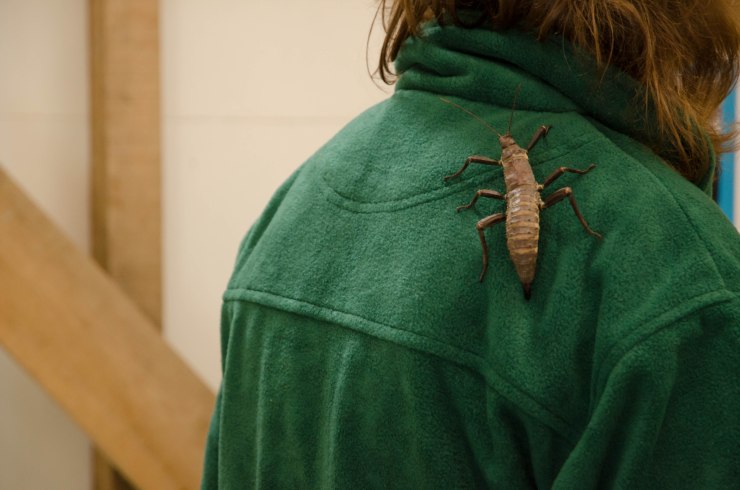
Creepy crawlies get everywhere. A stick insect roams at the Minibeast Mayhem stall.
Creepy crawlies get everywhere. A stick insect roams at the Amateur Entomologists’ Society stall
20130420_161353
Our expert navigators confer over the best route to Wittenham.

Rachel Parle, Education officer

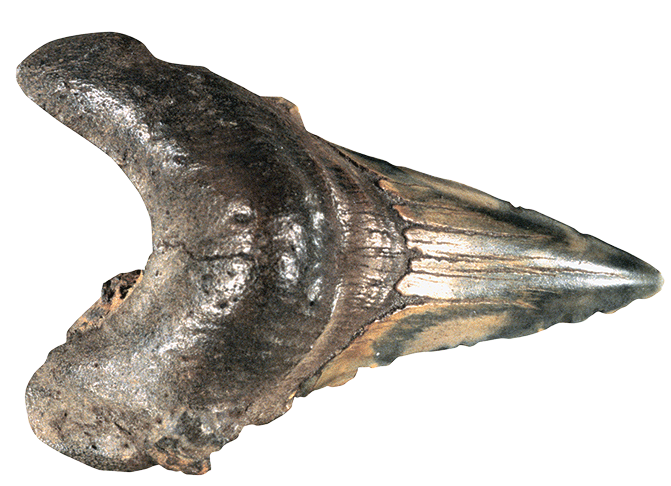
What’s on the van? – Shark tooth fossil

_Lhwyd-1260-original

This week’s What’s on the van? comes from Paul Jeffery, assistant curator of the Museum’s Geological Collections.

The oldest known collection in the Museum is that of Edward Lhuyd (1660-1709), made during the 1680s-1690s. This collection formed the basis for Lhuyd’s ground-breaking monograph, Lithophylacii Britannici ichnographia – a systematic illustrated catalogue of the collection of fossils he was responsible for as Keeper of the Ashmolean Museum, which at that time was still based in its original building, now the Museum of the History of Science in Broad Street.

Lhuyd’s book set the framework for later works by authors such as Carl Linnaeus (1707-1778) and Gustavus Brander (1720-1787) who further systematised the naming and description of animals, plants and fossils, and introduced a Latin-based naming regime still used today.

Lhuyd also advanced thinking on fossils, recognising them as organic in origin, rather than spontaneous mineral concretions or sports of the devil. This was daring and radical for its time – an era when religious orthodoxy still strongly influenced philosophical and academic thought.

This particular shark’s tooth comes from the extinct species Otodus obliquus. It is from the 50 million year old London Clay (Early Eocene), and was found on the Isle of Sheppey, Kent. Such teeth can still be found on the beaches there today, washed from the crumbling clay cliffs by rain and wave alike.

It is an uncommonly large species of shark – teeth may exceed 75mm in length, and represents one of the earliest steps in an evolutionary “arms race”. During the Palaeogene and Neogene this lineage of lamniform sharks evolved ever larger and more comprehensively serrated teeth, along with proportionately increased body sizes, to keep pace with early whale evolution, as they too increased from modest proportions to the giants of today.

It was a race the whales eventually won in the Early Pleistocene. Otodus’s descendant – the giant Carcharocles megalodon, a 20m long super-predator – disappeared around this time: outgrown by the whales, out-competed by new predatory species and displaced by global climatic cooling.

We will be exhibiting some of Lhuyd’s fossils in Natural Histories, a collaborative exhibition based at the Museum of the History of Science, opening on 14 May. More information about this will follow very shortly.

Paul Jeffery, Assistant curator of Geology

What's on the van?

Presenting… Bruno’s fossil find

Presenting Bruno's fossil find

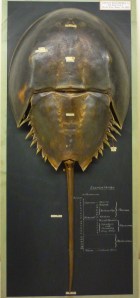
Limulus polyphemisYou’ve read about it in the press (probably), but now you can see Bruno Debattista’s rare trace fossil find for yourself in our Presenting… display, just inside the entrance of the Museum. Although we are closed, this changing exhibit can be seen by visitors coming through the building to the Pitt Rivers Museum.

On display we have Bruno’s shale rock, found in Bude, Cornwall last year, which shows faint tracks left by a pair of horseshoe crabs as they crawled up an ancient, muddy shore more than 300 million years ago. Although the species of horseshoe crab which made these tracks is long extinct, we are displaying two modern specimens for comparison. One is around the size of the animal which left the original trackway; the other is a full size horseshoe crab which lives in the Atlantic Ocean – Limulus polyphemus.

We should also point out that horseshoe crabs aren’t really crabs at all. Crabs are crustaceans, but horseshoe crabs are more closely related to the arachnids, such as spiders and scorpions.Fossil and horseshoe crab

Scott Billings – Communications coordinator

Roof revelation

8588044846_75091db95d_b
Up in the rafters
Credit: Mike Peckett

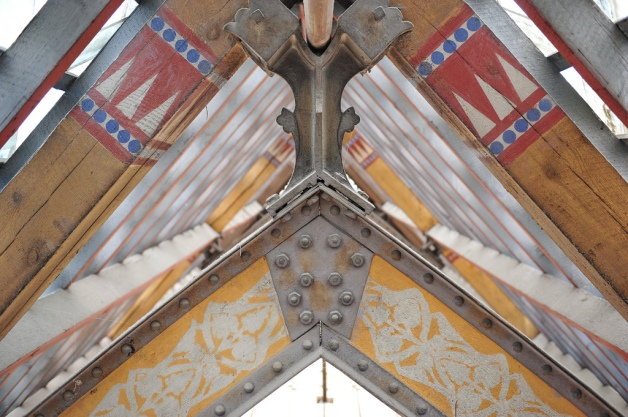
Our beautiful Victorian roof is a masterpiece of wrought and cast iron topped with 8,500 glass tiles. It’s one of the first things our visitors notice when they enter the Museum, and its leaks are the reason we’re closed this year. But what many people don’t notice is that the glass is supported by decorated wooden struts, painted with bright geometric patterns, and contrasting surprisingly with the organic Gothic detail of the rest of the building.

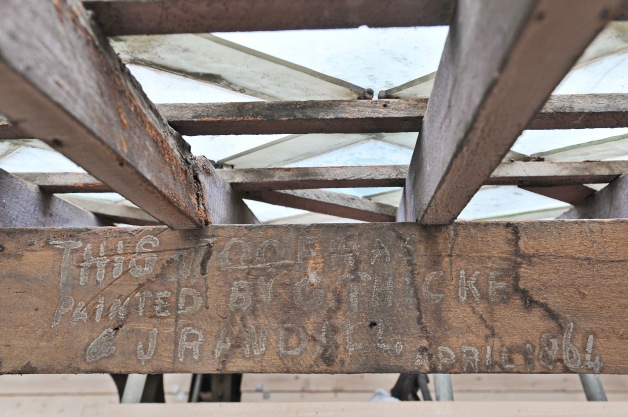
Whilst the construction team from Beard were up in amongst the rafters last week, they spotted a surprising addition to the paint work. Hidden high up, and out of sight of even the most observant of visitors, was a message from the past. The roof decorators had left their names and the date of their work painted onto the woodwork for future generations to discover.

Roof graffiti
Credit: Mike Peckett

The message reads “This roof was painted by G. Thicke and J Randall, April 1864”. In general, we don’t approve of graffiti inside the Museum, but this discovery felt pretty special. Well done Randall and Thicke, you did a great job!

Rachel Parle, Education Officer

What’s on the van? – Heliconius hecale

butterfly3This week’s What’s on the van? comes from Zhengyang Wang, an undergraduate volunteer in our Hope Entomology Collection

Belonging to the genus of Heliconius, this species of butterfly can be seen from Southern Mexico to north-central Bolivia, from dense forests to open savannah. Like many other species of this genus, Heliconius hecale has many different forms of a single species. The picture illustrates the form felix of this species, which is commonly found in Munchai, Rio Beni and Bolivia.

In one of the cabinets of the Hope Entomology Collection here at the Museum, you can find another form of the same species but of slightly different wing pattern, vestustus, usually found in Columbia. Sometimes the visual differences between forms of the same species can be quite stark: the fornarina form of Heliconius hecale from Guatemala, for example, is only black and white.

In fact, morphological differences within species is quite common among butterflies. As well as sexual dimorphism, where male and female body shapes differ, species found at different localities, different climates, and in different seasons can also exhibit variations in morphology.

Speaking of morphology, it also needs to be mentioned that many other species from different sub-families of brush-foot butterflies, such as Danaini and Ithomiini, mimic the morphology of these Heliconius butterflies. Why is that? It’s because many Heliconius butterflies are quite unpalatable to their predators, so a mimicry of them might tell predators “Don’t eat me, I’m poisonous.” This kind of mimicry of other species’ warning signals is called Mullerian mimicry.

Thanks to their choice of plant food, their differing wing patterns and the relative ease with which they can be monitored, the butterflies from the genus of Heliconius have also been widely studied to understand genetic evolution and co-evolution between butterflies and plants.

Zhengyang Wang, visiting student at Hertford College, Oxford and volunteer in the Hope Entomological Collection

What's on the van banner 2

Research links: The Kingdom of Saudi Arabia

Recently, Darren Mann (HEC) and Mike Wilson, Head of Entomology at the National Museum Wales in Cardiff visited Tabuk, Tabuk Province, Saudi Arabia. They were there to meet lecturers and students of Tabuk University and discuss setting up collaborative links to establish an entomology course, a collection of insects and undertake a faunal survey of the area. Below are some pictures from their trip:

Darren, night collecting- sorting dung beetles from camel dung


A hawkmoth (Sphingidae) caterpillar. Note the spine on its rear end.

Anthia duodecimguttata Bonelli, 1813, a species belonging to the coleoptera family Carabidae (Ground beetles) 

Species of the genus Anthia are some of the largest of the Carabidae. All of them are heavily armoured and have strong, sharp mandibles which they use to catch and crush their prey with. The species are usually black with either white or creamy-yellow spots or stripes on them. Many of them also have descriptive species name. With the above species ‘duodecimguttata‘ translates roughly as ’12-spot’.

Mike attempting to make friends with the local camel population

A desert locust, Schistocerca gregaria. Orthoptera: Acrididae.

Darren, camel trekking. Note the slightly uncertain look on his face and the slightly wry one of the face of the camel.

Darren attested to the speediness of this particular camel, something that it seemed particularly proud of and eager to demonstrate at any available opportunity.

Orthoptera: Acrididae, Poekilocerus bufonius (Klug, 1832), a possible new species record for this area of Saudi Arabia.

The grasshopper above can be identified as female by looking at the length of the wings. In this instance the end of the abdomen (tip of its bottom) pokes out by an easily visible amount from under its wings. Male grasshoppers of this species have wings that completely cover the abdomen.

Dermaptera (earwigs) feeding on a flower head of Cynomorium coccineum L. at night

Darren and Mike with , Haitham Badrawy, one of the lecturers at Tabuk University.