What’s on the van? – Red fox

L-MNH_073

This week’s What’s on the van? comes from Malgosia Nowak-Kemp, Collections Manager in the Museum’s Zoological Collections.

The Red Fox, scientific name Vulpes vulpes, is a member of the order Carnivora.  Nowadays you can see foxes not only in the wild, but also in towns and cities. Resourceful, cunning, agile, with an ability to climb, they use varied sources of food to sustain them and their families.

They are unusual in having a golden or amber colour eye instead of green like cats, or brown like most other mammals. Their fur varies from yellowish to reddish with the rump often showing white-tipped hairs. The lower parts of the legs and the back of the ears are usually black.

They are highly vocal with barks, howls or yaps and other distinctive sounds with which they communicate between each other. Foxes breed once a year, and live in family groups consisting of a male (dog), female (vixen) and their cubs, and only occasionally, with one or two non-adult females from previous  litters.  Their cubs are born blind after about 53 days gestation, and open their eyes after 10 to 14 days.The males take an active part in caring for the family, by bringing food for the cubs and their mother. They mostly hunt at night for small mammals like voles and rabbits, but also scavenge and explore the contents of dustbins for anything to eat. In summer they would add beetles, and in the autumn, fruit to their diet.

Foxes moult once a year, in the early summer, and during the late summer and autumn months they grow additional hairs so the fur becomes thicker in preparation for the low temperatures of winter. Foxes rarely live longer than 8 years.

What's on the van?

Naturally Curious

Attenborough - Natural Curiosities 2

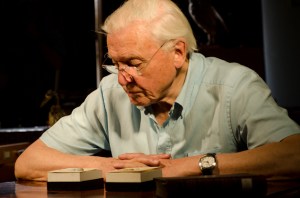
This week we’ve been delighted to welcome Sir David Attenborough to the Museum as he filmed his new television series. He spent three days filming in the Museum’s library, entomology and zoology departments and used many of our specimens in the process. Here you can see him in the library with a cuckoo and eggs.

Attenborough - Natural CuriositiesSir David was working with Humble Bee Films to make a new series of Natural Curiosities for the Eden channel. This will be the second season of the documentary, which explores some of nature’s most extraordinary and baffling species. It is due to be screened later this year; see if you can spot our scenes!

Although TV programmes and films are regularly shot in the museum, it’s always very special when Attenborough’s in the building. Such an important and famous figure adds an extra excitement to the usual film crew fuss. Needless to say, I was rather giddy when I had the opportunity to snatch a quick chat between takes. When I explained to Sir David that I was writing for a blog about our year of closure, he joked that the Museum’s closure actually made it much easier to get the filming done efficiently! Glad we could be of service.

Another exciting moment was popping into the staff room for a cup of tea, only to find a world famous natural history presenter enjoying his lunch!

Attenborough lunch
Staff from the Museum and Humble Bee Films in our staff room… with David Attenborough!

Rachel Parle, Education Officer

1683 and all that…

16836Just a quick post to say that things are pressing ahead with our Natural Histories exhibition, which is being hosted and co-curated by the Museum of the History of Science in Broad Street.

Jewson delivery

This morning, as I arrived at the MHS, Jewson had just delivered the pre-cut MDF boards that we will use to make various plinths and structures for many of the specimens in the exhibition.

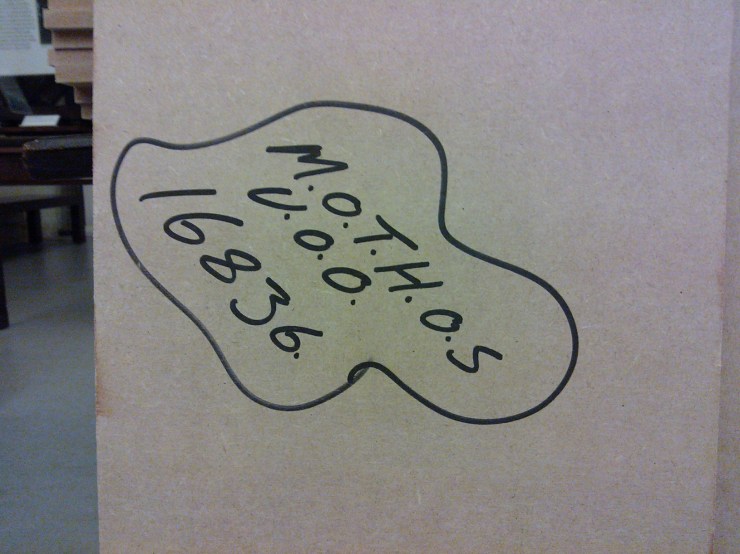
But along with this delivery came a sweet little coincidence; perhaps even a good omen. On one of the Jewson boards the order number had been written in black marker pen and the number, which you can see above, was 16836, tantalisingly close to 1683, the year this building was founded by Elias Ashmole as the original Ashmolean Museum. The ‘6’ is even written just a little bit smaller than the ‘year’.

Given that Natural Histories is partly about a temporary return of Oxford University‘s natural history collections to their original home in the building in Broad Street, this is an unusually apposite order reference.

I don’t know when in 1683 the building opened, but I really hope it was June.

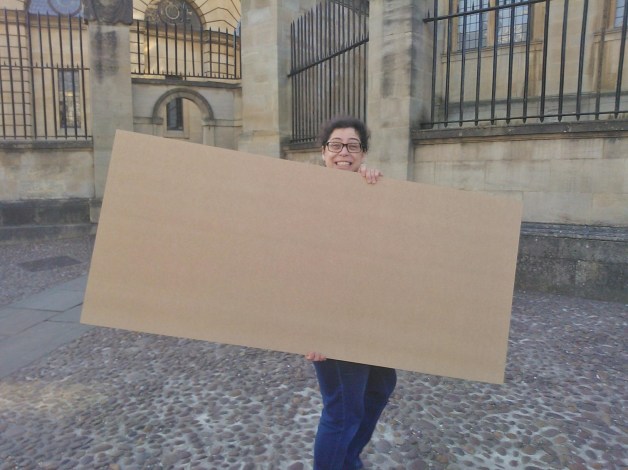
Cheryl helps bring the boards into the Museum of the History of Science

Scott Billings, Communications coordinator

EntoModena

by Darren Mann

entomodena, insect fair,
Specimens and equipment for sale at EntoModena

Last week I spent a few days in sunny Italy, visiting my good friends Stefano and Roberta Ziani and timed to coincide with the Italian entomological show ‘EntoModena‘. I had a wonderful few days of dung beetle chitchat and homemade, mouth-watering Italian gnocchi.

vegan, gnocchi, delicious
My vegan gnocchi as made by Roberta Ziani- it was that good it needed a picture all to itself.

Stefano is a dung beetle researcher, specialising in the fauna of the Middle-East. He has published over 40 papers, mostly on faunistics and taxonomy and systematics, and has described a number of new species to sciences from the genus Onthophagus, including some that are associated with nests of small mammals. During my visit I had the chance to study Stefano’s superb collection of Palaearctic dung beetles, which is better than our Museum’s, and with this collection finally managed to get a grasp of the identification of some difficult species.

EntoModena is similar to the Juvisy and Prague shows, a sort of trade fair with a difference- you can buy live and dead insects, as well as books and various items of equipment. Most people go to meet up with old friends and make new ones.

entomodena
Pasta picnic at EntoModena 2013

I met for the first time Giovanni Dellacasa, the world’s leading expert on the small dung beetles in the group Aphodiinae, although we have corresponded over many years and even published a paper together (Dellacasa, G., Dellacasa M. & Mann, D.J., 2010. The morphology of the labrum (epipharynx, ikrioma and aboral surface) of adult Aphodiini (Coleoptera: Scarabeaidae: Aphodiinae), and its implications for systematics. Insecta Mundi 0132: 1-21). I also chatted with Giuseppe Carpaneto and other dung beetle researchers, bought a few bits of equipment and admired the selection of insects for sale.

Coleoptera, scarabaeidae, dung beetles, researchers, entomodena
From left to right: Giovanni Dellacasa. Stefano Ziani, Giuseppe Carpaneto and me, Darren Mann.

My only chance to sit down during the day was by meeting up with Magdelana and Marek from Majkowski Woodworking Company who had a table (and chairs) of their wares; this is the company who supply our wonderful collection drawers, postal boxes and wooden cabinets.

drawers, entomological cabinets, unit trays, entomological and musuem equipment
Magdelana and Marek from Majkowski Woodworking Company.

What’s on the van? – Moss agate

_02-OUMNHMossAgate[1]

This week’s What’s on the van? comes from Monica Price, Assistant Curator of the Museum’s Mineralogical Collections.

This beautiful polished moss agate is about 8 cm across. It is one of 26 moss agate slices collected by John Middlemiss Luff, and given to the Museum in 1909. John Luff was a civil engineer who, as a young man in 1863, took a posting to the public works department in Bengal, India. Some of the finest moss agates come from India, and every one of the samples in John Luff’s collection is of the best quality.

Despite its name, moss agate doesn’t contain any plant material at all. The orange and brown ‘moss’ is made up of crystals of iron minerals, mostly goethite (iron hydroxide).  The crystals grew in a translucent white gel composed of silica (silicon dioxide) which solidified to form a mineral called chalcedony. Moss agates are found filling fractures and gas bubbles in volcanic lava. When the lava is eroded away by rivers or the sea, the hard lumps of moss agate survive, to be washed up as pebbles on river banks or beaches.

Moss agates take a beautiful polish and they have been prized as semi-precious gemstones for thousands of years. Brown moss agates are sometimes known as ‘mocha stone’. This has a connection with ‘mocha’ coffee beans, for both are named after the port of Mocha in Yemen, from which they were traditionally exported.

What's on the van?

Natural Histories

Natural Histories

14 May – 29 September at the Museum of the History of Science

One of the things we’ve been working hard on recently (darkened, not dormant remember) is a temporary exhibition we are putting together with the Museum of the History of Science, just up the road in Broad Street. Taking over the MHS’s lovely special exhibition gallery is a neat way of getting some great specimens out and visible to the public while we’re closed. But there’s a bit more to it than that, as it also ties in with some nice history of the museums in Oxford.

A giraffe in the entrance gallery of the 'Old Ashmolean', now the Museum of the History of Science
A giraffe in the entrance gallery of the ‘Old Ashmolean’, now the Museum of the History of Science

The first public museum to open in Britain – and quite possibly the world – was the Ashmolean Museum, established in 1683 by Elias Ashmole in the building in Broad Street that is now the Museum of the History of Science. Although the current Ashmolean (in Beaumont Street) focuses on art and archaeology, the ‘Old’ Ashmolean’s collections were of both man-made objects and natural specimens.

They remained there – and grew – until the mid-19th century when our Museum was built in Parks Road. At this point, in 1860, the natural history specimens came here, where many of them remain. So the Natural Histories exhibition at the MHS represents a return of natural history to its original Oxford home in the building on Broad Street. There was even once a giraffe in the entrance gallery as you can see above.

Magnificent Riflebird (Ptiloris magnificus)

But back to the exhibition. Natural Histories takes a look at some of the history of natural history itself. This is a big subject to tackle, so we’ve picked out just a few themes and stories – some important ideas and big name scientists, as well as some lesser-known but nonetheless significant naturalists. The displays will show specimens and ideas from throughout the centuries, right up to the present day.

There will be creatures collected by Charles Darwin and Alfred Russel Wallace, Darwin’s contemporary and co-originator of the theory of evolution through natural selection. We have got some examples of the oldest rocks on Earth; extinct plants and animals; and some of the very latest techniques being used in the Museum to reveal exquisitely preserved fossils.

There’s a lot of material to prepare and we’ve been mocking up shelf layouts and making sure everything is going to fit, as you can see in the picture below.

Testing case layouts.
A particularly busy display: what can you spot…?

And since this is the Museum of Natural History there will of course be some things you can touch. We’re also building in a special thread running throughout the exhibition just for families and children, which I think might well be narrated by our friend the Dodo.

We hope you’ll all come and see the exhibition and let us know what you think, either here or on Twitter. And if you can’t make it, there will also be a dedicated Natural Histories website – more on that and our programme of events and activities to follow.

One way or another, we’ll hopefully see you there…

Scott Billings, Communications coordinator