Wrapped up, packed up, squashed up

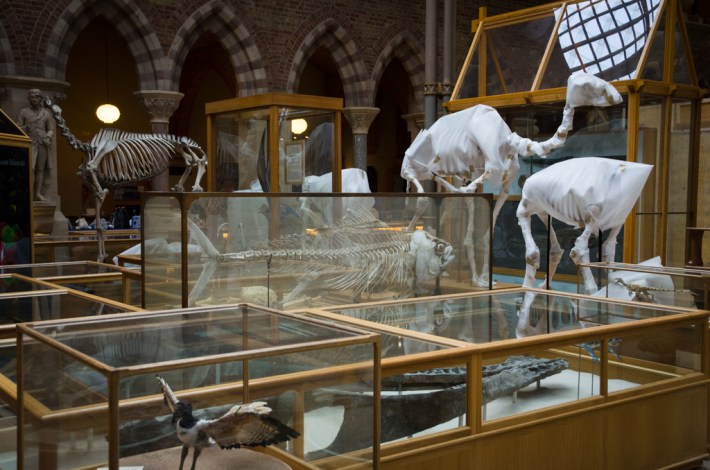
Our permanent residents are suffering the minor indignities of a shared living space. Accustomed to their own quarters – the gallery territories ruled by mammals, fish, arthropods, or dinosaurs – during closure everyone is instead piled into a single aisle at the south end of the Museum.

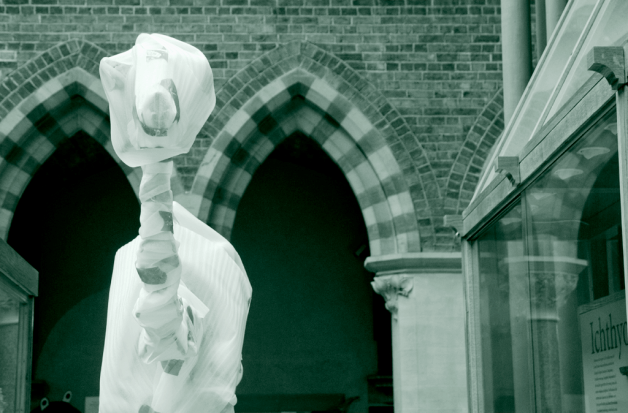
We’ll take a look at some of the individual wrappings later, but for now we just wanted to show the squash and the squeeze that has been required to allow the roof repairs to take place.

If you’re visiting the Pitt Rivers Museum you’ll be able to see this little bone jungle for yourself as you make your way out from the Pitt Rivers and back through our Museum.Image

ImageScott Billings, communications coordinator

10th Coleopterists Day


On February 2nd we hosted for the second year the annual national beetle (Coleoptera) enthusiasts day, with the fifty attendees coming from as far as Cornwall and Lancashire. The day kicked off with proper coffee, tea and biscuits and then a series of talks, followed by a tour of the entomology department and a dung beetle workshop. 


The talks presented were a nice mix of professional, student and enthusiast and were enjoyable and entertaining. The talks were: Using traits to evaluate ladybird distributions – Richard Comont, CEH; Prionus coriarius in Richmond Park – John Lock; Suckers & sexual conflict in diving beetles – Dave Bilton, Plymouth University; Studying the ecology of British Oil Beetles – John Walters; New initiatives to support beetle recording in Britain – Helen Roy, BRC.

Coleoptera, beetles, lecture, OUMNH
Helen Roy presenting her talk on beetle recording in Britain
The collections (thanks to Amoret Spooner) and Library (thanks to the Librarian Kate Santry) were accessible throughout the afternoon, and many took advantage of using the library (for the first time) and the collections to confirm identifications against our reference material or just to see the more unusual species and extract data. 


The workshop ‘Dung Beetle Identification’ was a bit of squeeze in our teaching area, with a few too many enthusiastic coleopterists wanting to know how to identify the small and often difficult Aphodius

Coleoptera, beetles, dung beetles, Scarabaeidae, British, identification
Darren Mann presenting his workshop on dung beetle identification

However, using our digital video set-up and monitor we managed to get through the entire dung beetle fauna, giving tips and tricks on their identification and interpretation of the key couplets, the stalwart coleopterists continuing until 8pm.

Coleoptera, beetles, identification, course, Scarabaeidae, characters, morphology
Darren Mann using the video microscope to show characters used in the identification of British dung beetle species

Raising the roof

Raising the roof

As a year of closure stretches ahead of us, it’s easy to feel down about the boards and darkness that are replacing the spectacular views across the Museum court. Our regular visitors have certainly expressed sadness and disappointment that they will be deprived of their favourite museum for a year. But we have to remember that it will all be worth it in the end: the restoration project will return the roof to its full Victorian glory and give the building below the respect it deserves.

During a trial last year one third of the roof’s glass tiles were delicately cleaned, restored and resealed in an attempt to keep the rain out. This test proved successful – the rain drops ceased and the light flooded in. The project to repair the whole roof was given the go ahead.

DSC_6685

A close-up of the glass roof tiles before the trial cleaning project

DSC_6689

And sparklingly clean afterwards!

At the same time, staff were treated to a guided tour of the roof itself. We scaled ladders and scaffolding high up in the south aisle of the Museum. It was remarkable to see that the careful details of carved screws and painted beams are as beautiful and painstaking at the very peak of the roof as they are at eye level, down in the courts below. It made us all appreciate the effort and care that the Victorian architects, engineers and artists put into creating this masterpiece in the mid-19th century.

_DSC0765

The pinnacle of the south aisle’s roof

Up close, it was also easy to see dust on the metalwork and the ancient grime that has steadily built up on the glass tiles. We all wanted this faded glamour to be returned to its original glory; there was no denying it, the roof works were an essential project.

DSC_6658

The detailed metal work that adorns the roof

Although we’ll miss the specimens and the stunning architecture during this closure year, the roof restoration will ensure that the Museum is back to its original best for another 150 years… and hopefully many more after that.

Rachel Parle, Education Officer

Alfred Russel Wallace


In 2013, 100 years after his death, we celebrate the life of Alfred Russel Wallace (1823-1913), one of the greatest Victorian naturalists, travellers and collectors, a scientific and social thinker, early bio-geographer and ecologist, co-founder with Charles Darwin, of the theory of evolution through Natural Selection.

The Hope Entomological Collections (HEC) has many examples of species named after Wallace and of specimens collected by Wallace himself including species types such as Wallace’s giant bee.

Hymenoptera, Megachilidae, Megachile pluto, bee, insect, type, OUMNH, HEC
Megachile pluto described by B. Smith, 1869 is the largest bee species in the world. It occurs in Indonesia and builds its nest inside active termite nests.

The OUMNH also has nearly 300 letters written by Wallace discussing scientific topics, social issues, his relationship with Charles Darwin, and family matters which have been scanned as part of the Wallace Correspondence Project (WCP). Recently, the WCP has launched a new searchable open access on-line database entitled  ‘Wallace letters on-line‘. Staff and volunteers in the HEC have put in many hours of work in order to add our own holdings of letters and correspondance to this exciting project.

Wallace, correspondance, letter, entomologist, naturalist, archives

Wallace, correspondance, letter, entomologist, naturalist, archives
A letter from A.R. Wallace to E.B. Poulton, a former curator of the Hope Entomological Collections.
Wallace was largely self-educated. He developed an interest in natural history when young, and, like Darwin, became a keen beetle-collector. Fourteen years younger than Darwin, and from a less wealthy background, Wallace always had to earn a living while developing his scientific ideas. The Victorians were fascinated by the mystery behind the development of species and the anonymous publication in 1844 of ‘Vestiges of the Origin of Creation’ (actually written by Robert Chambers) caused a sensation. Wallace determined to resolve the species question himself, and travelled to South America with Henry Walter Bates to collect specimens and theorise about species, inspired by earlier travellers such as Humboldt, Edwards and Darwin himself. 
Wallace spent four and a half years in Amazonia before returning to England (losing most of his precious collections and notes in a ship’s fire on the way home) and had already published some scientific articles before publishing two short books, ‘A Narrative of Travels on the Amazon and Rio Negro’ and ‘Palm Trees of the Amazon and their Uses’, but he realised he needed to continue collecting if he was to achieve his aim.
Wallace chose as his new collecting ground, the Indonesian region. Before leaving England, Wallace happened to meet Darwin briefly at the British Museum. While Darwin continued his painstaking work on barnacles and other researches, Wallace arrived in Singapore in 1854 and spent eight and a half years travelling an estimated 14,000 miles throughout the region, as described in his much republished book ‘The Malay Archipelago’.
It was here that Wallace wrote his illuminating essay ‘On the Law which has Regulated the Introduction of New Species’ (known as the ‘Sarawak Law’ paper) in 1855. This was followed in February 1858 by Wallace’s most famous paper ‘On the Tendency of Varieties to Depart Indefinitely from the Original Type’ which did lead Darwin to publish On The Origin of Species the following year.
Wallace was suffering from malarial fever when the idea crystallised in his mind. Between bouts of fever, he wrote out his theory in a few days, and sent it to Darwin (whom he knew would be sympathetic to his ideas), hoping for advice on whether and how to publish it. A key for both Darwin and Wallace in formulating their theories of natural selection was recollection of Malthus’s essay on population. Of course, when Darwin received Wallace’s letter, he was presented with a dilemma. He had been working on his theory for twenty years, and here was an outline of that theory, written by a relative unknown, far away in the tropics. Darwin sought advice from Sir Charles Lyell and Joseph Hooker(later Sir Joseph Hooker), who decided that it would be fairest to publish some extracts of Darwin’s earlier writings together with Wallace’s paper, at the next meeting of the Linnean Society. It happened that an emergency meeting was being called and the papers were added to the agenda and read on 1 July 1858, with neither author present (Wallace was still in the Malay Archipelago and Darwin’s son Charles had just died).
Darwin was relieved when he found that far from resenting his treatment, Wallace felt honoured for their ideas to be associated. In fact, when writing about natural selection, Wallace chose the term ‘Darwinism’ and defended ‘Darwinism’ with vigour, both in England and abroad, describing himself as a ‘Darwinian’. Both Darwin and Wallace recognised that their theory (which they both acknowledged had been arrived at independently) had anticipators and were fully aware of the importance of recognising the contributions of others. They remained correspondents, consulting each other on various topics and Wallace was one of the pall-bearers at Darwin’s funeral.
Wallace was a believer in inspiration and said ‘all my best ideas have come to me suddenly’. Modest to a fault, he was happy to receive (among many other honours heaped on him) the Royal Society’s ‘Darwin’ medal, and described as ‘outrageous’ attempts to put him on same level as Darwin. 
When presented with the first ‘Darwin-Wallace’ medal by the Linnean Society on 1 July 1908 (celebrating the anniversary of publication of the Darwin-Wallace papers), Wallace contrasted himself with Darwin: “I was then (as often since) the “young man in a hurry”: he, the painstaking and patient student, seeking ever the full demonstration of the truth that he had discovered, rather than to achieve immediate personal fame.”.  Wallace felt himself more suited to fieldwork (he was meticulous with his labels and had always recognised the importance of noting the location where each specimen had been found) and was glad that Darwin had been able to provide the vital detailed proofs and analysis for their controversial ideas.
Although they did not agree on everything (and sometimes had to agree to disagree), Darwin and Wallace shared mutual respect and friendship, and believed ardently in the spirit of co-operation, which their relationship personified.
Wallace, correspondance, postcard, entomologist, naturalist, archives
The postcard above, written in Wallace’s handwriting reads as follows ‘Many thanks for the kind congratulations- Am feeling quite jolly! Alfred R Wallace’

Hello world, goodbye world

Wrapped camel It is customary to launch into the digital realm for the first time with a tentative yet friendly ‘Hello, world’. A Hello World computer program is one that displays this simple message in confirmation of the novice programmer’s successful coding – “You’ve done it, you’re digital!” it announces.

At the Museum of Natural History in Oxford we have of course already made it on to the internet, and our Entomology team already have their very own bug blog, Hope You Like Insects. In fact,our previous writer in residence, Georgina Ferry, blogged about the Museum’s comings and goings during her tenure too, but this is our first fully in-house Museum-wide blog and so a tentative but friendly ‘Hello, world’ feels just about right to kick things off.

But it’s also a case of ‘Goodbye, world’, for this blog is conceived to document a year of closure to the public. As the Museum becomes clad in board and scaffold – rigged up to enable a painstaking repair of the glass tiled roof – it’s goodbye to the natural world that is normally on display in the courts and galleries: camels, reindeer and dinosaurs are foam-wrapped and huddled together in the south aisle like cartoon outlines of themselves, and many other specimens have been removed from display and placed in safe storage.

So is it a funny time to launch a blog? Hopefully not. We hope that this blog will give people a window into some of the work that is taking place in the Museum throughout the year, including the important cleaning and repair of the roof, but also of some behind the scenes activity in various departments. There are some special public things planned to make up for the closure too – more of that to come.

In the meantime follow the blog, tweet it, or stick it in your RSS reader and we’ll let you know what we’re up to. Right now, whale skeletons are being lowered for cleaning and conservation; our Education team is about to hit the road to visit schools in a resplendent new van; and we’re putting together a special exhibition with the Museum of the History of Science in Broad Street.

Which leads nicely to the last thing, the name of this blog. The building may be thrown into shadow by the large construction hoardings that are consuming the north aisle and central court, and there may be an unusual hush as families, children and other visitors make their way straight to the Pitt Rivers Museum, which remains open as normal, but there is still plenty going on. As we hope to reveal here over the next twelve months, we may be darkened but we are definitely not dormant.

Scott Billings, communications coordinator

Drawing techniques for publication

By Katherine Child

Despite the prevalence of photography in scientific and technical books and papers today, there are still times when a scientific work will call for a more traditional approach. Drawing remains an important part of natural history illustration, and can often provide a more specific and flexible way of communicating information.

Coleoptera, Corylopidae, beetle, drawing
An example of the way key features can be highlighted and isolated to provide clarity in a drawn illustration. Cleidostethus meliponae Arrow, from the genus Cleidostethus Arrow, by Stanley Bowestead.


Stanley Bowestead and Thomas Eccles are both enthusiastic advocates of drawing and have recently published a joint paper on technical drawing for publication in collaboration with the HEC. They argue that the value of drawing lies not only in the end results ability to communicate, but also that the process of drawing is in itself crucial to the better understanding of the subject at hand.  Producing a detailed drawing of a beetle for example, requires rigorous observational skills and after studying the insect, the observer will have gained a unique understanding of the form of that specimen.
Coleoptera, Coccinellidae, ladybird, beetle, drawing

Anatis ocellata (L.) by Stanley Bowestead. White gel pen has been used to highlight the setae on the legs.

In the past it was not only the lack of modern alternatives which made drawing a popular tool for documenting scientific findings. Science, art and religion all used to be closely linked to one another – to the point of being virtually indistinguishable as separate subjects. The study and appreciation of natural history through drawing was thought to bring a person closer to God, as well as being at the height of fashion during the Victorian era.    

So, it is shifting attitudes towards science and art, as well as photographic advances and the development of other imaging techniques such as SEMs, that have lead drawing to decline over the last 50 years or so in the study of natural history.  


Coleoptera, Scarabaidae, Cetoniinae, beetle, scarab, insect
An automontage photograph of a scarab. Photographic equipment and image processing have advanced rapidly in the last 30 years and high quality digital pictures are now becoming normal in scientific publications.
Stan and Thomas’ paper as well as being a practical how to guide on the technical drawing of insects, hopes to promote the value of drawing alongside other contemporary methods of illustration, as being something which remains relevant and invaluable as a learning resource in the field of science today. ­­
Coleoptera, Carabidae, Harpalinae, ground beelte, drawing

Lebia chlorocephalaby Thomas Eccles. Worked in colour pencil with highlights picked out in white ink.


The paper is available to download for free from the museum’s website.