The One Show

Amazon Dismorphia Wallace

Last week, members of our conservation team were presented with a wonderful opportunity to get out of the ‘Whale Tank’ and make their way to London to escort some very special specimens to the BBC.

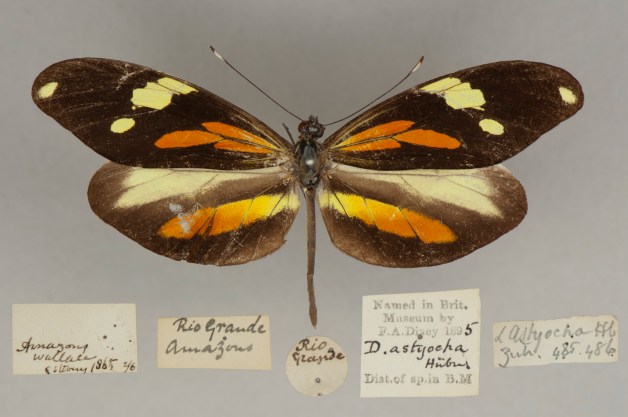
The precious cargo consisted of newly-discovered Alfred Russel Wallace butterfly specimens that were uncovered in the Museum’s Life Collection by 17-year-old Athena Martin, a Nuffield Research Placements work experience student. This story featured on Thursday night’s edition of The One Show, where presenter Mike Dilger spoke about Athena’s project with the Museum and was able to show, on national television, the fruit of her hard work.

Papilio
Papilio ulysses. Examples collected by Wallace are marked with a red dot.

Two cases of butterflies were used on the programme and contained specimens collected by Wallace during his exploration of the Malay Archipelago. The show focused in particular on Papilio ulysses, and it was a joy to witness Mike Dilger’s excitement at discovering Wallace’s handwritten collection labels.

Our specimens, which were shown alongside some wonderful footage of CT scans of a developing chrysalis, made for excellent viewing for anyone with an interest in Lepidoptera.

If you missed it the first time around please do have a look on the BBC iPlayer. The butterfly feature begins at about 15’40”.
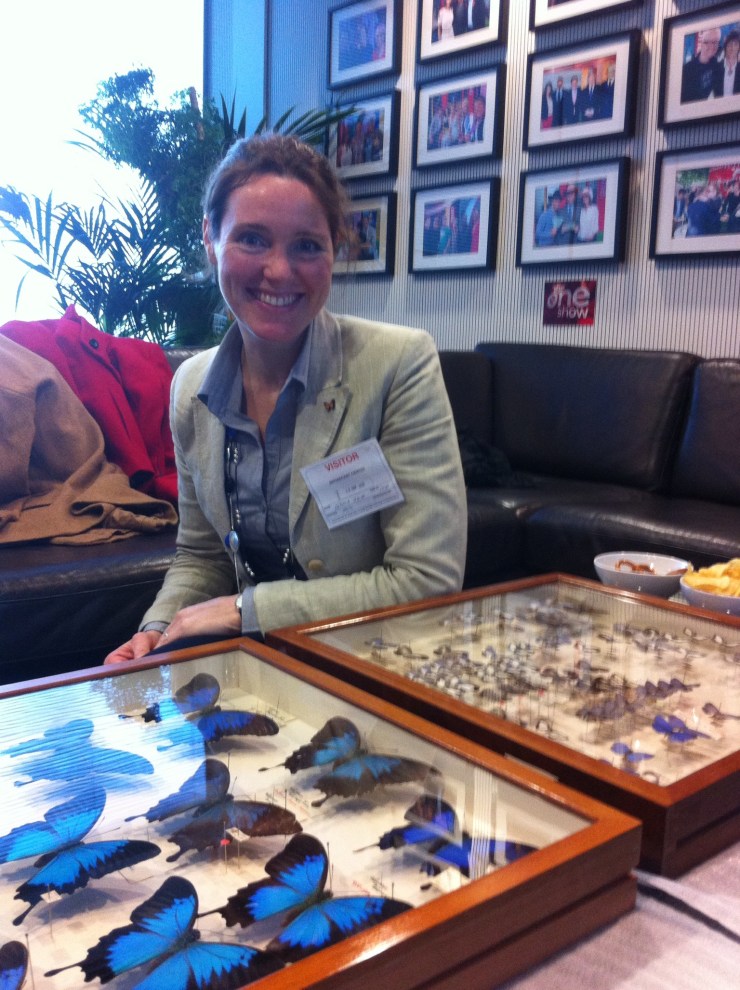
Gemma Aboe with the drawers of Wallace specimens.

We are very grateful for coverage on The One Show as it was an excellent opportunity to demonstrate, outside the Museum environment, the significance of natural history specimens, as well as highlight the important work of our conservators. It was also a thrill to be on set and watch the live show, so thanks a lot to the BBC for asking us along.

Nicola Crompton, Conservation intern
Gemma Aboe, Assistant conservator

What’s on the van? – Black-capped kingfisher

_kingfisher

This week’s What’s on the van? comes from Malgosia Nowak-Kemp, Collections Manager in the Museum’s Life Collections.

Kingfishers belong to a family Alcenidae where they are organised into 14 genera with 86 species. Most of them live in the tropics and only a small number of species venture into temperate zones as migrant breeders. Some species feed on forest-floor or air-borne insects, some prey on birds and reptiles and some, similar to our native species, on fish. Kingfishers living away from water, called the tree kingfishers, adopt a sit-and-wait strategy to catch their prey on the ground, whereas kingfishers living near lakes, rivers or streams, the so-called river kingfishers, deep-dive either from a perch or from hovering flight.

The kingfisher you see painted on the van is called the black-capped kingfisher, Latin name Halcyon pileata. It lives in tropical Asia, from India to China, Korea and Southeast Asia. This is a relatively big kingfisher whose length reaches about 28cm.

The black-capped kingfisher is a river kingfisher, found near coastal waters, especially in mangroves. It surveys the area from a high perch and hunts not only for insects but also for frogs and fish. As in other kingfishers, it has very good eyesight, enabling it to cope with reflections on the rippling surface and light refraction of the water, which makes the prey appear to be nearer the surface than it really is.

It makes its nest on the banks near water, with both sexes excavating the nest tunnel. A single clutch of 4-5 round white eggs is typical, with the female being mostly responsible for the incubation. The eggs hatch at daily intervals, resulting in a marked size difference between the chicks. Both parents are equally involved with feeding the brood.

This particular specimen of the black-capped kingfisher was collected in Bangladesh and, after being prepared by a taxidermist, was displayed in a glazed case for a number of years. It came to the Museum in 1963 as part of a large donation of bird skins presented by B.B. Osmaston.

What's on the van?

Whales making waves

Gemma Aboe's avatarOnce in a Whale

Yesterday BBC Radio Oxford interviewed Bethany Palumbo, Conservator of Life Sciences at OUMNH about our ‘Once in a Whale’ project. Do listen to the broadcast online, before it runs out in 6 days!                    http://www.bbc.co.uk/programmes/p01fp8r2

Malcolm Boyden’s interview with Bethany lasts 14 minutes- select ‘1:06min’ to listen in on their chat about the whales, the museum renovation, Bethany’s experiences of being a conservator and more!

Project update
As we enter into the last 5 weeks on the whale conservation project, we are pressing ahead with re-articulating the skeletons with new screw fixings and stainless steel wire (- our hands end up looking like we had a fight with a sharp clawed cat).

We’ve also been meeting with professional riggers, who once the main scaffolding has been de-assembled, will raise the cetacean skeletons into their NEW positions- watch this space!

Our next…

View original post 30 more words

Latest on the lawn

_DSC4589

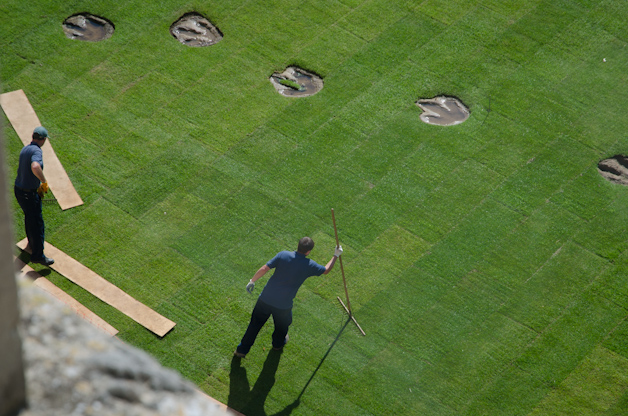
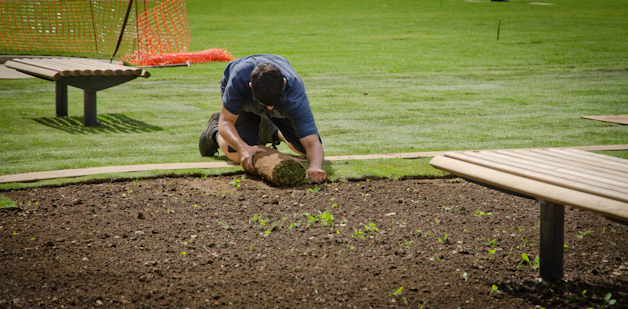
_DSC4566As I explained last week, the outside of the Museum has been getting a make-over, and the finishing touches are now rolling into place. Each day I’ve checked progress through my office window as roll after roll of turf has been immaculately lined up and pressed firmly into place. It took the team just 5 days to transform the space from a dusty wasteland into a spectacular expanse of technicolor green.

_DSC4600

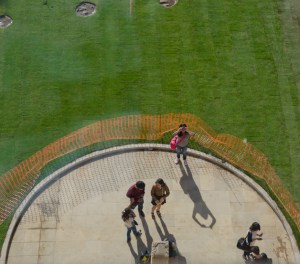
Looking out of the window today, the new irrigation system is obviously doing a great job and the grass is lush and getting long. The only problem is the bright orange fence that surrounds the lawn and stops us from testing it out. I can’t wait until that comes down and we can use it for the first time. I just hope there are a few more chances for a picnic lunch on the lawn before Autumn really sets in!

Rachel Parle, Education Officer

_DSC4574
Photos: Scott Billings

Space traveller’s arrival

Limerick meteoriteTwo hundred years ago today, at 9 o’clock in the morning on 10 September 1813, the residents of County Limerick in Ireland had a bit of a surprise. They heard loud bangs as a shower of meteorites fell to ground. More than 48 kilograms of rock had just arrived from space!
More specifically, it had come from the asteroid belt, a band of rocky debris that orbits the Sun between Mars and Jupiter. Collisions can knock asteroids out of orbit, and occasionally send them hurtling on a collision course with Earth. Small fragments burn up in the Earth’s atmosphere, forming meteors or ‘shooting stars’. Larger pieces fall to the Earth’s surface, and these are known as meteorites.

Limerick chondrulesThe meteorite that fell over County Limerick broke into pieces, and the one in our collection is the second largest. It weighs nearly 8.5 kilograms, and landed near the village of Faha on the estates of the Blakeney family. The Rev. Robert Blakeney was an Oxford graduate whose ministry was in the parish of South Elm in Somerset. The meteorite was perhaps found in the rectory after his death, as it was the new rector’s younger brother, the Rev. John W. Griffith, who presented it to the University of Oxford in 1825.
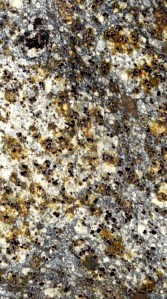
The outer crust of the meteorite is smooth and dark where the surface melted as it fell through the Earth’s atmosphere. The inside is a pale grey rock. Look closely at the photograph to the left, and you can see flecks of metal – nickel iron alloy – and tiny rounded crystalline grains called chondrules. The picture shows an area about 35 mm x 20 mm.

The chondrules show that the Limerick belongs to a class of stony meteorites called ‘chondrites’. At around 4.55 billion years old, chondrite meteorites are some of the oldest materials in the Solar System. They give researchers important clues about how the planets – including the Earth – originally formed.

To celebrate the 200th anniversary of the arrival on Earth of the Limerick meteorite, we are exhibiting it in  ‘Presenting…’, a changing display of treasures from the Museum’s collection. Although the main Museum is closed, this display can be seen by visitors on the way through to the Pitt Rivers Museum, so do come and have a look. It might be the oldest thing you’ll ever see!

Photography: Dara Lohnes

Monica T. Price, Head of Earth Collections

What’s on the van? – 7 spot ladybird

_5450712_xl_ladybird2

This week’s What’s on the van? comes from Richard Comont of the Centre for Ecology and Hydrology.

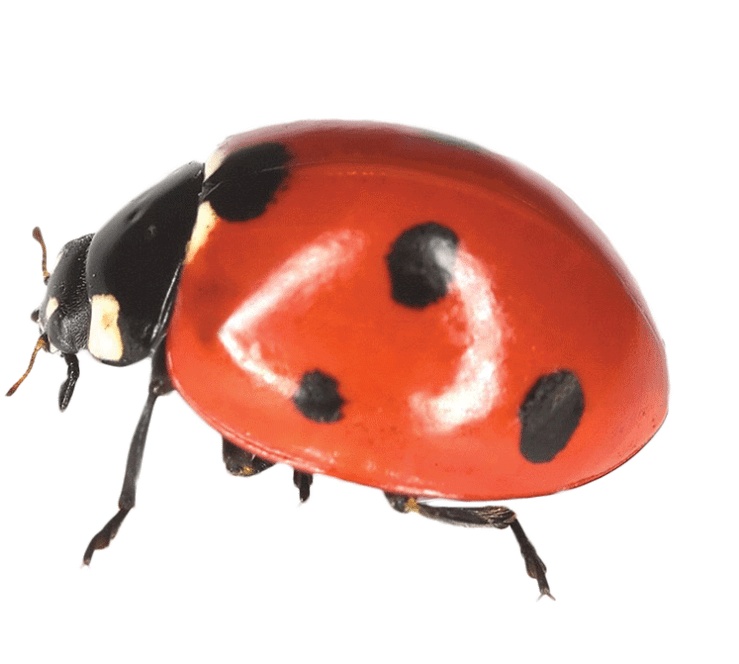
The 7-spot ladybird, Coccinella septempunctata, is one of the most iconic examples of British wildlife. Probably our best-known beetle, its image has been used as the logo for books, clothes, and much more.

It’s one of our largest ladybirds, up to 8mm long, and it can be found almost anywhere – it’s not fussy about habitat and usually arrives shortly after an aphid colony has established. Gardens and rough ground are good areas for the species – they especially love nettle patches!  Their bright red colouration makes them easy to spot, but is actually a warning to predators – ladybirds practice chemical warfare by producing a foul-tasting yellow liquid from their knee joints when disturbed.

_5450712_xlThe 7-spot has been familiar to farmers and gardeners throughout history as a brightly-coloured guardian against greenfly, and it’s from this that ladybirds get their slightly odd name. Bright red in colour (matching the cloak of the virgin Mary in early biblical illustrations) and with seven black spots recalling the seven sorrows of Mary, these tiny predators were clearly a gift from the gods to farmers suffering from aphids on their crops, and so they became known as ‘Our Lady’s birds’, which became shortened to ‘ladybirds’.

Most people recognise the 7-spot, but are surprised to hear that there are actually 47 different ladybird species in Britain alone! The UK Ladybird Survey team have published a new ladybird handbook to help people learn about and identify these fascinating insects – why not submit your next sighting at www.ladybird-survey.org?

What's on the van?