Drawing on the past

page 3 low

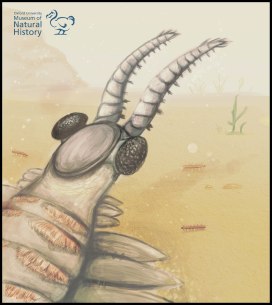
My name is Jasmine Bevis and I’m an Illustration student at Plymouth University. I have a great interest in prehistoric life, so when the Museum of Natural History suggested a project, I just had to get involved. The task was to develop a new reconstruction of Anomalocaris, a 500 million year old predator from the Cambrian era. With input from palaeontologist Allison Daley I came up with a successful design, and was invited to come to the museum for a placement.

Jasmin's Anomalocaris
Jasmine’s Anomalocaris

On my first day I was welcomed with open arms by Allison Daley and Eliza Howlett. I was given a look behind the scenes and shown some extraordinary fossil specimens that brought out my inner child. It got more exciting when I was shown my workstation, a room packed full of fossils and all manner of objects; I would not have to look far for inspiration! Meeting the Public Engagement team was next, where I was given my first project, to draw digital line artworks for education worksheets. These drawings needed to be clear, accurate and easy to photocopy.

Ichthyosaur to be used for education resources

Over the next 5 days I completed line artworks of a turtle, a spider crab, a nautiloid and an Ichthyosaur. I was also given the pleasure of illustrating 3 crustacean fossils for a paper that Allison was working on.

Another of Jasmine's Anomalocaris illustrations
Another of Jasmine’s Anomalocaris illustrations

Allison and I would talk about the Anomalocaris project over lunch and then I’d make improvements to my reconstruction; knowing that she would use it in lectures was a great feeling.

page 4 low

On the last day I met botanical illustrator Rosemary Wise, who filled me in on her career and showed me her wonderful artworks. I took this last day to finish as much as I could, and wander around the beautiful museum doing huge numbers of drawings. It was no  surprise to see the that T. rex, king of the dinosaurs, conquered most of my pages!

Jasmine Bevis, illustration student
Prehistoric parasites

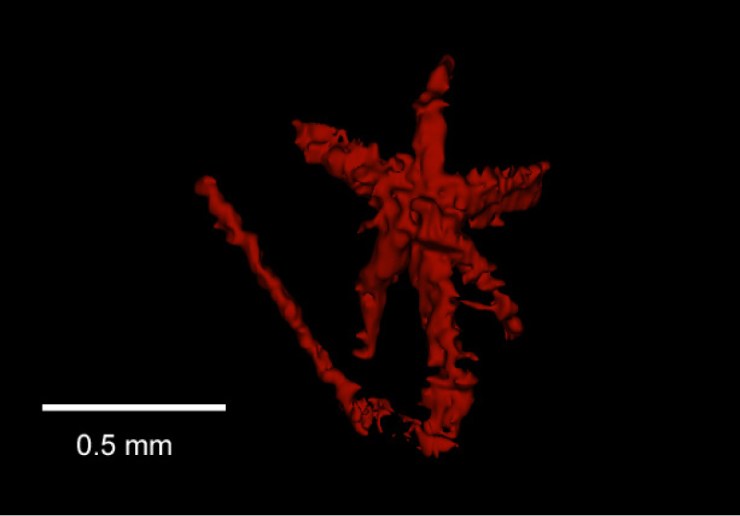
Digital reconstruction of fossil pentastomid, Invavita piratica

Our understanding of very early life is constantly developing. Carolyn Lewis, research technician in the Museum’s Earth collections, describes a recent discovery.

**

Invavita piratica is a new species of fossil parasite, recently discovered at the Museum in a 425 million year old rock from Herefordshire. This tiny creature, which belongs to an unusual group of parasitic arthropods called pentastomids, is particularly exciting because it was found attached to its host, an ostracod crustacean. A paper published last week in the journal Current Biology by Professor Derek Siveter, Senior Research Fellow at the Museum, and his co-researchers describes how this discovery sheds new light on the evolution of pentastomids.

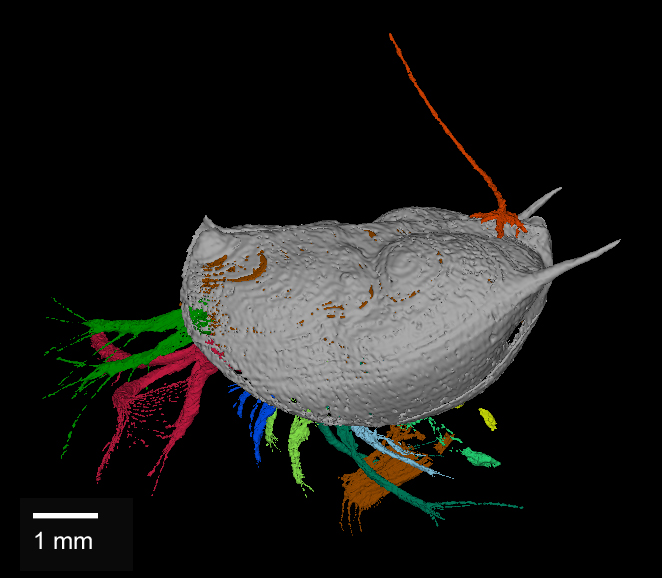
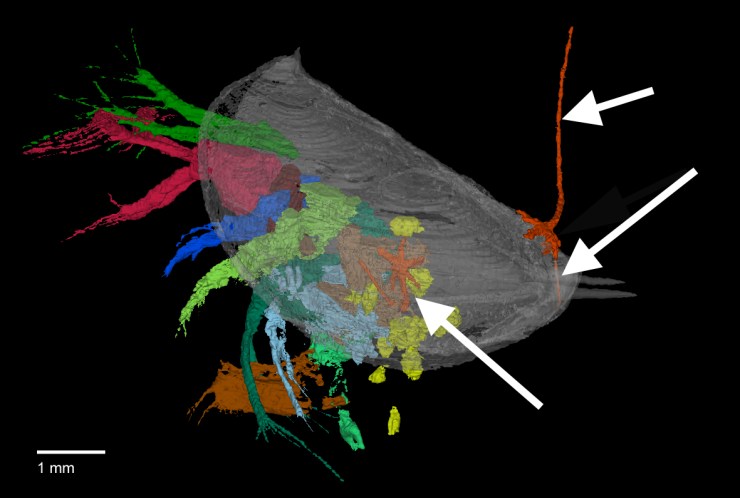
Digital reconstruction of the ostracod Nymphatelina gravida with 2 overlapping specimens of the pentastomid Invavita piratica (artificially coloured orange) attached externally to the shell of the ostracod.

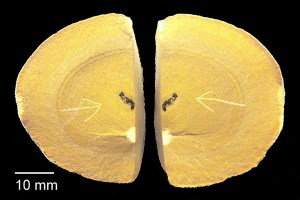
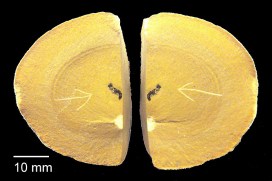
The pentastomid Invavita piratica is the latest new species from the Silurian Herefordshire Lagerstätte, a deposit of exceptionally well preserved marine invertebrate fossils ranging from less than a millimetre up to a few centimetres in length. We investigate the fine structure of the Herefordshire fossils by a process of serial grinding and photography followed by painstaking editing and 3D digital reconstruction of the specimens as ‘virtual’ fossils.

Nodule split and ready for investigation

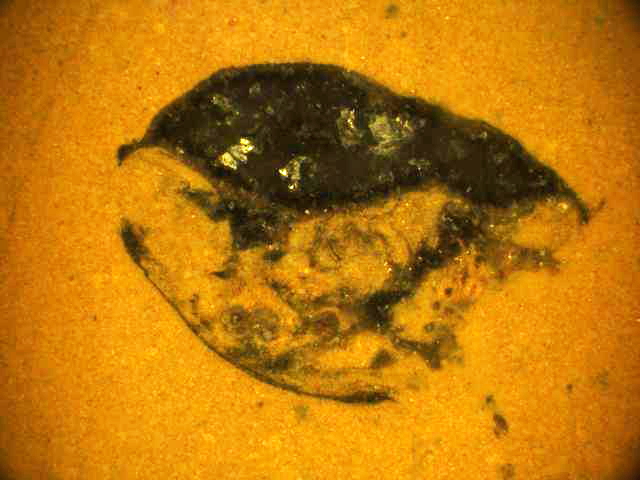
The many arthropods so far described from the Herefordshire Lagerstätte include four new species of ostracod, tiny bivalved crustaceans that are widespread in the oceans of today. The Herefordshire ostracod fossils are preserved in exquisite detail including limbs, spines, eyes and in one species, Nymphatelina gravida, eggs.

It was while editing a specimen of Nymphatelina gravida, that we spotted three puzzling star-shaped objects: an overlapping pair attached externally to the shell and one inside the body of the ostracod. On further investigation these were identified as adult pentastomids, each with an elongated snout, two pairs of outstretched limbs and a long slender trunk, together forming the star-shape. The eggs of Nymphatelina gravida may have provided a source of nutrition for the internal parasite.

The ostracod Nymphatelina gravida before digital reconstruction

Fossil pentastomids are incredibly rare: Invavita piratica is the first adult fossil pentastomid to be discovered and the fossil pentastomid to be found attached to its host.  Apart from our Silurian specimens, just a few isolated juvenile pentastomid fossils are known from even older Upper Cambrian and Ordovician rocks.

Digital reconstruction Nymphatelina gravida (with shell rendered semi-transparent).  The arrows indicate the 3 specimens of the parasite Invavita piratica (artificially coloured orange) – 2 external overlapping specimens attached to the shell and 1 internal parasite near the eggs (yellow) of the ostracod.

Our discovery of a marine ostracod as the host of Invavita piratica shows that the parasitic lifestyle of pentastomids first evolved in the sea with invertebrates as early hosts. Pentastomids like Invavita piratica may have been transferred to marine vertebrates when their ostracod hosts were eaten by fish or conodonts. The timing of the terrestrialisation of pentastomids is unknown but it may have been in parallel with the subsequent vertebrate invasion of the land.

Living pentastomid species almost exclusively infest the respiratory tract of land-dwelling vertebrates, particularly reptiles but also birds and mammals. Because all known fossil pentastomids lived long before land vertebrates evolved, the identity of these early hosts were something of a puzzle.

Carolyn Lewis – Research Technician


Trowel Blazers

Lottie 8 (2) As the recent winner of the Jan Bergström Young Geoscientist Award, Dr Allison Daley is an inspiration to many budding geologists. Today, to celebrate the birthday of Mary Anning, probably the most famous female paleontologist ever, Allie reflects on the scientists who have inspired her and describes an encounter with a tiny female fossil hunter.

**

This week I received a special visit from a pint-sized friend, who is small enough that she actually arrived in the post. Fossil Hunter Lottie is an aspiration ‘pro girl’ doll who was designed in collaboration with my friend Tori Herridge at Trowelblazers. If you haven’t heard of Trowelblazers, you should definitely check it out. Trowelblazers is a celebration of women and their many contributions to archaeology, paleontology and geology. Articles and blog posts explore the important work of both historical and modern women scientists in these fields.

Special delivery on Allie's desk
Special delivery on Allie’s desk

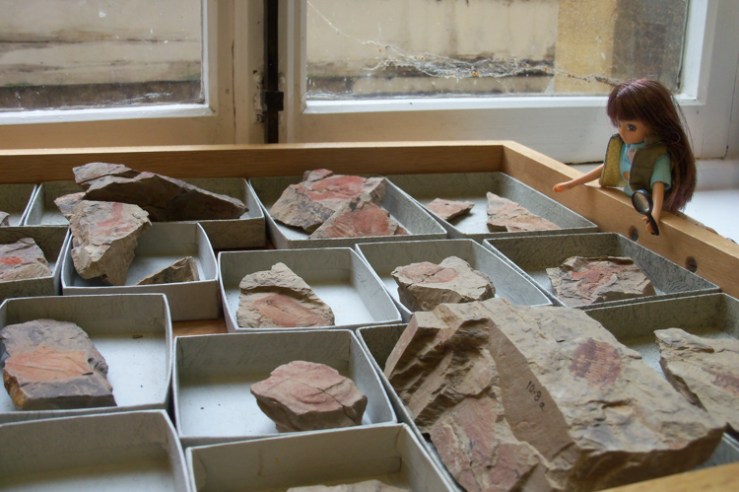
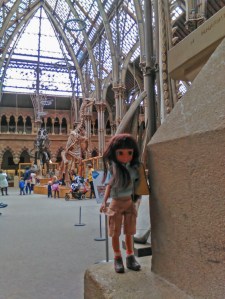
Trowelblazers has organized a UK tour of Fossil Hunter Lottie, leading up to today, her “official” launch day. Lottie is visiting women academics across the country, and blogging photos and videos along the way. During her day with me, Lottie explored the Museum and had a look at the research currently going on here.

Lottie explores the Museum

Fossil Hunter Lottie’s launch day, 21st May, coincides with the anniversary of Mary Anning’s birthday. Considered one of the greatest fossil hunters of all time, Mary Anning discovered some of the earliest specimens of Ichthyosaurus and Plesiosaurus from the Jurassic Coast in Dorset in the early 1800’s. This was a critically important time when ideas about palaeontology and the history of life on Earth were in a state of flux. Although she was not able to participate fully in the male-dominated scientific community, her contributions greatly influenced the thinking of academics at the time. She was intelligent, skilled and had the tenacity to build a name for herself in the face of much opposition. Mary Anning has always been an inspiration for me, as I’m sure she is for many female palaeontologists. It is almost impossible to imagine the kind of challenges Mary Anning faced, solely because she is a woman. I am fortunate to have rarely ever felt any limitations imposed on my work or my career by the fact that I am female.

Allie and Lottie outside the Museum... on a very windy day
Allie and Lottie outside the Museum… on a very windy day

I’ve participated in many field expeditions, and worked globally with wonderful colleagues, both male and female. As a child I always loved science, and my enthusiasm to become a scientist was encouraged and nurtured by my parents, who both studied biology at university. They have both always been a source of inspiration for me (thank you, mom and dad!). During my education and these early stages of my academic career, I’ve had excellent male and female mentors. This kind of support didn’t exist in Mary Anning’s time, making her accomplishments all the more impressive. Hopefully Fossil Hunter Lottie will help inspire more girls to take up science and consider becoming a trowelblazer, just like Mary Anning!

Dr. Allison Daley, Museum Research Fellow

All the fun of the Fossil Festival

Lead image

By Monica Price, Head of Earth Collections

Glowing from the success of our ‘Goes to Town’ and ‘Goes for a Pint’ events, which helped us win this year’s Museums and Heritage Award for best marketing campaign, we decided to ‘Go to the Festival’: the Lyme Regis Fossil Festival to be precise. Thousands of fossil collectors and holiday makers came to a marquee on the beach to discover more about fossils and enjoy all sorts of activities led by museums, universities, societies and conservation groups.

Monica and a festival-goer discuss William Smith's map
Monica and a festival-goer discuss William Smith’s map

This year marked the 200th anniversary of the very first geological map of Britain, made by geologist William ‘Strata’ Smith. As we hold the largest archive of his maps and papers, we were delighted to come and exhibit at the festival.

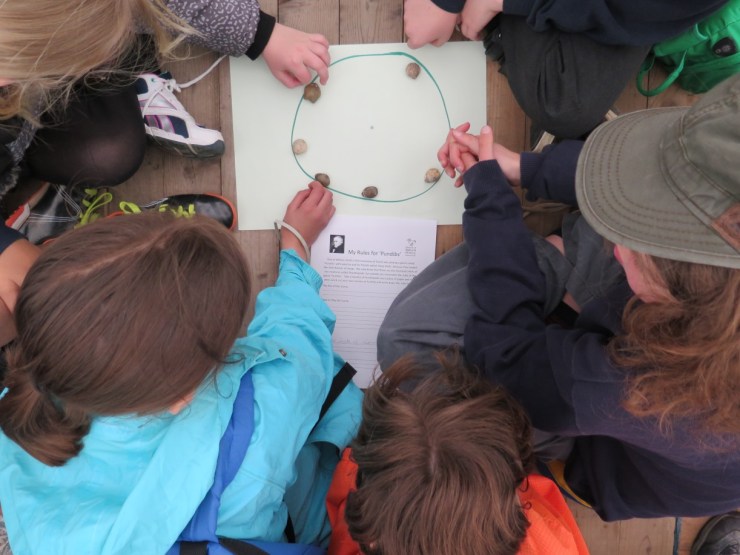
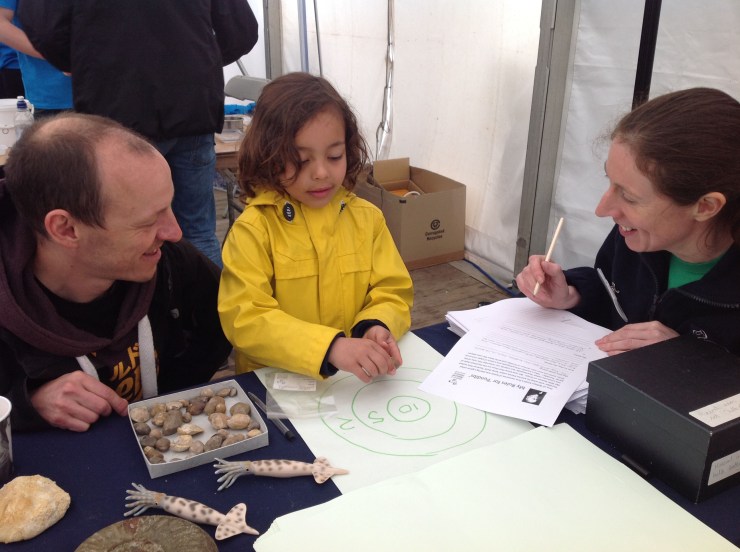
We brought with us some beautiful old specimens and archives from our collections, and let everyone enjoy and even play with real fossils. Play? Well, William Smith grew up in the Oxfordshire village of Churchill and used to play a game he called ‘pundibs’ using fossil brachiopods. He didn’t say what the rules were, and it appears that nobody living there today can remember either. We decided to challenge festival-goers to devise new rules.

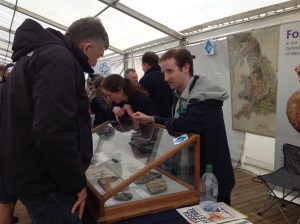
Phil from Earth Collections shares some of the Museum's fossil specimens
Phil from Earth Collections shares some of the Museum’s fossil specimens

Brachiopods are curious aquatic animals that are very common in the fossil record, but are much rarer today. They have shells composed of two valves, a bit like a clam, but with a very different kind of body inside. The brachiopod holds onto a rock with its long stalk-like ‘pedicle’, opens its shell, and as the water filter through, catches food with tiny fibres on its loop-like ‘brachia’ or arms. The shell can be shaped like a pottery oil lamp, giving brachiopods their common name ‘lamp shells’.

Our brachiopod fossils proved quite challenging to play with. If you rolled them, they veered sideways. If you threw them, they’d bounce in all directions. Variations on skittles, boules, bowls and dice were all suggested, and even a race game to see which would fall to the bottom of a bowl of water first. Perhaps the original game is the one suggested by a former school teacher; children in his school used to play ‘dibs’, a throwing and catching game now better known as ‘knuckle bones’, ‘jacks’ or ‘five stones’.

Writing down the rules with Eliza

We thoroughly enjoyed our time at Lyme Regis, talking about fossils, answering enquiries, helping people have fun discovering the amazing world of geology – and of course, playing ‘pundibs’!

Special deer-livery

Deer25

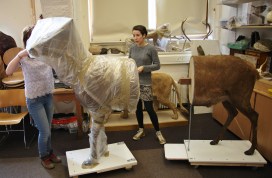
In just under a month we’ll be opening a brand new exhibition called ‘Sensing Evolution’. It will be a dramatic overhaul of our touchable displays, with many new touchable specimens for you to explore. Touchable taxidermy is always one of the most popular features in the Museum, but it’s been a real challenge sourcing some larger pieces for this new display.

Bethany Palumbo, our Conservator of Life Collections, has been busy researching far and wide to find the ideal specimens.

**

As well as the touchable tables that will form the major part of Sensing Evolution, we wanted an animal which would make a big impression when you arrive in the Museum. This specimen must also be obtained from an ethical source.

Mieke arrives at the Museum with the deer

Based on its availability and abundance, we decided to go for a farmed Red Deer, (Cervus elaphus) which is one of the largest deer species. The specimen, a male, was collected and prepared by taxidermist Mieke De Leeuw, from Taxidermieke in Belgium.

Work began with tanning the skin and preparing the armature. We had a few special requests. The first was that the specimen would able to fit into our walk-in freezer, should it require freezer treatment to eradicate insect pests, such as webbing clothes moth. Another request was that the specimen be reinforced as much as possible – strong enough to withstand potentially decades of affection and curiosity from museum visitors. Mieke was enthusiastic about the mount and the unusual challenges it presented.

Packing up ready for freezing
Packing up ready for freezing. All new arrivals are frozen to ensure pests aren’t brought into the Museum.

In order for it to fit into our freezer, it was necessary for the specimen to come apart into three pieces. For this Mieke devised a locking pin system, which would be completely invisible on the finished specimen. The beautiful antlers are also removable using a similar system.

Vulnerable areas of the deer were reinforced to withstand years of attention

She reinforced the specimen in weaker areas, such as the ears and the tendons of the legs, which were strengthened using metal rod. Once all the skin was glued into place, it was pinned down to keep it stable while it dried.

The deer is unpacked at the Museum
Walter puts finishing touches to the deer

Last week Mieke and her family drove from Peer, in Belgium, to deliver the specimen to us. They showed us how to assemble the beautiful specimen, before we took him all apart again for freezing.

IMG_9030

We thank the deer’s creators, Mieke and her husband Walter, for their hard work and skill in producing such a wonderful feature for the ‘Sensing Evolution’ display.

Bethany Palumbo, Conservator, Life Collections

Access all areas


symbols4

A museum can be a busy, daunting and overwhelming place, particularly if you find unknown surroundings challenging. Today is World Autism Awareness Day – an ideal opportunity to highlight a set of resources recently launched at the Museum, which help to make the environment more accessible to all. The resources are aimed at families with children on the autistic spectrum and provide a visual and descriptive introduction to the Museum, including pictures of everything from cockroaches to carpets and the café!

chair
An example of the clear images which help prepare for a museum visit

The idea for the resources came from a member of the public who in Summer 2012 asked: did we have a guide she could use to help prepare her son, who is on the spectrum, to visit the Museum? The answer at that point was ‘No’, but it got us thinking…

So while this Museum was under wraps for a year having its roof restored, we scoured the websites of museums on both sides of the Atlantic trying to find out what other places were up to. Although, in one way, we were reassured to discover we weren’t alone in our lack of resources, we were still surprised by how few places did provide anything.

Though we eventually modelled our resources on those of the Metropolitan Museum of Art, our budget sadly couldn’t stretch to a trip to New York. We found inspiration and support a lot closer to home, fortunately, and we spent a day with staff at the Science Museum in London. Their Early Birds programme has proven a great success, giving families exclusive access to the museum before other visitors are let in. We hope to pilot a similar event later this year.

AboutTheMuseumCover smaller
The front page of the new resources

And so began the creative process – or rather not-so-creative process. For me, the biggest challenge was altering my writing style. I have to admit that this blog post is not particularly autism-friendly, with its idioms and (attempts at) humour. Sentences like ‘Walk when you are inside the museum. Do not run.’ are more typical of the resources – direct and to the point – no chattiness, no alliteration.

Pages introducing the Museum's feely boxes and DNA model
Pages introducing the Museum’s feely boxes and DNA model

Anyway, fast-forward several more months, and we’ve now had the resources up on the Museum website for a few weeks. They’re still very much a work in progress, but they’re a really positive start.

As for the mum who initially emailed us… we’ve kept in touch, and in her last email she said, ‘I remember contacting you one summer wishing that there was something I could just download and print off that would allow me to do that all important pre-work … I think it looks fabulous and I will be trying it out during the holidays coming up.’

You can download the resources from the Museum’s Visiting Us pages

More information about autism can be found through the National Autistic Society


Caroline Cheeseman, Volunteers and Outreach Officer